
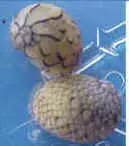
Cayo Largo Screw
Neritina (Vitta) virginea
Not available for sale
Profile
| Home: | Florida to Brazil |
| Size: | 5 to 15mm |
| Sexual differences: | Are not hermaphrodites. Sex difference is not recognisable. |
| Nutrition: | Algae, flake food |
| Temperature: | 20 - 35 degrees |
| Water values: | PH: 7.0 and 7.5 GH 14 |
Product information "Cayo Largo Screw"
Herkunftsgebiet:
Florida bis Brasilien, Bermuda (Fundort Cayo Largo/Kuba) und auf Jamaica (Blue River bis Frenchman's Cove) Die Schnecken sind auch ausserhalb des Wassers bis zu 0,5m im feuchten Uferbereich zu finden.
Beschreibung:
Die Schnecke ist in der Farbe und im Muster extrem variabel
Besonderheiten:
Fressen keine Pflanzen.
Für Fragen und Probleme steht Ihnen unser ausgebildetes Team im Zoo Roco zur Verfügung. Es kann Sie in allen Fragen fachgerecht beraten.
Composition
Feeding recommendation
Technical details
Size information
Login
Suggested products

Eubranchipus grubii
Fairy shrimps (spring gillfoot)
Fairy shrimps (spring gillfoot) are very common. Fairy shrimps are gilled crustaceans that have been found on our planet since prehistoric times in salt lakes, drying waters or polar waters.Only animals from Asia or America that live in a water temperature of 20-30°C are suitable for keeping in an aquarium. These species (Branchinella thailandensis and Dendrocephalus brasiliensis) live in waters that regularly dry out and are only filled with rainwater. The water is therefore very soft.
Appearance
The animals have 11 pairs of leaf feet. These leaf-shaped limbs serve not only for locomotion but also for breathing – which has led to the term "gilled-foot crustacean". There are sometimes minor differences in colour. They are found in colours ranging from orange to reddish-brown and may have greenish to bluish hues at the joints and at the boundaries of the segments.Both sexes have two short thread-like antennae. However, another pair of antennae differ in both shape and according to sex. Males have lobe-shaped appendages that can be curled up. Adult females are mainly distinguished by the ventrally located brood sacs, which are filled with eggs, and the ends of the female's tail are translucently light.
Systematics
Phylum: Arthropoda / ArthropodsSubphylum: Crustacea / CrustaceansClass: Anostraca – Gill-feetFamily: BranchipodidaeGenus: Branchipus / Eubranchipus /Tanymastix etc.
Care
Depending on the species, fairy shrimps live for 6-12 weeks and the size of adult animals varies from 1-3cm.Can Triops and fairy shrimps be kept together?yes, they can
Aquarium size:
Initially, a Faunarium box size 230 x 155 x 170 mm is quite sufficient
From a body length of 1.5cm, they can be gradually accustomed to larger tanks
Basic lighting: Sunlight or aquarium lighting is sufficientAeration: An air pump with a stone and very little air flow is sufficient for keepingSetup:Only water and breeding substrate in the breeding/starting container. A little fine aquarium sand can be used as substrate (but this is not absolutely necessary)Decorations can be used, but are only for our eyes and not of importance to the fairy shrimps.Fairy shrimps are free-swimmers – so they need enough free swimming space in the breeding container.If the animals swim around freely, you can also add a little aquarium moss to the water.
To ensure the water is soft, it is best to use 2/3 distilled water and 1/3 mineral water (non-carbonated).Water temperature: Fluctuations in temperature of +/- 5° C are not dramatic.The ideal breeding temperature is 26°.Start:The larvae only hatch when they are completely surrounded by water. Therefore, place the eggs on adhesive tape and then put this in the water – so the eggs are not washed to the edge and always remain in contact with water.After 1-3 days the larvae hatch. The larvae grow quickly and can reach sexual maturity after up to 40 moults in one to two weeks. The males hold the females with their jaw pincers shortly before and also during mating. After mating, the eggs develop in the egg sacs on the females’ abdomens. They fall to the bottom of the water and can survive for several years of prolonged drought in the substrate.When the fairy shrimps have died, the water can be drained off and the substrate with the eggs left completely dry. The larvae can only hatch again if the eggs were completely dry.Once this is dried out, a new batch can be started.If no substrate is used, you can also siphon off the eggs with a thin hose. Let the water containing the eggs run through a fine net or a coffee filter – this way you can collect the eggs.Important: The animals do not tolerate large water changes. If fairy shrimps are to be moved to a larger home, it is best to place the animals together with the breeding water into the new home or tank and slowly fill up the container with conditioned tap water.
Feeding
The larvae are fed from the 3rd day after hatching.The larvae can be fed with algae powder or JBL Artemio fluid.
For all animal husbandry: Children must be guided, supervised and monitored by their parents. Children must learn that an animal has its own needs and habits and they must respect this. Parents should be aware that they are responsible for the animal.
For questions and problems our trained team at Zoo Roco is at your disposal. They can advise you professionally on all matters.
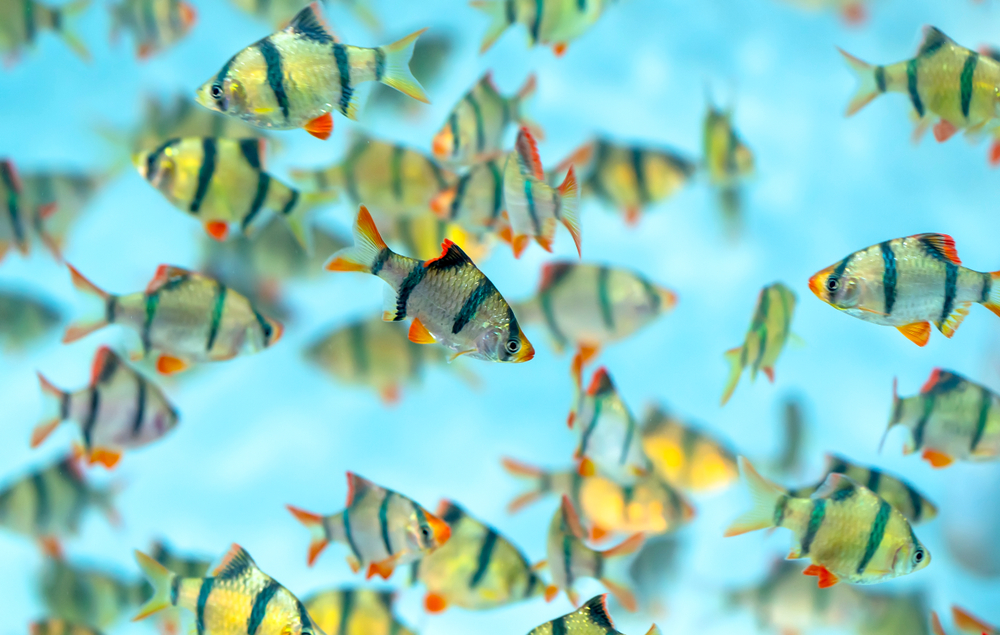
Sumatran barb
Profile: Sumatran barbArea of origin:The Sumatran barb lives in clear to slightly murky, shallow waters with dense shore vegetation in South-East Asia.Species:The Sumatran barb is a single species, but there are numerous colour variants.
The species frequently offered in the pet trade include
(colour forms)Classic Sumatran barb (wild-coloured)Moss barb (green)Albino Sumatran barbGold Sumatran barbBlack Ruby Barb (similar, but different species)Social behaviour:Sumatran barbs are lively, playful and sometimes rough towards slower or long-finned fish. In a larger group, the intra-species temperament is evenly distributed, which makes them appear much more peaceful. They are constantly on the move and very active.Keeping conditions:A long aquarium with plenty of swimming space and dense marginal planting is ideal. They love gently flowing water and clear structures. Regular water changes and good filtration contribute to their health.Breeding:Breeding is successful in a separate breeding tank. They are free spawners that scatter eggs over plants or spawning substrates. The parents must be removed after spawning as they eat the spawn and fry.Special features:Very active, lively fish
Can nibble fins if kept in groups that are too small
Easy to care for and robust
Colours develop particularly strongly with a varied dietConclusion:The Sumatran barb is a colourful, lively and sociable schooling fish that exhibits fascinating behaviour with sufficient swimming space and a larger group. It brings dynamism and movement to any community aquarium, but requires suitable tankmates and sufficient space.If you have any questions or encounter any problems, our trained team at Zoo Roco is here to help. They can provide expert advice on all matters.
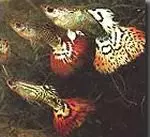
Guppy
The guppy fish (guppies / guppies)
Area of origin:
Central America to Brazil, today mostly captive bred from Asia (Singapore).
Social behaviour:
Livebearers. Some parents chase their young immediately after birth. No brood care, otherwise very peaceful
Keeping conditions:
The persistent guppy can be kept in almost any aquarium. High-breeding guppies are sensitive. pH 5.5 - 8.5 (7.0); hardness 5 - 25 (15) dGH. Well-planted tank of any size if possible.
Breeding:
Surface plants such as floating ferns for random breeding. Targeted breeding only possible with spawning box. 20 - 40 young, males sexually mature at three months, females earlier. Stock insemination possible. Raise fry with Artemia, powdered food and powdered flake food.
Standard forms:
European guppy breeders currently recognise 12 different standards, which can be divided into three classes. The classes are the large-finned breeding forms (fantail, triangle-tail, veiltail and flag-tail), the swordtype class (double-sword, top-sword, bottom-sword and lyre-tail) and the short-tail class (spade-tail, spear-tail, round-tail and needle-tail). In addition, there is an almost infinite number of colours in the animals in each class and in each standard, which are usually judged separately at shows.
Here are the individual standards:
Fantail
The tail fin has an elongated triangular shape with an angle of 45 degrees close to the body. Its ideal length is equal to the body length. The edges are straight, the transitions can be slightly rounded. The dorsal fin is pointed, rises steeply at the base and extends to the end of the first third of the caudal fin
Triangle tail
The tail fin has the shape of a triangle with an angle of 70 degrees close to the body. Its length is 80% of the body length. The edges are straight, the transitions can be slightly rounded. The dorsal fin rises steeply, is broad and extends bluntly to the end of the first third of the caudal fin.
Veiltail
The upper and lower edges of the caudal fin form curves which run in such a way that the greatest width of the fin is reached at 75% of its length. The rear edge is concave, the length is 80% of the body length and should not be less than 50%. The fin width is 3/4 of the length. The dorsal fin has a rounded end and extends to the end of the first third of the caudal fin.
Bannertail
The tail fin has the shape of a rectangle, the length of which is 8/10 of the body length. The fin width is 4/10 of the body length. The base of the fins is rounded. Minimum tail length 6/10 of the body length. Minimum width the largest body width. The dorsal fin extends to the end of the first third of the caudal fin and is pointed.
Double sword
The caudal fin has an oval basic shape with sword-shaped extension of the upper and lower fin rays. The length of the fins corresponds to the length of the body. The outer edges form an angle of 30 degrees. The part of the fins between the blades must not exceed 4/10 of the body length and can be colourless. Here too, the dorsal fin extends to the end of the first third of the caudal fin. The dorsal fin is slender, rises steeply at the base and is pointed at the end.
Topsword
The caudal fin has an oval basic shape with a sword-shaped extension of the upper fin rays. The length of the sword corresponds to the length of the body and runs at the upper edge at a 15 degree angle or parallel to the body axis. The basic oval shape must not exceed 4/10 of the body length and can be colourless. The dorsal fin is slender and extends, as usual, tapering to the end of the first third of the caudal fin.
Bottom sword
The caudal fin has an oval basic shape with a sword-shaped extension of the lower fin rays. The length of the sword corresponds to the body length and forms an angle of 15 degrees to the body axis at its lower edge. The basic oval shape must not exceed 4/10 of the body length and can be colourless. The dorsal fin is slender, rises steeply at the base and reaches out to where? To the end of the first third of the caudal fin, of course.
Lyretail
The caudal fin has approximately the shape of a lyre. The basic shape is round and must not exceed 4/10 of the body length. The outer fin rays reach 8/10 of the body length with the tips clearly bent outwards. The dorsal fin rises steeply and reaches the end of the first third of the caudal fin with an upwardly curved tip.
Spade tail
The shape of the tail fin resembles a miner's spade. The upper and lower fin borders, which stand out from the body with a clear projection, are parallel. Their length corresponds to half the body length, the height reaches 8/10 of the fin length. The dorsal fin extends pointedly from the base of the caudal fin to the end of the first third of the caudal fin.
Speartail
The shape of the tail fin resembles the tip of a spear. Its length is 8/10 of the body length, the height 6/10 of the fin length. The dorsal fin rises steeply and reaches the end of the first third of the caudal fin with an upward curved tip.
Roundtail
The caudal fin has a circular shape, the diameter is 5/10 of the body length The dorsal fin extends roundly to the base of the caudal fin.
Needletail
The tail fin has a circular shape, the length of which is 4/10 of the body length. The centre fin rays are elongated like needles. The total length of the fin corresponds to the body length. The dorsal fin is slender, rises steeply at the base and tapers to the end of the first third of the caudal fin.
Special features:
The guppy's ability to breed quickly, its variability in shape and colour and its endurance make it one of the most popular fish for beginners. Recently, the guppy has been reclassified as a member of the genus Lebistes. It is therefore correctly called Lebistes reticulatus again. Do not socialise guppies with fighting fish. The fins of the males are eaten by the fighting fish of both sexes.Source reference: Mergus Atlas Volume 1If you have any questions or problems, our trained team is at your disposal at Zoo Roco. They can provide you with expert advice on all questions.

Axolotl (Ambystoma mexicanum)
A journey of discovery into the world of the axolotlIn the mysterious and fascinating world of aquatic creatures, there is one creature that delights scientists and enthusiasts alike: the axolotl. With its fascinating appearance and amazing abilities, this amphibious salamander has captured the hearts of many people and is increasingly becoming the object of research and admiration. Let's immerse ourselves in the world of the axolotl and discover what makes these fascinating creatures so special.Origin: Originally native to the waters around Lake Xochimilco in Mexico.Life expectancy: In the wild, axolotls can live for around 10-15 years, while in human care they can often live up to 15-20 years or even longer.Appearance: The axolotl is an amphibious tailed amphibian and often retains juvenile characteristics even when fully grown. It has a flat body, external gills that look like a curly crest, and characteristic small eyes. Colours vary depending on the breeding line and range from white to grey, brown and black.Size: Axolotls typically reach a length of around 15-45 centimetres, with females usually being larger than males.Lifestyle: Axolotls are aquatic creatures and spend their entire lives in water. They are nocturnal and feed mainly on small fish, insects, worms and other invertebrates.Origin and habitatThe axolotl (Ambystoma mexicanum) is a tailed salamander that is originally native to the waters around Lake Xochimilco in Mexico. This species of salamander is found exclusively in a small area in central Mexico, making it an endemic species. Historically, the axolotl was an important part of Aztec culture and mythology, which further emphasises its importance in the region.Unique characteristicsWhat makes the axolotl particularly fascinating are its amazing regenerative abilities. Unlike most other amphibians, the axolotl retains its ability to regenerate limbs, organs and even parts of its brain well into adulthood. This remarkable property has piqued the interest of medical researchers as it could potentially provide insights to regenerate human tissues as well.The axolotl is also known for its neotenic appearance, which means that it retains certain juvenile characteristics even when fully grown. These include its extremely cute facial expression, external gills and, of course, its characteristic swan neck. These characteristics make the axolotl a popular pet and a sought-after species in aquariums worldwide.Threatened existenceDespite its fascinating characteristics and popularity as a pet, the axolotl unfortunately faces serious threats in the wild. The destruction of its natural habitat through pollution, drainage of wetlands and the introduction of non-native species have led to a sharp decline in populations. In the wild, the axolotl is even considered endangered and its future is uncertain.The importance of protectionWith the axolotl under increasing threat, it is vital that measures are taken to protect its habitats and conserve its populations. This requires not only protecting the waters in which the axolotl lives, but also raising public awareness of the importance of conserving this fascinating species. Furthermore, it is important to continue research on the axolotl in order to better understand its regenerative potential and possibly transfer it to medical applications.Overall, the axolotl is undoubtedly a remarkable creature, admired not only for its cute appearance, but also for its unique abilities and its importance to science. It is up to us to safeguard its future and ensure that this fascinating creature continues to enrich the waters of our planet for a long time to come.Created with ChatGPT – revised by Zoo Roco
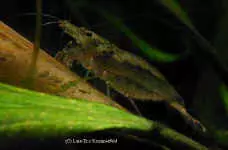
Amano Shrimp
Diese bis 4 cm groß werdende Garnele besticht nicht durch ihr Aussehen, sondern durch ihre Leidenschaft für (Grün-)Algen. Der Name "Amanogarnele" wird benutzt, da der bekannte Aquarienfotograf Takashi Amano diese Garnelen zur Algenbekämpfung in seine Becken einsetzt und sie somit auf vielen seiner Bilder erscheinen. Diese Art gehört zu den besten bekannten Algenfressern und muss mit Algen und Futter mit Schwerpunkt auf Pflanzenbasis ernährt werden. Sie ist sehr friedlich. Gehalten werden kann sie bei Temperaturen bis 27°C und einem pH-Wert zwischen 6 und 8. Die Wasserhärte ist zweitrangig und sollte unter 20 dgH liegen.Caridina japonica wurde bereits mehrfach erfolgreich nachgezogen. Da sie zum primitiven Fortpflanzungstyp gehört, die Larven sehr klein sind und zur erfolgreichen Aufzucht Brackwasser benötigen, ist die Zucht allerdings mit etwas Aufwand verbunden.
Herkunftsgebiet:
Japan
Beschreibung:
Farbe milchig, glasig, 0,3 mm braune Punkte.
Zucht:
Nach erfolgreicher Befruchtung wandern die Eier in die Bauchtaschen der Weibchen. Nach ca. 6 Wochen stößt das Weibchen die Eier ab und es schlüpfen ca. 1mm kleine, milchig-durchsichtige Larven. Diese müssen in Brackwasser (1,6% Salzgehalt) überführt werden. Nach 4 Wochen und zahlreichen Häutungen sind die Larven zu Junggarnelen herangewachsen und können in Süßwasser überführt werden.Gelegegrössen / Nachwuchsanzahl: bis ca. 2000 EierHäufigkeit der Vermehrung: ständig, mit einer Laichpause im Januar/Februar
Besonderheiten:
Die Amano-Garnele ist sehr beliebt aufgrund der guten AlgenbekämpfungFür Fragen und Probleme steht Ihnen unser ausgebildetes Team im Zoo Roco zur Verfügung. Es kann Sie in allen Fragen fachgerecht beraten.
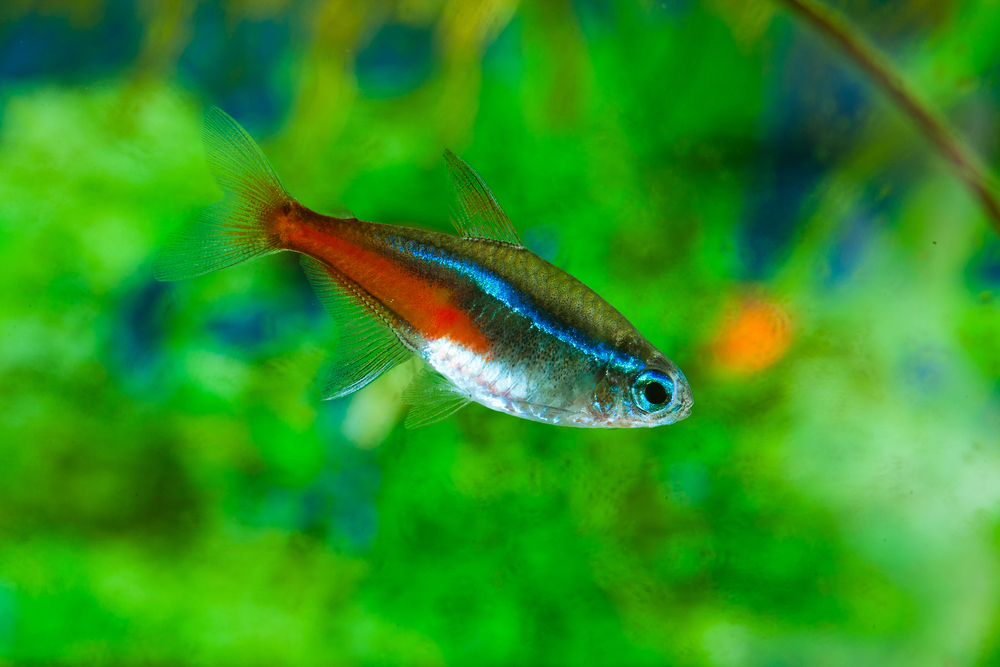
Red neon
Profile red neon / cardinalfishArea of originThe cardinal tetra inhabits the dark, blackwater rivers of theAmazonas region.
There, the water is very soft, acidic, rich in humic substances and heavily overgrown with plants and roots.SpeciesParacheirodon axelrodi is one of three Paracheirodon species:
Species commonly offered in the pet trade include:Paracheirodon axelrodi - Cardinalfish (solid red lower body)Paracheirodon innesi - neon fish (red stripe only at the back)Paracheirodon simulans - Blue neon / Green neon (smaller, more delicate)Social behaviourVery peaceful.
Shows harmonious, synchronised swimming behaviour in a shoal.
Ideal for community tanks with calm species.
Intense colours in larger groups.
Shy in groups that are too small or with hectic tankmates.Keeping conditionsSoft, slightly acidic water. Dark substrate and subdued light. Lots of plants, roots, leaf litter. Good filtration, but no strong current. Regular water changes important. Very sensitive to nitrite BreedingSophisticated
Requires soft, very acidic water. Twilight promotes readiness to spawn. Free spawners, eggs are scattered. Parents must be removed immediately after laying eggs. Eggs are sensitive to light → darken!
Breeding the tiny fry requires infusoria Special featuresOne of the most colourful freshwater fish species
Blackwater requirements → ideal for biotope aquariums. Requires stable water conditions. Stress-free in large groupsConclusionParacheirodon axelrodi is a particularly colourful, peaceful schooling fish that unfolds its full beauty in a soft, acidic and densely planted aquarium. It is ideal for quiet community tanks and blackwater aquariums. It displays fascinating, harmonious shoaling behaviour in groups.If you have any questions or problems, our trained team at Zoo Roco is here to help. They can provide expert advice on all matters.
Julii armoured catfish
Profile of the Julii armoured catfishArea of originThe Julii armoured catfish lives in slow-flowing, shallow waters in South America with sandy bottoms and dense vegetation. Often found in flooded forest areas.SpeciesCorydoras comprises over 170 species.
The Julii armoured catfish is one of the smaller, finely marked Corydoras species.
The species frequently offered in the pet trade includeCorydoras julii (true Julii armoured catfish - rare)Corydoras trilineatus (three-line armoured catfish - often sold as "Julii")Corydoras pandaCorydoras sterbaiCorydoras aeneus (incl. albino)Social behaviourVery peaceful and sociable. Prefers bottom region. Likes to dig in the sand for food. Ideal for community tanks. No aggressive behaviour.Keeping conditionsFine sandy soil is a must!
→ Gravel can injure the barbels.
Well-planted aquarium with lots of hiding places (roots, stones). Calm current. Very clean water required. Oxygen-rich environment. Regular water changesBreedingPossible, but somewhat more demanding
Typical "T-position" spawning behaviour: Females stick eggs to glass or plants. Eggs often have to be protected from the parents. Fry require very fine food (infusoria, Artemia nauplii)Special featuresVery active and peaceful bottom dwellers. True Corydoras julii is rare - Corydoras trilineatus is often sold as Julii. Tolerates higher temperatures than some other Corydoras species. A larger group ensures well-being and beautiful observationsConclusionThe Julii armoured catfish is a pretty, sociable and extremely peaceful bottom fish that fits perfectly into a community aquarium. With fine sand, good water quality and a larger group, it displays its lively, charming behaviour and remains healthy for a long time. If you have any questions or problems, our trained team at Zoo Roco is here to help. They can provide expert advice on all matters.

Purple Matano crab
Violet matano crab
The violet matano crab is a species of snail-eating crab that lives purely in the water and does not require a land part.
Home:
Sulawesi
Keeping:
The violet matano crab can be kept in aquariums from 100 litres and grows up to 10 cm in size (carapace)The matano crab does not eat plants and can therefore be kept in a planted aquarium without any problems.The water values should be in the hard range, the pH value around 7.0 – 8.5The water temperature between 20-28°C
Food:
Snails, or as an alternative also crab and shrimp food
Description and appearance:
The basic colouring is purple / violet and a characteristic of this crab species is a rather square body as well as spikes on the edges of the body.
Socialisation:
The violet matano crab can easily be socialised with shrimps as well as fish.If there are snails in the aquarium, they will not survive living together.
Siamese trunk barb
Profile of the Siamese trunk barbArea of originRunning waters and weedy river sections in Southeast Asia.
Clear, oxygen-rich water with a moderate current.SpeciesThere are several similar species within the genus Crossocheilus, which are often confused:
The species frequently offered in the pet trade includeCrossocheilus siamensis / oblongus (true Siamese trunk barb)Crossocheilus langei (often confused, but less effective against algae)Gyrinocheilus aymonieri (Chinese algae eater - NOT to be confused!)The real SAE can be recognised by:
a continuous black stripe up to the caudal fin
Transparent fins without dark areas
small barbelsSocial behaviourPeaceful, active and social.
Less shy in groups.
More territorial towards conspecifics when older.
Ideal for community tanks with other robust fish.
Eager to jump → cover requiredKeeping conditionsPlenty of swimming space.
Light to medium current.
Lots of plants and roots.
Very good oxygen supply.
Cover important.
Stable water conditions.
Excellent for controlling algae, especially filamentous and brush algaeBreedingExtremely rare in the aquarium.
Presumably free spawners.
Spawning behaviour hardly documented in captivity.
Mostly bred commercially by hormone stimulation.
Natural breeding in the hobby is considered almost impossible.Special featuresOne of the few species that eat brush algae.
Very industrious algae eaters.
Frequent mix-ups in the trade → look out for characteristics.
Slightly less algae-eating with age, but still beautiful behaviour.
Does not tolerate high nitrate and dirt levelsConclusionThe Siamese barb is an extremely useful, peaceful and lively aquarium inhabitant. As an excellent algae eater - especially of stubborn brush algae - it is ideal for larger community aquariums. With good care, plenty of space and group keeping, it remains active, robust and a valuable helper in the tank.If you have any questions or problems, our trained team at Zoo Roco is here to help. They can provide expert advice on all matters.

Glowlight tetra
Herkunftsgebiet:
Endemisch im Essequibo-Fluss, Guyana.
Soziales Verhalten:
Friedlicher Schwarmfisch für jedes gut gepflegte Gesellschaftsbecken
Hälterungsbedingungen:
Dieser Fisch kommt erst im Schwarm und bei gedämpftem Licht (Torffilterung, Schwimmpflanzendecke) richtig zur Geltung.
Zucht:
Bei 28° C zwischen feinfiedrigen Pflanzen im Schwarm oder als Einzelpaar im Zuchtbecken bei weichem, torfgefiltertem Wasser
Besonderheiten:
Einer der schönsten kleinbleibenden Salmler, der dem Neonfisch nicht nachsteht. Quellennachweis: Mergus Atlas Band 1Für Fragen und Probleme steht Ihnen unser ausgebildetes Team im Zoo Roco zur Verfügung. Es kann Sie in allen Fragen fachgerecht beraten.
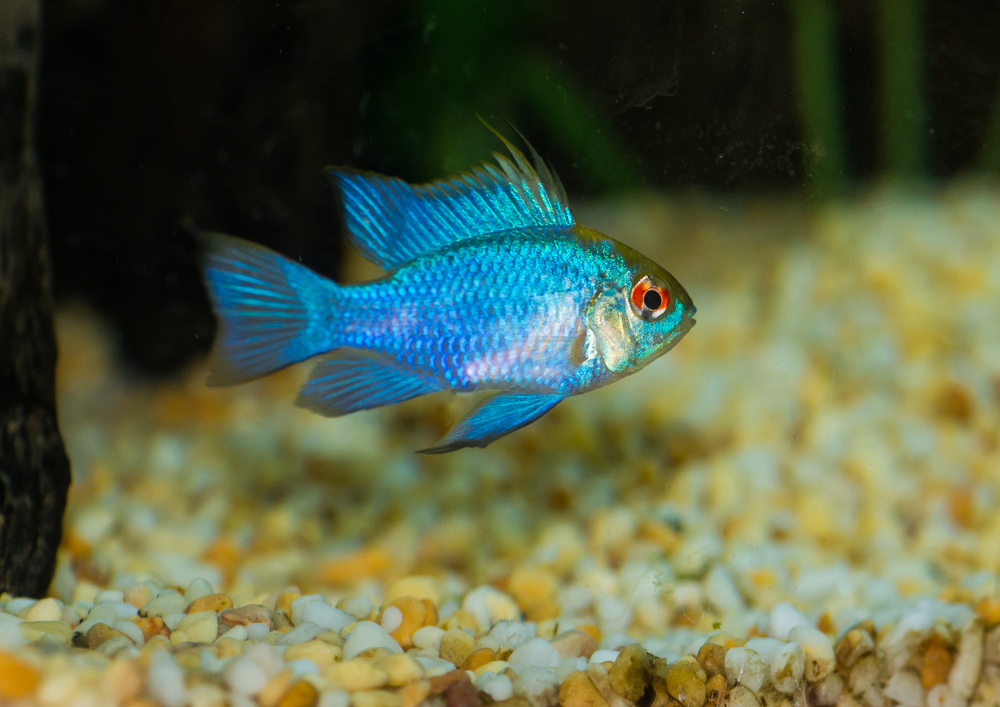
Butterfly cichlid
Butterfly cichlidArea of origin:The butterfly cichlid (Mikrogeophagus ramirezi) originates from the warm, slow-flowing waters of Venezuela and Colombia. There it lives in densely overgrown bank zones with soft, slightly acidic water.Species:The species frequently offered in pet shops includeMicrogeophagus ramirezi - the classic butterfly cichlidMicrogeophagus ramirezi "Gold" - gold-coloured breeding formMicrogeophagus ramirezi "Electric Blue" - intense blue colour variantMicrogeophagus ramirezi "German Blue" - brightly coloured standard breeding forSocial behaviour:Butterfly cichlids are peaceful dwarf cichlids and can be kept well in the company of calm species. They show pronounced social behaviour within the pair, while males can rival each other in aquaria that are too small.Keeping conditions:The butterfly cichlid prefers warm temperatures of 26-30 °C, soft to medium-hard water and a slightly acidic pH value. Fine sandy soil, lots of plants and quiet hiding places create ideal conditions. Good water quality is particularly important for this species.Breeding:The animals form pair bonds and usually spawn on flat stones or leaves. Both parents take care of the brood, fan the eggs and later lead the fry. Successful breeding is best achieved in a separate breeding tank with very good water quality.Special features:Butterfly cichlids are among the most colourful dwarf cichlids around. Although their requirements are moderate, they are sensitive to poor water values. High-bred forms can be more sensitive than the wild form.Conclusion:The butterfly cichlid is an attractive, peaceful dwarf cichlid that is a joy to keep under the right conditions. It is an enrichment for aquaria with calm tankmates and good care.If you have any questions or problems, our trained team at Zoo Roco is always available to help. We’re happy to provide expert advice!
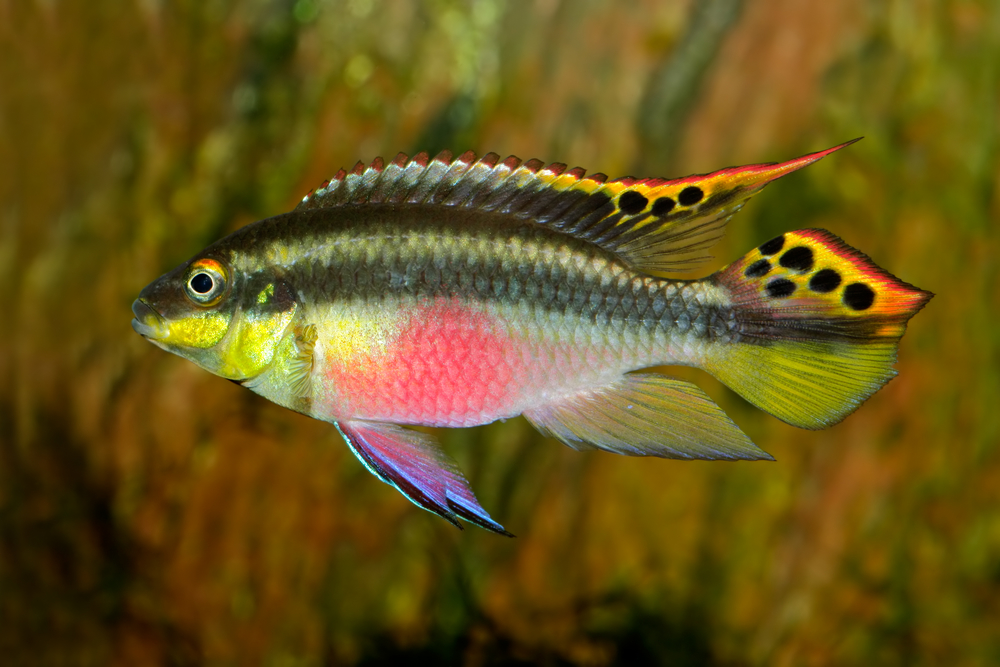
Purple splendour perch
Profile purple splendour perchArea of originThe purple perch originates from soft, slightly acidic rivers and streams in West Africa.
It prefers densely overgrown bank zones and areas with roots, stones and caves.SpeciesThe purple splendour perch belongs to the genus Pelvicachromis, which also includes other well-known species:
The species frequently offered in the pet trade include Pelvicachromis pulcher (purple splendour perch)Pelvicachromis taeniatusPelvicachromis subocellatus
Various location and colour variants ("Nigeria Red", "Moliwe" etc.)Social behaviourVery peaceful towards most tankmates. Becomes territorial during the breeding season, but not overly aggressive. Exhibits wonderful pair and brood care behaviour. Easy to socialise in a well-structured aquarium.Keeping conditionsWell-planted aquarium with caves (flower pots, coconut caves, roots). Fine sandy bottom for burrowing. Low to moderate light. Regular water changes. Choose calm tankmates (no fin biters)BreedingVery easy - ideal for beginners in cichlid breeding. Cave breeder
Female usually takes care of the brood. After hatching, the pair will care for the offspring together. Fry accept Artemia nauplii and fine food without any problems. High survival rateSpecial featuresOne of the most peaceful dwarf cichlids around. Shows extremely beautiful colours during mating. Ideal for smaller community tanks. Robust and easy to care for. Very good parents - exemplary breeding behaviour.ConclusionThe purple splendour perch is a beautiful, peaceful and extremely robust cichlid that is ideal for beginners and advanced keepers. Its fascinating mating and breeding behaviour as well as its intense colouring make it a highlight in any community aquarium.If you have any questions or problems, our trained team at Zoo Roco is here to help. They can provide expert advice on all matters.
Customers also saw
Eubranchipus grubii
Fairy shrimps (spring gillfoot)
Fairy shrimps (spring gillfoot) are very common. Fairy shrimps are gilled crustaceans that have been found on our planet since prehistoric times in salt lakes, drying waters or polar waters.Only animals from Asia or America that live in a water temperature of 20-30°C are suitable for keeping in an aquarium. These species (Branchinella thailandensis and Dendrocephalus brasiliensis) live in waters that regularly dry out and are only filled with rainwater. The water is therefore very soft.
Appearance
The animals have 11 pairs of leaf feet. These leaf-shaped limbs serve not only for locomotion but also for breathing – which has led to the term "gilled-foot crustacean". There are sometimes minor differences in colour. They are found in colours ranging from orange to reddish-brown and may have greenish to bluish hues at the joints and at the boundaries of the segments.Both sexes have two short thread-like antennae. However, another pair of antennae differ in both shape and according to sex. Males have lobe-shaped appendages that can be curled up. Adult females are mainly distinguished by the ventrally located brood sacs, which are filled with eggs, and the ends of the female's tail are translucently light.
Systematics
Phylum: Arthropoda / ArthropodsSubphylum: Crustacea / CrustaceansClass: Anostraca – Gill-feetFamily: BranchipodidaeGenus: Branchipus / Eubranchipus /Tanymastix etc.
Care
Depending on the species, fairy shrimps live for 6-12 weeks and the size of adult animals varies from 1-3cm.Can Triops and fairy shrimps be kept together?yes, they can
Aquarium size:
Initially, a Faunarium box size 230 x 155 x 170 mm is quite sufficient
From a body length of 1.5cm, they can be gradually accustomed to larger tanks
Basic lighting: Sunlight or aquarium lighting is sufficientAeration: An air pump with a stone and very little air flow is sufficient for keepingSetup:Only water and breeding substrate in the breeding/starting container. A little fine aquarium sand can be used as substrate (but this is not absolutely necessary)Decorations can be used, but are only for our eyes and not of importance to the fairy shrimps.Fairy shrimps are free-swimmers – so they need enough free swimming space in the breeding container.If the animals swim around freely, you can also add a little aquarium moss to the water.
To ensure the water is soft, it is best to use 2/3 distilled water and 1/3 mineral water (non-carbonated).Water temperature: Fluctuations in temperature of +/- 5° C are not dramatic.The ideal breeding temperature is 26°.Start:The larvae only hatch when they are completely surrounded by water. Therefore, place the eggs on adhesive tape and then put this in the water – so the eggs are not washed to the edge and always remain in contact with water.After 1-3 days the larvae hatch. The larvae grow quickly and can reach sexual maturity after up to 40 moults in one to two weeks. The males hold the females with their jaw pincers shortly before and also during mating. After mating, the eggs develop in the egg sacs on the females’ abdomens. They fall to the bottom of the water and can survive for several years of prolonged drought in the substrate.When the fairy shrimps have died, the water can be drained off and the substrate with the eggs left completely dry. The larvae can only hatch again if the eggs were completely dry.Once this is dried out, a new batch can be started.If no substrate is used, you can also siphon off the eggs with a thin hose. Let the water containing the eggs run through a fine net or a coffee filter – this way you can collect the eggs.Important: The animals do not tolerate large water changes. If fairy shrimps are to be moved to a larger home, it is best to place the animals together with the breeding water into the new home or tank and slowly fill up the container with conditioned tap water.
Feeding
The larvae are fed from the 3rd day after hatching.The larvae can be fed with algae powder or JBL Artemio fluid.
For all animal husbandry: Children must be guided, supervised and monitored by their parents. Children must learn that an animal has its own needs and habits and they must respect this. Parents should be aware that they are responsible for the animal.
For questions and problems our trained team at Zoo Roco is at your disposal. They can advise you professionally on all matters.