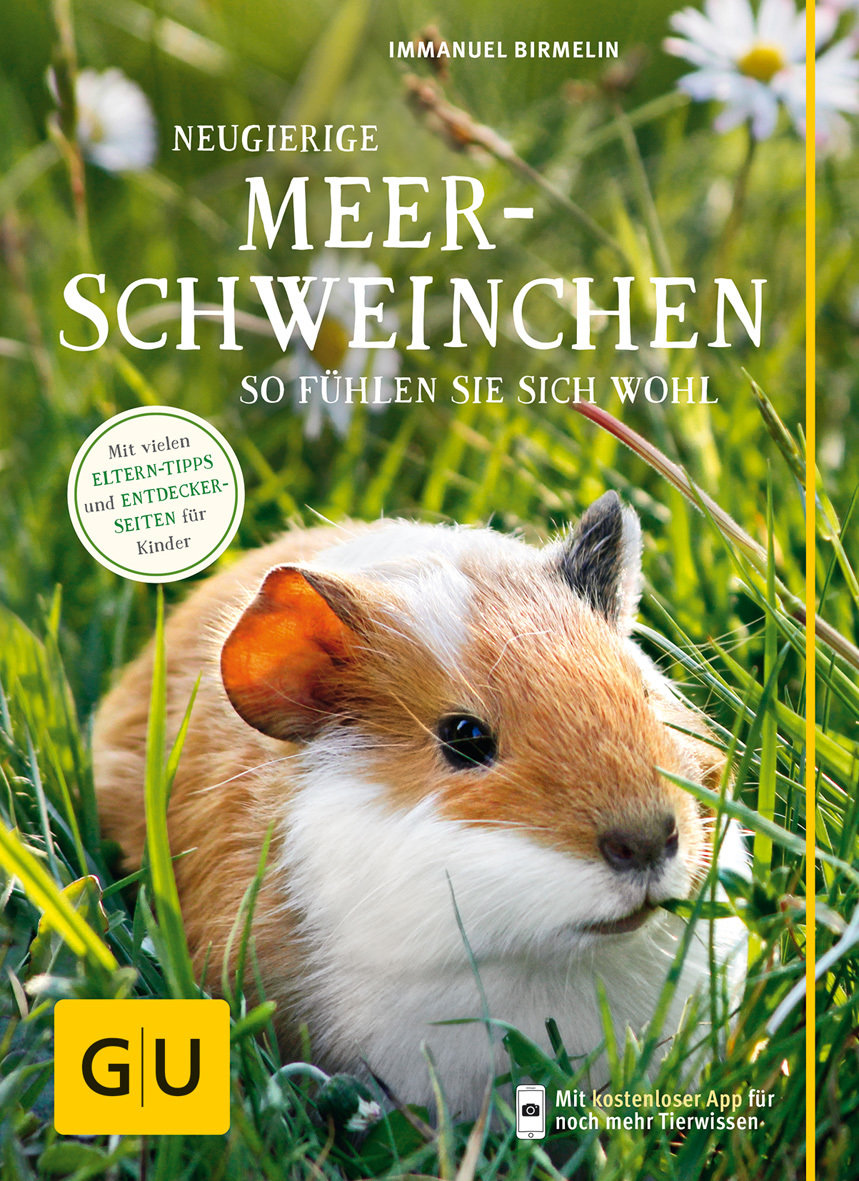
GU Curious guinea pigs - how they feel at home
This guide shows what guinea pigs need to feel comfortable in everyday family life - from the right equipment to meaningful activities. With tips for parents and discovery pages, knowledge is conveyed in a way that is easy to understand and suitable for everyday use.
Important features
Practical guinea pig guide from the GU small animals series
With quick start pages, infographics and discovery pages (observation tips/small experiments)
Contains tips for parents on how to handle children correctly with the animal
Extra: reference to the free GU Pet Plus app
Important advantages
Helps you to avoid husbandry mistakes so that guinea pigs show typical behavior and feel safe
Supports species-appropriate, family-friendly husbandry with clear step-by-step information
Promotes activity and observation - ideal if children are to be actively involvedGuinea pigs appear uncomplicated - but in order for them to remain really trusting and show their typical, lively behavior, they need suitable housing conditions. This is exactly where "Curious Guinea Pigs" from the GU Small Animals series comes in: The guide bundles knowledge about a fulfilling guinea pig life and makes it so easy to understand that it can be implemented immediately in everyday life.
The author, Dr. Immanuel Birmelin, a well-known behavioral researcher, shares his experiences from years of keeping and researching guinea pigs and explains what is important in practice. You will receive guidance on key topics such as equipment, care and activity - the very things that determine whether your animals feel safe and become active. The book is particularly family-friendly, with quick-start pages for a quick introduction and infographics that show important information at a glance. There are also discovery pages with observation tips and small ideas that encourage children (and adults) to understand guinea pigs better - instead of just "having" them. In addition, tips for parents help children to treat the animals correctly and respectfully.
Zoo-Roco tip
Guinea pigs are very much group animals: plan the housing from the outset so that your animals have social contact, opportunities to retreat and something to do. If you are unsure whether your enclosure, structure or feeding is suitable, make a note of your questions as you read - this way you can implement the tips in your home.
Guinea pigs - How to make them feel good all roundBlurbEverything beginners and real guinea pig fans need to know about keeping and the special needs of these lively rodents.needs of these lively rodents - so that animals and humans feel at home together under one roof.SummaryAll the basics and practical tips from the experts - for happy rodents
Guinea pigs are mainly cute, but boring? Not at all! These little South Americans like to go on voyages of discovery and are also really clever. They love company and prove to be real chatterboxes, squeaking and cooing to keep in constant contact with their conspecifics.
In the new, completely revised GU Animal Guide to Guinea Pigs, renowned behavioral scientist Dr. Immanuel Birmelin explains what these cute rodents need to feel completely at ease. Whether it's cage equipment, nutrition, care or health: you will learn everything you need to know about keeping guinea pigs in a species-appropriate way in a quick, clear and entertaining way. There are also numerous tips on how to keep the animals moving in an outdoor enclosure in the home, on the balcony or in the garden and provide plenty of variety in your guinea pigs' everyday lives.Sound expert knowledge:Renowned behaviorist Dr. Immanuel Birmelin explains everything you need to know about guinea pigs, their adorable quirks and how to keep and care for them appropriately.
Varied activities: With lots of tips for an exciting and healthy guinea pig life - indoors and outdoors.
Practical instructions: With easy-to-understand instructions and practical tips, the book helps you to better understand the needs of guinea pigs and provide them with a home in which they feel completely at ease.
Hamsters - How to make them feel good all roundBlurbEverything beginners and hamster fans need to know about keeping these small rodents and their special needs - so that animals and humans feel at home together under one roof Summary So your hamster feels completely at ease. Hamsters are real night owls: they only really come to life when it gets dark. Then they climb, burrow and of course "hamster" for all they're worth. In the new, completely revised GU hamster pet guide, you will learn what your hamster needs to feel completely at ease - how to acclimatize it step by step, what it likes and what keeps it healthy and how to satisfy its strong urge to move. You will find lots of ideas for exciting activities and find out how the hamster house and enclosure should look and be equipped to meet the needs of these small rodents. The guide is rounded off with tried and tested tips on selection and purchase, offspring, illnesses and veterinary emergencies. Behavioral scientist Peter Fritzsche also explains typical animal behavior. You can then test your hamster knowledge in the large online hamster quiz and be well prepared for the arrival of your new pet.Comprehensive hamster care: Find out how to keep your hamster happy and healthy from settling in to species-appropriate keeping.Creative activity ideas: Discover numerous ideas on how to encourage your nocturnal hamster's strong urge to move in a sensible and exciting way.Expert knowledge and practical tips: The guide offers practical tips on selection, care and emergencies as well as an online quiz to test and expand your hamster knowledge.
Guinea pigs keeping, caring for and keeping activefrom Beck AngelaBlurbA life in pairs or in a small group, a nice enclosure and daily free run make guinea pigs happy. Optimum husbandry, a healthy diet and an understanding of their nature provide security in their daily life together. A wealth of play ideas provides variety and strengthens the relationship between humans and animals.
Everything that is important for species-appropriate keeping: from the selection and housing of guinea pigs to feeding, care and activity. The plus to the book: the free KOSMOS PLUS app with additional information and films.
Dwarf rabbitkeeping, caring for and keeping active from Beck AngelaBlurbPlenty of space to hop around, dig and make hooks, a life in pairs or in a group - that's what makes dwarf rabbits happy. Optimum husbandry, a healthy diet and an understanding of their nature provide security in their daily life together. Many play ideas provide variety and strengthen the relationship between humans and animals.
Everything that is important for species-appropriate keeping: from the selection and housing of dwarf rabbits to feeding, care and activity. The plus to the book: the free KOSMOS PLUS app with additional information and films.
The Djungarian dwarf hamsterPhodopus sungorus from Zachrau AndreaBlurbThe Djungarian dwarf hamster is one of the smallest pets in the world and takes hearts by storm with its beady eyes, loyal gaze and soft fur. In this guide, you will learn all about the dwarf hamster's distribution and habitat, as well as everything you need to know about enclosure size, furnishings and food. Read everything you need to know to better understand the behaviour of these small rodents and how to prevent diseases.
Summary
The Djungarian dwarf hamster is one of the smallest pets in the world and takes hearts by storm with its beady eyes, loyal gaze and soft fur. In this guide by Andrea Zachrau, you will learn about the dwarf hamster's distribution and habitat as well as everything you need to know about enclosure size, furnishings and food. Read everything you need to know to better understand the behaviour of these small rodents and how to prevent diseases. Each volume offers you detailed, practical care instructions and you will find all the information you need to successfully breed your animals. All the important questions, from housing to furnishings, technical equipment, species-appropriate nutrition and disease prevention, are answered with numerous tricks and tips. Experienced, long-standing breeders reveal how you can encourage the animals to reproduce and raise the young in good health, all in full colour, generously illustrated and attractively designed - species by species.
Can my cat eat daisies? Is it safe if my Wellensitticham Ficus nibbles? Broken down by wild plants, house and garden plants, fodder plants, herbs, poisonous and medicinal plants are described with which pet animals may come into contact. With advice for individual species.
The Persian gerbil book Among the many gerbil species, Persian gerbils are something very special. Their graceful appearance and highly interesting behaviour make the "Persians", as they are affectionately called by many owners, fascinating pets. Due to their curiosity and open-mindedness towards humans, they are also real "heartbreakers" Unfortunately, there is hardly any literature on keeping and breeding these beady-eyed rodents. Author Anne Weber is editor-in-chief of the small mammal specialist magazine RODENTIA and summarises her many years of experience with the care and breeding of "Persians" here. Benefit from her practical tips and detailed husbandry descriptions so that you can enjoy your Persian gerbils right from the start! Contents:Biology,Acquisition,Husbandry,Food and water,Keeping healthy,Fun and games,Offspring
Rodentia 01 - Chinchillas
Guinea pigs in the gardenDegus and their relativesSee the most beautiful rats
Contents:
2 INTERN
3 EDITORIAL AND ADVISORY BOARD
5 INTERESTING FACTS
11 legal
12 Dates & TIPS
15 MY STORY: Refined guinea pig, by Marion Zeddies
16 PHOTOstory: Chinchillas, by Christian Brüggemann
23 KEEPING AND BREEDING: The keeping of chinchillas, by Anke Suchy
28 REISE: Amy and the chinchillas, by Dr Martina Raffel
34 KEEPING AND BREEDING: Chinchilla colour breeding, by Rebecca Schmidt
38 BIOLOGY: Chinchilla genetics, by Christian Brüggemann
39 POSTER: The Campbell dwarf hamster, by Christian Brüggemann
43 HEIMISCHE TIERWELT: The brown hare gives up the spoons, by Christian Brüggemann
46 REPORTAGE: Guinea pigs in the garden, by Iris Küster
51 KEEPING AND BREEDING: The breeding of Virginia opossums, by Dirk Fußbahn
54 REPORTAGE: See the most beautiful: Rat exhibitions in Germany, by Simone Grigat
58 KEEPING AND BREEDING: Together they are strong: spiny mice, by Frank Böhme & Peter Kneisel
61 KEEPING AND BREEDING: Degus and their relatives, by Sabine Gehrsitz
64 KEEPING AND BREEDING: Persian gerbil, by Michael Herting
66 ZOOLOGISCHE GÄRTEN: The Zoo of Small Mammals: Tierpark Berlin, by Christian Kern
70 SPRECHSTUNDE: Anaesthesia in small rodents and rabbits, by Andreas Küster
73 SCIENCE: What kind of house does the mouse want?, by Lars Lewejohann
76 MAUSKLICK
77 RAT & TAT
78 BOOK REVIEW
80 snickers' wild life: Wild Westphalia, by Christian Brüggemann
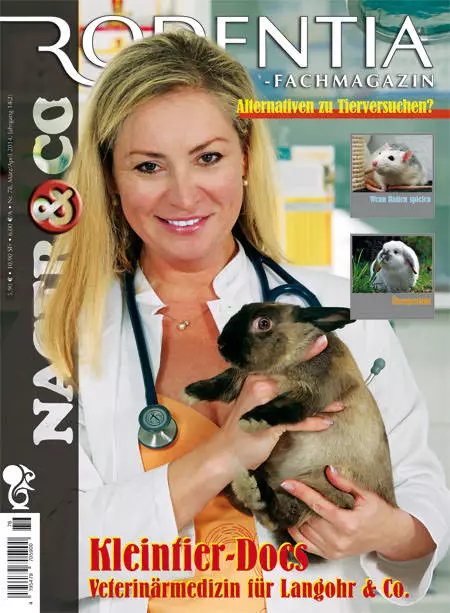
Rodentia 78 - Small Animal Doc's
Content:With the acquisition of a new home animal always the question about the choice of a competent veterinary surgeon arises. Since not each veterinarian is specialized in rabbits and Nager, small animal owners should inform themselves first, to whom they can turn in the case of an illness of their favorites trustingly. But how do I find a good veterinarian, how do I recognize his qualification? What should be considered before, during and after a visit to the vet? What are the most common questions and problems with rabbits and rodents that come "on the table" at the veterinarian? How does the everyday life of a veterinary surgeon and a veterinary nurse look like in practice? The title theme of the next RODENTIA - Nager & Co. is dedicated to these and other questions.Overweight with guinea pigs, rabbits & CO.: As with dog and cat also with the small domestic animals the number of overweight animals constantly increases. Unfortunately, obesity is not a harmless "blemish", but leads to limited mobility, digestive disorders and other serious illnesses, so that the life expectancy of fat animals is considerably reduced. But how do I know if my animal is overweight? What can I do if my pet is overweight? RODENTIA author Sara Roller will answer all these questions in the next issue.Alternative methods to animal testing: Animal experiments save human lives, say many scientists. Animal experiments are ethically unacceptable, contradict critics. The public splits itself particularly at medical animal experiments, because here it concerns human lives. A considerable number of scientists argue that many new therapies cannot be developed without animal experiments. The question is: Are we really faced with this choice? Do we really have to sacrifice human lives if we decide against exposing laboratory animals to terrible torture? Kerstin Han at RODENTIA - Nager & Co. is investigating these fundamental questions.Play behaviour of rats: Colour rats are extremely curious and playful animals, which explore the unknown through their playing behaviour and have learning experiences. The development of curiosity, play and learning depends not only on the individual, but also on the social situation of the animals and the "environmental enrichment". This means that rats that grow up and live in a richly structured environment are much more explorative and playful than their peers, who are cared for under unstructured conditions. Rat owner Katharina Groß gives insights into the fascinating curiosity, playing and learning behaviour of these rodents.Content:EditorialThings to knowTips and DatestitleThe veterinary profession in Germany. Trends and developments in the field of small animals and petsKathrin Aretz titleDevelopment of veterinary care for small mammals. More need for specialisationsProf. Dr. Michael Fehr titleDream jobs with animals. Which "animal" job description suits me best?Sara Roller titleIn search of the "right" one. How to recognize a competent veterinarianKerstin Han demeanorThe scared guinea pig. Dealing with fearful contemporariesDr. Marion Reich Humans and animalsThe other way. How research works without animal suffering Kerstin Han nutritionWhat's the truth? Grains and seeds in rabbit nutritionViola SchillingernutritionOh, you fat pig! Overweight with guinea pigs, rabbits & Co.Sara RollerpostureFree housing of ferrets. A field reportSabine HumburgnutritionIt works without pellets, too. Five years of near-narture chinchilla nutrition Part 2David KüpferpostureSprightly pensioners. Rabbits in old ageKerstin HandemeanorGenes and behavior. The influence of genetics and epigeneticsDr. Marion Reichservicedemeanor"Rattus ludens." The playing behaviour of colour ratsCatherine GreatmedicineDigestive problems in rabbits. When is it an emergency?Dr. med. vet. Jennifer Nehlsinternet forumspreviewLast but not least Full Pulle PaulaEpisode 13: We at the stationKathrin Aretz
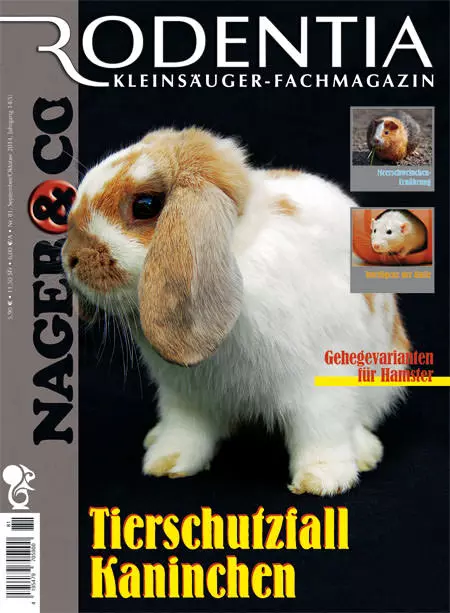
Rodentia 81 - Animal welfare case rabbit
Guinea pig nutritionIntelligence of ratsEnclosure variants for hamsters
Contents:
Cover story: Animal welfare case rabbits
With a population of 3 million, dwarf rabbits are by far the most popular small mammals in Germany. A lot has happened in the last 10–15 years in the field of species-appropriate rabbit keeping. Single housing and small mesh cages are increasingly becoming a thing of the past – at least in pet keeping. Nevertheless, there is still a lot to do in terms of animal welfare. Numerous animal welfare organisations are committed to ensuring that the needs of rabbits are given greater consideration in pet and farm animal husbandry. The “rabbit welfare case” is and remains a controversial topic, which we will get to the bottom of in the next issue of RODENTIA – Nager & Co.
EditorialWorth knowingTips and dates
TitleCage? No, thank you! Rabbits really wantKerstin Han
TitleCommitment is needed Practical tips for your animal welfare work Sara Roller
TitleAnimal welfare case fattening rabbits. Some thoughts on intensive rabbit husbandryA commentary by Anne Weber
TitleA life in the laboratory. Laboratory animal rabbitJulia Beutling
TitleIs animal welfare always animal welfare?A commentary by Ralf Sistermann
AttitudeHamster homes in comparison Different enclosure solutionsMagdalena Ochmann
BiologyIntelligence in rats Smart or stupid? Myth or truth?Katharina Groß
NutritionFeeding guinea pigs a healthy diet from a veterinary perspectiveMag. Nina Brabetz
AttitudeCheck-up for ferrets. Body care and health check made easySabine Humburg
HomemadeHomemade rodent furniture. Martin Höres
Services
ReportageNo two "piggies" are the same. Individual differences in guinea pigsDr. Marion Reich
MedicineCastrations for rodents & Co.Prof. Dr. Michael Fehr
Consultation hourwith Prof. Dr. Michael Fehr
Internet forumsPreview
Out with the mouseBerry hungerAnne Weber
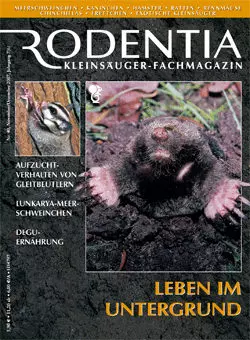
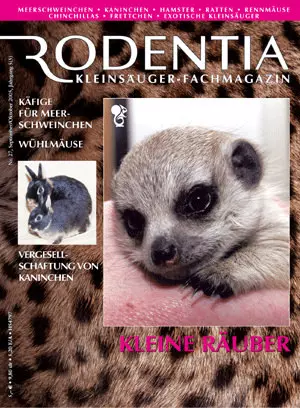
Rodentia 27 - Small predators
Cages for guinea pigsVolesSocialisation of rabbits
Contents:
2 INTERN
4 THINGS TO KNOW
12 DATES & TIPS
13 MY STORYThe editor, the gerbils and meBy Yannik Hansen
14 PHOTOSTORYSmall predatorsBy Christian Ehrlich
20 REPORTAGEMeerkats - The secret rulers of the Kalahari By Claudia Wolf
23 REPORTAGETwo men and three babies - Successful reunion of two meerkat groupsBy Dipl.-Biol. Sandra Honigs
24 REPORTAGEDwarf mongooses - small goblins with great curiosityBy Marion Naumann and Ralf Sistermann
28 KEEPING AND BREEDINGKeeping and breeding genets - civets with a very special charm By Martin Höhle
31 POSTERThe Persian gerbil (Meriones persicus)By Christian Ehrlich
35 REPORTAGEChildren and small mammals - How to have your first petBy Conchita Laurenz
38 PRAXISThe "South America House" in the garden - Building a house for keeping wild guinea pigsBy Björn Jordan
41 REPORTAGEBringing rabbits together - Of lone fighters, couples and male friendshipsBy Britta Haselhoff
44 REPORTAGELittle surprise in the rat cage - What to do with unplanned rat offspringBy Jolf Meyer
48 KEEPING AND BREEDINGPets from the underground - Keeping, feeding and breeding volesBy Ralf Sistermann
52 REPORTAGELife in "Guinea Pig House" - Creative do-it-yourself cage constructionsBy Gabriele Hofmann
56 CLASSIFIED ADS
58 CONSULTATION HOURDiseases of the digestive organs in ratsBy Prof. Dr. Michael Fehr
60 RAT & TAT
61 READER RAT
62 REGIONAL GUIDE
64 PEPPI ON TOURWhen long-eared animals have their days By Kathrin Aret
CHF 9.80
❅
❆
❅
❆
❅
❆
❅
❆
❅
❆
❅
❆
This website uses cookies to ensure the best experience possible. More information...