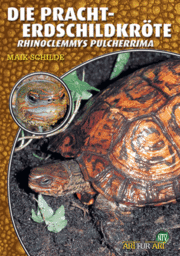
The magnificent tortoise of splendor

Article no: 978-3-937285-33-7

CHF 19.90

Stock: 0

Ready for dispatch in 1-3 days, delivery time 14 working days

Delivery between Tuesday, 5 May and Wednesday, 6 May
Zahlungsarten
Product information "The magnificent tortoise of splendor"

The magnificent tortoise impresses with its behaviour and body shape

  • 64 pages
  • Format: 14.8 x 21 cm
  • numerous colour photos
  • Author Maik Schilde

Contents:

There are species of tortoises that impress not only with their behaviour and body shape, but especially with their splendid colouring.
These striking colours, combined with a size that is comfortable for keeping, make the magnificent tortoise an attractive purchase.
However, this species of tortoise is very demanding when it comes to terrarium conditions – and yet it is a very pleasant pet, the keeping of which is great fun and enables a meaningful engagement with nature.
Tortoise expert Maik Schilde provides the reader in this volume with all the important fundamentals for the successful keeping and, if required, breeding of this fascinating species of tortoise.

  • Systematics and body structure
  • The fascinating biology: From the life of the magnificent tortoise
  • All information on species-appropriate keeping: From suitable terrarium, equipment and technology to feeding
  • Successful breeding: Mating stimulation, incubation of the eggs and rearing of the young
  • Problem solving: How to avoid the most common mistakes in care and how to help sick animals
  • Brilliant photos
Composition
Feeding recommendation
Technical details
Size information

0 of 0 reviews

Give us a rating!

Share your experience with the product with other customers.


Suggested products

Handbook of food plants for tortoises and other reptiles
Handbook of forage plants 2nd revised editionMarion Minch is not only a successful breeder of diverse tortoises for many years, but also an excellent connoisseur of native wild herbs. She founded and runs samenkiste.de, which is well known to many tortoise keepers and nature lovers. Her name is inextricably linked with reptile care and species-appropriate nutrition for tortoises. Her handbook of food plants summarises the most important native food plants for herbivorous and omnivorous reptiles. She not only considers tortoises, but also iguanas, spiny-tailed dragons and even chameleons. From the basics of plant biology to native wild herbs to suitable food plants for hardy tropical reptile species, this comprehensive work provides the basis for species-appropriate keeping. In the expanded and supplemented 2nd edition, the plant section is divided according to flower colour. This makes it even easier to identify wild herbs. The work has also been supplemented with a wealth of additional information and many pictures.

CHF 46.50

Geckos
Geckos in the terrarium by Astrid FalkThe book offers a comprehensive introduction to geckos and their species-appropriate keeping in terrariums. It explains what you need to think about before buying a gecko and what preparations should be made. The book describes in detail how the terrarium is technically equipped and set up. The care of the animals, their special features and behaviour, their diet, reproduction and rearing of young animals are described, as well as diseases and husbandry problems with tried and tested suggestions for prevention and treatment. Individual gecko species that are particularly suitable for keeping and breeding in terrariums are portrayed in detail in the second part of the book.

CHF 28.50

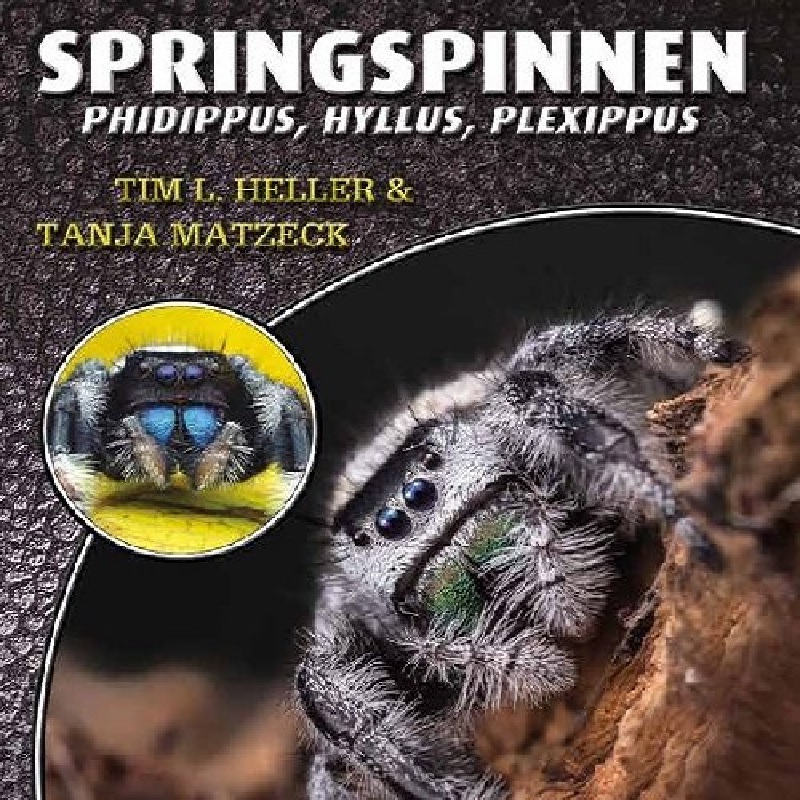
Jumping spiders Phidippus, Hyllus, Plexippus
Book Jumping Spiders - Phidippus, Hyllus & Plexippus A guide to keeping jumping spiders of the genera Phidippus, Hyllus & Plexippus. Who can resist the charm of jumping spiders? The childlike appearance of their expressive face simply leaves no one cold! In addition, their behavior is extremely exciting to observe, their colors are bright and their requirements for species-appropriate keeping are very easy to meet. No wonder these likeable jumpers are all the rage! This volume in the "Species by Species" series describes in detail what to look out for when buying and keeping them, introduces the most commonly kept species and color forms and provides plenty of tips on how to keep them successfully - so you can be sure they will breed well! Species by Species introduces you to the books in this series, which present the most popular terrarium animals. Each volume offers you detailed, practical care instructions and all the information you need to successfully breed your animals. All important questions from the required tank size to terrarium set-up, technical equipment, species-appropriate nutrition and disease prevention are answered with numerous tricks and tips. Experienced, long-standing breeders reveal how you can encourage the animals to reproduce and raise healthy young. All this in full color, generously illustrated and attractively designed - just about your terrarium animal - species by species

CHF 23.90

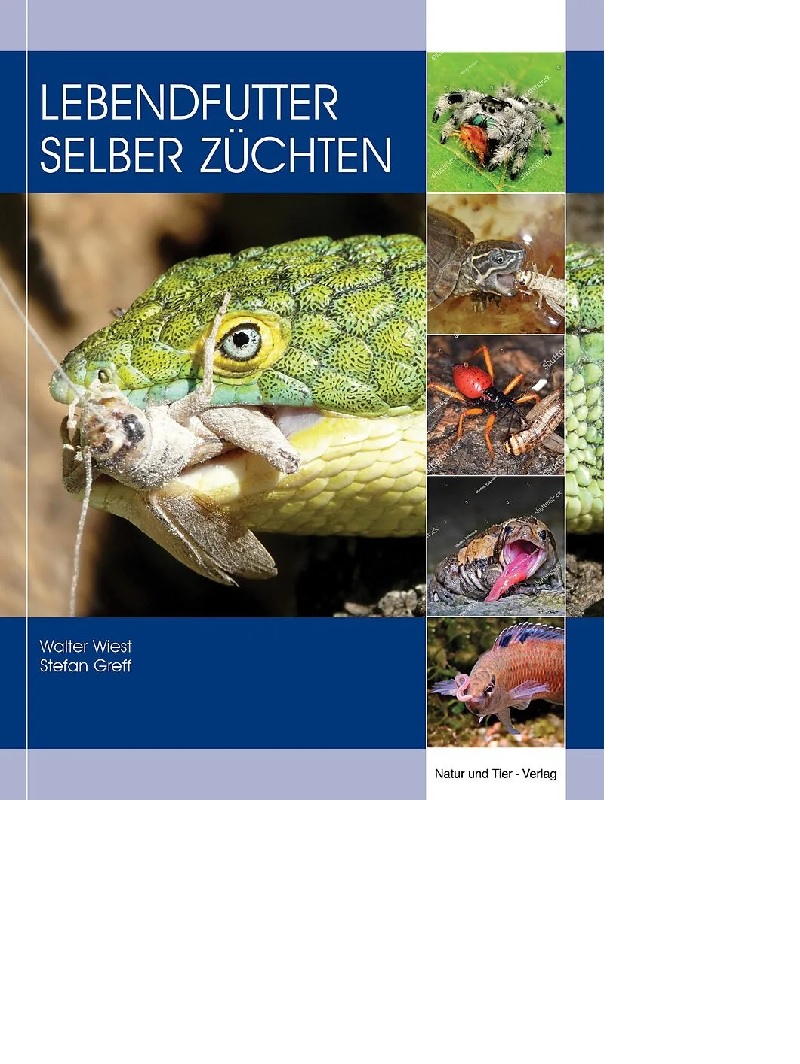
Book Breeding live food yourself
Book "Grow your own live food" - The perfect guide for pet owners Discover practical and detailed instructions on how you can easily breed food for your reptiles, birds, fish or other animals yourself in the book "Breeding live food yourself". With valuable tips on various food insects, their care and breeding, you can save money and ensure a species-appropriate diet for your pets. Contents of the book: Step-by-step instructions for breeding feeder insects Information on the best types of food for reptiles, birds and fish Care instructions and breeding conditions for various live food species Tips for sustainable and cost-effective food production Why breed your own live food? Get healthy, fresh food for your animals Save money and reduce dependence on pet shops Promote the health and well-being of your animals with species-appropriate food Whether you are a beginner or an experienced pet owner, this book provides you with everything you need to successfully breed live food yourself.

CHF 46.50

Marginata 69 - New Guinea tortoises
Marginata 69 - New Guinea tortoises – the genus ElseyaCover storyThe unrecognised beauties: New Guinea tortoises (Andreas S. Hennig)My experiences with Branderhorst's New Guinea tortoise, Elseya (Elseya) branderhorsti (Ouwens, 1914) (Andreas S. Hennig)Keeping and breeding of Rhodin's New Guinea tortoise, Elseya (Hanwarachelys) rhodini Thomson, Amepou, Anamiato & Georges, 2015 (Andreas S. Hennig)PortraitGeoemyda spengleri, Chinese serrated tortoise (Andreas S. Hennig)ReportageMacrochelys temminckii – Experiences and impressions with vulture tortoises part 2 (Reiner Praschag)KeepingAn alternative to year-round keeping of the Egyptian tortoise in the terrarium – my experiences with seasonal outdoor keeping of Testudo kleinmanni (Ricarda Schramm)EtymologySawbacks and living maps part 4: Graptemys gibbonsi, Pascagoula humpback tortoise (Holger Vetter)Classifieds & animal placement

CHF 16.50

Draco 12 - Poisonous Snakes
Draco 12 - Venomous snakes EDITORIAL The fascination of venomous snakes Pros and cons of keeping terrariumsDieter Schmidt Venomous snakes - Systematic observations on a difficult word Ulrich Kuch The genus Trimeresurus LACÉPÈDE, 1804On the state of knowledge of researchAndreas Gumprecht & Sergei Ryabov Observations of the monocle cobra (Naja kouthia LESSON, 1831) in the wild and in the terrariumLudwig Trutnau Crotalus willardi MEEK, 1905 - a small mountain rattlesnakeLudwig Trutnau The venomous snakes of Costa RicaAndreas Hohmeister Care and breeding of the Central American lancehead Atropoides nummifer (RÜPPELL, 1845)Andreas Hohmeister A visit to the Queen Saovabha Memorial Institute in ThailandJoachim Bulian & Lawan Chanhome The bird that knows the snakesDieter Mahsberg & K. Eduard Linsenmair Venomous snakes in southern Brazil - zoogeography, ecology and "ofidismo"Markus Monzel BOOKBOX MAGAZINE

CHF 16.80

Reptilia 111 - Rarities of snakes
Reptilia 111 - Snake raritiesAmazonian tortoisesMagnificent keel lizardMoroccoContents:Cover story: Snake raritiesSome species or subspecies of snakes have simply not managed to establish themselves in the terrarium hobby. Or they were once sought-after and regularly available, but have now completely or almost disappeared from the population. There are many reasons for this: they do not appear attractive enough at first glance, they were bred so frequently for a while that they were no longer profitable to breed, their requirements in terms of food are difficult to fulfil, they have a "bad reputation", no real lobby or are simply hardly ever imported. However, many of these mostly overlooked snakes are highly interesting and often extremely attractive, and are well worth keeping. We would like to introduce you to some of these wonderful rarities.EditorialMAGAZINEDATESWESTERN HERP PERSPECTIVESThe lamentation about terrarium fairsB. LovePhoto storySnake raritiesK. KunzKeeping and breedingWelcome back! Keeping and breeding Oocatochus rufodorsatusK. KunzKeeping and breedingThe queen of climbing snakes. Archelaphe bella chapaensis in the wild & in the terrariumS. Ryabov, I. Korshunov, T. T. Nguyen & X. WangHerpetofaunaThe magnificent keelback lizard Algyroides nigropunctatus - a little-known beauty from the BalkansM. DieckmannHerpetofaunaEncounters with turtles in the Venezuelan state of Amazonas. Part 2: TortoisesM. HeartReportageScorpions of IsraelM. Seiter & A. UllrichALSO NEAR YOUReportageThe white spring of the addersA. SchmidServicesJourneyThe herpetofauna of south-east MoroccoU. SchlüterPREVIEWBRUTKASTEN German animal welfare speaks hereH. Werning

CHF 12.00

Reptilia 68 - Soft-shelled Turtles
Reptilia 68 - Soft-shelled turtlesTiger pythons in the terrariumBert Langerwerf's lizard farmBlue poison dart frogContents: 2 EDITORIAL 3 MAGAZINE 14 DATES 16 PHOTO REPORTAGESoft-shelled turtlesBy J. Valverde 24 KEEPING AND REPRODUCTIONApalone ferox,the Florida soft-shelled turtleBy J. Valverde 29 HERPETOFAUNATrionyx triungius, the Nile soft-shelled turtleBy Oster Türkosan 34 KEEPING AND REPRODUCTIONPerspectives on the keeping and breeding of the Burmese soft-shelled turtleturtle (Lissemys scutata)By H. Prokop & L. Hojay 44 TRAVEL In search of the blue poison dart frogin the Sipalawini-Svanne in SurinamBy H. Divossen 51 PORTRAIT AND POSTERAtheris squamigeraBy M. Dobiey 56 KEEPING AND REPRODUCTIONKeeping and breeding the tiger pythonBy S. Barone 62 KEEPING AND REPRODUCTIONThe breeding of the Argentine black turtleMelanophryniscus stelzneriBy R. Siegenthaler 67 KEEPING AND REPRODUCTIONKeeping and breeding of the IberianEmerald lizard (Lacerta schreibersi) in an indoor terrariumBy C. Jeschull 75 PEOPLEHolidays on the farmThe agama farm "Agama International inc."by Bert LangerwerfBy H. Werning 88 WESTERN HERP PERSPECTIVESAccidents or carnageFrom B. Love 90 FAQ - FREQUENTLY ASKED QUESTIONSPogona henrylawsoniBy M. Dieckmann 93 LIBRARY 104 BRUTKASTENFlorida Diaries (Part 1)By H. Werning

CHF 11.20

Bugs No. 04 - Ants in the terrarium
Bugs No. 04 - Ants in the terrariumThe cover story of Bugs No. 4 is about tiny creatures that achieve great things: ants are the gardeners of nature, pruning grasses, bushes and trees, guarding entire shrubs and ensuring targeted "pest extermination". But they also act as cattle breeders, keeping small colonies of aphids in order to obtain their sweet droppings. Caring for these fascinating animals is highly interesting and there is always something to observe! Reason enough to take you, dear readers, on a journey into the realm of ants and show you how you can keep these colony-forming insects safely and in a species-appropriate way.Table of contentsEditorialFacetsDatesFlown inCover storyThe diversity of the superorganismMyrmecia vindex – archaic AustraliansSnap-jaw ants of the genus MyrmoterasFledgedInvertebrates in MalaysiaIn the crosshairsThe rainbow stag beetleKeeping & BreedingLittle rubies – two Centrobolus speciesReportageExemplary arthropods - Bionics, Part 2Keeping & Breeding The Jewel WaspKeeping & BreedingHorse-headed grasshoppersKeeping & BreedingThe genus PsalmopoeusPotter beeHomemade lime source for snailsBook scorpionAlso in your neighbourhoodKids CornerA small miracleShowcase The master of the MantodeaService & ImprintPreviewMetamorphosesAutumn

CHF 12.00

Marginata 7 - Magnificent tortoises
Marginata 7 - Magnificent Tortoises Food plants 2Herpesvirus in tortoisesTurkish tortoises Contents: 2 EDITORIAL 3 READER LETTERS 4 MAGAZINE 8 DATES 10 PHOTO REPORTAGE Magnificent Tortoises (Rhinoclemmys pulcherrima GRAY, 1856) Hans - Dieter Philippen 16 BREEDING IN HUMAN CARE Keeping, care and breeding of the Magnificent Tortoise Rhinoclemmys pulcherrima incisa (Bocourt, 1868) Andreas Mende & Thomas Berndt 21 BREEDING IN HUMAN CARE The Costa Rican Magnificent Tortoise (Rhinoclemmys pulcherrima manni) Fons Bänziger 26 FIELD RESEARCH The tropical dry forest in north-western Costa Rica Jan Michels 31 PORTRAIT Egyptian tortoise Testudo [Pseudotestudo] kleinmanni (Lortet, 1883) Hans - Dieter Philippen 35 VETERINARY MEDICINE An update on herpesvirus in tortoises Thomas Filip & Anna Kübber-Heiss 45 REPORTAGE Food plants for tortoises Part 2 Susanne Vogel 51 SHORT REPORT A foray through the area of Dalyan and Kaunos, Turkey Franz Hummel 54 SHORT REPORT Oh you big egg ... Heinz Frühauf 55 REPORTAGE ShellShock conservation campaign Hans - Dieter Philippen 59 RAT & TAT 60 BOOK TIP 61 CLASSIFIEDS 62 REGIONAL GUIDE 64 AGATHA MARGINATA

CHF 14.70

Reptilia 115 - Adders for the terrarium
Reptilia 115 - Adders for the Terrarium Flamingo flowersBlue rock iguanaNew Zealand mantis Contents:Cover story: Adders for the TerrariumAdders are among the classic and most popular terrarium animals. This extremely species-rich group of snakes has produced some of the most popular reptile pets. We provide an overview of the terrarium-relevant species and focus in particular on those adders suitable for beginners, among which there are many truly perfect pets. But we also have a real beauty for advanced keepers and report on the keeping and breeding of red bamboo adders. EditorialMAGAZINEDATES WESTERN HERP PERSPECTIVESThe dark sideB. Love FotostoryEvergreens in the terrarium: AddersK. Kunz PracticeAdders. Species and tips for beginnersD. Schmidt Husbandry and breedingThai bamboo adders (Oreocryptophis porphyraceus coxi) in the terrariumM. Hornig Husbandry and breedingThe New Zealand mantis, Orthodera novaezealandiae. A praying mantis from the other side of the worldB. Fuhrmann & C. Sehorz Husbandry and breedingThe keeping and breeding of the Blue rock iguana (Petrosaurus thalassinus) in the terrariumJ. Schulz PlantsArum family in the terrarium. Part 3: The genus AnthuriumB. Akeret Husbandry and breedingFirst ever natural rearing of the critically endangered Philippine crocodiles (Crocodylus mindorensis) in Europe successfulT. Ziegler, A. Rauhaus & C. Niggemann, AG Zoological Garden Cologne Animals of our homelandThe fire salamanderR. Leptien ALSO IN YOUR AREA Service TravelOn an excursion through the Colombian Amazon rainforestJ. Cañas-Orozco PREVIEW INCUBATOR Attention – more cat contentH. Werning

CHF 12.00

Draco 06 - Local amphibians
Draco 06 - Native amphibians Contents: Page content 2 Editorial 4 The native amphibians - an overview, by Dr B. Thiesmeyer 22 A king without a kingdom, by E. Meier & T. Mutz 30 The moor frog Rana arvalis NILSSON, 1842, by H. Laufer & A. Pieh 38 The green toad Bufo viridis LAURENTI, 1768, by A. Pieh & N. Braitmayer 45 Midwife toads (genus Alytes, discoglossidae): Biology, care and breeding, by H.-J. Schekeler 53 Great crested newts: Little water dragons in our ponds and pools, by A. Kupfer 58 Long time in the forest: Long live the salamander!, by Dr B. Thiesmeyer 69 First photos of the birth of the Alpine salamander (Salamandra atra atra) 78 Book box 89 Magazine

CHF 16.80