Reptilia 49 - Food animal breeding

Article no: reptilia49

CHF 11.20

Stock: 0

Ready for dispatch in 1-3 days, delivery time 7 working days

Delivery between Tuesday, 7 July and Wednesday, 8 July
Zahlungsarten
Product information "Reptilia 49 - Food animal breeding"

Reptilia 49 - Food animal breeding

Scorpion crust lizard
Spotted python
Chinese mountain dragon

Contents:

  • 2 EDITORIAL
    • 4 READER LETTERS
    • 5 MAGAZINE
    • 14 DATES
    • 18 WESTERN HERP PERSPECTIVES
      Hurricane Sale in Florida
      by B. Love
    • 20 PHOTO REPORTAGE
      Breeding food animals yourself - a problem?
      by F. Bruse & H. Werning
    • 27 REPORTAGE
      Efficient and productive cricket breeding by F. Bruse
    • 33 REPORTAGE
      Breeding the chocolate cockroach (Shellfordella tartara) by F. Bruse
    • 36 REPORTAGE
      A simple Drosophila breeding project by F. Bruse
    • 40 HERPETOFAUNA
      Notes on the Motagua lizard (Cnemidophorus motaguae) by U. Schlüter
    • 43 TRAVEL
      Herpetological observations and more from Gambia by U. Thieme
    • 51 PORTRAIT AND POSTER
      Geoclemys hamiltoni
      by H. - D. Philippen
    • 56 KEEPING AND BREEDING
      Keeping and Breeding the Chinese Mountain Agame (Japalura splendida)
      by H. Schradin
    • 68 HERPETOFAUNA
      Dendrobates pumilio
      The strawberry frog on the Bocas Islands
      by B. Schwarz
    • 72 KEEPING AND BREEDING
      The black Mexican chain snake (Lampropeltis getula nigrita in the terrarium
      by M. Thums
    • 79 REPORTAGE
      Antaresia maculosa (PETERS, 1873)
      Spotted python
      by D. Hasselberg
    • 85 CLASSIFIED ADS
    • 90 RAT & TAT
    • 93 LIBRARY
  • 104 GLOSSES
    In search of Uracentron azureum
    Part 1
    by H. Werning
Composition
Feeding recommendation
Technical details
Size information

0 of 0 reviews

Give us a rating!

Share your experience with the product with other customers.


Customers also bought

Reptilia 65 - Girdled lizards
Reptilia 65 - Girdled TailStar tortoiseIndigo snakeMonitor IslandContents: 2 EDITORIAL 3 READER LETTERS 4 MAGAZINE 12 DATES 14 WESTERN HERP PERSPECTIVESA country tripFrom B. Love 16 PHOTO REPORTAGEBelt-tailed lizards – the genus CordylusBy H. Schwier 24 KEEPING AND REPRODUCTIONDwarf Belted Tails: keeping and Breeding of Cordylus tropidosternum(Cope, 1869)From P. Fritz 32 KEEPING AND REPRODUCTIONCordylus mossambicus FitzSimons, 1958A persistent and interesting keeperFrom H.-P. Berghof 40 HERPETOFAUNAThe giant belted skink Cordylus giganteus – unique and mysterious at the same timeFrom H. Schwier 45 REPORTAGEThe radiated tortoise of Madagascar -an armoured beautyFrom J. Hammer 51 PORTRAIT AND POSTERPhilothamnus punctatusFrom M. Dobiey 56 KEEPING AND REPRODUCTIONNewts of the genus Paramesotriton- The Vietnamese and Laotian warty newtsFrom P. Bachhausen 64 KEEPING AND REPRODUCTIONDrymarchon couperi – the Eastern Indigo SnakeFrom N. Miele 72 TRAVELThe island of the monitor lizardsFrom A. Gumprecht 88 FAQ - FREQUENTLY ASKED QUESTIONSCorn snakesBy K. Kunz 92 REPORTAGESerpentário SanmaruFrom M. Junge 95 LIBRARY 104 BRUTKASTEN Chicken heart, be braveBy H. Werning

CHF 11.20

Reptilia 39 - Pythons
Reptilia 39 - Pythons Southern MexicoQuarantineChameleon protection Contents: 2 EDITORIAL 3 READER LETTERS 7 MAGAZINE 17 DATES 20 WESTERN HERP PERSPECTIVESNew citizenby B. Love 22 PHOTO REPORTAGE Pythonsby V. Franz 30 KEEPING AND BREEDINGMorelia spilota – Keeping and breeding the Diamond Python by U. Amundsen 34 KEEPING AND BREEDINGPython anchietae – Keeping and breeding the Angolan Python by V. Franz 37 REPORTAGEFascination record snake. Part 1: From childhood dream to research by H. Bellosa 40 TRAVELSouthern Mexicoby S. Vogler 51 PORTRAIT AND POSTERGeochelone nigraby H. Werning 56 REPORTAGEChamaeleo africanus in Europe: On a conservation project to preserve a reptile species threatened with extinction in Europeby B. Trapp 62 HerpetofaunaContribution to the knowledge and first report on breeding the Vietnamese swamp turtle, Mauremys annamensis (SIEBENROCK, 1903)by M. Schilde 66 REPORTAGEHow should a professional quarantine be carried out?by T. Eisenberg 72 REPORTAGEFire-bellied newts of the genus Cynops. Part 2: Breeding and newt registerby P. Bachhausen 78 REPORTAGEWith pencil and ink: treasures conjured on paperby R. Fenske 88 CLASSIFIED ADS 90 RAT & TAT 93 LIBRARY 104 GLOSSState guest in Chileby H. Werning

CHF 11.20

Reptilia 107 - Toad lizards
Reptilia 107 Toad lizards Eared frogMagnificent tortoiseConstruction of an outdoor terrarium Contents:Cover story: Toad lizardsThe bizarre toad lizards of the genus Phrynosoma are among the almost legendary terrarium animals. Every reptile lover is probably enchanted by the appearance of these small North American iguanas, but they have a reputation for being impossible to keep. However, more and more dedicated terrarium keepers are succeeding not only in keeping these food specialists for many years, but also in breeding them successfully. We provide an overview of the genus, discuss the problem of feeding these animals and provide two examples of successful keeping and breeding. EditorialMAGAZINEDATES WESTERN HERP PERSPECTIVESThe invisible ark B. Love PHOTOSTORYToad lizards – a (very good) freak of natureH. Werning REPORTAGEConsiderations on the diet of toad lizardsB. Fabian KEEPING AND BREEDINGKeeping and breeding the giant toad lizard (Phrynosoma asio) in the terrariumK. Haase KEEPINGPhrynosoma orbiculare – a toad lizard  from the highlands in captive careK. Haase KEEPINGThe eared frog, a little-known guest in the terrariumP. Janzen KEEPING AND BREEDINGSilent observers – on the lifestyle and keeping of the Central American magnificent tortoiseL. Spinner PracticeConstruction of an outdoor enclosure for emerald lizardsM. Herz TEST RUNSuccessful combination of terrarium and rackK. Kunz ANIMALS OF OUR HOMEThe spadefoot toadR. Leptien LIBRARYSERVICEALSO NEAR YOU TRAVELTerra incognita in the middle of Madagascar's rice fields – the herpetofauna of BetaolanaS. Wolf PREVIEW BRUTKASTEN Tangimangi – or: Take what you need!M. Zawadzki 

CHF 12.00

Bugs No. 06 - Asian Mantids
Bugs No. 06 - Asian Mantids African Harlequin CockroachRed Hainan crabThailandContents:The cover story of Bugs No. 6 is full of beauties, but they all have only three things on their minds: Eat, hide and reproduce. They are beautiful in their own right, but their perfect camouflage makes them hard to spot in their habitat - mantids from Asia! Find out new and interesting facts about species that live in mosses and lichens and read detailed breeding reports.Table of contents EditorialFacetsDatesFlown in      Cover storyAsian mantids Cover storySmall, colourful flower mantises Cover storyDemanding Dwarfs ReportageNative ‘tigers’ on a slimy trail  In the crosshairsBlood-red freshwater crab from China  FledgedIn search of scorpions in Morocco Keeping & BreedingSuccessful breeding of a roller spider CultureCuisine from Laos ShowcaseThe State Zoological Collection, Munich Kids CornerWhat’s crawling about in May? Potter beeHandling tarantulas Book scorpionAlso in your neighbourhoodService & ImprintPreview MetamorphosesThe Very Hungry Caterpillar

CHF 12.00

Reptilia 06 - Mimicry - The perfect deception
Reptilia 06 - Mimicry - The perfect illusion MaltaBuilding polystyrene terrariumsNutrition of tortoises Contents: Page 2 - EditorialPage 3 - Letters to the editorPage 5 - MagazinePage 11 - DatesPage 14 - Western Herp Perspectives: The Queen of Snakes, by B. LovePage 16 - Photo reportage: Mimicry, by L. AissefairePage 24 - Report: Mimicry - Saving energy through camouflage, by Dr M. GaulkePage 32 - Keeping and breeding: Like a leaf in the wind. The walking leaf Phyllum celebicum in the terrarium, by H. FischerPage 38 - Travelogue: Temples, disc-tongued frogs and reptiles – impressions of a trip to Malta, by U. SchlüterPage 43 - Photographic profile: Reptiles and amphibians in the Du Tsingy de Bamaraha nature reserve (West Madagascar), by G. Hallmann, E. Hoffmann, J. Krüger, P. Schlagböhmer and G. TrautmannPage 47 - Portrait and poster: Gastrotheca riobambae, by H. WerningPage 51 - Report: Nutrition of European tortoises, Part 2, by Dr C. DennertPage 59 - Keeping and breeding: A mini-crocodile for the paludarium – The keeled skink Tropidophorus grayi, by U. DostPage 64 - Terrarium practice: Styrofoam terrariums, by D. HasselbergPage 69 - Herpetofauna: The Bismarck Dwarf Python Liasis boa – keeping and breeding a colourful giant snake, by V. FranzPage 72 - Herpetology and culture: Snakes go to school – Part 2, by M. HallmenPage 81 - Reptilia on the road: Zoo Berlin-Friedrichsfelde, by H. WerningPage 84 - Advice and HelpPage 90 - LibraryPage 96 - Satire: Something different, by A. Scheffler

CHF 9.80

Reptilia 81 - Hognose snakes
Reptilia 81 - Hook-nosed snakes Samar cobraPantanal flatback turtleGalápagos Contents: The hook-nosed snakes of the genus Heterodon are currently experiencing an unimagined terraristic boom. Previously rather underappreciated, various very attractive colour forms have recently been bred, and this has led to a real boom. But even the normally coloured animals – and the natural spectrum of the eastern hook-nosed snake in particular covers an extremely wide range of colours – are extremely lovable terrarium pets.We present all species in detail, offer detailed breeding reports even on rarer forms, and a splendidly illustrated overview of current developments in colour variety breeding is of course also included. EDITORIAL MAGAZINE DATES PHOTOSTORY Hooked on Hogs! Hooked on hook-nosed snakes by K. Kunz KEEPING AND REPRODUCTION The Western hook-nosed snake of North America "trend snake" by B. Bumgardner HERPETOFAUNA Unleashed East! – The Eastern hook-nosed snake, Heterodon platirhinos by L. Spinner KEEPING AND REPRODUCTION Small but mighty! The Southern hook-nosed snake by K. Kunz & N. Nickel HERPETOFAUNA The Pantanal flatback turtle, Acanthochelys macrocephala – A turtle that still raises many questions by T. & S. Vinke PORTRAIT AND POSTER Gekko gecko (Linnaeus, 1758). Tokay gecko von M. Gaulke TRAVEL In the footsteps of Darwin through South America Part 4: Galápagos – The Darwin Archipelago by H. Werning KEEPING AND REPRODUCTION Keeping and breeding Samar cobra (Naja samarensis) by C. Frömberg KEEPING AND REPRODUCTION Sicarius terrosus in the terrarium by R. Hübers ANIMALS OF OUR HOME The forest lizard by R. Leptien WESTERN HERP PERSPECTIVES The big frost by B. Love LIBRARYBook review: Fläschendräger & Wijffel (2009): Anolisby U. Bartelt SUBSCRIPTION & SERVICE ALSO NEAR YOU PREVIEW BRUTKASTEN Alone among sheep. Part 1 by H. Werning

CHF 12.00

Suggested products

Handbook of food plants for tortoises and other reptiles
Handbook of forage plants 2nd revised editionMarion Minch is not only a successful breeder of diverse tortoises for many years, but also an excellent connoisseur of native wild herbs. She founded and runs samenkiste.de, which is well known to many tortoise keepers and nature lovers. Her name is inextricably linked with reptile care and species-appropriate nutrition for tortoises. Her handbook of food plants summarises the most important native food plants for herbivorous and omnivorous reptiles. She not only considers tortoises, but also iguanas, spiny-tailed dragons and even chameleons. From the basics of plant biology to native wild herbs to suitable food plants for hardy tropical reptile species, this comprehensive work provides the basis for species-appropriate keeping. In the expanded and supplemented 2nd edition, the plant section is divided according to flower colour. This makes it even easier to identify wild herbs. The work has also been supplemented with a wealth of additional information and many pictures.

CHF 46.50

Geckos
Geckos in the terrarium by Astrid FalkThe book offers a comprehensive introduction to geckos and their species-appropriate keeping in terrariums. It explains what you need to think about before buying a gecko and what preparations should be made. The book describes in detail how the terrarium is technically equipped and set up. The care of the animals, their special features and behaviour, their diet, reproduction and rearing of young animals are described, as well as diseases and husbandry problems with tried and tested suggestions for prevention and treatment. Individual gecko species that are particularly suitable for keeping and breeding in terrariums are portrayed in detail in the second part of the book.

CHF 28.50

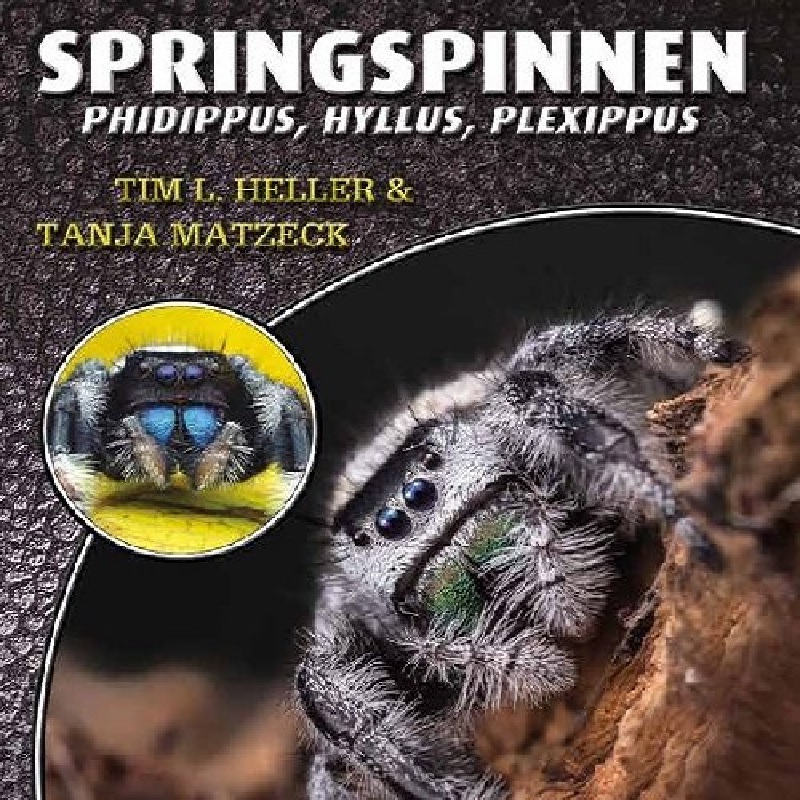
Jumping spiders Phidippus, Hyllus, Plexippus
Book Jumping Spiders - Phidippus, Hyllus & Plexippus A guide to keeping jumping spiders of the genera Phidippus, Hyllus & Plexippus. Who can resist the charm of jumping spiders? The childlike appearance of their expressive face simply leaves no one cold! In addition, their behavior is extremely exciting to observe, their colors are bright and their requirements for species-appropriate keeping are very easy to meet. No wonder these likeable jumpers are all the rage! This volume in the "Species by Species" series describes in detail what to look out for when buying and keeping them, introduces the most commonly kept species and color forms and provides plenty of tips on how to keep them successfully - so you can be sure they will breed well! Species by Species introduces you to the books in this series, which present the most popular terrarium animals. Each volume offers you detailed, practical care instructions and all the information you need to successfully breed your animals. All important questions from the required tank size to terrarium set-up, technical equipment, species-appropriate nutrition and disease prevention are answered with numerous tricks and tips. Experienced, long-standing breeders reveal how you can encourage the animals to reproduce and raise healthy young. All this in full color, generously illustrated and attractively designed - just about your terrarium animal - species by species

CHF 23.90

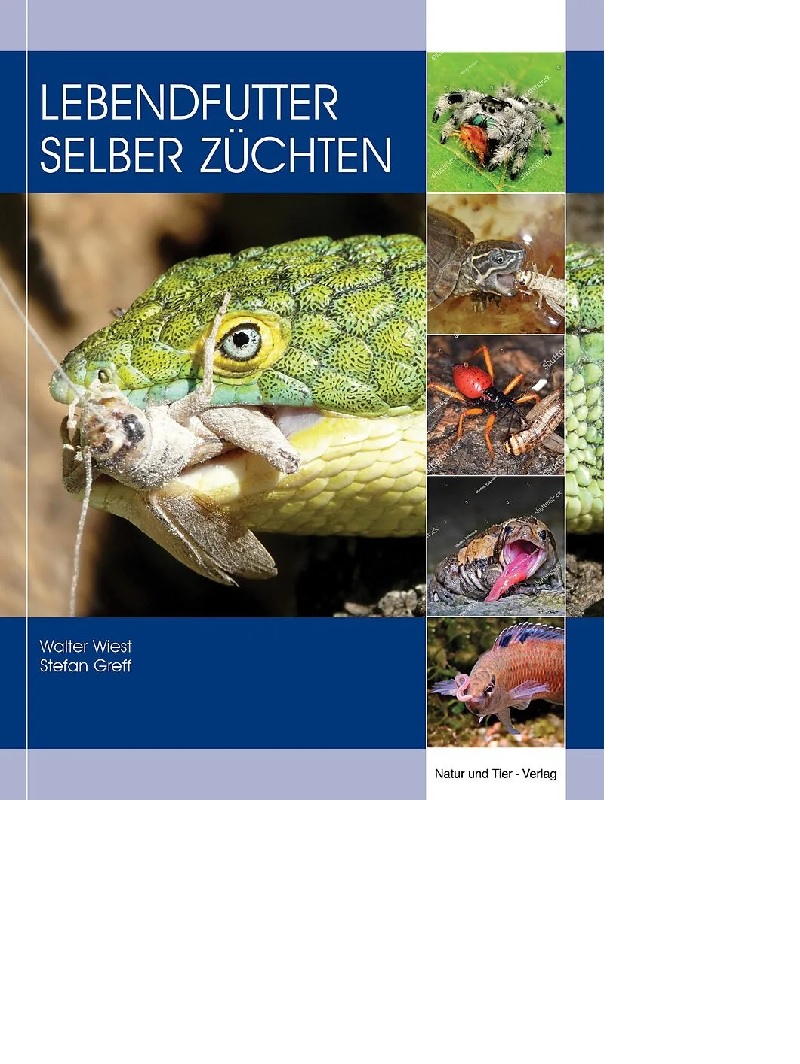
Book Breeding live food yourself
Book "Grow your own live food" - The perfect guide for pet owners Discover practical and detailed instructions on how you can easily breed food for your reptiles, birds, fish or other animals yourself in the book "Breeding live food yourself". With valuable tips on various food insects, their care and breeding, you can save money and ensure a species-appropriate diet for your pets. Contents of the book: Step-by-step instructions for breeding feeder insects Information on the best types of food for reptiles, birds and fish Care instructions and breeding conditions for various live food species Tips for sustainable and cost-effective food production Why breed your own live food? Get healthy, fresh food for your animals Save money and reduce dependence on pet shops Promote the health and well-being of your animals with species-appropriate food Whether you are a beginner or an experienced pet owner, this book provides you with everything you need to successfully breed live food yourself.

CHF 46.50

Marginata 69 - New Guinea tortoises
Marginata 69 - New Guinea tortoises – the genus ElseyaCover storyThe unrecognised beauties: New Guinea tortoises (Andreas S. Hennig)My experiences with Branderhorst's New Guinea tortoise, Elseya (Elseya) branderhorsti (Ouwens, 1914) (Andreas S. Hennig)Keeping and breeding of Rhodin's New Guinea tortoise, Elseya (Hanwarachelys) rhodini Thomson, Amepou, Anamiato & Georges, 2015 (Andreas S. Hennig)PortraitGeoemyda spengleri, Chinese serrated tortoise (Andreas S. Hennig)ReportageMacrochelys temminckii – Experiences and impressions with vulture tortoises part 2 (Reiner Praschag)KeepingAn alternative to year-round keeping of the Egyptian tortoise in the terrarium – my experiences with seasonal outdoor keeping of Testudo kleinmanni (Ricarda Schramm)EtymologySawbacks and living maps part 4: Graptemys gibbonsi, Pascagoula humpback tortoise (Holger Vetter)Classifieds & animal placement

CHF 16.50

Reptilia 94 - Terrarium photography
  Philippinen-KrokodilCumberland-SchmuckschildkröteHalsbandleguane im Freilandterrarium Inhalt: Die Terraristik bietet eine unendliche Fülle wunderbarer Fotomotive, ein Eldorado für Hobby-Fotografen! Und wohl jeder Halter hat den Wunsch, seine Pfleglinge, seine Nachzuchten und seine Anlage im Bild festzuhalten. Zumal Fotografieren nie einfacher war als heute, wo jedes Telefon die schnelle Aufnahme erlaubt, die dann direkt ins virtuelle Fotoalbum auf Facebook hochgeladen werden kann, wo alle Freunde sie anschauen können.Profi-Fotograf Benny Trapp aber gibt zahlreiche Tipps und Tricks, wie Sie zu Bildern kommen, bei denen garantiert jeder den „Gefällt mir“-Button drückt, ganz gleich, ob Sie mit einer Kompaktkamera oder einer hochwertigen Spiegelreflexkamera arbeiten. EDITORIALMAGAZINTERMINEIN 5 JAHREN UM DIE WELT Menschen und SchildkrötenA. PachmannWESTERN HERP PERSPECTIVESBörsenbesuch down under B. LoveFOTOSTORYBild schön! Fotografie von Terrarientieren K. KunzPRAXISTerrarientiere fotografieren. Einsatz von Licht und Blitz bei SpiegelreflexkamerasB. TrappPRAXISTipps für bessere Bilder mit KompaktkamerasB. TrappHALTUNG UND VERMEHRUNGPhilippinenkrokodile (Crocodylus mindorensis) im Aquarium des Kölner Zoos. Teil 1: Erfahrungen mit „Off-Exhibit“- Haltung einer der am stärksten bedrohten Krokodilarten der Welt T. Ziegler, R. Sommerlad, W. Brass, K. van der Straeten, D. Karbe & A. RauhausHERPETOFAUNAAuf dem Weg ins All. Die Welt der Buchstaben-Schmuckschildkröte, Trachemys scripta Teil 4: Cumberland- und Südtexas-Schmuckschildkröte A. S. HennigWIRBELLOSEDie Isles of Scilly. Ein Paradies nicht nur für Phasmidenfreunde H.-J. LuefHALTUNG UND VERMEHRUNGErfahrungen mit der Haltung von Halsbandleguanen im FreilandterrariumM. DieckmannTIERE UNSERER HEIMATDie AspisviperR. LeptienBIBLIOTHEKTIPPS & TRICKSTESTLAUFABO & SERVICEAUCH IN IHRER NÄHEREISEThe Rock. Die Herpetofauna GibraltarsU. SchlüterVORSCHAUBRUTKASTENIguana chilenaH. Werning  

CHF 12.00

Reptilia 06 - Mimicry - The perfect deception
Reptilia 06 - Mimicry - The perfect illusion MaltaBuilding polystyrene terrariumsNutrition of tortoises Contents: Page 2 - EditorialPage 3 - Letters to the editorPage 5 - MagazinePage 11 - DatesPage 14 - Western Herp Perspectives: The Queen of Snakes, by B. LovePage 16 - Photo reportage: Mimicry, by L. AissefairePage 24 - Report: Mimicry - Saving energy through camouflage, by Dr M. GaulkePage 32 - Keeping and breeding: Like a leaf in the wind. The walking leaf Phyllum celebicum in the terrarium, by H. FischerPage 38 - Travelogue: Temples, disc-tongued frogs and reptiles – impressions of a trip to Malta, by U. SchlüterPage 43 - Photographic profile: Reptiles and amphibians in the Du Tsingy de Bamaraha nature reserve (West Madagascar), by G. Hallmann, E. Hoffmann, J. Krüger, P. Schlagböhmer and G. TrautmannPage 47 - Portrait and poster: Gastrotheca riobambae, by H. WerningPage 51 - Report: Nutrition of European tortoises, Part 2, by Dr C. DennertPage 59 - Keeping and breeding: A mini-crocodile for the paludarium – The keeled skink Tropidophorus grayi, by U. DostPage 64 - Terrarium practice: Styrofoam terrariums, by D. HasselbergPage 69 - Herpetofauna: The Bismarck Dwarf Python Liasis boa – keeping and breeding a colourful giant snake, by V. FranzPage 72 - Herpetology and culture: Snakes go to school – Part 2, by M. HallmenPage 81 - Reptilia on the road: Zoo Berlin-Friedrichsfelde, by H. WerningPage 84 - Advice and HelpPage 90 - LibraryPage 96 - Satire: Something different, by A. Scheffler

CHF 9.80

The banded water snake
All about the banded water snake from Dieter Schmidt 64 pages 14.8 x 21 cm numerous color photos Author Dieter Schmidt Content: Watermans have always been one of the most popular terrariums. The Wassernatter, the water-racketeer, shows all the advantages of being a friend of the serpent of his caregiver. It is attractively drawn, easily satisfied with fish as food, is not too large, and has a tempered temperament.Dieter Schmidt, the experienced snake expert, will give you a wealth of experience in this guidebook and explain everything you need to know about the successful keeping and care of this popular species. The author goes into the multiplication of the animals and the rearing of the young - so you will soon be able to celebrate such successes. Systematics and physique The fascinating biology: From the life of the Banded Watercats All information on species-appropriate husbandry: From the appropriate terrarium to equipment and technology to feeding Successfully reproducing: mating stimulation and rearing of the young animals Troubleshooting: How to avoid the most common mistakes in care, and how to help sick animals Brilliant photos

CHF 18.50

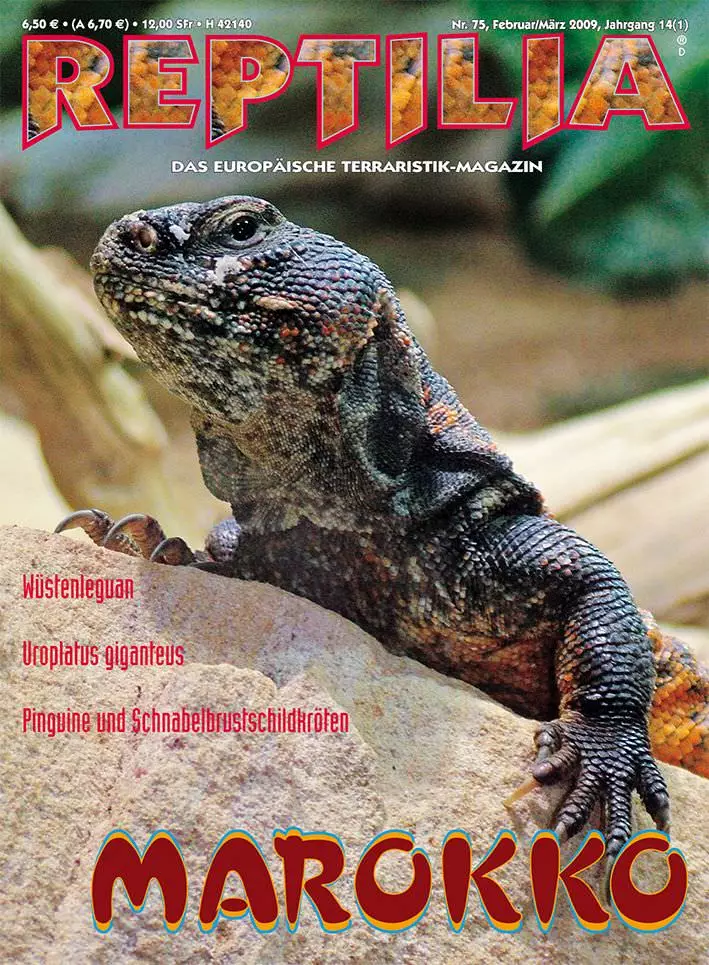
Reptilia 75 - Morocco
Reptilia 75 - Morocco FAQ Terrarium lightingTransport of terrarium animalsPenguins and beaked-breasted tortoises Contents: Morocco - so close to Europe, and yet a completely different world. Culturallyof course, but also in its animal world the country withits vast deserts and the mighty Atlas Mountains is of particular interest. Arabia expert and spinytail researcher ThomasWilms introduces you to Morocco, its spectacular landscapes and the very special herpetofauna. Stephanie de Pury, Sascha Esser and Michel Aymerich report on their exciting search for the lizard snake there, Rolf Leptien has travelled to the south of the country, and finally Hemmo Nickel portrays the remarkable scorpions of Morocco. 2 EDITORIAL3 MAGAZINE11 DATES14 WESTERN HERP PERSPECTIVES            The "crisis" of the Florida soft-shelled turtle            by B. Love16 PHOTOSTORY            Morocco            Treasure trove in north-west Africa            by T. Wilms24 TRAVEL            Morocco: In search of             the lizard snake            by S. de Pury, S. Esser & M. Aymerich32 TRAVEL            On an excursion to the south of Morocco            by R. Leptien38 REPORTAGE            The scorpions of Morocco            Part 1            by H. Nickel, J. Hornung & M. Koch47 PORTRAIT and POSTER            Uroplatus giganteus            by P. Schönecker51 HERPETOFAUNA            The Big Bend National Park and its             reptiles. Part 2: Snakes            by P. M. Kornacker & U. Dederichs59 TERRARIUM PRACTICE             Animal-friendly transport of reptiles            by S. Knauf66 HERPETOFAUNA            African beauty among penguins            Ecological relationships of the             beaked-breasted tortoise in             the Cape of South Africa            by M. Wirth79 FAQ – Frequently Asked Questions            Terrarium lighting – Part 1            by I. Kober & U. Geissel86  ALSO NEAR YOU91  SUBSCRIPTION & SERVICE94  PREVIEW96  BRUTKASTEN            Travel snippets from the Caribbean – Part 2            by H. Werning

CHF 12.00

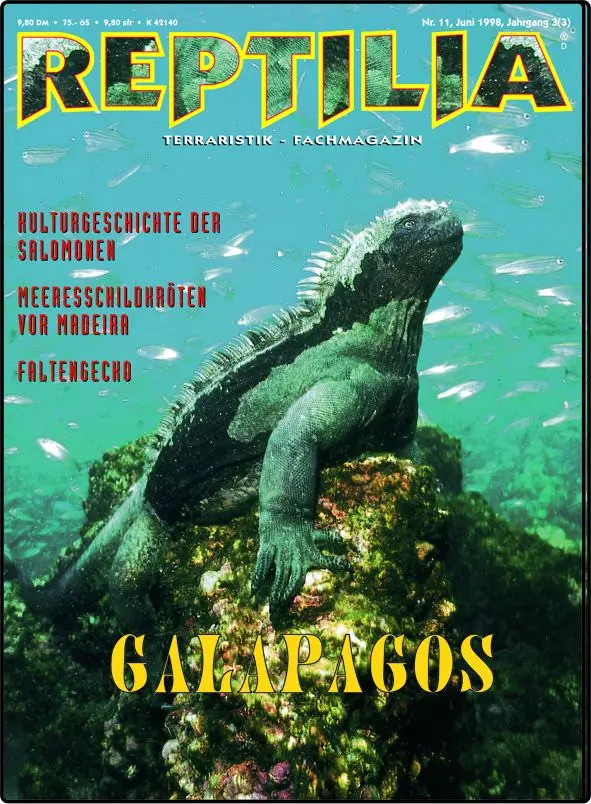
Reptilia 11 - Galapagos
Reptilia 11 - Galapagos Cultural history of the Solomon IslandsSea turtles off MadeiraWrinkled gecko Contents: EditorialLetters to the editorMagazinesDatesWestern Herp Perspectives: The Terrarium TrapB. Love Photo reportageGalápagosH. Werning HerpetofaunaThe Galápagos giant tortoiseB. Schramm ReportageSpecies conservation hunt on GalápagosH. Stoldt ReportageEl niño and the Galápagos reptilesH. Stoldt Keeping and breedingThe Egg Snake Dasypeltis atraD. Modry and P. Neças Portrait and posterBrachypelma emiliaP. Klaas HerpetofaunaSea turtles off MadeiraProf. T. Dellinger and Prof. P. Wirtz Keeping and breedingThe poison dart frog Minyobates minutusM. Schulte TerraristicsProphylaxis and quarantineProf. P. Kölle and Prof. R. Hoffmann Herpetology and cultureAmphibian and reptile myths of the MelanesiansDr. H.-J. Hermann Reptilia on the roadLeipzig ZooS. Hennig LibraryAdvice and actionIncubator

CHF 9.80

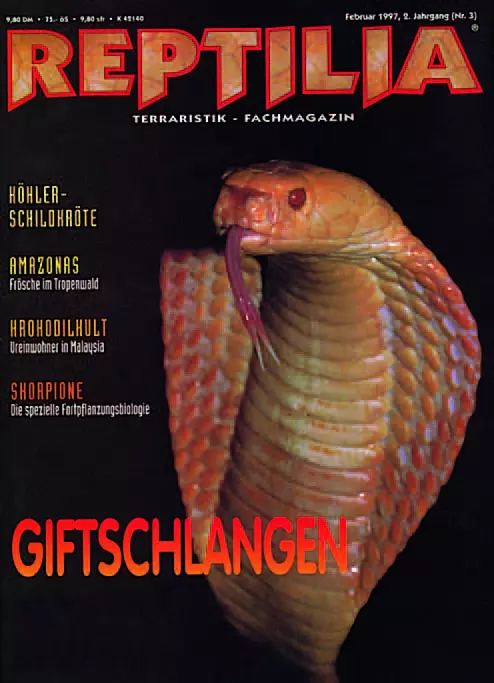
Reptilia 03 - Poisonous snakes
Reptilia 03 - Venomous snakesCave turtleAmazonas - Frogs in the tropical forestCrocodile cult - Aborigines in MalaysiaScorpions - The special reproductive biologyContents:Page 2 - EditorialPage 3 - Letters to the editorPage 6 - MagazinePage 17 - Photo report: Venomous snakes, by E. Barcenas and J. GuañabensPage 24 - Herpetofauna: Crotalus adamanteus, by J. BergadáPage 27 - Terraristics: Keeping venomous snakes, by P. LammersPage 30 - Herpetology and medicine: Venomous effects, by Dr M. Korthals AltesPage 33 – Travel report: Amazonas: In search of Dendrobates galactonotus, by B. PieperPage 39 - Portrait and poster: Salamandra salamandra, by M. Aresté and J. L. FarriolsPage 43 - Herpetofauna: How scorpions ensure their reproduction, by Dr D. MahsbergPage 49 - Herpetology and ecology: Toad migrations by A. de Saint-PaulPage 53 - Herpetofauna: Geochelone carbonaria, by S. MétraillerPage 56 - Herpetofauna: Toad lizards, by B. BaurPage 60 - Species and nature conservation: The extinction of reptiles and amphibians, by M. Viader StaubPage 71 - Herpetology and culture: The crocodile people of Malaysia, by Dr C. López del CastilloPage 74 - Advice and actionPage 75 - LibraryPage 80 - Incubator: Glossary by H. Werning

CHF 9.80

The corn snake
All about corn snakes from Kriton Kunz 64 Seiten 14,8 x 21 cm zahlreiche Farbfotos Autor Kriton Kunz Inhalt: Vielleicht der Klassiker der Terraristik schlechthin ist die Kornnatter. Sie vereint in sich alle Eigenschaften, die eine Schlange zu einem geeigneten und auch dem Einsteiger empfehlenswerten Pflegling machen: Wunderschöne Färbung, attraktive Farbvarianten, ruhiges, umgängliches Wesen und leichte Haltbarkeit. Damit Sie Ihre Kornnattern vom ersten Tag an richtig und artgerecht pflegen können, vermittelt Ihnen Kriton Kunz, REPTILIA-Redakteur und erfahrener Schlangenhalter, in diesem Band der Reihe „Art für Art“ ausführlich und leicht verständlich alles, was Sie für die erfolgreiche Haltung dieser faszinierenden Art wissen müssen. Selbstverständlich erfahren Sie auch, wie Sie Ihre Tiere zur Vermehrung bringen, die Eier ausbrüten und die Jungtiere aufziehen können. Systematik und Körperbau Die faszinierende Biologie: Aus dem Leben der Kornnatter Alle Informationen zur artgerechten Haltung: Vom geeigneten Terrarium über Einrichtung und Technik bis hin zur Fütterung Erfolgreich nachzüchten: Paarungsstimulation, Inkubation der Eier und Aufzucht der Jungtiere Problemlösungen: Wie man die häufigsten Fehler bei der Pflege vermeidet, und wie man kranken Tieren helfen kann Brillante Fotos

CHF 21.90