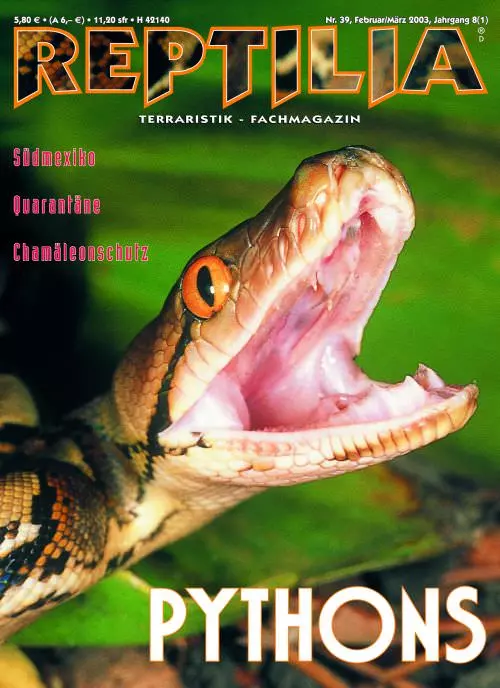
Reptilia 39 - Pythons

Article no: reptilia39

CHF 11.20

Stock: 0

Ready for dispatch in 1-3 days, delivery time 7 working days

Delivery between Tuesday, 28 April and Wednesday, 29 April
Zahlungsarten
Product information "Reptilia 39 - Pythons"

Reptilia 39 - Pythons

Southern Mexico
Quarantine
Chameleon protection

Contents:

    • 2 EDITORIAL
    • 3 READER LETTERS
    • 7 MAGAZINE
    • 17 DATES
    • 20 WESTERN HERP PERSPECTIVES
      New citizen
      by B. Love
    • 22 PHOTO REPORTAGE
      Pythons
      by V. Franz
    • 30 KEEPING AND BREEDING
      Morelia spilota – Keeping and breeding the Diamond Python by U. Amundsen
    • 34 KEEPING AND BREEDING
      Python anchietae – Keeping and breeding the Angolan Python by V. Franz
    • 37 REPORTAGE
      Fascination record snake. Part 1: From childhood dream to research by H. Bellosa
    • 40 TRAVEL
      Southern Mexico
      by S. Vogler
    • 51 PORTRAIT AND POSTER
      Geochelone nigra
      by H. Werning
    • 56 REPORTAGE
      Chamaeleo africanus in Europe: On a conservation project to preserve a reptile species threatened with extinction in Europe
      by B. Trapp
    • 62 Herpetofauna
      Contribution to the knowledge and first report on breeding the Vietnamese swamp turtle, Mauremys annamensis (SIEBENROCK, 1903)
      by M. Schilde
    • 66 REPORTAGE
      How should a professional quarantine be carried out?
      by T. Eisenberg
    • 72 REPORTAGE
      Fire-bellied newts of the genus Cynops. Part 2: Breeding and newt register
      by P. Bachhausen
    • 78 REPORTAGE
      With pencil and ink: treasures conjured on paper
      by R. Fenske
    • 88 CLASSIFIED ADS
    • 90 RAT & TAT
    • 93 LIBRARY
  • 104 GLOSS
    State guest in Chile
    by H. Werning
Composition
Feeding recommendation
Technical details
Size information

0 of 0 reviews

Give us a rating!

Share your experience with the product with other customers.


Customers also bought

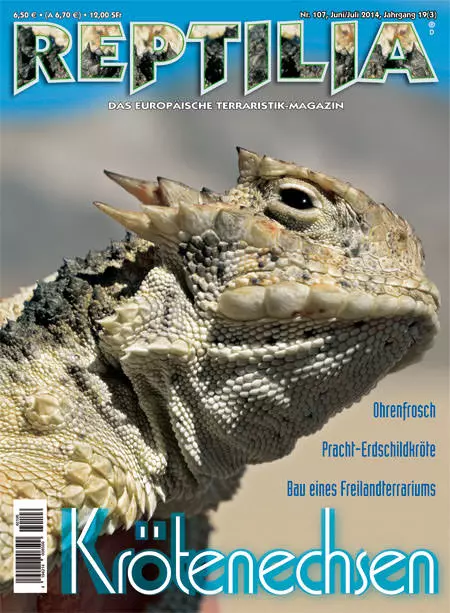
Reptilia 107 - Toad lizards
Reptilia 107 Toad lizards Eared frogMagnificent tortoiseConstruction of an outdoor terrarium Contents:Cover story: Toad lizardsThe bizarre toad lizards of the genus Phrynosoma are among the almost legendary terrarium animals. Every reptile lover is probably enchanted by the appearance of these small North American iguanas, but they have a reputation for being impossible to keep. However, more and more dedicated terrarium keepers are succeeding not only in keeping these food specialists for many years, but also in breeding them successfully. We provide an overview of the genus, discuss the problem of feeding these animals and provide two examples of successful keeping and breeding. EditorialMAGAZINEDATES WESTERN HERP PERSPECTIVESThe invisible ark B. Love PHOTOSTORYToad lizards – a (very good) freak of natureH. Werning REPORTAGEConsiderations on the diet of toad lizardsB. Fabian KEEPING AND BREEDINGKeeping and breeding the giant toad lizard (Phrynosoma asio) in the terrariumK. Haase KEEPINGPhrynosoma orbiculare – a toad lizard  from the highlands in captive careK. Haase KEEPINGThe eared frog, a little-known guest in the terrariumP. Janzen KEEPING AND BREEDINGSilent observers – on the lifestyle and keeping of the Central American magnificent tortoiseL. Spinner PracticeConstruction of an outdoor enclosure for emerald lizardsM. Herz TEST RUNSuccessful combination of terrarium and rackK. Kunz ANIMALS OF OUR HOMEThe spadefoot toadR. Leptien LIBRARYSERVICEALSO NEAR YOU TRAVELTerra incognita in the middle of Madagascar's rice fields – the herpetofauna of BetaolanaS. Wolf PREVIEW BRUTKASTEN Tangimangi – or: Take what you need!M. Zawadzki 

CHF 12.00

Reptilia 06 - Mimicry - The perfect deception
Reptilia 06 - Mimicry - The perfect illusion MaltaBuilding polystyrene terrariumsNutrition of tortoises Contents: Page 2 - EditorialPage 3 - Letters to the editorPage 5 - MagazinePage 11 - DatesPage 14 - Western Herp Perspectives: The Queen of Snakes, by B. LovePage 16 - Photo reportage: Mimicry, by L. AissefairePage 24 - Report: Mimicry - Saving energy through camouflage, by Dr M. GaulkePage 32 - Keeping and breeding: Like a leaf in the wind. The walking leaf Phyllum celebicum in the terrarium, by H. FischerPage 38 - Travelogue: Temples, disc-tongued frogs and reptiles – impressions of a trip to Malta, by U. SchlüterPage 43 - Photographic profile: Reptiles and amphibians in the Du Tsingy de Bamaraha nature reserve (West Madagascar), by G. Hallmann, E. Hoffmann, J. Krüger, P. Schlagböhmer and G. TrautmannPage 47 - Portrait and poster: Gastrotheca riobambae, by H. WerningPage 51 - Report: Nutrition of European tortoises, Part 2, by Dr C. DennertPage 59 - Keeping and breeding: A mini-crocodile for the paludarium – The keeled skink Tropidophorus grayi, by U. DostPage 64 - Terrarium practice: Styrofoam terrariums, by D. HasselbergPage 69 - Herpetofauna: The Bismarck Dwarf Python Liasis boa – keeping and breeding a colourful giant snake, by V. FranzPage 72 - Herpetology and culture: Snakes go to school – Part 2, by M. HallmenPage 81 - Reptilia on the road: Zoo Berlin-Friedrichsfelde, by H. WerningPage 84 - Advice and HelpPage 90 - LibraryPage 96 - Satire: Something different, by A. Scheffler

CHF 9.80

Reptilia 49 - Food animal breeding
Reptilia 49 - Food animal breedingScorpion crust lizardSpotted pythonChinese mountain dragonContents: 2 EDITORIAL 4 READER LETTERS 5 MAGAZINE 14 DATES 18 WESTERN HERP PERSPECTIVESHurricane Sale in Floridaby B. Love 20 PHOTO REPORTAGE Breeding food animals yourself - a problem?by F. Bruse & H. Werning 27 REPORTAGEEfficient and productive cricket breeding by F. Bruse 33 REPORTAGEBreeding the chocolate cockroach (Shellfordella tartara) by F. Bruse 36 REPORTAGEA simple Drosophila breeding project by F. Bruse 40 HERPETOFAUNANotes on the Motagua lizard (Cnemidophorus motaguae) by U. Schlüter 43 TRAVELHerpetological observations and more from Gambia by U. Thieme 51 PORTRAIT AND POSTERGeoclemys hamiltoniby H. - D. Philippen 56 KEEPING AND BREEDINGKeeping and Breeding the Chinese Mountain Agame (Japalura splendida) by H. Schradin 68 HERPETOFAUNADendrobates pumilioThe strawberry frog on the Bocas Islands by B. Schwarz 72 KEEPING AND BREEDING The black Mexican chain snake (Lampropeltis getula nigrita in the terrariumby M. Thums 79 REPORTAGEAntaresia maculosa (PETERS, 1873)Spotted pythonby D. Hasselberg 85 CLASSIFIED ADS 90 RAT & TAT 93 LIBRARY 104 GLOSSESIn search of Uracentron azureumPart 1by H. Werning

CHF 11.20

Reptilia 81 - Hognose snakes
Reptilia 81 - Hook-nosed snakes Samar cobraPantanal flatback turtleGalápagos Contents: The hook-nosed snakes of the genus Heterodon are currently experiencing an unimagined terraristic boom. Previously rather underappreciated, various very attractive colour forms have recently been bred, and this has led to a real boom. But even the normally coloured animals – and the natural spectrum of the eastern hook-nosed snake in particular covers an extremely wide range of colours – are extremely lovable terrarium pets.We present all species in detail, offer detailed breeding reports even on rarer forms, and a splendidly illustrated overview of current developments in colour variety breeding is of course also included. EDITORIAL MAGAZINE DATES PHOTOSTORY Hooked on Hogs! Hooked on hook-nosed snakes by K. Kunz KEEPING AND REPRODUCTION The Western hook-nosed snake of North America "trend snake" by B. Bumgardner HERPETOFAUNA Unleashed East! – The Eastern hook-nosed snake, Heterodon platirhinos by L. Spinner KEEPING AND REPRODUCTION Small but mighty! The Southern hook-nosed snake by K. Kunz & N. Nickel HERPETOFAUNA The Pantanal flatback turtle, Acanthochelys macrocephala – A turtle that still raises many questions by T. & S. Vinke PORTRAIT AND POSTER Gekko gecko (Linnaeus, 1758). Tokay gecko von M. Gaulke TRAVEL In the footsteps of Darwin through South America Part 4: Galápagos – The Darwin Archipelago by H. Werning KEEPING AND REPRODUCTION Keeping and breeding Samar cobra (Naja samarensis) by C. Frömberg KEEPING AND REPRODUCTION Sicarius terrosus in the terrarium by R. Hübers ANIMALS OF OUR HOME The forest lizard by R. Leptien WESTERN HERP PERSPECTIVES The big frost by B. Love LIBRARYBook review: Fläschendräger & Wijffel (2009): Anolisby U. Bartelt SUBSCRIPTION & SERVICE ALSO NEAR YOU PREVIEW BRUTKASTEN Alone among sheep. Part 1 by H. Werning

CHF 12.00

Reptilia 72 - Grasshoppers, crickets, house crickets
Reptilia 72 - Grasshoppers, Crickets, House Crickets Jamaican AnoleIndochinese Hinged TurtleSunglow Boas Contents: 2    EDITORIAL 4    REPORTAGE      Potential Dangers of Giant Snakes      by B. Akeret 13  MAGAZINE 21  DATES 24  PHOTOSTORY      Crickets and Grasshoppers      by F. Tomasinelli 32  REPORTAGE      Grasshoppers:      Defence and Survival      by F. Tomasinelli 36  KEEPING AND BREEDING      The Egyptian Migratory Locust     Anacridium aegyptium     by A. Mangoni 40  REPORTAGE      Lord of the Bugs      Visiting Europe’s Largest       Breeding Facility for Feeder Insects      by H. Werning 54  HERPETOFAUNA      The European Tree Frog (Hyla arborea)      “Frog of the Year” in the “Year of the       Frog 2008”      by A. Kwet, A. Nöllert & A. Geiger 64  KEEPING AND BREEDING      Successful Keeping and Offspring of      Cistoclemmys (galbinifrons) bouretti,      the Indochinese Hinged Turtle      by W. & K. Heuberger 73  TRAVEL/KEEPING AND BREEDING      Jamaica, its Iguanas and the      Giant Anole Anolis garmani      by T. Baum 81  KEEPING AND BREEDING      And the Sun Rises … the Sunglow Boa      by R. Ihle & J. Bergman 86  WESTERN HERP PERSPECTIVES      A Turtle Story      by B. Love 91  LIBRARY 104 BRUTKASTEN      Thoughts on the Day of Milk Suffering      by H. Werning

CHF 12.00

Reptilia 98 - Sick due to reptiles? About the [alleged] danger of salmonella
Reptilia 98 - Sick due to reptiles? About the [alleged] danger of salmonella Drosophila food animal breedingUnderwoodisaurus miliiToad-headed tortoises Contents: EDITORIALMAGAZINEDATES AROUND THE WORLD IN 5 YEARSTree creepers instead of flowersA. Pachmann WESTERN HERP PERSPECTIVES   American herp problemsB. Love REPORTAGEAttack with bioweapons: Salmonella tactics against the terrarium hobbyH. Werning ReportageSalmonella in amphibians and reptiles. The importance of terrarium animals as sources of infection for humansF. Mutschmann HerpetofaunaPhrynops. The genus of toad-headed tortoisesH. - D. Philippen ReportageIn the land of the golden ants. Splendour to the end of the worldM. Freuding Keeping and breedingThe Australian fat-tailed gecko, Underwoodisaurus miliiS. Arth & S. Baus Terrarium practiceCursed in the kitchen, loved in the terrarium: fruit fliesU. Dost Terrarium displaysLa Ferme aux Crocodiles in Pierrelatte/Southern FranceM. Dieckmann LibraryTest runTips & tricksSUBSCRIPTION & SERVICEALSO NEAR YOU TRAVELDzanga-Sangha. In search of frogs between elephants and gorillasJ. M. Dehling & D. M. Dehling PREVIEWBRUTKASTENSpecies protection reportH. Werning

CHF 12.00

Suggested products

Handbook of food plants for tortoises and other reptiles
Handbook of forage plants 2nd revised editionMarion Minch is not only a successful breeder of diverse tortoises for many years, but also an excellent connoisseur of native wild herbs. She founded and runs samenkiste.de, which is well known to many tortoise keepers and nature lovers. Her name is inextricably linked with reptile care and species-appropriate nutrition for tortoises. Her handbook of food plants summarises the most important native food plants for herbivorous and omnivorous reptiles. She not only considers tortoises, but also iguanas, spiny-tailed dragons and even chameleons. From the basics of plant biology to native wild herbs to suitable food plants for hardy tropical reptile species, this comprehensive work provides the basis for species-appropriate keeping. In the expanded and supplemented 2nd edition, the plant section is divided according to flower colour. This makes it even easier to identify wild herbs. The work has also been supplemented with a wealth of additional information and many pictures.

CHF 46.50

Geckos
Geckos in the terrarium by Astrid FalkThe book offers a comprehensive introduction to geckos and their species-appropriate keeping in terrariums. It explains what you need to think about before buying a gecko and what preparations should be made. The book describes in detail how the terrarium is technically equipped and set up. The care of the animals, their special features and behaviour, their diet, reproduction and rearing of young animals are described, as well as diseases and husbandry problems with tried and tested suggestions for prevention and treatment. Individual gecko species that are particularly suitable for keeping and breeding in terrariums are portrayed in detail in the second part of the book.

CHF 28.50

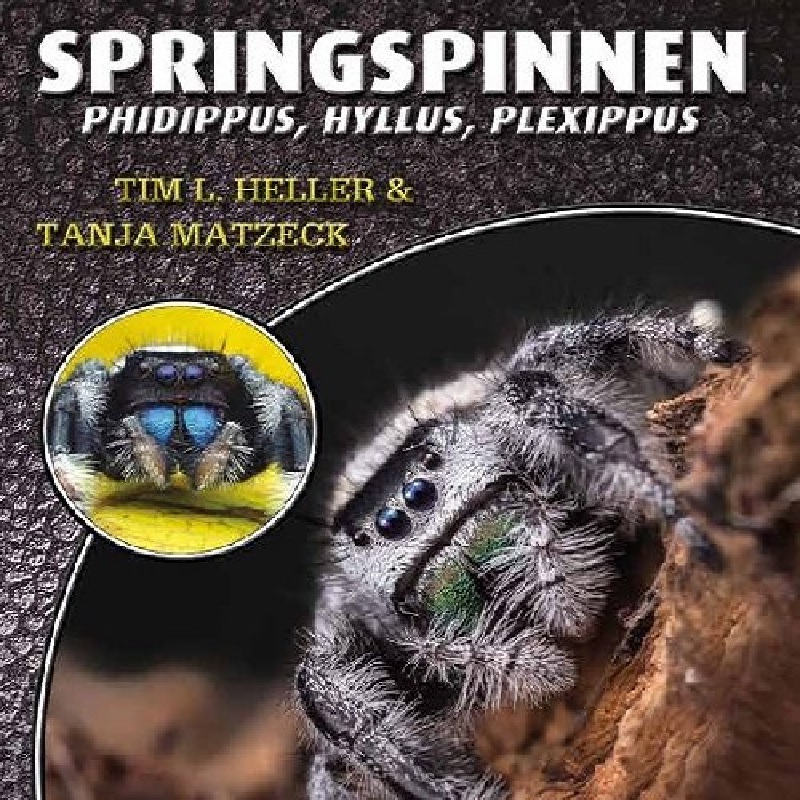
Jumping spiders Phidippus, Hyllus, Plexippus
Book Jumping Spiders - Phidippus, Hyllus & Plexippus A guide to keeping jumping spiders of the genera Phidippus, Hyllus & Plexippus. Who can resist the charm of jumping spiders? The childlike appearance of their expressive face simply leaves no one cold! In addition, their behavior is extremely exciting to observe, their colors are bright and their requirements for species-appropriate keeping are very easy to meet. No wonder these likeable jumpers are all the rage! This volume in the "Species by Species" series describes in detail what to look out for when buying and keeping them, introduces the most commonly kept species and color forms and provides plenty of tips on how to keep them successfully - so you can be sure they will breed well! Species by Species introduces you to the books in this series, which present the most popular terrarium animals. Each volume offers you detailed, practical care instructions and all the information you need to successfully breed your animals. All important questions from the required tank size to terrarium set-up, technical equipment, species-appropriate nutrition and disease prevention are answered with numerous tricks and tips. Experienced, long-standing breeders reveal how you can encourage the animals to reproduce and raise healthy young. All this in full color, generously illustrated and attractively designed - just about your terrarium animal - species by species

CHF 23.90

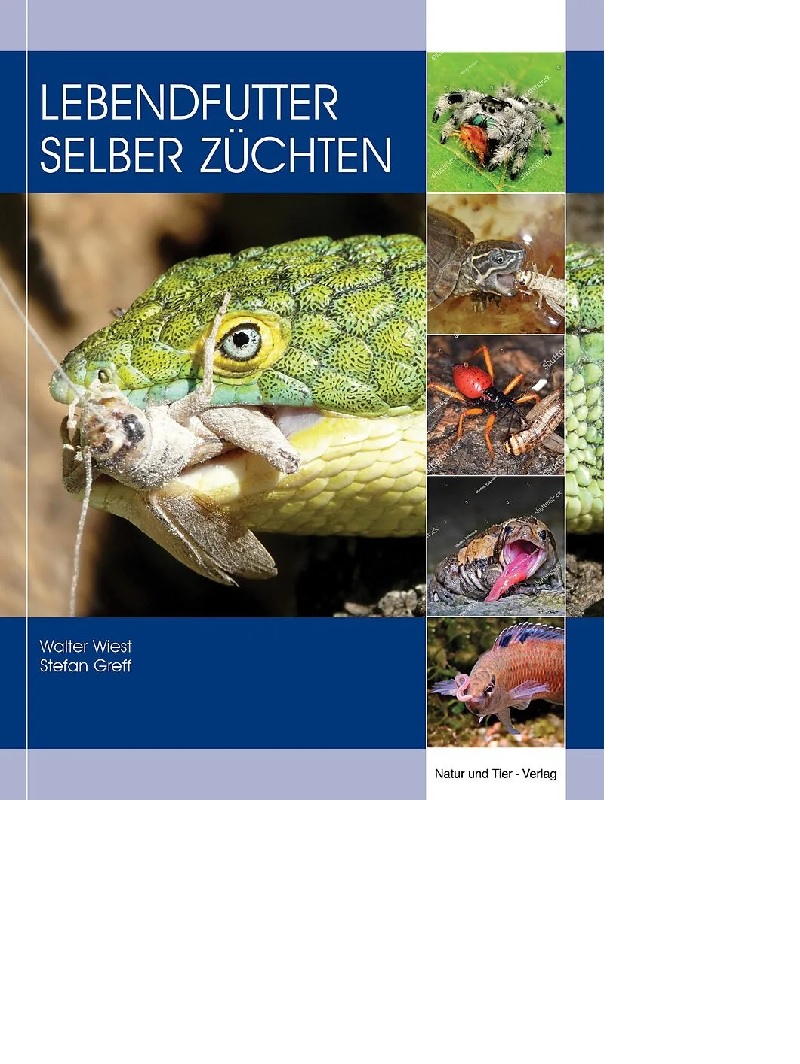
Book Breeding live food yourself
Book "Grow your own live food" - The perfect guide for pet owners Discover practical and detailed instructions on how you can easily breed food for your reptiles, birds, fish or other animals yourself in the book "Breeding live food yourself". With valuable tips on various food insects, their care and breeding, you can save money and ensure a species-appropriate diet for your pets. Contents of the book: Step-by-step instructions for breeding feeder insects Information on the best types of food for reptiles, birds and fish Care instructions and breeding conditions for various live food species Tips for sustainable and cost-effective food production Why breed your own live food? Get healthy, fresh food for your animals Save money and reduce dependence on pet shops Promote the health and well-being of your animals with species-appropriate food Whether you are a beginner or an experienced pet owner, this book provides you with everything you need to successfully breed live food yourself.

CHF 46.50

Marginata 69 - New Guinea tortoises
Marginata 69 - New Guinea tortoises – the genus ElseyaCover storyThe unrecognised beauties: New Guinea tortoises (Andreas S. Hennig)My experiences with Branderhorst's New Guinea tortoise, Elseya (Elseya) branderhorsti (Ouwens, 1914) (Andreas S. Hennig)Keeping and breeding of Rhodin's New Guinea tortoise, Elseya (Hanwarachelys) rhodini Thomson, Amepou, Anamiato & Georges, 2015 (Andreas S. Hennig)PortraitGeoemyda spengleri, Chinese serrated tortoise (Andreas S. Hennig)ReportageMacrochelys temminckii – Experiences and impressions with vulture tortoises part 2 (Reiner Praschag)KeepingAn alternative to year-round keeping of the Egyptian tortoise in the terrarium – my experiences with seasonal outdoor keeping of Testudo kleinmanni (Ricarda Schramm)EtymologySawbacks and living maps part 4: Graptemys gibbonsi, Pascagoula humpback tortoise (Holger Vetter)Classifieds & animal placement

CHF 16.50

Reptilia 96 - Invertebrates in trend
Reptilia 96 - Invertebrates in Trend Ring-necked snakeIberian emerald lizardTortoises of Mallorca Contents: A wide variety of different invertebrates can be kept in a species-appropriate, space- and energy-saving manner in a small space. However, it would be far too short-sighted to attribute the growing enthusiasm for the mostly many-legged co-inhabitants solely to such practical aspects: More and more terrarium keepers are simply being carried away by the often bizarre beauty of the animals, by extremely exciting behaviours and lifestyles that could not be more different from our world. In our photo story, we offer you an up-to-date overview of the keeping of a wide variety of species. With chameleon crabs, Madagascan giant crickets and praying mantises, our authors also present some “trendy” invertebrates in detail. EDITORIALMAGAZINEDATESAround the world in 5 yearsBuzzers in the webA. PachmannWESTERN HERP PERSPECTIVESSecret PlacesB. LovePHOTOSTORY Invertebrates. The new rulers in the terrarium hobbyK. KunzKEEPING AND BREEDINGBeetles in the terrarium. Evolutionary wonders of natureI. Fritzsche & F. RossowKEEPING AND BREEDINGExperiences with the Red Chameleon Crab (Metasesarma aubryi) U. DostKEEPING AND BREEDINGPredatory bugs of the genus Platymeris in the terrariumI. FritzscheREPORTAGE/KEEPING AND BREEDINGJourney into the microcosm. In search of mantids in MalaysiaJ. KühneKEEPING AND BREEDINGKeeping and breeding of Parymenopus davisoni T. RönischHERPETOFAUNADiscovery of a new colour variant of the Iberian emerald lizard (Lacerta schreiberi) C. JeschullHERPETOFAUNAThe tortoises of Son Real on Mallorca M. RognerKEEPING AND BREEDINGRing-necked snakes (Diadophis punctatus) in the terrariumU. SchlüterSHOW FACILITIESThe Bonn Museum Alexander KoenigS. EsserANIMALS OF OUR HOMEThe alpine newtR. LeptienSUBSCRIPTION & SERVICELibraryTips & TricksTest runALSO IN YOUR AREATRAVELChameleon holiday – a Madagascar trip K. PawlikPREVIEWINCUBATORDangerous encountersM. Zawadzki

CHF 12.00

Marginata 24 - Pointed Red-bellied Pond Turtle
Marginata 24 - Red-bellied Pointed Pond Turtle South African Beaked Tortoise Part 2Sea turtles of AustraliaHibernation and dry hibernation Part 1 Contents: EditorialLetters to the editorMagazineDates REPORTAGEThe red-bellied pointed pond turtle, Emydura subglobosa (Krefft, 1876) – long known and yet virtually unknownHans - Dieter Philippen & John Cann BREEDINGLong-term breeding experiences with the red-bellied pointed pond turtle (Emydura subglobosa) – compilation of personal and published data spanning over 40 yearsHans - Dieter Philippen & Martin Leonard Voss POSTERThe Black-bellied Box Turtle, Pelusios niger (Dumeril & Bibron, 1835)Hans - Dieter Philippen REPORTAGEThe African Beaked Tortoise (Chersina angulata). Part 2: Behavioural observationsMichael Wirth REPORTAGEThreats, protection and use of sea turtles. Part 4: Green Turtle (Chelonia mydas) and Loggerhead Turtle (Caretta caretta) in Northwest Australia Gerald & Christa Benyr REPORTAGEPhysiology of rest phases in reptiles, especially tortoises – Part 1: Hibernation – a literature overviewMarkus Baur & Tobias Friz Book tipClassifiedsSubscription & ServiceRegional guide

CHF 16.50

Draco 61 - Eggsnakes
Draco 61 - Egg snakesContents:EditorialThe pacifists among snakes – African egg-eating snakes of the genus DasypeltisHelmut Göthel Pre-packaged food - bird eggs as a food sourceHelmut GöthelThe feeding behaviour of African egg snakesHelmut Göthel Evolutionary biological considerationsHelmut GöthelMimicry and defensive behaviour in egg snakesHelmut Göthel African egg snakes in the terrariumHelmut GöthelBreeding of African egg snakes Helmut Göthel Diseases and parasites in egg snakesHelmut GöthelThe egg snake species of AfricaHelmut GöthelThe Indian egg snake, Elachistodon westermanniHelmut Göthel

CHF 32.00

Reptilia 20 - Water dragons
Reptilia 20 - Water dragons Charcoal tortoiseAspis viperOregon Contents: Page 2 - EditorialPage 3 - Letters to the editorPage 6 - MagazinePage 13 - DatesPage 14 - Western Herp Perspectives: a childhood with box turtles, by B. LovePage 15 - Photo report: Water dragons, by. H. WerningPage 22 - Report: Observations of Physignathus concincinus in Thailand and Laos, by S. and U. MantheyPage 24 - Keeping and breeding: 15 years with water dragons, by H. WerningPage 32 - Report: The Australian water dragon Physignathus lesueurii lesueurii, by B. LangerwerfPage 40 - Journey: On tailed amphibian excursions in northern Oregon. Part 1: From the Columbia River Gorge to the north coast, by H. WallaysPage 47 - Portrait and poster: Tribolonotus gracilis, by U. DostPage 51 - Report: the alpine viper Vipera aspis atra, by W. StrassmannPage 56 - Report: Biology, distribution and conservation of the charcoal tortoise Geochelone carbonaria, by M. Merchàn, A. M. Fidalgo and C. PérezPage 64 - Keeping and breeding: Keeping and breeding of some Andean keel-tailed iguanas (Stenocercus) from the Peruvian highlands. Part 2, by U. SchlüterPage 68 - Report: Insects in the terrarium. Part 2, by H. FischerPage 80 - Reptilia on the road: Vivarium Darmstadt, by A. HauschildPage 83 - Advice and actionPage 89 - LibraryPage 96 - Gloss: The crisis in statutory health insurance for reptiles and amphibians, Part 1, by M. Vanselow

CHF 9.80

NTV, Genetics for Terrarians
NTV - Genetics for Terrarium Keepers 88 pages numerous illustrations Format: 16.8 x 21.8 cm Author Jens R. Poschadel & Martin Plath Publisher NTV Contents: Genetics plays an outstanding role in modern herpetology and terrarium keeping. Not only are new species described and pedigrees compiled on the basis of genetic analyses, but above all, anyone who breeds amphibians or reptiles must at least be familiar with the basics of heredity. Jens R. Poschadel and Martin Plath explain classical as well as molecular genetics in this book in an easily comprehensible manner and describe their significance for research and breeding of terrarium animals.

CHF 32.50

Draco 07 - Monitor
Draco 07 - Monitor lizards Contents: 2 Editorial 4 On the taxonomy and biology of monitor lizards (Sauria: Varanidae), by Thomas Wilms & Wolfgang Böhme 20 The most common monitor lizards in the pet trade - species and basics of keeping, by Jeff M. Lemm 30 The monitor lizards of the Northern Territory, Australia, by Bernd Eidenmüller 42 On the biology of the Raunacken-banded monitor lizard, by Maren Gaulke & Jochen Reiter 50 Lifestyle and keeping of Varanus primordius, by G.A. Husband 55 Overview of keeping and breeding Varanus panoptes panoptes Storr, 1980 in the next generation F2, by Michael Schardt 62 Keeping and breeding of Varanus (Odatria) tristis orientalis Fry, 1913, by Michael Schardt 67 The Cape monitor (Varanus albigularis): lifestyle, care and breeding at San Diego Zoo, by Jeff Lemm 75 Knowledge, observations and breeding of the Duméril monitor Varanus dumerili (Schlegel, 1839), by Andree Hauschild 78 Book box 89 Magazine

CHF 16.80

Draco 55 - How to winter terrarium animals
Draco 55 - Correct wintering of terrarium animals Contents: Editorial   Every year again – Ecology of hibernation of amphibians and reptilesMichael Wirth    Hibernation of reptiles – what are the most suitable media for the resting period?Hans - Dieter Philippen    Minus fifteen degrees, so what? Successful hibernation of amphibians and reptiles in outdoor terrariumsMartin Hallmen    The hibernation of lizardsMike Zawadzki    When the cold comes – the hibernation of snakes Thomas Klesius    Hibernation of aquatic turtlesAndreas S. Hennig    Hibernation of European tortoises - natural or controlled?Michael Wirth    The hibernation of amphibians at Riga ZooIlze Dunce, Ginta Jansone & Elvira Hrscenovica   Book box    In your neighbourhood     Services

CHF 32.00