
Reptilia 121 - More light - Terrarium lighting for sun-loving reptiles

Article no: reptilia121

CHF 12.00

Stock: 0

Ready for dispatch in 1-3 days, delivery time 7 working days

Delivery between Tuesday, 7 July and Wednesday, 8 July
Zahlungsarten
Product information "Reptilia 121 - More light - Terrarium lighting for sun-loving reptiles"

Reptilia 121 - More light

Terrarium lighting for sun-loving reptiles

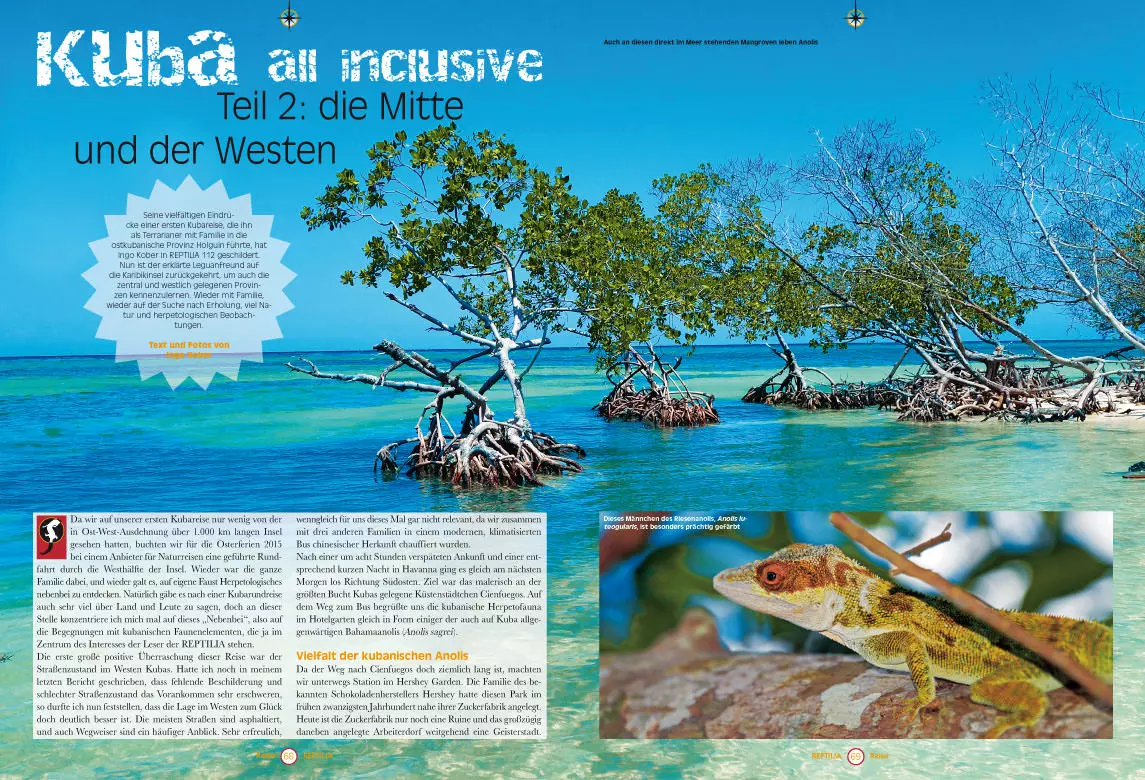
Cuba
Terrarium for emerald monitor lizards
Peacock-eyed terrapins

Contents:

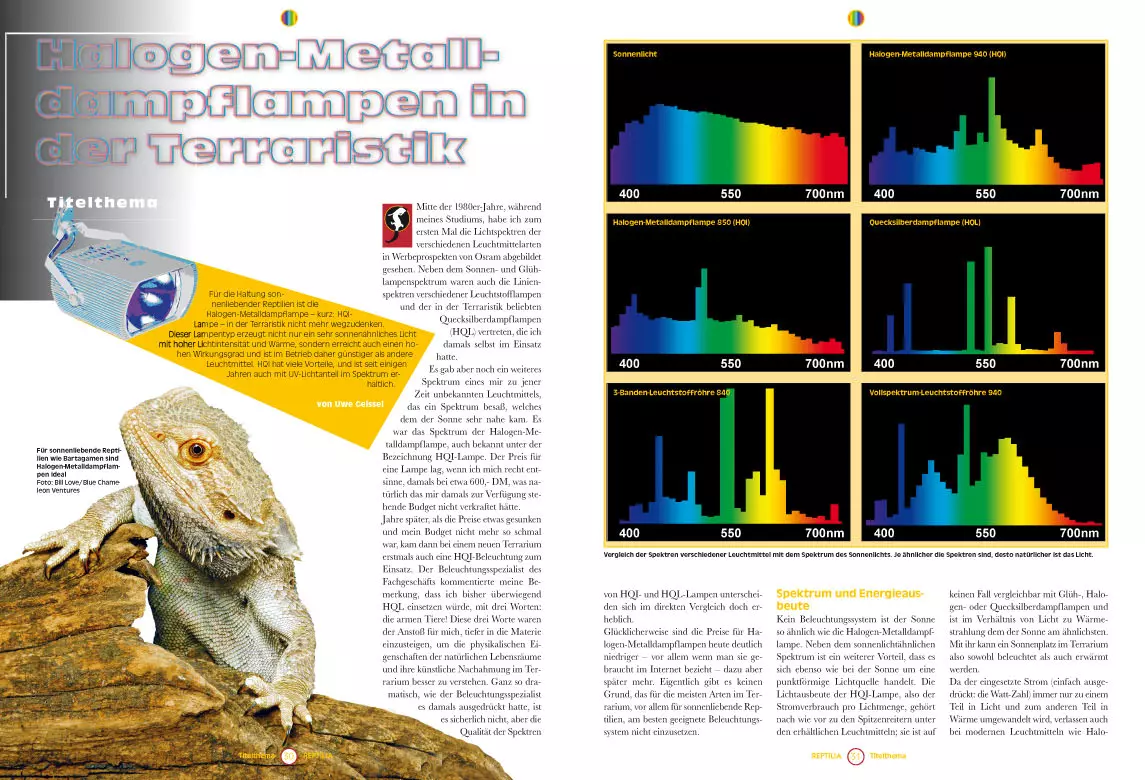
Cover story: More light! – Terrarium lighting for sun-loving reptiles

There are few topics that occupy terrarium keepers as much as the question of the right lighting, especially for sun-loving species. Which lamps give off the most light, how do I ensure that my animals get enough UV rays, what do I need to do to provide the ideal lighting? In our cover story, we take a closer look at this sometimes complex subject and analyse the suitability of HQI spotlights & co. as terrarium lamps.

Editorial
MAGAZINE
DATES

WESTERN HERP PERSPECTIVES
A political view of today's terrarium challenges
B. Love

REPORTAGE
The right terrarium lighting for chameleons and other reptiles
M. Grimm

Terrarium technology
Metal halide lamps in terrariums
U. Geissel

Keeping and breeding
Peacock-eyed terrapins. The genus Sacalia
M. Rogner

Reportage
A lifelong dream comes true. 40 years Reptile House Unteruhldingen
A. Kwet

Terraristics
A terrarium for the emerald monitor (Varanus prasinus)
S. & S. Leber

SERVICE

Animals of our homeland
The little water frog
R. Leptien

ALSO NEAR YOU

Journey
Cuba all inclusive. Part 2: the centre and the west
I. Kober

PREVIEW

BRUTKASTEN
A day with Reiner
J. Bulian

Composition
Feeding recommendation
Technical details
Size information

0 of 0 reviews

Give us a rating!

Share your experience with the product with other customers.


Suggested products

Handbook of food plants for tortoises and other reptiles
Handbook of forage plants 2nd revised editionMarion Minch is not only a successful breeder of diverse tortoises for many years, but also an excellent connoisseur of native wild herbs. She founded and runs samenkiste.de, which is well known to many tortoise keepers and nature lovers. Her name is inextricably linked with reptile care and species-appropriate nutrition for tortoises. Her handbook of food plants summarises the most important native food plants for herbivorous and omnivorous reptiles. She not only considers tortoises, but also iguanas, spiny-tailed dragons and even chameleons. From the basics of plant biology to native wild herbs to suitable food plants for hardy tropical reptile species, this comprehensive work provides the basis for species-appropriate keeping. In the expanded and supplemented 2nd edition, the plant section is divided according to flower colour. This makes it even easier to identify wild herbs. The work has also been supplemented with a wealth of additional information and many pictures.

CHF 46.50

Geckos
Geckos in the terrarium by Astrid FalkThe book offers a comprehensive introduction to geckos and their species-appropriate keeping in terrariums. It explains what you need to think about before buying a gecko and what preparations should be made. The book describes in detail how the terrarium is technically equipped and set up. The care of the animals, their special features and behaviour, their diet, reproduction and rearing of young animals are described, as well as diseases and husbandry problems with tried and tested suggestions for prevention and treatment. Individual gecko species that are particularly suitable for keeping and breeding in terrariums are portrayed in detail in the second part of the book.

CHF 28.50

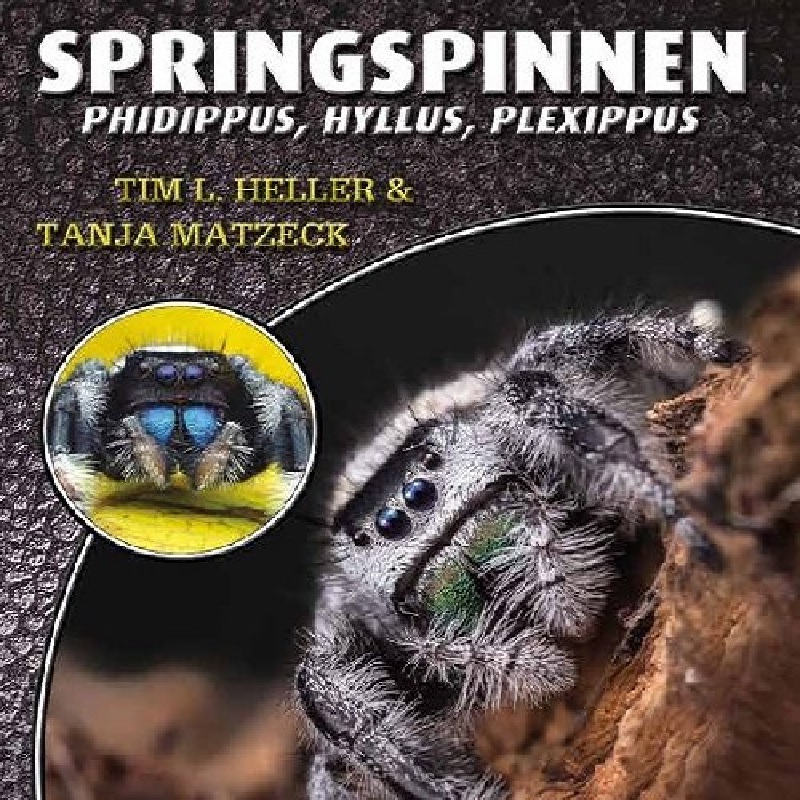
Jumping spiders Phidippus, Hyllus, Plexippus
Book Jumping Spiders - Phidippus, Hyllus & Plexippus A guide to keeping jumping spiders of the genera Phidippus, Hyllus & Plexippus. Who can resist the charm of jumping spiders? The childlike appearance of their expressive face simply leaves no one cold! In addition, their behavior is extremely exciting to observe, their colors are bright and their requirements for species-appropriate keeping are very easy to meet. No wonder these likeable jumpers are all the rage! This volume in the "Species by Species" series describes in detail what to look out for when buying and keeping them, introduces the most commonly kept species and color forms and provides plenty of tips on how to keep them successfully - so you can be sure they will breed well! Species by Species introduces you to the books in this series, which present the most popular terrarium animals. Each volume offers you detailed, practical care instructions and all the information you need to successfully breed your animals. All important questions from the required tank size to terrarium set-up, technical equipment, species-appropriate nutrition and disease prevention are answered with numerous tricks and tips. Experienced, long-standing breeders reveal how you can encourage the animals to reproduce and raise healthy young. All this in full color, generously illustrated and attractively designed - just about your terrarium animal - species by species

CHF 23.90

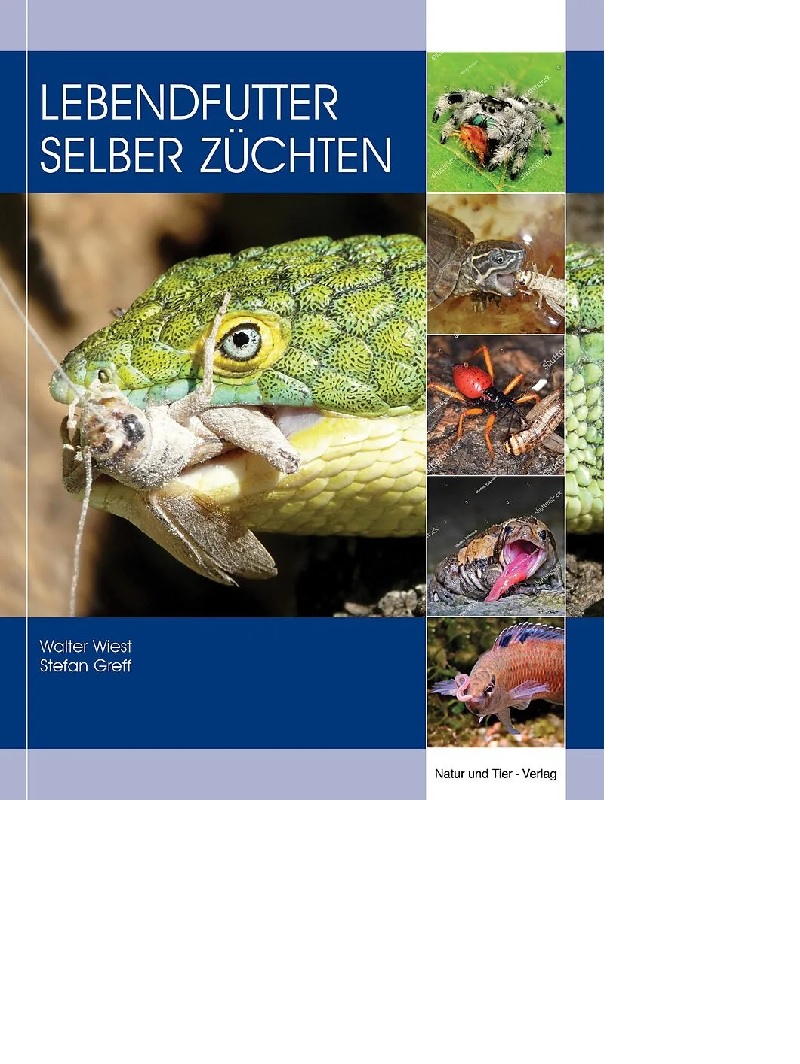
Book Breeding live food yourself
Book "Grow your own live food" - The perfect guide for pet owners Discover practical and detailed instructions on how you can easily breed food for your reptiles, birds, fish or other animals yourself in the book "Breeding live food yourself". With valuable tips on various food insects, their care and breeding, you can save money and ensure a species-appropriate diet for your pets. Contents of the book: Step-by-step instructions for breeding feeder insects Information on the best types of food for reptiles, birds and fish Care instructions and breeding conditions for various live food species Tips for sustainable and cost-effective food production Why breed your own live food? Get healthy, fresh food for your animals Save money and reduce dependence on pet shops Promote the health and well-being of your animals with species-appropriate food Whether you are a beginner or an experienced pet owner, this book provides you with everything you need to successfully breed live food yourself.

CHF 46.50

Marginata 69 - New Guinea tortoises
Marginata 69 - New Guinea tortoises – the genus ElseyaCover storyThe unrecognised beauties: New Guinea tortoises (Andreas S. Hennig)My experiences with Branderhorst's New Guinea tortoise, Elseya (Elseya) branderhorsti (Ouwens, 1914) (Andreas S. Hennig)Keeping and breeding of Rhodin's New Guinea tortoise, Elseya (Hanwarachelys) rhodini Thomson, Amepou, Anamiato & Georges, 2015 (Andreas S. Hennig)PortraitGeoemyda spengleri, Chinese serrated tortoise (Andreas S. Hennig)ReportageMacrochelys temminckii – Experiences and impressions with vulture tortoises part 2 (Reiner Praschag)KeepingAn alternative to year-round keeping of the Egyptian tortoise in the terrarium – my experiences with seasonal outdoor keeping of Testudo kleinmanni (Ricarda Schramm)EtymologySawbacks and living maps part 4: Graptemys gibbonsi, Pascagoula humpback tortoise (Holger Vetter)Classifieds & animal placement

CHF 16.50

Reptilia 21 - Terrarium equipment
Reptilia 21 - Terrarium equipment Sand ottersPhrynops Dahli - a rare tortoise from ColombiaSkolopender - Schnapps and scorpion snacks Contents: Page 2 - EditorialPage 3 - Letters to the editorPage 6 - MagazinePage 13 - DatesPage 16 - Western Herp Perspectives: Broadening horizons abroad, by B. LovePage 18 - Photo report: The biotope in the living room, by J. RauhPage 24 - Report: An uncomplicated indoor terrarium, by M. SchmidtPage 29 - Report: Artificial rocks in the terrarium, by H. Zwartepoorte and M. VriesPage 33 - Report: Substrates and back wall design, by J. RauhPage 40 - Journey: On a tail lizard excursion in northern Oregon. Part 2: From the coast to Eugene, by H. WallaysPage 47 - Portrait and poster: Chlamydosaurus kingii, by M. Aresé and J. L. FarriolsPage 51 - Report: The sand adder Vipera ammodytes, by P. Katke and B. TrappPage 58 - Keeping and breeding: Keeping and breeding of some Andean keel-tailed iguanas (Stenocercus) from the Peruvian highlands. Part 3, by U. SchlüterPage 63 - Herpetofauna Phrynops dahli - A little known turtle species from the Caribbean coast of Colombia, by J. L. de la Osa VelásquezPage 68 - Keeping and breeding: Rare in the terrarium: The desert dragon Trapelus mutabilis, by H. D. MüllerPage 73 - Report: A drink with a bite and the liver with a sting, by I. and B. FritzschePage 80 - REPTILIA on the road: Reptile Zoo Iguana in Visslingen/NL, by A. HauschildPage 83 - Advice and actionPage 89 - LibraryPage 96 - Glossary: The crisis of statutory health insurance for reptiles and amphibians, by M. Vanselow

CHF 9.80

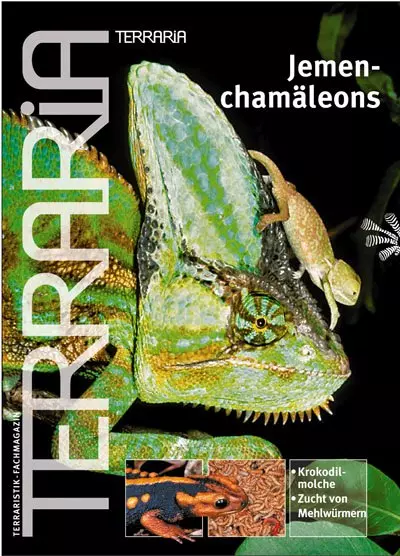
Terraria 08 - Yemen Chameleons
Terraria 08 - Yemen ChameleonsCrocodile newtsBreeding of mealwormsContents:2 EditorialHeiko WERNING TOPIC4 Chamaeleo calyptratus – a creature unknown!Nicolá LUTZMANN12 10 years of keeping and breeding Yemen chameleonsDavid HELLENDRUNG20 Hidden invadersBill LOVE24 Construction of a free room enclosure for keeping Yemen and panther chameleonsAndreas DICKHOFF & Tanja DICKHOFFSCIENCE35 Herpetorama External parasites in the king python / The closest relatives of snakes37 New species Naja ashei / Micrurus silviae & M. altirostris / Atractus40-43 Among researchers Of iguana islands and rainforests: Biodiversity research in HondurasAlexander GUTSCHE44 Keeping, Care and Breeding of the Mealworm Beetle (Tenebrio molitor) Peter Maria MÜLLER48 The Yellow Crocodile Newt, Tylototriton shanjing: Taxonomy, Care and BreedingWolf-Rüdiger GROSSE54 North American soft-shelled turtles of the genus ApalonePart 2: The Apalone speciesAndreas S. HENNIG62 Centruroides limbatus Daniel GAISER66 Experiences with keeping and breeding the forest tortoise Part 2 Read NIESSEN TRAVEL70 In the mountain rainforests of Mount Kinabalu/BorneoPart 3Rudolf MALKMUS TERRARIUM PRACTICE83 Test run Measurement and control technology from Lucky Reptile84 Prelude A good start: the Transpecos rat snake (Bogertophis subocularis)Michaela SCHULZ & Marco SCHULZ88 Eye-catcherThe snake cupboard - a visit to garter snake breeder Jörn FischbeckMike ZAWADZKI92 Also in your neighbourhood 95 TERRAnetGarter snake pages96 TERRAglobal With pleated skirt and high heels into the rainforestJoachim BULIANPerils of a herpetologist, part IIManuel ACEVEDO104 TERRAwinn

CHF 11.20

Bede your hobby chameleons
Bede - Your Hobby Chameleons Rolf Müller and Ulrike Walbröl have been successfully breeding chameleons for years. As members of the DGHT’s Chameleon Working Group and contact persons for the Chameleon Hotline, they are thoroughly familiar with the problems faced by beginners in chameleon keeping. Here, they have brought together their knowledge and experience for the first time and, in collaboration with Dominik Kieselbach, have created a book for beginners unlike any other previously available on the German market.

CHF 23.50

Draco Nr. 45 - Costa Rica (German edition)
Draco 45 - Costa Rica Editorial Costa Rica - a herpetological paradise!Michael Wirth --> Literature Worthwhile destinations for amphibian and reptile lovers in Costa RicaMichael Wirth In search of frogs in Costa RicaTobias Eisenberg Of crocodiles and caimans - the armoured lizards of Costa RicaMichael Wirth --> Literature Redfrog Team - Conservation of reptiles and amphibians in the Talamanca region, Costa RicaJens Ackermann & Thorsten Tittel Looking for snakes around Puerto Viejo - a great day in Costa RicaMichael Wirth

CHF 18.40

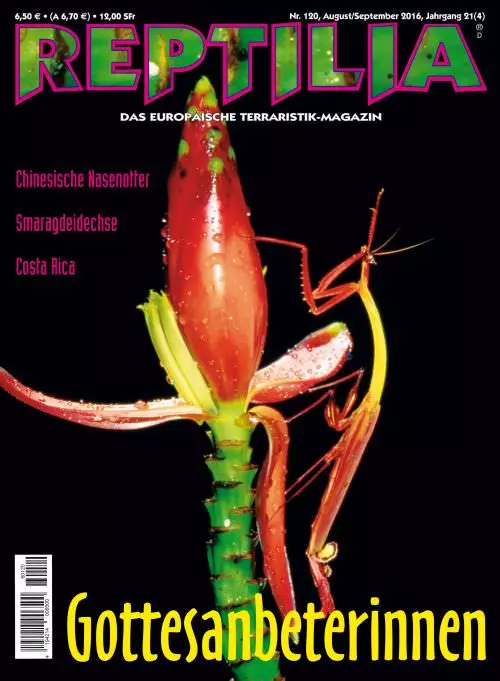
Reptilia 120 - Praying Mantises
Reptilia 120 - Praying Mantises Chinese viperEmerald lizardCosta Rica Contents: Cover story: Praying MantisesNobody can escape the fascination of praying mantises. These predatory insects with their alien appearance and martial mating habits have long secured a permanent place in terrariums. We offer an overview of mantids in breeding, the classics, and the latest trends. We also feature an unusual species from the Philippines and look to eastern Germany, where Mantis religiosa has spread. EditorialMAGAZINEDATES Photo storyThe fascination of praying mantisesK. Kunz Keeping and breedingPraying mantises. The basics of keeping in terrariumsC. J. Schwarz REPORTAGEPraying mantises on the advance in eastern GermanyN. von Lettow-Vorbeck BiologyPraying mantis, change your tune. On the challenge of identifying praying mantises using the Philippine species Creobroter meleagris as an exampleC. J. Schwarz ReportageThe Chinese viper (Deinagkistrodon acutus): a herpetological and cultural phenomenonDr. T. Eimermacher Keeping and breedingThe banded fire salamander (Salamandra salamandra terrestris).  Distribution, habits and breedingM. Rogner RreportageA display terrarium for fire salamandersR. Hoppe Animals of our homelandThe emerald lizardR. Leptien SERVICE WESTERN HERP PERSPECTIVESBut it’s a dry heatB. Love ALSO NEAR YOU TravelCosta Rica – Paradisiacal biodiversity between the Atlantic and the PacificN. Weinbeer PREVIEW INCUBATOR The breakH. Werning

CHF 12.00

Reptilia 93 - Terraristics in the crossfire
Reptilia 93 - Terraristics in the crossfire Dreistreifen-BlattsteigerTürkis-ZwerggeckoRotschwanzboa Inhalt: EDITORIALLESERBRIEFENACHSCHLAGMAGAZINTERMINEIN 5 JAHREN UM DIE WELT Meine zweite herpetologische Exkursion: Lateinamerika A. PachmannWESTERN HERP PERSPECTIVES Total cool: Winterherping B. LoveFOTOSTORY Terraristik im Kreuzfeuer. Ein Hobby in der Kritik K. KunzInterview „Denen ist jedes Mittel recht!“ K. KunzREPORTAGE„Wir sind im Ausnahmezustand!“. Der Kölner Schmuggelfall K. KunzHerpetofauna Der Türkis-Zwerggecko. Ein Juwel vor dem Aus? H. SchneiderHALTUNG UND NACHZUCHTBoa constrictor constrictor. Haltung und Nachzucht der RotschwanzboaM. BorerHerpetofaunaAuf dem Weg ins All. Die Welt der Buchstaben-Schmuckschildkröte, Trachemys scripta Teil 3: Die Gelbwangen-Schmuckschildkröte, Trachemys scripta scripta A. S. HennigHaltung und Vermehrung Der Dreistreifen-Blattsteiger, Epipedobates anthonyi. Der trillernde Guppy unter den Pfeilgiftfröschen U. DostTiere unserer Heimat Der Moorfrosch R. LeptienBibliothekABO & SERVICETipps & TricksTestlaufAUCH IN IHRER NÄHEReiseSüdamerikas „Big One“ – Auf Anakondasuche in der unberührten Wildnis von GuyanaL. DirksenVORSCHAUBRUTKASTENDas Chamäleon-GebetB. Trapp  

CHF 12.00

Bugs No. 01 - Goliath beetle colorful giants
Bugs No. 01 - Goliath beetles colourful giants Preparation of invertebratesMesobuthus gibbosusPoecilotheria metallicaTable of contents EditorialTeam introductionFacetsFlown inDates Cover storyGoliath beetles – not just giants!Frank Rossow Top class! Keeping and breeding Goliathus goliatusFrank Rossow & Jens Rudnik Colour galore! Mecynorhina, brightly coloured rose beetles with big nosesFrank Rossow & Jens Rudnik FledgedOn the hunt for invertebrates in the LevantIngo Fritzsche In the crosshairsAtlas moth Attacus atlasDaniel Dittmar PracticeA gem in the terrarium Poecilotheria metallicaPatrick Meyer PracticeColourful splendour and predator hunger, breeding the "tiger cricket"Uwe Dost ReportageFungi as deadly enemies of arthropods – but worth their weight in goldIngo Fritzsche Reportage On the trail of the field scorpion. Mesobuthus gibbosus in nature and in the terrarium. Part 1: Exciting behaviourBenny Trapp Reportage“Cracking difficult species!” A visit to Jutta RendaKriton Kunz Potter bee Weathering of food plantsBruno Kneubühler Kids Corner Feeder animals under the microscopeIngo Fritzsche Showcase Specimens homemade – an introductionPatrick Urban Book scorpionService & ImprintPreview MetamorphosesStart into lifeKriton Kunz

CHF 12.00

Customers also saw

Medaka - Breeding basket
Medaka breeding basket - Safe protection for eggs & fryThe medaka breeding basket is the ideal solution for reliably protecting delicate eggs and newly hatched medaka. It has been specially developed for the needs of medaka breeding and can be easily inserted directly into the tank. Thanks to its fine structure, the breeding basket provides a protected area that prevents adult fish from endangering the offspring.At the same time, it ensures optimum water circulation so that eggs and fry are always supplied with fresh, clean water. Perfect for hobby breeders as well as experienced aquarists who want to offer their medaka the best possible starting conditions.Advantages at a glanceSafe protection for eggs and newborn medakaEasy to place in the medaka tankSpecially designed for medaka breedingFine structure for optimal water circulationPrevents eggs or fry from being eaten by adult animalsIdeal for stress-free, successful breedingProvide a safe environment for your medaka offspring - with the specially developed medaka breeding basket.

CHF 6.60