Draco 61 - Eggsnakes

Article no: draco61

CHF 32.00

Stock: 0

Ready for dispatch in 1-3 days, delivery time 7 working days

Delivery between Tuesday, 28 April and Wednesday, 29 April
Zahlungsarten
Product information "Draco 61 - Eggsnakes"

Draco 61 - Egg snakes

Contents:

Editorial

The pacifists among snakes – African egg-eating snakes of the genus Dasypeltis
Helmut Göthel

Pre-packaged food - bird eggs as a food source
Helmut Göthel

The feeding behaviour of African egg snakes
Helmut Göthel

Evolutionary biological considerations
Helmut Göthel

Mimicry and defensive behaviour in egg snakes
Helmut Göthel

African egg snakes in the terrarium
Helmut Göthel

Breeding of African egg snakes
Helmut Göthel

Diseases and parasites in egg snakes
Helmut Göthel

The egg snake species of Africa
Helmut Göthel

The Indian egg snake, Elachistodon westermanni
Helmut Göthel

Composition
Feeding recommendation
Technical details
Size information

0 of 0 reviews

Give us a rating!

Share your experience with the product with other customers.


Suggested products

Handbook of food plants for tortoises and other reptiles
Handbook of forage plants 2nd revised editionMarion Minch is not only a successful breeder of diverse tortoises for many years, but also an excellent connoisseur of native wild herbs. She founded and runs samenkiste.de, which is well known to many tortoise keepers and nature lovers. Her name is inextricably linked with reptile care and species-appropriate nutrition for tortoises. Her handbook of food plants summarises the most important native food plants for herbivorous and omnivorous reptiles. She not only considers tortoises, but also iguanas, spiny-tailed dragons and even chameleons. From the basics of plant biology to native wild herbs to suitable food plants for hardy tropical reptile species, this comprehensive work provides the basis for species-appropriate keeping. In the expanded and supplemented 2nd edition, the plant section is divided according to flower colour. This makes it even easier to identify wild herbs. The work has also been supplemented with a wealth of additional information and many pictures.

CHF 46.50

Geckos
Geckos in the terrarium by Astrid FalkThe book offers a comprehensive introduction to geckos and their species-appropriate keeping in terrariums. It explains what you need to think about before buying a gecko and what preparations should be made. The book describes in detail how the terrarium is technically equipped and set up. The care of the animals, their special features and behaviour, their diet, reproduction and rearing of young animals are described, as well as diseases and husbandry problems with tried and tested suggestions for prevention and treatment. Individual gecko species that are particularly suitable for keeping and breeding in terrariums are portrayed in detail in the second part of the book.

CHF 28.50

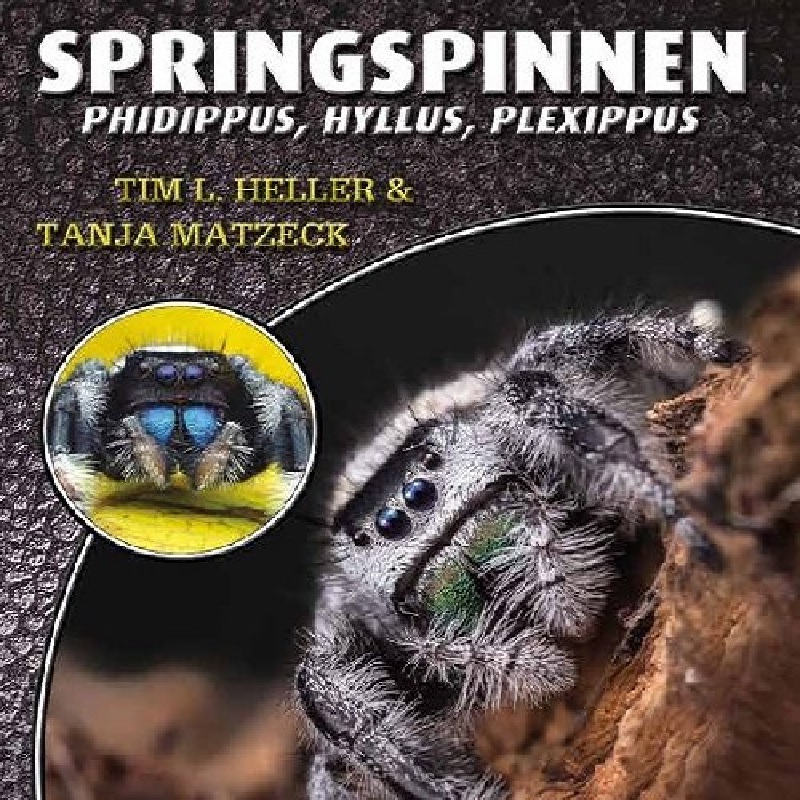
Jumping spiders Phidippus, Hyllus, Plexippus
Book Jumping Spiders - Phidippus, Hyllus & Plexippus A guide to keeping jumping spiders of the genera Phidippus, Hyllus & Plexippus. Who can resist the charm of jumping spiders? The childlike appearance of their expressive face simply leaves no one cold! In addition, their behavior is extremely exciting to observe, their colors are bright and their requirements for species-appropriate keeping are very easy to meet. No wonder these likeable jumpers are all the rage! This volume in the "Species by Species" series describes in detail what to look out for when buying and keeping them, introduces the most commonly kept species and color forms and provides plenty of tips on how to keep them successfully - so you can be sure they will breed well! Species by Species introduces you to the books in this series, which present the most popular terrarium animals. Each volume offers you detailed, practical care instructions and all the information you need to successfully breed your animals. All important questions from the required tank size to terrarium set-up, technical equipment, species-appropriate nutrition and disease prevention are answered with numerous tricks and tips. Experienced, long-standing breeders reveal how you can encourage the animals to reproduce and raise healthy young. All this in full color, generously illustrated and attractively designed - just about your terrarium animal - species by species

CHF 23.90

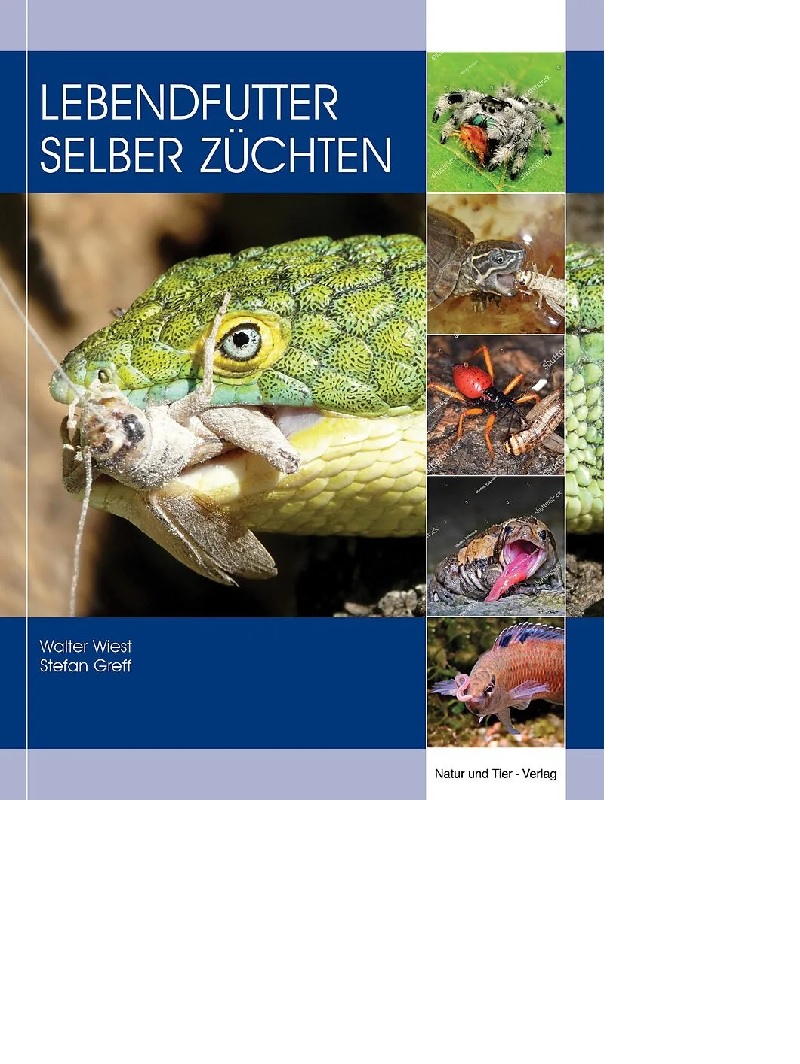
Book Breeding live food yourself
Book "Grow your own live food" - The perfect guide for pet owners Discover practical and detailed instructions on how you can easily breed food for your reptiles, birds, fish or other animals yourself in the book "Breeding live food yourself". With valuable tips on various food insects, their care and breeding, you can save money and ensure a species-appropriate diet for your pets. Contents of the book: Step-by-step instructions for breeding feeder insects Information on the best types of food for reptiles, birds and fish Care instructions and breeding conditions for various live food species Tips for sustainable and cost-effective food production Why breed your own live food? Get healthy, fresh food for your animals Save money and reduce dependence on pet shops Promote the health and well-being of your animals with species-appropriate food Whether you are a beginner or an experienced pet owner, this book provides you with everything you need to successfully breed live food yourself.

CHF 46.50

Marginata 69 - New Guinea tortoises
Marginata 69 - New Guinea tortoises – the genus ElseyaCover storyThe unrecognised beauties: New Guinea tortoises (Andreas S. Hennig)My experiences with Branderhorst's New Guinea tortoise, Elseya (Elseya) branderhorsti (Ouwens, 1914) (Andreas S. Hennig)Keeping and breeding of Rhodin's New Guinea tortoise, Elseya (Hanwarachelys) rhodini Thomson, Amepou, Anamiato & Georges, 2015 (Andreas S. Hennig)PortraitGeoemyda spengleri, Chinese serrated tortoise (Andreas S. Hennig)ReportageMacrochelys temminckii – Experiences and impressions with vulture tortoises part 2 (Reiner Praschag)KeepingAn alternative to year-round keeping of the Egyptian tortoise in the terrarium – my experiences with seasonal outdoor keeping of Testudo kleinmanni (Ricarda Schramm)EtymologySawbacks and living maps part 4: Graptemys gibbonsi, Pascagoula humpback tortoise (Holger Vetter)Classifieds & animal placement

CHF 16.50

The bearded dragon
All about bearded dragons by Peter Maria Müller 168 pages 155 colour photos, maps, tables, drawings Hardcover Format: 17.5 x 23.2 Author Peter Maria Müller Publisher NTV Contents: Hardly any other reptile is as popular with terrarium keepers as the bearded dragon Pogona vitticeps. It owes its success in the terrarium hobby not least to its interesting appearance, exciting behaviour and its calm and very trusting nature. Its husbandry requirements are easy to fulfil, and so it is bred by the thousands every year, making it easy to obtain and also ideal as a terrarium animal for beginners.Their close relatives such as the black-earth bearded dragon (Pogona henrylawsoni) or – although much rarer – Mitchell's bearded dragon (Pogona mitchelli) are also becoming increasingly popular.Peter Maria Müller, himself an experienced breeder of bearded dragons, gives you a detailed introduction to all representatives of the genus and their habitats. An identification key helps, you to differentiate between the individual species. In addition, all important aspects of keeping bearded dragons are explained in a comprehensive and easy-to-understand manner, such as decision-making aids before buying, handling the animals, sex determination, species-appropriate care and nutrition, possible diseases and, finally, successful breeding. Over 150 brilliant colour photos bring you closer to the world of bearded dragons and show the fascination of these popular lizards.

CHF 21.90

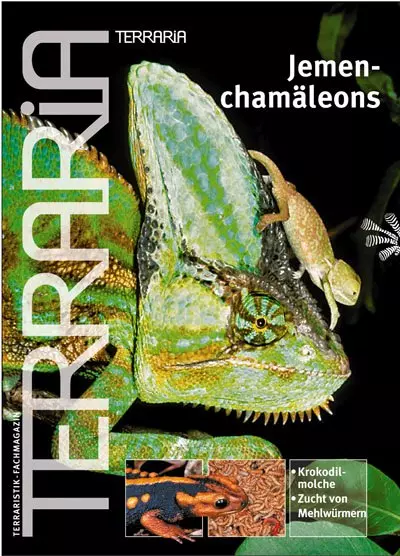
Terraria 08 - Yemen Chameleons
Terraria 08 - Yemen ChameleonsCrocodile newtsBreeding of mealwormsContents:2 EditorialHeiko WERNING TOPIC4 Chamaeleo calyptratus – a creature unknown!Nicolá LUTZMANN12 10 years of keeping and breeding Yemen chameleonsDavid HELLENDRUNG20 Hidden invadersBill LOVE24 Construction of a free room enclosure for keeping Yemen and panther chameleonsAndreas DICKHOFF & Tanja DICKHOFFSCIENCE35 Herpetorama External parasites in the king python / The closest relatives of snakes37 New species Naja ashei / Micrurus silviae & M. altirostris / Atractus40-43 Among researchers Of iguana islands and rainforests: Biodiversity research in HondurasAlexander GUTSCHE44 Keeping, Care and Breeding of the Mealworm Beetle (Tenebrio molitor) Peter Maria MÜLLER48 The Yellow Crocodile Newt, Tylototriton shanjing: Taxonomy, Care and BreedingWolf-Rüdiger GROSSE54 North American soft-shelled turtles of the genus ApalonePart 2: The Apalone speciesAndreas S. HENNIG62 Centruroides limbatus Daniel GAISER66 Experiences with keeping and breeding the forest tortoise Part 2 Read NIESSEN TRAVEL70 In the mountain rainforests of Mount Kinabalu/BorneoPart 3Rudolf MALKMUS TERRARIUM PRACTICE83 Test run Measurement and control technology from Lucky Reptile84 Prelude A good start: the Transpecos rat snake (Bogertophis subocularis)Michaela SCHULZ & Marco SCHULZ88 Eye-catcherThe snake cupboard - a visit to garter snake breeder Jörn FischbeckMike ZAWADZKI92 Also in your neighbourhood 95 TERRAnetGarter snake pages96 TERRAglobal With pleated skirt and high heels into the rainforestJoachim BULIANPerils of a herpetologist, part IIManuel ACEVEDO104 TERRAwinn

CHF 11.20

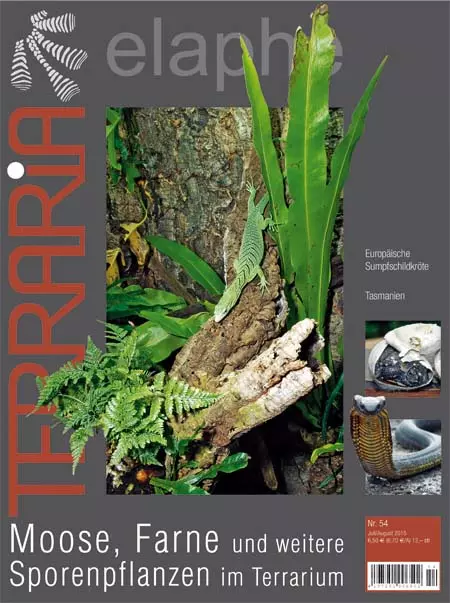
Terraria 54 - Mosses, ferns and further spore plants in the terrarium
Terraria 54 - Mosses, ferns and other spore plants in the terrariumEuropean pond turtleTasmaniaContents:Cover story: Mosses, ferns and other spore plants in the terrariumIn 1892, the English physician Dr N.B. Ward realised that ferns could be cultivated in closed glass containers. This gave rise to Victorian plant display cases planted with ferns and mosses - the forerunners of today's terrariums. However, mosses, ferns and other spore plants are more than just decorative accessories in humid terrariums. Their reproduction by means of alternation of generations, which can also be observed in the terrarium, is particularly interesting. In addition to many interesting aspects of spore plants, the next issue will also contain numerous tips and tricks on how these plants can thrive in the terrarium and how they can best be kept together with reptiles and amphibians.ContentsTerritorialHerpetoramaNew study by the Federal Agency for Nature Conservation: What really jeopardises biodiversity in Germany LookupThorn Devil: The Variable Rain FrogCultural successors: tortoises in ViennaWhat did the first snakes look like?Leafhoppers: In the NewsCover storyWitnesses of the dinosaur era - about terrarium plants with generational changeBeat AkeretMosses - unrecognised dwarfs among terrarium plantsBeat AkeretEpiphytic ferns in the terrariumBeat AkeretNeither moss nor fern. Lycopodiopsida as terrarium plantsBeat AkeretPanoramaTiger otters: an invitation to get to know the reptiles of Tasmania Guillaume GomardResearchNew speciesIn wild Kurdistan - a spectacular large monitor lizard from the Zagros MountainsAxel KwetAmong researchersThe miracle black toad, one of the rarest amphibian species in the worldLuis Fernando Marin da FonteSalamandraTerraristicsMany years of experience in keeping and breeding the European pond turtle. Part 2: Egg laying, incubation, rearing the young, hibernation, husbandry problemsBernd WolffFirst herpetological assistance from Cologne at Saigon ZooThomas Ziegler & Anna RauhausNature and species conservationField notesLate finds of yellow-bellied toad and natterjack toad larvaeJürgen GebhartMysterious deaths of frogs and newtsAxel KwetAlso in your neighbourhoodSubscription & ServicePreviewIncubator The danger seekersHeiko Werning 

CHF 12.00

Reptilia 120 - Praying Mantises
Reptilia 120 - Praying Mantises Chinese viperEmerald lizardCosta Rica Contents: Cover story: Praying MantisesNobody can escape the fascination of praying mantises. These predatory insects with their alien appearance and martial mating habits have long secured a permanent place in terrariums. We offer an overview of mantids in breeding, the classics, and the latest trends. We also feature an unusual species from the Philippines and look to eastern Germany, where Mantis religiosa has spread. EditorialMAGAZINEDATES Photo storyThe fascination of praying mantisesK. Kunz Keeping and breedingPraying mantises. The basics of keeping in terrariumsC. J. Schwarz REPORTAGEPraying mantises on the advance in eastern GermanyN. von Lettow-Vorbeck BiologyPraying mantis, change your tune. On the challenge of identifying praying mantises using the Philippine species Creobroter meleagris as an exampleC. J. Schwarz ReportageThe Chinese viper (Deinagkistrodon acutus): a herpetological and cultural phenomenonDr. T. Eimermacher Keeping and breedingThe banded fire salamander (Salamandra salamandra terrestris).  Distribution, habits and breedingM. Rogner RreportageA display terrarium for fire salamandersR. Hoppe Animals of our homelandThe emerald lizardR. Leptien SERVICE WESTERN HERP PERSPECTIVESBut it’s a dry heatB. Love ALSO NEAR YOU TravelCosta Rica – Paradisiacal biodiversity between the Atlantic and the PacificN. Weinbeer PREVIEW INCUBATOR The breakH. Werning

CHF 12.00

Reptilia 22 - Still hope for Asian turtles?
Reptilia 22 - Still hope for Asian turtles?Incubation of phelsum eggsHomeopathyCosta RicaContents:Page 2 - EditorialPage 4 - MagazinePage 13 - DatesPage 16 - Western Herp Perspectives: A rattlesnake under every bush, by B. LovePage 18 - Photo report: The incredible diversity of Asian turtles, by E. MeierPage 26 - Report: The turtles of Asia: Sacred animals, food and medical wonder weapon, by E. MeierPage 30 - Report: The end of Asian turtles? The live animal markets of Southeast Asia, by E. MeierPage 34 - Report: An ark for the last of their kind: The planned conservation breeding centre at the Allwetterzoo Münster, by E. MeierPage 40 - Travelling: Herpetological travel impressions from Costa Rica, Part 1: Rara Avis rainforest lodge, by T. EisenbergPage 47 - Portrait and poster: Parasphendale affinis, by I. & R. BischoffPage 51 - Report: Elaphe mandarina: A problem animal in terraristics? by Dr R. Fesser & H. SommerauerPage 57 - Keeping and breeding: Notes on egg laying in day geckos of the genus Phelsuma, by J. KrügerPage 63 - Herpetofauna: The poison dart frog Epipedobates tricolor, by J. & J. Canela Agraz & J. Vazquez SuñéPage 67 - Herpetology and culture: The arachno- and herpetofauna in homeopathic medicine, by K. KunzPage 78 - REPTILIA on the move: The Exotarium in Frankfurt am Main Zoological Garden, by T. WilmsPage 81 - Help and advicePage 87 - LibraryPage 96 - Glossary: Moving with lizards, once again. Part 1: Good preparation is half the move, by H. Werning

CHF 9.80

Marginata No. 31 - Moorish pond turtles in Morocco
Marginata No. 31 - Moorish pond turtles in Morocco Zucht der Madagassischen Strahlenschildkröte, Teil 3Zucht von Kinosternon cruentatumSchildkröten im Unterricht Inhalt: EditorialMagazinTermineREPORTAGEDie Maurische Bachschildkröte, Mauremys leprosa (Schweiger, 1812) in MarokkoMario SchweigerHALTUNG UND NACHZUCHTWiederholte Nachzucht der Madagassischen Strahlenschildkröte (Astrochelys radiata) im Zoo RotterdamHenk ZwartepoortePOSTER Die Namibische Bushmanland-Zeltschildkröte, Psammobates tentorius verroxi Hans - Dieter PhilippenHALTUNG UND ZUCHTHaltung und Nachzucht der Madagassischen Strahlenschildkröte Teil 3Michael Wirth und Peter FritzHALTUNG UND ZUCHT Pflege und Vermehrung der Rotwangen-Klappschildkröte, Kinosternon scorpioides cruentatumSebastian NicklREPORTAGEZeitgemäßer Umgang mit „Problemschildkröten“ – Verwahrung, Euthanasie oder gar Nutzung zur Arterhaltung?Tobias Friz, Markus Baur & Rudolf W. HoffmannREPORTAGEBilder einer Ausstellung – Schildkröten einmal anders. Ungewöhnliche Ausstellung im HochharzHans - Dieter PhilippenBuchtippKleinanzeigenAbo & ServiceRegionalführer  

CHF 16.50

The green water dragon
All about the green water dragon by Heiko Werning 64 pages Format: 14.8 x 21 cm 43 colour photos Paperback Author Heiko Werning Contents: The green water dragon is without question a "classic" of terraristics. For decades it has been a permanent fixture both in the pet trade and in the terrariums of enthusiasts.REPTILIA editor Heiko Werning explains in this volume of the "Species by Species" series what is involved in the species-appropriate keeping and care of the green water dragon and, of course, also reveals how you can successfully breed your favourites and raise the adorable young animals. Systematics and body structure The fascinating biology: From the life of the green water dragon All information on species-appropriate keeping: from suitable terrariums to equipment and technology to feeding Successful breeding: Mating stimulation, incubation of the eggs and rearing the young Solutions to problems: How to avoid the most common mistakes in care and how to help sick animals Brilliant photos

CHF 18.50