Terraria 62 - Unusual food animals

Article no: terraria62

CHF 12.00

Stock: 0

Ready for dispatch in 1-3 days, delivery time 7 working days

Delivery between Tuesday, 20 October and Wednesday, 21 October
Zahlungsarten
Product information "Terraria 62 - Unusual food animals"

Terraria 62 - Unusual Food Animals

Campbell’s Tree Lizard
Succulents

Contents:

Cover Story: Unusual Food Animals

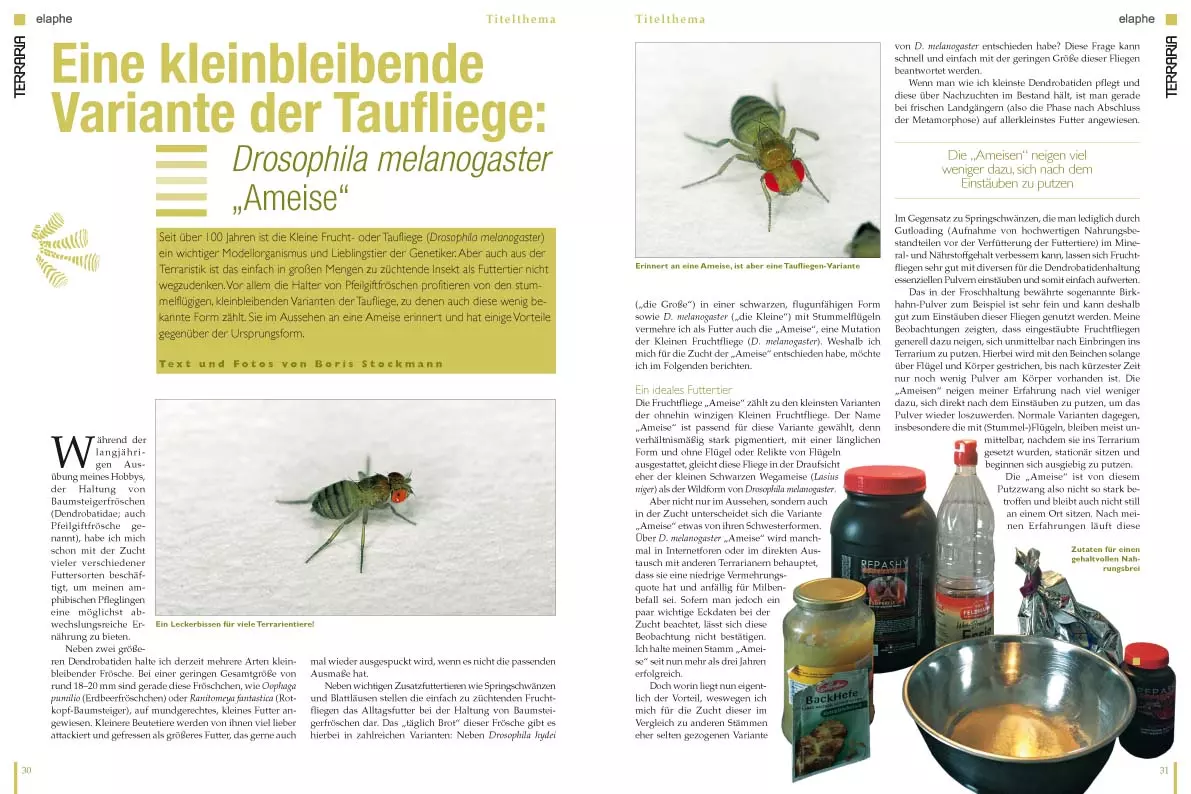
A healthy diet plays a decisive role in the successful care and breeding of our terrarium animals. The famous mealworm as a standard food is far from sufficient. Fortunately, specialist retailers now offer a wide range of suitable food insects such as house crickets, crickets, flies or cockroaches, which are available all year in any quantity. However, many pets also like to eat food animals outside the mainstream and some specialists are even dependent on a special diet for their well-being. In this issue of TERRARIA/elaphe, we take a closer look at some of these little-known, rather unusual food animals such as field slugs, woodlice, moth flies or a small-growing fruit fly variant.

3          Territorial
8          Herpetorama
            Results of the 17th CITES Conference in Johannesburg – new regulations for some reptiles and amphibians
            Synanthrope: Creeping Schnapps
            Leaf Climber: Wasted “Time”
            Thorny Devil: A Rural Keel-Tailed Iguana
 
Cover Story
14        Food Animals
            A perennial topic in terraristics
            Krition Kunz
20        Slippery Snacks
            Breeding and use of the Mediterranean field slug as live food
            Frank Täufer
25        Woodlice as Food Animals
            Dominik Hoffses
30        A Small-Growing Variant of the Fruit Fly: Drosophila melanogaster “Ant”
            Boris Stockmann
34        A Frog Farm for Feeding Reptiles and Amphibians: the Painted Disk-Tongued Frog (Discoglossus pictus)
            Frank Pasmans, Sergé Bongaerts & An Martel
39        Moth Flies
            A new food animal for small nocturnal hunters
            Ingo Fritzsche
 
Panorama
42        Snake searching in the Ecuadorian Chocó rainforest
            Daniel Jestrzemski
 
Research
50        New Species
            A new slender boa from the Bahamas: the Conception Silver Boa (Chilabothrus argentum)
            Axel Kwet
            A new Borneo bush frog from Mt. Kinabalu
            Axel Kwet
52        Among Researchers
            The Comoros, a forgotten hotspot of diversity
            Oliver Hawlitschek
56        Salamandra
 
Terraristics
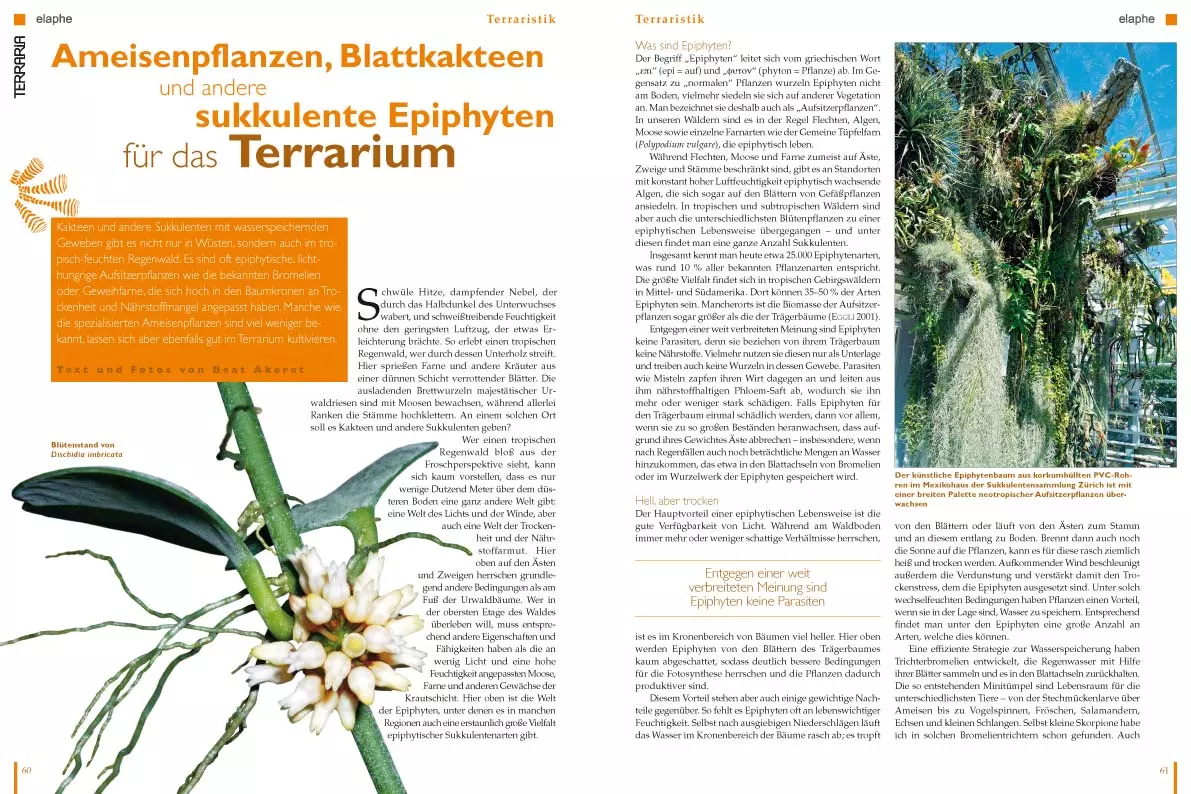
60        Ant plants, leaf cacti and other succulent epiphytes for the terrarium
            Beat Akeret
 
Nature and Species Conservation
70        Field Notes
            Grass snake eating
            Günther Vater
            The feeding behaviour of the wall lizard Part 2
            Malte Hornig
72        Project to protect the critically endangered tree lizard Abronia campbelli in eastern Guatemala
            Brad Lock & Mónica Torres
84        Terrarino – the children’s page 
            The fire salamander – not a lucky animal
            Alexa Sabarth
 
81        Subscription & Service
86        Also in your area
88        Preview
90        Incubator 
            No mercy for Mouse Z
            Part 2
            Heiko Werning

Composition
Feeding recommendation
Technical details
Size information

0 of 0 reviews

Give us a rating!

Share your experience with the product with other customers.


Suggested products

Handbook of food plants for tortoises and other reptiles
Handbook of forage plants 2nd revised editionMarion Minch is not only a successful breeder of diverse tortoises for many years, but also an excellent connoisseur of native wild herbs. She founded and runs samenkiste.de, which is well known to many tortoise keepers and nature lovers. Her name is inextricably linked with reptile care and species-appropriate nutrition for tortoises. Her handbook of food plants summarises the most important native food plants for herbivorous and omnivorous reptiles. She not only considers tortoises, but also iguanas, spiny-tailed dragons and even chameleons. From the basics of plant biology to native wild herbs to suitable food plants for hardy tropical reptile species, this comprehensive work provides the basis for species-appropriate keeping. In the expanded and supplemented 2nd edition, the plant section is divided according to flower colour. This makes it even easier to identify wild herbs. The work has also been supplemented with a wealth of additional information and many pictures.

CHF 46.50

Geckos
Geckos in the terrarium by Astrid FalkThe book offers a comprehensive introduction to geckos and their species-appropriate keeping in terrariums. It explains what you need to think about before buying a gecko and what preparations should be made. The book describes in detail how the terrarium is technically equipped and set up. The care of the animals, their special features and behaviour, their diet, reproduction and rearing of young animals are described, as well as diseases and husbandry problems with tried and tested suggestions for prevention and treatment. Individual gecko species that are particularly suitable for keeping and breeding in terrariums are portrayed in detail in the second part of the book.

CHF 28.50

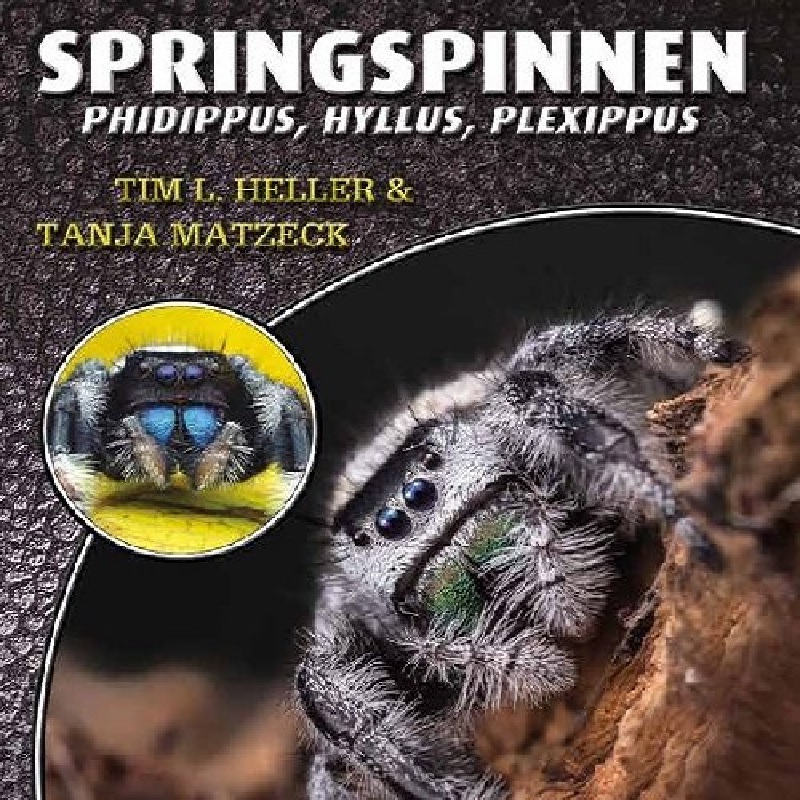
Jumping spiders Phidippus, Hyllus, Plexippus
Book Jumping Spiders - Phidippus, Hyllus & Plexippus A guide to keeping jumping spiders of the genera Phidippus, Hyllus & Plexippus. Who can resist the charm of jumping spiders? The childlike appearance of their expressive face simply leaves no one cold! In addition, their behavior is extremely exciting to observe, their colors are bright and their requirements for species-appropriate keeping are very easy to meet. No wonder these likeable jumpers are all the rage! This volume in the "Species by Species" series describes in detail what to look out for when buying and keeping them, introduces the most commonly kept species and color forms and provides plenty of tips on how to keep them successfully - so you can be sure they will breed well! Species by Species introduces you to the books in this series, which present the most popular terrarium animals. Each volume offers you detailed, practical care instructions and all the information you need to successfully breed your animals. All important questions from the required tank size to terrarium set-up, technical equipment, species-appropriate nutrition and disease prevention are answered with numerous tricks and tips. Experienced, long-standing breeders reveal how you can encourage the animals to reproduce and raise healthy young. All this in full color, generously illustrated and attractively designed - just about your terrarium animal - species by species

CHF 23.90

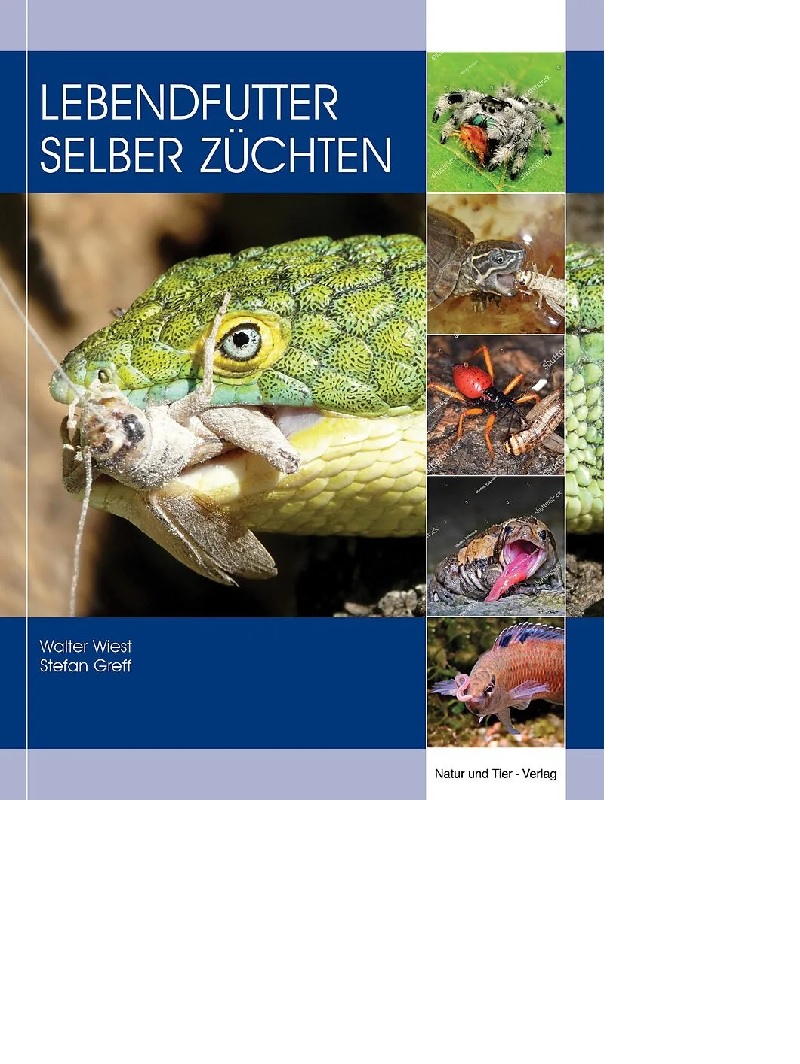
Book Breeding live food yourself
Book "Grow your own live food" - The perfect guide for pet owners Discover practical and detailed instructions on how you can easily breed food for your reptiles, birds, fish or other animals yourself in the book "Breeding live food yourself". With valuable tips on various food insects, their care and breeding, you can save money and ensure a species-appropriate diet for your pets. Contents of the book: Step-by-step instructions for breeding feeder insects Information on the best types of food for reptiles, birds and fish Care instructions and breeding conditions for various live food species Tips for sustainable and cost-effective food production Why breed your own live food? Get healthy, fresh food for your animals Save money and reduce dependence on pet shops Promote the health and well-being of your animals with species-appropriate food Whether you are a beginner or an experienced pet owner, this book provides you with everything you need to successfully breed live food yourself.

CHF 46.50

Marginata 69 - New Guinea tortoises
Marginata 69 - New Guinea tortoises – the genus ElseyaCover storyThe unrecognised beauties: New Guinea tortoises (Andreas S. Hennig)My experiences with Branderhorst's New Guinea tortoise, Elseya (Elseya) branderhorsti (Ouwens, 1914) (Andreas S. Hennig)Keeping and breeding of Rhodin's New Guinea tortoise, Elseya (Hanwarachelys) rhodini Thomson, Amepou, Anamiato & Georges, 2015 (Andreas S. Hennig)PortraitGeoemyda spengleri, Chinese serrated tortoise (Andreas S. Hennig)ReportageMacrochelys temminckii – Experiences and impressions with vulture tortoises part 2 (Reiner Praschag)KeepingAn alternative to year-round keeping of the Egyptian tortoise in the terrarium – my experiences with seasonal outdoor keeping of Testudo kleinmanni (Ricarda Schramm)EtymologySawbacks and living maps part 4: Graptemys gibbonsi, Pascagoula humpback tortoise (Holger Vetter)Classifieds & animal placement

CHF 16.50

Marginata 23 - Soft-shelled turtles
Marginata 23 - Soft-shelled turtlesSea turtles of IndiaCold frames for tortoisesTestudo hermanni in CataloniaContents:2 Editorial3 letters to the editor4 Magazine8 dates10 REPORTAGE The African Beaked Tortoise (Chersina angulata). Part 1 Comments on the biology and ecology of the species, the comparison of three different biotopes and the integration of the species in these areas Michael Wirth31 POSTER The pale-footed tortoise (Pangshura smithii pallidipes) Hans - Dieter Philippen36 REPORTAGE Status and protection of the western tortoise turtle (Testudo hermanni hermanni) in Catalonia, Spain Silvia Brusciotti, Joaquim Soler and Albert Martinez42 REPORT Threats to, protection and utilisation of marine turtles. Part 3: Mass egg laying of the bastard turtles turtle and current protection measures taken in India Gerald & Christa Benyr50 REPORTAGE The Chelonium - a cold frame with a system Michael Wirth58 Book tip60 classifieds61 Subscription & Service63 regional guide

CHF 16.50

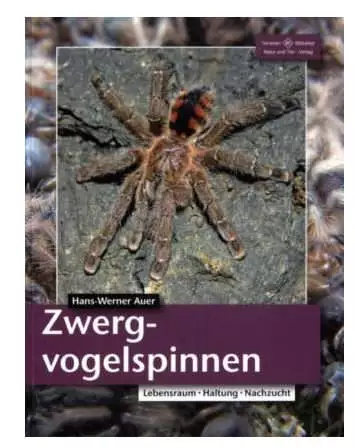
NTV - Dwarf bird spiders
NTV - Dwarf tarantulas all about keeping and caring for these amazing tiny creatures. 160 pages 179 photos Paperback Publication date 24.06.2011 1st edition Author Hans-Werner Auer Anyone interested in dwarf tarantulas, i.e. very small species, has hit the jackpot: These tiny creatures include some of the most exciting, spectacular and colourful species of all!What's more, spider lovers can keep and observe a large number of different tree and ground dwellers in a very small space. And this hobby never gets boring anyway, as new, wonderful species are constantly being discovered and introduced to terraristics.

CHF 35.40

Terraria 52 - Expedition Borneo
Terraria 52 - Expedition Borneo Glass creepNewly described amphibians 2014 Contents: Borneo is the third largest island in the world and home to a unique variety of amphibians and reptiles. For herpetologists, it therefore has an almost mystical ring to it. We give you an overview of the biodiversity of this island and take you on current expeditions to explore the local herpetofauna.TerritorialHerpetoramaSuccessful snake model – oldest fossils discovered / Thorn devils: Larval-bearing fang frog / Reptile rescue centre in Munich: We urgently need help! / Cultural successor: Not at all poisonous adder / Leafhoppers: Sand lizards cost Lenin his head / Killer cats and animal welfare          Cover storyOn the way to the last wild paradises in the land of the headhunters on BorneoAxel Hilger In the north of Sarawak. An expedition reportJörg Hofmann The amphibians of the Gunung Mulu National Park on Borneo            Rudolf Malkmus PanoramaMaster for the masterless. A reptile rescue centre as a workplaceAndrea Frank Research New species            List of amphibians newly described in 2014            Axel Kwet Molecular differentiation of flagellates in reptiles. A research project in the Ingo-und-Waltraud-Pauler-Fonds of the DGHTDr Barbara Richter & Dr Nikola Pantchev Salamandra TerraristicsColourful underground fighters. Keeping and breeding the glass snake Dopasia gracilisAndreas Danier Also in your neighbourhood Nature and species conservation Field Notes            Instead of hibernation: Activity and prey acquisition of alpine and pond newts in southern Hesse            Alfred Buschinger Instead of going ashore in autumn: late larvae of common toads in the AllgäuAxel Kwet Observations on the predation behaviour of the large arrow snake (Dolichophis jugularis jugularis) in CyprusDaniel Jestrzemski Subscription & ServicePreview Incubator No more bees and flowers!            Heiko Werning

CHF 12.00

Hard armour - soft heart
The turtle expert Thorsten Geier would like to inspire you as a turtle enthusiast to keep these special animals as close to nature as possible. Based on his almost 20 years of in-depth experience with European tortoises, he provides a wealth of practical advice and tips for practical use: using nature as a model, he explains that the animals should be spared a life in a terrarium. His guide contains over 180 pages of detailed suggestions for keeping animals close to nature. Thorsten Geier explains the design of outdoor enclosures and presents suitable and less suitable food plants. Other topics include: optimal nutrition, caring for hatchlings and young animals, winter torpor, animal health, successful reproduction, species protection, but also mistakes in keeping tortoises and much more. Over 200 photos of the animals' habitat, enclosure photos, plant pictures etc. make this book a particularly valuable read. In a separate chapter, the author addresses our youngest turtle friends. Thorsten Geier would like to encourage them (and their parents) in particular to treat turtles in a species-appropriate manner.

CHF 21.90

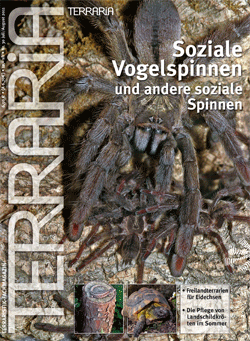
Terraria No. 30 - Social bird spiders and other social spiders
Terraria No. 30 - Social bird spiders and other social spiders Freilandterrarien für EidechsenDie Pflege von Landschildkröten im Sommer Inhalt: Etliche Vertreter der Vogelspinnen lassen sich im Terrarium in Gruppen halten, beispielsweise Poecilotheria-Arten oder Holothele incei. Die Pflege einer solchen Spinnengemeinschaft zählt zum Faszinierendsten, was man in der Wirbellosenterraristik erleben kann. Boris F. STRIFFLER stellt nicht nur sämtliche Vogelspinnen vor, die für eine solche Haltung infrage kommen, sondern geht außerdem auch auf weitere soziale Spinnen ein – selbst auf solche, die direkt vor unserer Haustür leben! EditorialKriton KunzMagazinGondwanaland – ein zukunftsweisendes Projekt im Zoo Leipzig. Teil 4: Die Eröffnung der Tropenerlebniswelt / Revision der Familie Cordylidae / Marktplatz / Rechtliches / Wie kommt das Gift in die Beute?TERRAglobalIn der Bergwelt der Inka Maik DobieyTitelthemaSoziale Vogelspinnen und andere soziale SpinnenBoris F. StrifflerSoziale Spinnen – ein Widerspruch in sich?Boris F. StrifflerSoziale Vogelspinnen? Beispiele aus Amerika Boris F. Striffler, Frank Schneider und Ingo WendtDas Schildkrötenjahr. Freilandbiologie und Haltung europäischer Landschildkröten über den Jahreslauf Teil 3: Juli bis August – SommerhitzeMichael WirthDie Gattung Nerodia. Wassernattern aus Nordamerika: Lebensweise sowie Haltung und Vermehrung im Terrarium Teil 1 Dieter SchmidtEidechsen im Freilandterrarium Martin DieckmannReise Auf Amphibien- und Reptiliensuche in der Umgebung von Iquitos: Ranitomeya reticulata im Wald von Llanchama Mario KassatNeue Arten Ein psychedelischer Gecko Axel Kwet Neuer Pfeilgiftfrosch aus Brasilien Axel KwetAbo & ServiceUnter Forschern Der Weg ist das Ziel – oder: Wie man sich eine Diplomarbeit selbst organisiertStephan BöhmBlickfang Terrarianernostalgie und tropischer Regenwald in Reutlingen – ein Besuch bei Florian Riedel Michael WirthIn Ihrer Nähe Vorschau Brutkasten Schlimme Nächte: Guayaquil Teil 2: Wir Kleinlaut-Touristen Heiko Werning  

CHF 12.00

Draco 40 - Dinosaurs, the return of the prehistoric giants
Draco 40 - Dinosaurs, the return of the prehistoric giants Contents: Editorial Dinosaurs - a success story of evolutionRainer Schoch, State Museum of Natural History Stuttgart Living fossils - digital dinosaurs in 3D qualityAxel Kwet Dinosaur show - in the realm of the giantsAxel Kwet Argentina - birthplace of the dinosaursBernd Herkner, Senckenberg Research Institute and Nature Museum Wild children's room - or: How a dinosaur book is madeMarkus Paßlick The tracks found in the Obernkirchen sandstone quarriesThorsten van der Lubbe, Lower Saxony State Museum Hanover In dinosaur countryHeiko Werning Magazine

CHF 18.40

Reptilia 82 - The Fox-faced Lidgecko
Reptilia 82 - The Fox-faced Lidgecko Californian chain snakeNorthern Madagascar boaReptile rescue centre Contents: It is undoubtedly one of the strangest lizards in our terrariums, the Fox-faced Lidgecko (Aeluroscalabotes felinus), with its feline-like silent movements and almost ghostly appearance. And it has had one of the most remarkable terrarium careers in recent times. Just a few years ago, this species was practically unknown and a sensation for specialists, but today it has almost become a fashionable gecko.No wonder, because these easy-to-hold animals captivate with their appearance as well as their behaviour. Siriporn Maier and Thomas Bamann present the keeping and breeding of this exceptional gecko in detail and in a way that is easy to understand, even for beginners. EDITORIAL MAGAZINE DATES WESTERN HERP PERSPECTIVES The China-Connection B. Love PHOTOSTORY Fox-faced geckos – fascinating goblins of the night S. Maier & T. Bamann KEEPING AND REPRODUCTION A wild cat in the terrarium – keeping fox-faced geckos S. Maier & T. Bamann KEEPING AND REPRODUCTION Breeding the fox-faced gecko S. Maier & T. Bamann TRAVEL Mysterious Peru C. Koch PORTRAIT and poster Rhacophorus nigropalmatus J. M. Dehling KEEPING AND REPRODUCTION Keeping and breeding the Californian chain snake, Lampropeltis californiae R. Meierkord REPORTAGE The Berlin Reptile Centre L. Dirksen KEEPING AND REPRODUCTION Acrantophis madagascariensis – keeping and breeding of the Northern Madagascar boaM. Borer HERPETOFAUNA The genus Ambystoma in Mexico G. Casas-Andreu & X. Aguilar-Miguel HERPETOFAUNA Observations on common toads M. Felke ANIMALS OF OUR HOME The grass snake R. Leptien SUBSCRIPTION & SERVICE ALSO NEAR YOU PREVIEW BRUTKASTEN Alone among sheep. Part 2 H. Werning

CHF 12.00