Product information "Terraria 45 - Tree creepers Abronia"
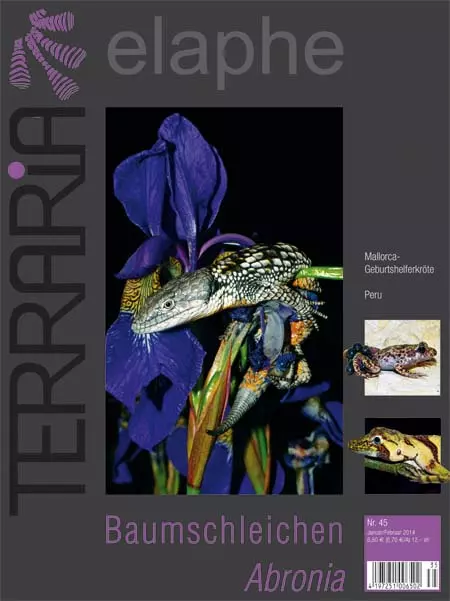
Terraria 45 - Tree creepers Abronia
Majorca Treehugger Toad Peru
Contents:
The fascinating tree creepers are a little-known but particularly magnificent reptile. In their Central American homeland, they are sometimes highly endangered, but in the terrarium hobby more and more species are being successfully kept and bred. We offer a comprehensive overview.
Territorial Herpetorama
Cover story Tree Snakes of the Genus Abronia Christian Langner
Keeping and breeding the tree snake Abronia lythrochila Christian Langner
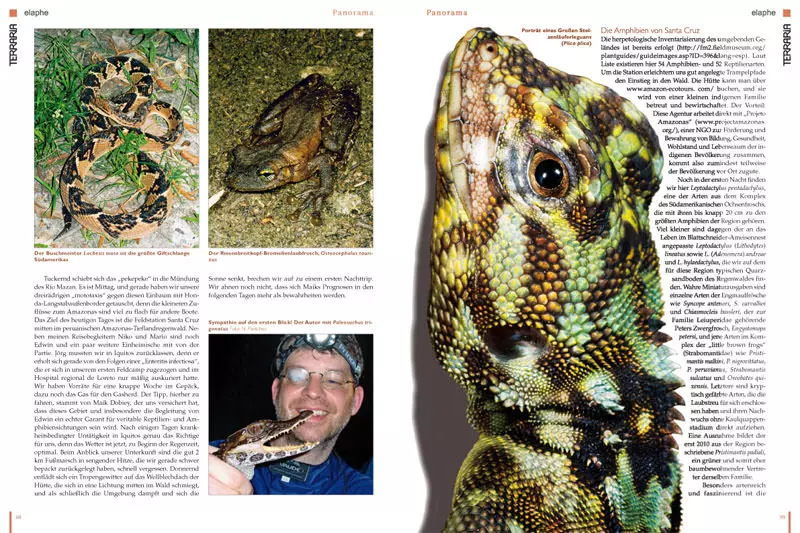
Panorama In search of amphibians and reptiles at the Amazonas Tobias Eisenberg
Research Among researchers Black toads with red bellies: the genus Melanophryniscus in Uruguay Raúl Maneyro
New species Two species of treehollow toad frogs Axel Kwet
The Italian slow worm is a separate species Axel Kwet
Sun protection for snakes. Investigation into the UV light transmission of the eye scales and skin of some species Jochen Geiger & Frank Buchter
Salamandra
Terraristics Keeping and breeding the Ceylon lancehead, Trimeresurus trigonocephalus Karsten Hoer
Care and breeding of the Majorcan midwife toad, Alytes muletensis Sergé Bogaerts & Uwe Seidel
Nature and species conservation Field notes Snake wedding at the Lopper - Dice snakes at Lake Alpnach, Schweizer Urs & Heidi Jöst
Late discovery of young sand lizards Axel Kwet
Wall gecko with tick Guntram Deichsel
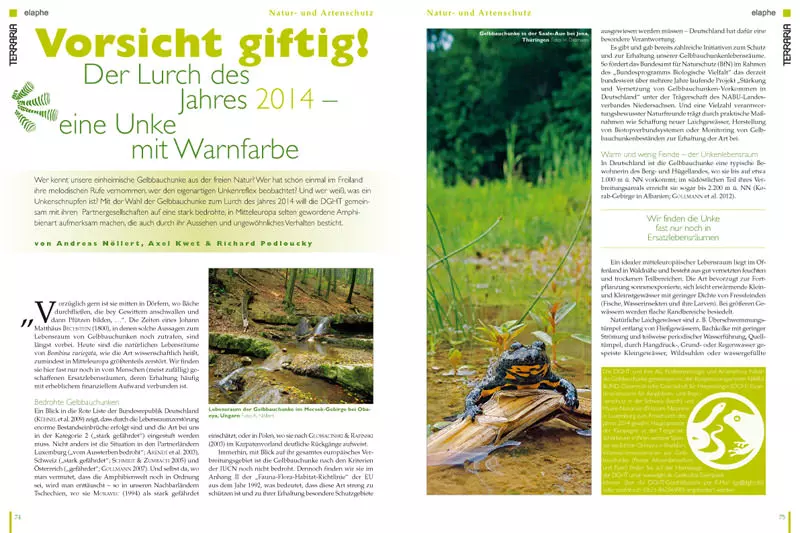
Caution poisonous!
The amphibian of the year 2014 - a toad with warning colour Andreas Nöllert, Axel Kwet & Richard Podloucky
Subscription & Service Also in your neighbourhood Preview
Incubator Lost Dutchman Part 2 Heiko Werning
Composition
Feeding recommendation
Technical details
Size information
0 of 0 reviews
Give us a rating!
Share your experience with the product with other customers.
Login
No reviews found. Go ahead and share your findings with others.
Handbook of forage plants 2nd revised editionMarion Minch is not only a successful breeder of diverse tortoises for many years, but also an excellent connoisseur of native wild herbs. She founded and runs samenkiste.de, which is well known to many tortoise keepers and nature lovers. Her name is inextricably linked with reptile care and species-appropriate nutrition for tortoises. Her handbook of food plants summarises the most important native food plants for herbivorous and omnivorous reptiles. She not only considers tortoises, but also iguanas, spiny-tailed dragons and even chameleons. From the basics of plant biology to native wild herbs to suitable food plants for hardy tropical reptile species, this comprehensive work provides the basis for species-appropriate keeping. In the expanded and supplemented 2nd edition, the plant section is divided according to flower colour. This makes it even easier to identify wild herbs. The work has also been supplemented with a wealth of additional information and many pictures.
Geckos in the terrarium by Astrid FalkThe book offers a comprehensive introduction to geckos and their species-appropriate keeping in terrariums. It explains what you need to think about before buying a gecko and what preparations should be made. The book describes in detail how the terrarium is technically equipped and set up. The care of the animals, their special features and behaviour, their diet, reproduction and rearing of young animals are described, as well as diseases and husbandry problems with tried and tested suggestions for prevention and treatment. Individual gecko species that are particularly suitable for keeping and breeding in terrariums are portrayed in detail in the second part of the book.
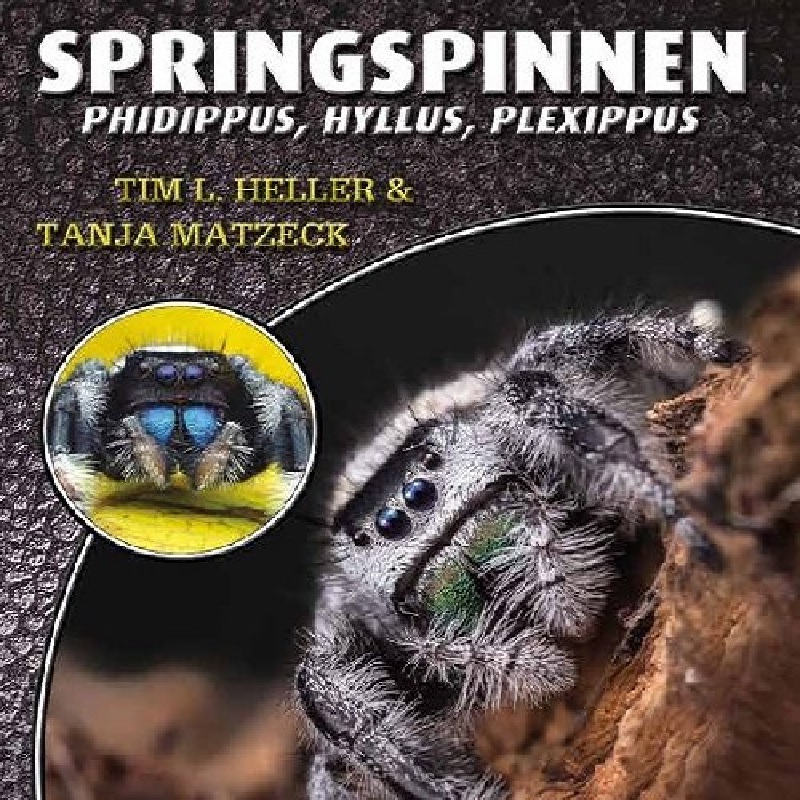
Book Jumping Spiders -
Phidippus, Hyllus & Plexippus
A guide to keeping jumping spiders of the genera Phidippus, Hyllus & Plexippus. Who can resist the charm of jumping spiders? The childlike appearance of their expressive face simply leaves no one cold! In addition, their behavior is extremely exciting to observe, their colors are bright and their requirements for species-appropriate keeping are very easy to meet. No wonder these likeable jumpers are all the rage!
This volume in the "Species by Species" series describes in detail what to look out for when buying and keeping them, introduces the most commonly kept species and color forms and provides plenty of tips on how to keep them successfully - so you can be sure they will breed well!
Species by Species introduces you to the books in this series, which present the most popular terrarium animals. Each volume offers you detailed, practical care instructions and all the information you need to successfully breed your animals.
All important questions from the required tank size to terrarium set-up, technical equipment, species-appropriate nutrition and disease prevention are answered with numerous tricks and tips.
Experienced, long-standing breeders reveal how you can encourage the animals to reproduce and raise healthy young.
All this in full color, generously illustrated and attractively designed - just about your terrarium animal - species by species
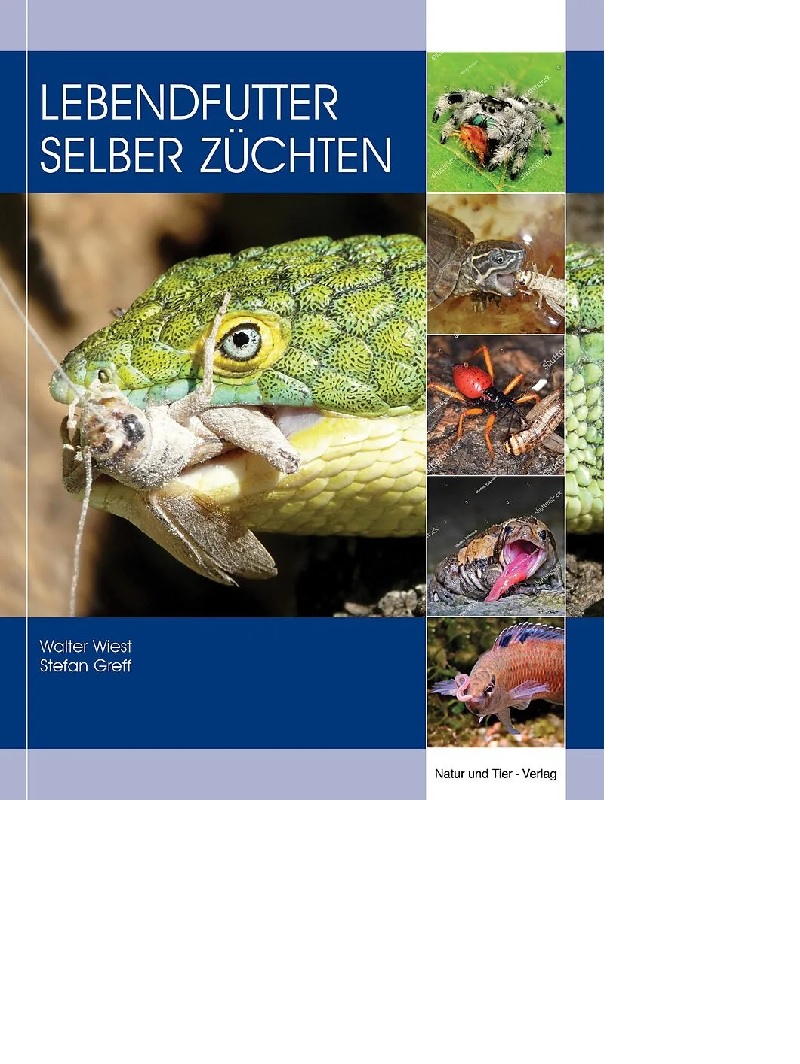
Book "Grow your own live food" - The perfect guide for pet owners
Discover practical and detailed instructions on how you can easily breed food for your reptiles, birds, fish or other animals yourself in the book "Breeding live food yourself". With valuable tips on various food insects, their care and breeding, you can save money and ensure a species-appropriate diet for your pets.
Contents of the book:
Step-by-step instructions for breeding feeder insects
Information on the best types of food for reptiles, birds and fish
Care instructions and breeding conditions for various live food species
Tips for sustainable and cost-effective food production
Why breed your own live food?
Get healthy, fresh food for your animals
Save money and reduce dependence on pet shops
Promote the health and well-being of your animals with species-appropriate food
Whether you are a beginner or an experienced pet owner, this book provides you with everything you need to successfully breed live food yourself.
Marginata 69 - New Guinea tortoises – the genus ElseyaCover storyThe unrecognised beauties: New Guinea tortoises (Andreas S. Hennig)My experiences with Branderhorst's New Guinea tortoise, Elseya (Elseya) branderhorsti (Ouwens, 1914) (Andreas S. Hennig)Keeping and breeding of Rhodin's New Guinea tortoise, Elseya (Hanwarachelys) rhodini Thomson, Amepou, Anamiato & Georges, 2015 (Andreas S. Hennig)PortraitGeoemyda spengleri, Chinese serrated tortoise (Andreas S. Hennig)ReportageMacrochelys temminckii – Experiences and impressions with vulture tortoises part 2 (Reiner Praschag)KeepingAn alternative to year-round keeping of the Egyptian tortoise in the terrarium – my experiences with seasonal outdoor keeping of Testudo kleinmanni (Ricarda Schramm)EtymologySawbacks and living maps part 4: Graptemys gibbonsi, Pascagoula humpback tortoise (Holger Vetter)Classifieds & animal placement
Reptilia 57 - Leopard geckos
2 - Editorial4 - Magazine15 - Dates18 - Western Herp Perspectives: In the trap, by B. Love20 - Photo report: The leopard gecko (Eublepharis macularius), by D.Duscha30 - Herpetofauna: Behaviour and biology of the leopard gecko (Eublepharis macularius) in Pakistan, by M. Sharif Khan36 - Keeping and reproduction: Colour and pattern variations of the leopard gecko (Eublepharis macularius), by R. Kreutz42 - Journey: In the Magic Kingdom of the Quetzal - Dream journeys through the land of "Eternal Spring", by K. Kunz51 - Portrait and poster: Trimeresurus flavomaculatus, by M. Gaulke56 - Hepertomedicine: Herpesvirus infections in tortoises - disease, diagnosis and prophylaxis options, by S. Fischer & M. Homuth65 - Care and reproduction: Monkeys with orange legs - Care and reproduction of the Chaco macifrog Phyllomedusa hypochondrialis azurea, by E. Biggi72 - Keeping and reproduction: On keeping the ventral viper Maticora bivirgata flaviceps (Cantor, 1839) in the terrarium, by G. Vogel & P. Freed78 - Terrarium technology: Building instructions for a polystyrene terrarium according to Marco Beck, by M. Schicker86 - Classifieds93 - Advice and action95 - Library104 - Incubator: My flat-sharing community, part 2: The Grand Coalition has promised to solve the problems in the country, but once again nobody is showing up, by H. Werning
Reptilia 37 Jackson's chameleons
Kenyaschool vivariumTurtle trade in CambodiaContent:2 EDITORIAL4 READER'S LETTERS6 MAGAZINE12 DATES16 PHOTO REPORTAGEthree-horned chameleonsfrom P. Necas36 HUSBANDRY AND BREEDINGChamaeleo (Trioceros)bitaeniatus and its relatives - With comments on the keeping and reproduction of a representative of the Grupeeby N. Lutzmann44 HERPETOFAUNAChamaeleo (Trioceros)jacksonii and its subspeciesby N. Lutzmann51 PORTRAIT AND POSTEREryx jaculusby B. Trapp55 TRAVELOn Herpeto Safari in Kenyafrom I. Schürkes, V. Wasanga & S. Lötters62 REPORTStudies on the turtle trade in Cambodiaby E. Lehr & R. Holloway71 HUSBANDRY AND BREEDINGOne of Europe's most beautiful lizards in a terrarium: the pearl lizardfrom S. Bania76 WESTERN HERP PERSPECTIVESExotic poisonous snakes - the charm of something specialfrom B. Love79 REPORTThe school vivariumPart 2: Example Franziskaner-Gymnasium Kreuzbergby M. Hallmen90 CLASSIFIEDS95 LIBRARY104 GLOSSEBig autumn extra: you have mail!by H. WerningThe October/November issue of your terraristic magazine REPTILIA makes the hearts of all lizard fans and aesthetes beat faster with the title theme "Threehorned Chameleons": In this photo story, which is even more sumptuous than usual, chameleon expert Petr Necas not only gives a general overview of these fascinating animals from the subgenus Trioceros, but he also introduces you to no less than all species in detail!
Chamaeleo (Trioceros) bitaeniatus and his relatives are then described in detail by the expert par excellence in this field, namely Nicolá Lutzmann. He reports about the biology of the small dragons, brings clarity into the confused systematics and not least describes their keeping and breeding vividly - for all terrarists interested in these beautiful lizards an absolute "must".Just like the next article on the title theme of Nicolá Lutzmann, who deals with the popular Chamaeleo (Trioceros) jacksonii and its relatives. Here, too, the author knows how to write expertly about the field biology of the animals, clears up the subspecies confusion and gives detailed tips for the successful care and breeding of the primeval lizards.We stay in Africa and go on Herpeto Safari in Kenya with I. Schürkes, V. Wasanga and S. Lötters. This dreamlike nature destination has not only the "big five" to offer, but is also herpetologically the very first cream, of which you can convince yourself with brilliant photos and a highly interesting expedition report.Unfortunately, the fatal situation of the Asian turtle fauna is a long runner in the REPTILIA, and if we together with you, dear readers, could contribute significantly to the construction of the conservation breeding station in the all-weather zoo Münster, the situation on site is still dramatic. This is proven by the drastic pictures and shattering experiences that Edgar Lehr and Rohan Hollowy bring back from investigations into the turtle trade in Cambodia.Sandra Bania takes care of one of the most beautiful lizards in Europe in her terrarium: the pearl lizard. Therefore she knows how to describe enthusiastically that these magnificent and trustful animals are not only an optical delight, but also show a very varied and interesting behaviour, which makes the lizards together with their relatively unproblematic keeping to best suitable fosterlings, whose keeping and breeding after the reading of this detailed contribution certainly no problems, but however much joy prepares.In the second part of his report on Das Schulvivarium, Martin Hallmen presents a practical example, namely the vivarium at the Franziskaner-Gymnasium Kreuzberg, which he initiated and praised highly. Here you can learn concretely what you have to consider during the planning and expansion phase and how everyday life with the vivarium works, how it is integrated into lessons and what publicity effect can be achieved with it. Certainly a thing worth imitating!Also in this REPTILIA we offer you of course again the full spectrum of our service: In the magazine, for example, you will read curiosities about a reptilian flower pot and get to know an interesting and up-to-date approach to the labelling of tank lizards. Dates, classifieds and the poster (this time with the Western Sandboa Eryx jaculus) are not missing in the incubator, as is Heiko Werning's infamous gloss: "This time, some people will certainly be very happy about caring mail. Will you also be there?
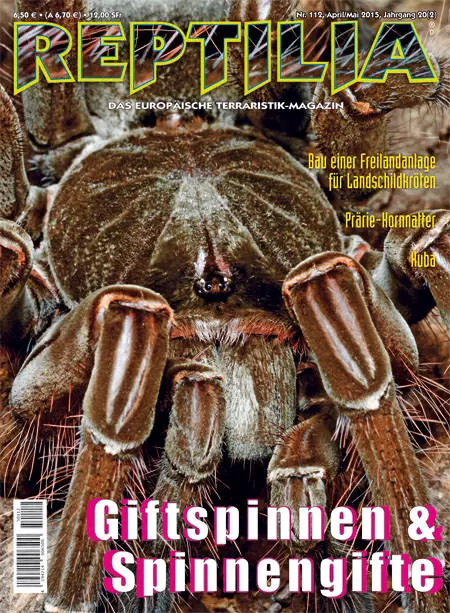
Reptilia 112 - Venomous Spiders & Spider Venoms
Building an outdoor enclosure for tortoisesPrairie horned snakeCubaContents: Cover story: Venomous spiders & spider venomsAll spiders are venomous, including tarantulas, which are particularly popular in terrariums. Nevertheless, they are largely harmless to humans, but are often considered dangerous. This becomes a problem when legislators believe they need to protect the public from these “dangerous animals”. But how dangerous are venomous spiders really? We provide an overview, take a tour of the spider fauna in Australia, the kingdom of all venomous animals, and cover the keeping of venomous spiders in terrariums, from tarantulas to black widows.
EditorialMAGAZINEDATES
WESTERN HERP PERSPECTIVESFrog paradise EuropeB. Love
Photo story“Venomous spiders” in terraristicsK. Kunz
ReportageQueensland’s spiders and their venoms Part 1: The mygalomorph spidersT. J. Hauke
Bibliography
Keeping and breedingVenomous yet harmless – the genera Loxosceles and Sicarius in the terrariumG. Ackermann & A. Leetz
ReportageStung by a tarantula? The South Russian tarantula (Lycosa singoriensis) in BurgenlandH.-J. Luef
TERRARIUM PRACTICEOutdoor enclosure for tortoises 2.0M. Hallmen
KEEPING AND BREEDINGRediscovering an old acquaintance: the Prairie Corn Snake (Pantherophis emoryi emoryi)K. Kessler
Animals of our homelandThe smooth newtR. Leptien
ServiceLibraryALSO NEAR YOU
JourneyCuba all inclusive. Beaches, cocktails, anoles and roll-tailed iguanasI. Kober
PREVIEW
BRUTKASTEN Chuckwalla anecdotes Part 1H. Werning
Reptilia 108 Unlabelled
AmazonasPraying mantisMotorised brooderContents:Cover story: Masterless! – About animal shelters, rescue centres and fire brigade operationsWith the increasing popularity of terrarium keeping, problems have also arisen that were previously only known from classic pets. Overburdened owners abandon animals or let them fall into neglect, and when personal circumstances change, there is suddenly no space for a terrarium. Traditional animal shelters are overwhelmed, and animal welfare activists use this as an argument against the keeping of wild animals. We examine the issue, show solution approaches, present the largest German reptile rescue centre in Munich along with its spectacular new project “Chelonia”, and see how firefighters prepare to rescue a snake as well as a cat.
EditorialMAGAZINEEVENTS
WESTERN HERP PERSPECTIVESNew horizonsB. Love
ReportageTerrarium animals – a problem for animal shelters?K. Kunz
REPORTAGENot just home, but a home for a while. The reptile rescue centre MunichH. Werning
ReportageExotic emergency call. How the professional fire brigade equips itself for operations with reptilesS. Müller ReportageDifferent continents – similar problems:? About the work of a reptile rescue centre in ArizonaS. Kalopp
HUSBANDRYThe praying mantis Mantis religiosa. An insect of superlativesU. & J. Schimmelpfennig
PracticeConcept and construction of a motorised brooderP. Schönecker
ALSO IN YOUR AREA
ANIMALS OF OUR HOMEThe tree frogR. Leptien
Service
TravelAlong the mighty Amazonas. In the herpetological paradiseK.-H. Switak
PREVIEW
INCUBATOR Television is coming – Part 1H. Werning
Draco 05 - Giant snakesContents:
Page content
2 Editorial
4 On the systematics and biology of giant snakes (Boidae), by Dr L. Dirksen & M. Auliya
20 Quo vadis, keeping boids in human hands, by Dr H. D. Lehmann
26 record specimens and man-eaters, by Dr L. Dirksen
32 Notes on the green tree python Morelia viridis(SCHLEGEL 1872) - population-related variants, care and breeding, by A. Kirschner & H. Abend
40 Quo vadis, Boa regia, by A. Kirschner
43 The King Python (SHAW 1802), by A. Kirschner
48 Destination: Down under - The giant snakes of Australia, by V. Franz
56 KLeine Riesenschlangen - Care and breeding of sand boas in the terrarium, by H. Seufer
68 Experiences with rarely kept Corallus species Corallus annulatus annulatus, Corallus hortulanus hortulanus and Corallus hortulanus ruschenbergeria, by S. Wirz
78 Book box
93 Magazine
Alles über die Taggeckos der Gattung Phelsume von Hans-Peter Berghof
192Seiten
mit zahlreichen Farbfotos
3. Auflage
Über Lebensweise, Haltung und Nachzucht
Autor Hans-Peter Berghof
Verlag NTV
Inhalt:
Die Taggeckos der Gattung Phelsuma mit ihren bunten Farben und ihrem interessanten Verhalten zählen zu den absoluten Lieblingen der Terrarianer. Hans-Peter Berghof vermehrt diese Echsen seit langem erfolgreich und gibt hier sein gesammeltes Wissen über Haltung und Nachzucht dieser schönen Geckos weiter. Der spezielle Teil stellt detailliert sämtliche Arten mit ihren Pflegeansprüchen in Wort und Bild vor und gibt an, welche Tiere leichter und welche schwieriger zu halten sind. Die ideale Ergänzung zum Standardwerk von Hallmann et. al. von 1997, ergänzt um alle seither entdeckten Arten und neu erschienene Literatur.
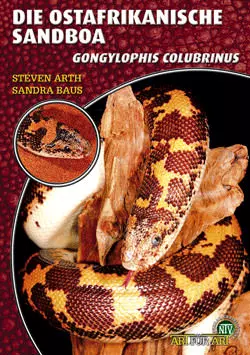
All about the East African Sand Boa
64 pages
Format 14.5 x 21 cm
Colour photos
Author Steven Arth & Sandra Baus
Contents:
Foreword
Description of the species
Relationship
Behaviour and lifestyle
Colour variations
Legal regulations
Considerations before acquisition
Acquisition of the animals
Transport and quarantine
Socialisation
Keeping in the terrarium
Terrarium and terrarium design
Terrarium technology and climate
Keeping in the "rack"
Care work
Feeding
Breeding
Sexual differences and sexual maturity
Mating trigger
Pregnancy and birth of the young animals
Housing, feeding and further rearing of the young animals
Diseases
Thanks
Further information
Literature used and further reading
CHF 19.90
❅
❆
❅
❆
❅
❆
❅
❆
❅
❆
❅
❆
This website uses cookies to ensure the best experience possible. More information...