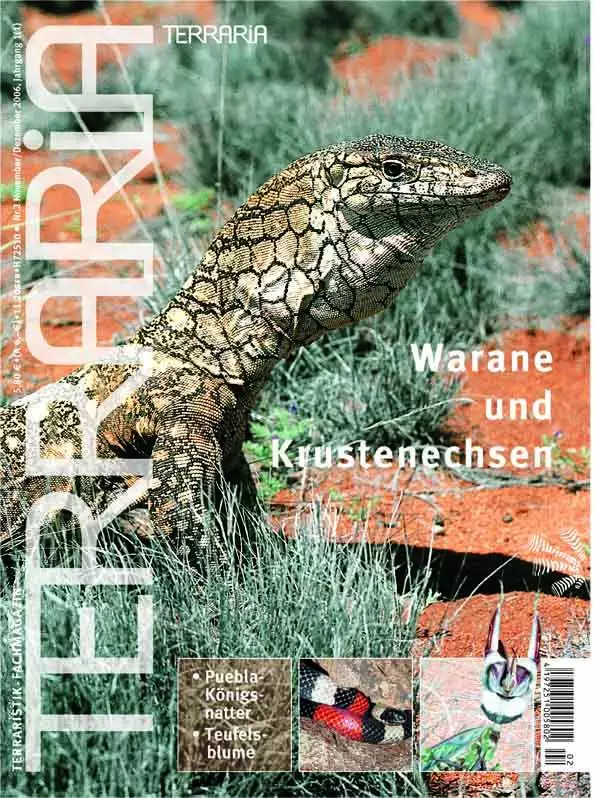
Terraria 02 - Monitor lizards and crustacean lizards

Article no: terraria2

CHF 11.20

Stock: 0

Ready for dispatch in 1-3 days, delivery time 7 working days

Delivery between Tuesday, 28 April and Wednesday, 29 April
Zahlungsarten
Product information "Terraria 02 - Monitor lizards and crustacean lizards"

Terraria 02 - Monitor lizards and crustacean lizards

Puebla King Snake
Devil's Flower

Contents:

  • 2 Editorial
    Axel Kwet
    TITLE TOPIC
  • 4–23 • Crustacean lizards and monitor lizards:
    New and familiar facts about the four-footed poisonous clan
    Hans-Georg Horn
    SCIENCE
  • 24 Herpetorama
    New amphibian family tree highly controversial / New names for well-known poison dart frogs
  • 30 New species
    Melanophryniscus admirabilis – a brightly coloured “black toad”
  • 32 Among researchers
    In the shadow of the saw – Amphibian communities in selectively logged tropical forests
    Raffael Ernst
  • 36 My Home Is My Castle
    Experiences with the self-construction of a terrarium for a Yemen chameleon
    Frank Angermann
  • 40 A new way to disinfect terrariums
    Hans-Peter Berghof and Ulf Schwabe
  • 44 Melanophryniscus – not just black toads
    Part 1: General information on the genus Melanophryniscus
    Axel Kwet
  • 54 Ornate turtles – the genus Pseudemys
    Part 1: Introduction, systematics, production and trade
    Andreas S. Hennig
  • 59 Keeping and breeding the Puebla King Snake, Lampropeltis triangulum campbelli
    Thorsten Schmidt
  • 63 The devil's flower Idolomantis diabolica (Saussure, 1869)
    Part 1
    Christian J. Schwarz, Jürgen E. Mehl and Jürg Sommerhalder
    TRAVEL
  • 71 In the land of the Jacarés – the Pantanal
    Part 2
    Heiko Werning
    TERRARIUM PRACTICE
  • 82 Test run
    Artificial rock furnishings from Exo Terra
    84 Prelude
    A good start: the leopard gecko (Eublepharis macularius)
    Sven Zeeb
  • 88 Eye-catcher
    The rainforest in your living room
    Mike Zawadzk
  • 93 Also in your neighbourhood
  • 96 TERRAnet
    Of snakes and poisonous snakes
  • 98 TERRAglobal
    Santa Catalina – Island of the rattleless rattlesnakes
    Karl H. Switak
    A new workplace, a plethora of new animals
    Mirco Solé
  • 103 Preview
  • 104 TERRAwinn
Composition
Feeding recommendation
Technical details
Size information

0 of 0 reviews

Give us a rating!

Share your experience with the product with other customers.


Suggested products

Handbook of food plants for tortoises and other reptiles
Handbook of forage plants 2nd revised editionMarion Minch is not only a successful breeder of diverse tortoises for many years, but also an excellent connoisseur of native wild herbs. She founded and runs samenkiste.de, which is well known to many tortoise keepers and nature lovers. Her name is inextricably linked with reptile care and species-appropriate nutrition for tortoises. Her handbook of food plants summarises the most important native food plants for herbivorous and omnivorous reptiles. She not only considers tortoises, but also iguanas, spiny-tailed dragons and even chameleons. From the basics of plant biology to native wild herbs to suitable food plants for hardy tropical reptile species, this comprehensive work provides the basis for species-appropriate keeping. In the expanded and supplemented 2nd edition, the plant section is divided according to flower colour. This makes it even easier to identify wild herbs. The work has also been supplemented with a wealth of additional information and many pictures.

CHF 46.50

Geckos
Geckos in the terrarium by Astrid FalkThe book offers a comprehensive introduction to geckos and their species-appropriate keeping in terrariums. It explains what you need to think about before buying a gecko and what preparations should be made. The book describes in detail how the terrarium is technically equipped and set up. The care of the animals, their special features and behaviour, their diet, reproduction and rearing of young animals are described, as well as diseases and husbandry problems with tried and tested suggestions for prevention and treatment. Individual gecko species that are particularly suitable for keeping and breeding in terrariums are portrayed in detail in the second part of the book.

CHF 28.50

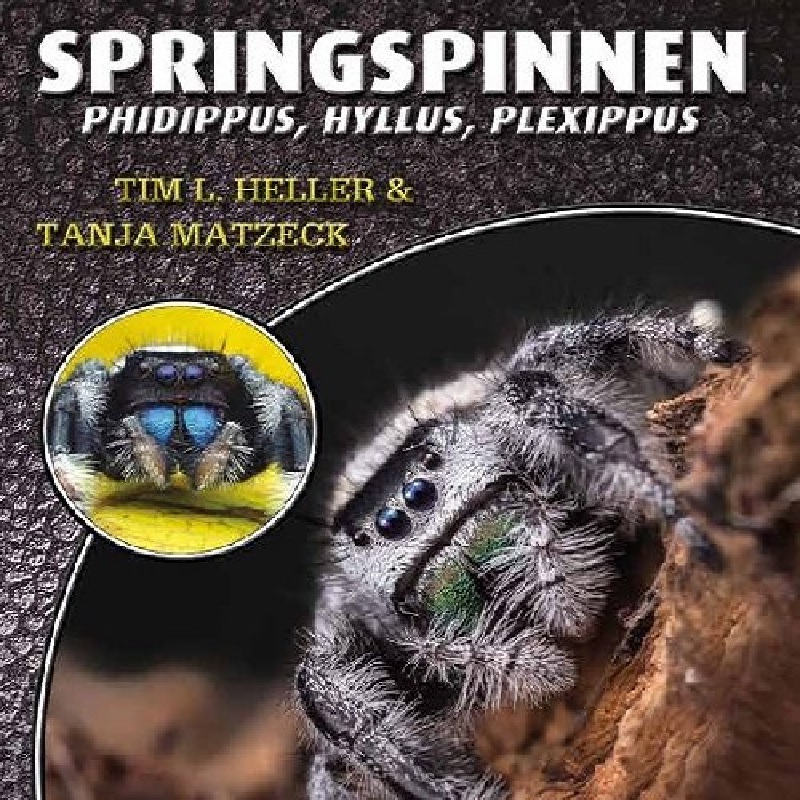
Jumping spiders Phidippus, Hyllus, Plexippus
Book Jumping Spiders - Phidippus, Hyllus & Plexippus A guide to keeping jumping spiders of the genera Phidippus, Hyllus & Plexippus. Who can resist the charm of jumping spiders? The childlike appearance of their expressive face simply leaves no one cold! In addition, their behavior is extremely exciting to observe, their colors are bright and their requirements for species-appropriate keeping are very easy to meet. No wonder these likeable jumpers are all the rage! This volume in the "Species by Species" series describes in detail what to look out for when buying and keeping them, introduces the most commonly kept species and color forms and provides plenty of tips on how to keep them successfully - so you can be sure they will breed well! Species by Species introduces you to the books in this series, which present the most popular terrarium animals. Each volume offers you detailed, practical care instructions and all the information you need to successfully breed your animals. All important questions from the required tank size to terrarium set-up, technical equipment, species-appropriate nutrition and disease prevention are answered with numerous tricks and tips. Experienced, long-standing breeders reveal how you can encourage the animals to reproduce and raise healthy young. All this in full color, generously illustrated and attractively designed - just about your terrarium animal - species by species

CHF 23.90

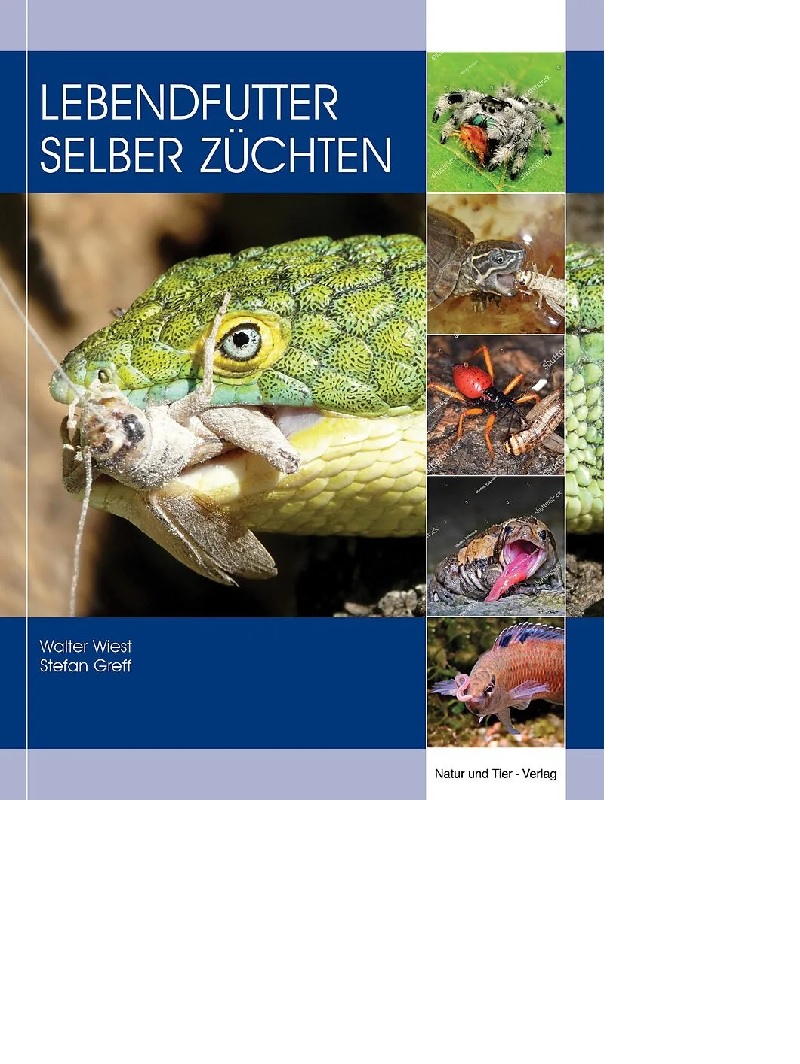
Book Breeding live food yourself
Book "Grow your own live food" - The perfect guide for pet owners Discover practical and detailed instructions on how you can easily breed food for your reptiles, birds, fish or other animals yourself in the book "Breeding live food yourself". With valuable tips on various food insects, their care and breeding, you can save money and ensure a species-appropriate diet for your pets. Contents of the book: Step-by-step instructions for breeding feeder insects Information on the best types of food for reptiles, birds and fish Care instructions and breeding conditions for various live food species Tips for sustainable and cost-effective food production Why breed your own live food? Get healthy, fresh food for your animals Save money and reduce dependence on pet shops Promote the health and well-being of your animals with species-appropriate food Whether you are a beginner or an experienced pet owner, this book provides you with everything you need to successfully breed live food yourself.

CHF 46.50

Marginata 69 - New Guinea tortoises
Marginata 69 - New Guinea tortoises – the genus ElseyaCover storyThe unrecognised beauties: New Guinea tortoises (Andreas S. Hennig)My experiences with Branderhorst's New Guinea tortoise, Elseya (Elseya) branderhorsti (Ouwens, 1914) (Andreas S. Hennig)Keeping and breeding of Rhodin's New Guinea tortoise, Elseya (Hanwarachelys) rhodini Thomson, Amepou, Anamiato & Georges, 2015 (Andreas S. Hennig)PortraitGeoemyda spengleri, Chinese serrated tortoise (Andreas S. Hennig)ReportageMacrochelys temminckii – Experiences and impressions with vulture tortoises part 2 (Reiner Praschag)KeepingAn alternative to year-round keeping of the Egyptian tortoise in the terrarium – my experiences with seasonal outdoor keeping of Testudo kleinmanni (Ricarda Schramm)EtymologySawbacks and living maps part 4: Graptemys gibbonsi, Pascagoula humpback tortoise (Holger Vetter)Classifieds & animal placement

CHF 16.50

Reptilia 08 - Grasping frogs
Reptilia 08 - Grasping frogsDay geckos on the MascarenesRoyal pythonArizonaContents:Page 2 - EditorialPage 3 - Letters to the editorPage 5 - MagazinePage 14 - Western Herp Perspectives: Albino turtles, by B. LovePage 16 - Photo report: Griffin frogs, by C. ProyPage 23 - Report: Sleepyheads - Maci frogs, by Dr H. HermannPage 28 - Keeping and breeding: Keeping and breeding the red-eyed frog, by H. Birkhahn and K. WassmannPage 33 - Travelogue: Arizona, by H. WerningPage 39 - Portrait and poster: Laudakia stellio, by D. Modry and P. NecasPage 43 - Report: The genus Neurergus - Fascinating mountain stream salamanders, by S. Steinfartz and G. SchultschickPage 49 - Keeping and breeding: Keeping and breeding the royal python, by W. WenglerPage 54 - Report: Day geckos on the Mascarene Islands, by G. TrautmannPage 60 - Herpetology and culture: The reptile cult in the realm of the pharaohs, by L. Batista Carissimi-PrioriPage 69 - Reptilia on the road: Zoo-Aquarium in Berlin, by H. WerningPage 74 - Advice and actionPage 77 - LibraryPage 80 - Incubator: Glossary by H. Evers

CHF 9.80

NTV - Dwarf bird spiders
NTV - Dwarf tarantulas all about keeping and caring for these amazing tiny creatures. 160 pages 179 photos Paperback Publication date 24.06.2011 1st edition Author Hans-Werner Auer Anyone interested in dwarf tarantulas, i.e. very small species, has hit the jackpot: These tiny creatures include some of the most exciting, spectacular and colourful species of all!What's more, spider lovers can keep and observe a large number of different tree and ground dwellers in a very small space. And this hobby never gets boring anyway, as new, wonderful species are constantly being discovered and introduced to terraristics.

CHF 35.40

Reptilia 48 - Dwarf chameleons
Reptilia 48 Dwarf Chameleons Rail turtlesEl SalvadorRing-tailed boas Contents: 2 EDITORIAL 4 MAGAZINE 12 DATES 16 WESTERN HERP PERSPECTIVESThe Cutsby B. Love 18 PHOTO REPORTAGE Mysterious mini-dragons – The ground and stub-tailed chameleons of the genera Brookesia and Rhampholeonby P. Necas and W. Schmidt 28 KEEPING AND BREEDINGKeeping and breeding of the short-tailed chameleon Rhampholeon brevicaudatus? by N. Lutzmann, S. Esser, A. Flamme & H. Schneider 34 HERPETOFAUNAThe low-frequency vibration of chameleons – New findings about a peculiar behaviour by N. Lutzmann 38 REPORTAGEPiggyback to the weddingWhy do some female chameleons carry the males on their backs? by N. Lutzmann 41 REPORTAGEThe desert in your own house by H. Zorn 45 TRAVELEl Imposible – The impossible is possibleThe national park "El Imposible" in El Salvador by T. Leenders 51 PORTRAIT AND POSTERMantis religiosaby B. Trapp 56 HERPETOFAUNAComments on the current situation of the rail turtles Podocnemis expansa and Podocnemis unifilis in Boliviaby J. Knaak 65 KEEPING AND BREEDINGThe ring-tailed boa (Corallus annulatus annulatus)A little-known jewel in the terrarium by S. Wirz 72 REPORTAGEEndemic terrestrial salamanders of the Italian mainlandby F. Pasmans and S. Bogaerts 80 REPORTAGEPlanning and construction of a reptile zoo: "Reptilium - Terrarium and Desert Zoo" in Landau - Part 3: The Openingby H. Werning 90 LIBRARY 91 CLASSIFIEDS 96 RAT & TAT 104 GLOSSA family history. Part 2by H. Werning

CHF 11.20

Bede your hobby chameleons
Bede - Your Hobby Chameleons Rolf Müller and Ulrike Walbröl have been successfully breeding chameleons for years. As members of the DGHT’s Chameleon Working Group and contact persons for the Chameleon Hotline, they are thoroughly familiar with the problems faced by beginners in chameleon keeping. Here, they have brought together their knowledge and experience for the first time and, in collaboration with Dominik Kieselbach, have created a book for beginners unlike any other previously available on the German market.

CHF 23.50

Terraria No. 30 - Social bird spiders and other social spiders
Terraria No. 30 - Social bird spiders and other social spiders Freilandterrarien für EidechsenDie Pflege von Landschildkröten im Sommer Inhalt: Etliche Vertreter der Vogelspinnen lassen sich im Terrarium in Gruppen halten, beispielsweise Poecilotheria-Arten oder Holothele incei. Die Pflege einer solchen Spinnengemeinschaft zählt zum Faszinierendsten, was man in der Wirbellosenterraristik erleben kann. Boris F. STRIFFLER stellt nicht nur sämtliche Vogelspinnen vor, die für eine solche Haltung infrage kommen, sondern geht außerdem auch auf weitere soziale Spinnen ein – selbst auf solche, die direkt vor unserer Haustür leben! EditorialKriton KunzMagazinGondwanaland – ein zukunftsweisendes Projekt im Zoo Leipzig. Teil 4: Die Eröffnung der Tropenerlebniswelt / Revision der Familie Cordylidae / Marktplatz / Rechtliches / Wie kommt das Gift in die Beute?TERRAglobalIn der Bergwelt der Inka Maik DobieyTitelthemaSoziale Vogelspinnen und andere soziale SpinnenBoris F. StrifflerSoziale Spinnen – ein Widerspruch in sich?Boris F. StrifflerSoziale Vogelspinnen? Beispiele aus Amerika Boris F. Striffler, Frank Schneider und Ingo WendtDas Schildkrötenjahr. Freilandbiologie und Haltung europäischer Landschildkröten über den Jahreslauf Teil 3: Juli bis August – SommerhitzeMichael WirthDie Gattung Nerodia. Wassernattern aus Nordamerika: Lebensweise sowie Haltung und Vermehrung im Terrarium Teil 1 Dieter SchmidtEidechsen im Freilandterrarium Martin DieckmannReise Auf Amphibien- und Reptiliensuche in der Umgebung von Iquitos: Ranitomeya reticulata im Wald von Llanchama Mario KassatNeue Arten Ein psychedelischer Gecko Axel Kwet Neuer Pfeilgiftfrosch aus Brasilien Axel KwetAbo & ServiceUnter Forschern Der Weg ist das Ziel – oder: Wie man sich eine Diplomarbeit selbst organisiertStephan BöhmBlickfang Terrarianernostalgie und tropischer Regenwald in Reutlingen – ein Besuch bei Florian Riedel Michael WirthIn Ihrer Nähe Vorschau Brutkasten Schlimme Nächte: Guayaquil Teil 2: Wir Kleinlaut-Touristen Heiko Werning  

CHF 12.00

The Bahamaanolis
All about the Bahamaanolis by the author duo Uwe Bartelt & Iris Zeilfelder 64 pages Format: 14.8 x 21 cm numerous colour photos Paperback Author Uwe Bartelt & Iris Zeilfelder Contents: Nothing is more fascinating than a healthy group of Bahama anoles in a species-appropriate terrarium.The very lively, diurnal animals are not very shy after familiarisation and can be well observed.They prove to be long-lived in the terrarium, forgive even minor husbandry mistakes and, in good conditions, readily reproduce. In short, they give the owner a great deal of pleasure. Systematics and body structure The fascinating biology: From the life of the Bahama anolis All information on species-appropriate keeping: From suitable terrariums and equipment and technology to feeding Successful breeding: Mating stimulation, incubation of the eggs and rearing the young Solutions to problems: How to avoid the most common mistakes in care and how to help sick animals Brilliant photos

CHF 17.90

Reptilia 52 - Maci frogs
Reptilia 52 - Maci frogs Wrath snakesSnake processionFishing spiders Contents: 2 EDITORIAL 6 MAGAZINE 16 DATES 20 PHOTO REPORTAGE The fairies of the forestThe Maci frogs of the genus Phyllomedusaby E. Biggi 31 HERPETOFAUNAThe Brazilian Maci frog Phyllomedusa burmeisteri by J. Bertoluci, P. S. Santos, M. A. S. Canelas & J. Cassimiro 35 KEEPING AND BREEDINGThe breeding of the giant Maci frog, Phyllomedusa bicolor by S. Soden 41 TRAVELThe emerald lizard forest of CaorleHerpetological observations between Venice and Trieste by S. Meyer 51 PORTRAIT AND POSTERLeiocephalus carinatusby K. Kunz 56 HERPETOFAUNAThe wrath snakes of North Africa by U. Schlüter 66 KEEPING AND BREEDINGA pirate's lifeKeeping and breeding the fishing spiders Ancylometes - Part 1 by K. Kunz 72 HERPTOCULTUREThe snake procession of Coculloby M. Meyer 79 REPTILIA ON THE ROADThe South America rainforest house in Krefeld Zooby A. Hauschild 86 LIBRARY 90 CLASSIFIEDS 95 WESTERN HERP PERSPECTIVESA lovely herping placeby B. Love 104 GLOSSSpider webs – spider lifeby H. Werning

CHF 11.20