The splendidly green-coloured, diurnal and completely harmless grass snakes are much sought-after terrarium animals. The fact that they can be easily fed with insects and other invertebrates is another plus point in favour of keeping these lively snakes. This guide tells you everything you need to know to keep and breed grass snakes successfully.
Thorsten Schmidt explains here from his rich experience with the animals that properly cared for grass snakes are not at all problematic, but can be easily cared for and also bred. The author explains what to look out for and gives specific tips on setting up and equipping species-appropriate terrariums.
Composition
Feeding recommendation
Technical details
Size information
0 of 0 reviews
Give us a rating!
Share your experience with the product with other customers.
Login
No reviews found. Go ahead and share your findings with others.
Handbook of forage plants 2nd revised editionMarion Minch is not only a successful breeder of diverse tortoises for many years, but also an excellent connoisseur of native wild herbs. She founded and runs samenkiste.de, which is well known to many tortoise keepers and nature lovers. Her name is inextricably linked with reptile care and species-appropriate nutrition for tortoises. Her handbook of food plants summarises the most important native food plants for herbivorous and omnivorous reptiles. She not only considers tortoises, but also iguanas, spiny-tailed dragons and even chameleons. From the basics of plant biology to native wild herbs to suitable food plants for hardy tropical reptile species, this comprehensive work provides the basis for species-appropriate keeping. In the expanded and supplemented 2nd edition, the plant section is divided according to flower colour. This makes it even easier to identify wild herbs. The work has also been supplemented with a wealth of additional information and many pictures.
Geckos in the terrarium by Astrid FalkThe book offers a comprehensive introduction to geckos and their species-appropriate keeping in terrariums. It explains what you need to think about before buying a gecko and what preparations should be made. The book describes in detail how the terrarium is technically equipped and set up. The care of the animals, their special features and behaviour, their diet, reproduction and rearing of young animals are described, as well as diseases and husbandry problems with tried and tested suggestions for prevention and treatment. Individual gecko species that are particularly suitable for keeping and breeding in terrariums are portrayed in detail in the second part of the book.
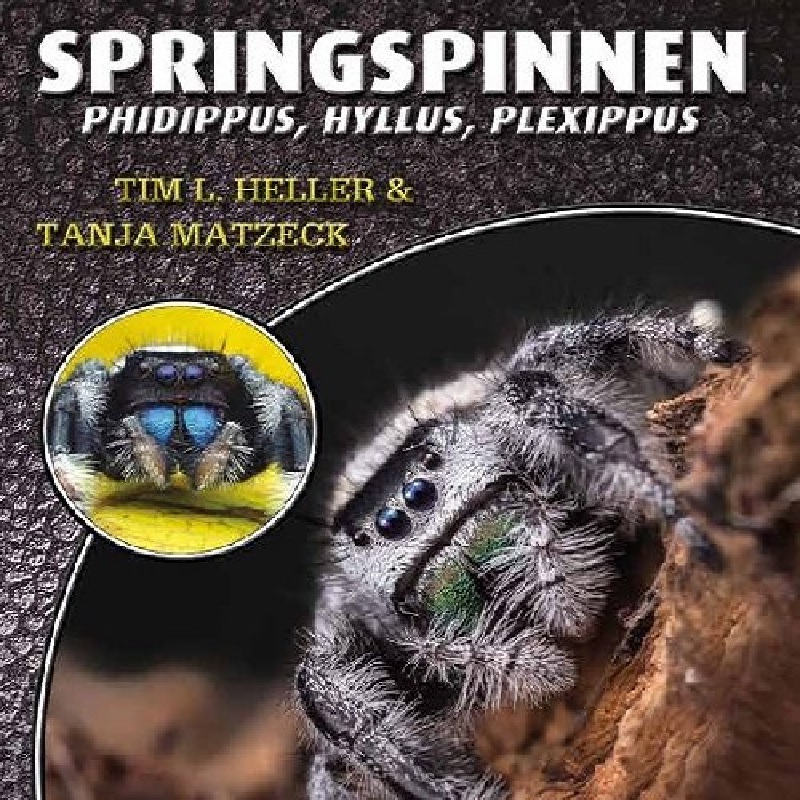
Book Jumping Spiders -
Phidippus, Hyllus & Plexippus
A guide to keeping jumping spiders of the genera Phidippus, Hyllus & Plexippus. Who can resist the charm of jumping spiders? The childlike appearance of their expressive face simply leaves no one cold! In addition, their behavior is extremely exciting to observe, their colors are bright and their requirements for species-appropriate keeping are very easy to meet. No wonder these likeable jumpers are all the rage!
This volume in the "Species by Species" series describes in detail what to look out for when buying and keeping them, introduces the most commonly kept species and color forms and provides plenty of tips on how to keep them successfully - so you can be sure they will breed well!
Species by Species introduces you to the books in this series, which present the most popular terrarium animals. Each volume offers you detailed, practical care instructions and all the information you need to successfully breed your animals.
All important questions from the required tank size to terrarium set-up, technical equipment, species-appropriate nutrition and disease prevention are answered with numerous tricks and tips.
Experienced, long-standing breeders reveal how you can encourage the animals to reproduce and raise healthy young.
All this in full color, generously illustrated and attractively designed - just about your terrarium animal - species by species
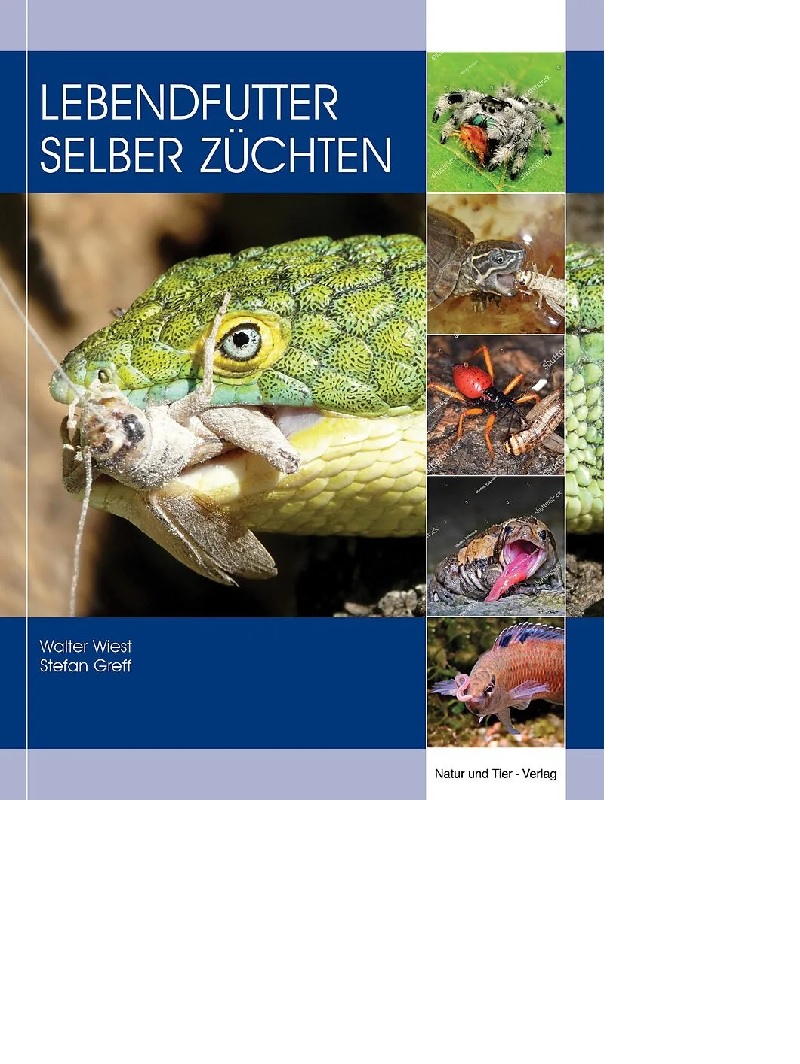
Book "Grow your own live food" - The perfect guide for pet owners
Discover practical and detailed instructions on how you can easily breed food for your reptiles, birds, fish or other animals yourself in the book "Breeding live food yourself". With valuable tips on various food insects, their care and breeding, you can save money and ensure a species-appropriate diet for your pets.
Contents of the book:
Step-by-step instructions for breeding feeder insects
Information on the best types of food for reptiles, birds and fish
Care instructions and breeding conditions for various live food species
Tips for sustainable and cost-effective food production
Why breed your own live food?
Get healthy, fresh food for your animals
Save money and reduce dependence on pet shops
Promote the health and well-being of your animals with species-appropriate food
Whether you are a beginner or an experienced pet owner, this book provides you with everything you need to successfully breed live food yourself.
Marginata 69 - New Guinea tortoises – the genus ElseyaCover storyThe unrecognised beauties: New Guinea tortoises (Andreas S. Hennig)My experiences with Branderhorst's New Guinea tortoise, Elseya (Elseya) branderhorsti (Ouwens, 1914) (Andreas S. Hennig)Keeping and breeding of Rhodin's New Guinea tortoise, Elseya (Hanwarachelys) rhodini Thomson, Amepou, Anamiato & Georges, 2015 (Andreas S. Hennig)PortraitGeoemyda spengleri, Chinese serrated tortoise (Andreas S. Hennig)ReportageMacrochelys temminckii – Experiences and impressions with vulture tortoises part 2 (Reiner Praschag)KeepingAn alternative to year-round keeping of the Egyptian tortoise in the terrarium – my experiences with seasonal outdoor keeping of Testudo kleinmanni (Ricarda Schramm)EtymologySawbacks and living maps part 4: Graptemys gibbonsi, Pascagoula humpback tortoise (Holger Vetter)Classifieds & animal placement
Reptilia 21 - Terrarium equipment
Sand ottersPhrynops Dahli - a rare tortoise from ColombiaSkolopender - Schnapps and scorpion snacks
Contents:
Page 2 - EditorialPage 3 - Letters to the editorPage 6 - MagazinePage 13 - DatesPage 16 - Western Herp Perspectives: Broadening horizons abroad, by B. LovePage 18 - Photo report: The biotope in the living room, by J. RauhPage 24 - Report: An uncomplicated indoor terrarium, by M. SchmidtPage 29 - Report: Artificial rocks in the terrarium, by H. Zwartepoorte and M. VriesPage 33 - Report: Substrates and back wall design, by J. RauhPage 40 - Journey: On a tail lizard excursion in northern Oregon. Part 2: From the coast to Eugene, by H. WallaysPage 47 - Portrait and poster: Chlamydosaurus kingii, by M. Aresé and J. L. FarriolsPage 51 - Report: The sand adder Vipera ammodytes, by P. Katke and B. TrappPage 58 - Keeping and breeding: Keeping and breeding of some Andean keel-tailed iguanas (Stenocercus) from the Peruvian highlands. Part 3, by U. SchlüterPage 63 - Herpetofauna Phrynops dahli - A little known turtle species from the Caribbean coast of Colombia, by J. L. de la Osa VelásquezPage 68 - Keeping and breeding: Rare in the terrarium: The desert dragon Trapelus mutabilis, by H. D. MüllerPage 73 - Report: A drink with a bite and the liver with a sting, by I. and B. FritzschePage 80 - REPTILIA on the road: Reptile Zoo Iguana in Visslingen/NL, by A. HauschildPage 83 - Advice and actionPage 89 - LibraryPage 96 - Glossary: The crisis of statutory health insurance for reptiles and amphibians, by M. Vanselow
Marginata 43 - Vietnamese pond turtlesEuropean pond turtles in Upper SwabiaChinese striped turtles on TaiwanGiant tortoises of CurieuseContents:Cover story: Vietnamese pond turtles - a success storyA Vietnamese pond turtle (Mauremys [Annamemys] annamensis), which was considered extinct in the wild between 1940 and around 1980, has been intensively bred by dedicated private keepers since the 1990s and thus saved from extinction. Zoos became involved in conservation breeding during the EAZA ShellShock turtle campaign in 2002, and in 2013 the first animals from private keepers and zoo breeding programmes were sent back to Vietnam. There, with the help of these animals and the designation of a suitable reintroduction site, a new foundation was laid for the conservation of the species within its original range. The forthcoming issue of Marginata will present both field data from Vietnam, including details on the reintroduction, and data on the long-term husbandry and breeding by private breeders and zoological institutions.EditorialMagazineKEEPING & BREEDINGCare, breeding and rearing of the Annam swamp turtle, Mauremys annamensisHerbert Becker, Elmar Meier, Martina Raffel & Henk ZwartepoorteBIOLOGYGenetic and carapace shape variability in Mauremys annamensisTomáš ProtivaSPECIES PROTECTIONThe critically endangered Annamese pond turtle (Mauremys annamensis) – captive breeding as a contribution to species conservationHenk Zwartepoorte, Herbert Becker, Elmar Meier, Martina Raffel & Tim McCormackREPORTAGEIn the habitat of the Chinese pond turtle (Mauremys sinensis) in TaiwanSebastian Nickl & Bastian EsserPORTRAITTestudo hermanni boettgeri (Mojsisovics, 1889), Böttger’s tortoiseBenny TrappTRAVELThe giant tortoises of CurieuseMartin DieckmannREPORTAGEMarginated tortoises (Testudo marginata) in Sardinia and their endangermentYvonne & Werner LantermannSPECIES PROTECTIONThe European pond turtle in Upper SwabiaDominik HauserBook tipSubscription & ServiceRegional guide
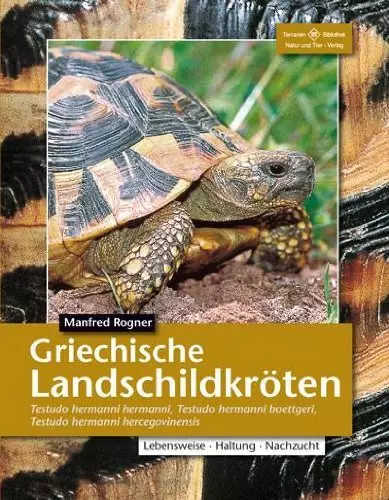
Book Greek tortoises
The Greek tortoise is a true classic of terraristics.
167 pages
with numerous mostly coloured illustrations and maps
Paperback
Author Manfred Rogner
Publisher NTV
Their attractive appearance and friendly character mean that they are rightly at the top of the list of favourites among tortoise lovers. For decades, the experienced terrarium keeper Manfred Rogner has been caring for and breeding this attractive species with great success, which he has also observed in their habitat.In this guide, he describes everything you need to know about the species-appropriate keeping and breeding of your armoured pets in a clear and practical way.
Chimaira, Outdoor facilities for water and swamp turtles
Practical guide
The author knows how to combine his enthusiasm for a species-appropriate and beautifully designed outdoor facility with the care needed to bring the individual aspects of this complex subject closer to an interested audience. A must for anyone who keeps or would like to keep turtles in a garden pond.
Draco 45 - Costa Rica
Editorial
Costa Rica - a herpetological paradise!Michael Wirth
--> Literature
Worthwhile destinations for amphibian and reptile lovers in Costa RicaMichael Wirth
In search of frogs in Costa RicaTobias Eisenberg
Of crocodiles and caimans - the armoured lizards of Costa RicaMichael Wirth
--> Literature
Redfrog Team - Conservation of reptiles and amphibians in the Talamanca region, Costa RicaJens Ackermann & Thorsten Tittel
Looking for snakes around Puerto Viejo - a great day in Costa RicaMichael Wirth
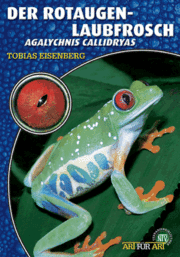
All about the red-eyed tree frog by Tobias Eisenberg
62 pages
Format: 14.8 x 21 cm
52 colour photos, maps, tables
2nd edition
Author Tobias Eisenberg
Publisher NTV
Contents:
The red-eyed tree frogs are undoubtedly among the most beautiful and interesting frog species of all. Hardly any other amphibian is so well known to laypeople from posters and postcards thanks to its attractive and downright photogenic appearance.The experienced terrarium keeper and vet specialising in amphibians and reptiles, Tobias Eisenberg, provides you in this guide with all the information about the lifestyle and terrarium keeping of the red-eyed tree frog and explains in an easy-to-understand way how to breed the animals successfully and rear the offspring.
Systematics and body structure
The fascinating biology: From the life of the red-eyed tree frog
All information about species-appropriate keeping: from suitable terrarium to furnishing and technology to feeding
Successful breeding: mating stimulation, rearing of tadpoles and juveniles
Problem solutions: How to avoid the most common mistakes in care and how to help sick animals
Brilliant photos
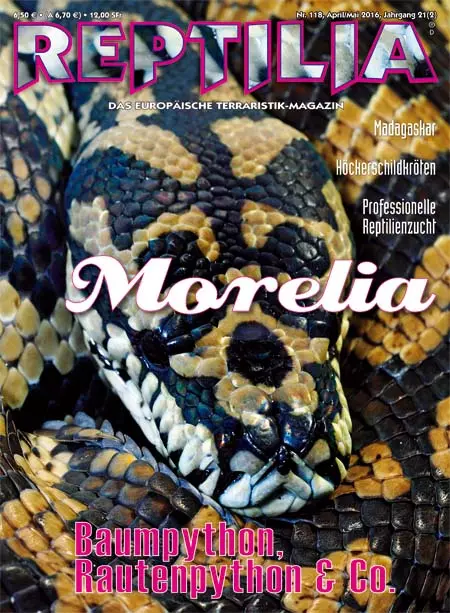
Reptilia 118 - MoreliaMadagascarHumpback turtlesProfessional reptile breeding Contents:Cover story: Morelia - tree python, diamond python & Co.Everyone knows the green tree python. The animals are admired for their colouring and their favourite position, curling up over a branch, almost symbolises our idea of a tree-dwelling snake. This species has been successfully kept and bred in terrariums for a long time. However, the other pythons of the Morelia genus are also very popular. We offer an overview of these exceptionally beautiful giant snakes, describe new ways of setting up a terrarium for Morelia viridis in a naturalistic way and look at the keeping and breeding of a species that is still little known, the python with a scaly scales, Morelia carinata.EditorialMAGAZINEDATESWESTERN HERP PERSPECTIVESThe fate of books part 2B. LovePhoto storyPython beauties from the other side of the world: Morelia, the tree and diamond pythonsM. MenseKeeping and breedingKeeping a green tree python in a naturally designed large terrariumR. StallingerKeeping and breedingMorelia carinata – The Python with a Difference!O. JugReportageRare exhibition animal: Morelia bredli at Frankfurt ZooD. RösselKeeping and breedingHumpback turtles – The genus GraptemysM. RognerKeeping and breedingProfessional breeding of terrarium animals for the pet tradeSimone P. ReportageUnder the spell of the big telescopic eyes: jumping spiders on the lookoutU. & J. SchimmelpfennigAnimals of our homelandThe sand lizardR. LeptienSERVICELIBRARYALSO NEAR YOUJourneySearching for reptiles in MadagascarC. SchneiderPREVIEWBRUTKASTEN Why do pigeons of all things have to be the symbol of peace?H. Werning
CHF 12.00
❅
❆
❅
❆
❅
❆
❅
❆
❅
❆
❅
❆
This website uses cookies to ensure the best experience possible. More information...