NTV, amphibians at the garden pond

Article no: 978-3-931587-09-3

CHF 32.50

Stock: 0

Ready for dispatch in 1-3 days, delivery time 14 working days

Delivery between Monday, 13 July and Tuesday, 14 July
Zahlungsarten
Product information "NTV, amphibians at the garden pond"

NTV, amphibians at the garden pond

André de Saint-Paul, Ingo Brand & Wolfgang Schmidt
  • 104 pages
  • 96 photos
  • Format: 16,8 x 21,8
  • With references to
    "Chemistry in the garden pond"
    "Safety at the garden pond"
    "Design"

Content:

You will not only get a beautiful
and interesting small biotope to the
own property, but can also be used
make an important contribution to nature conservation!

  • Everything you need to know in order for amphibians to settle in your pond
  • The amphibian-friendly garden pond
  • Large species part with splendid pictures
  • With "amphibian calendar" for the garden pond

Press commentaries:

Following a taste of the time more and more garden pond friends lay themselves ponds, many of them become so-called natural ponds. Surely, only the fewest investors consider thereby, what they can cause. For these a book appeared, which can answer each question, which they could ask, exhaustively, if it refers to the topic: Amphibien at the garden pond . Who knows them all, toads, toads, frogs and newts? All animal species that before man had settled in the places of today's ponds had long been resident and indigenous and had been suppressed for the time being. What to do when they return suddenly and inconspicuously? Many gardeners are aware of the fact that this can happen in well-designed gardens and have been described in some articles (...). So what should we do to get to know these new citizens of the garden better and, if possible, to help them even more? Very simple: Buy and read the book discussed here!
Rarely has a book summarized so much worth knowing about this topic so succinctly and comprehensibly.
Some garden friends, who are not quite firm with the determination, will use the many clear photos beside the text, in order to determine its pond inhabitants correctly. The text leaves also no wish open, there are chapters about the animal species themselves and such, which have apparently secondary meaning, but for a longer existence of pond and animal are extremely important: "Nature as a model", "Legal regulations", "Settlement of amphibians", "Water supply", "Pond technology" and "Safety at the garden pond" are just a few examples. Everything is presented very clearly and comprehensibly for zoological laymen and is also exciting to read.
Conclusion: A 5-star book!

Walther Rohdich in The Aquarium 08/2002


Recommended
(...)Altogether (...) a recommendable book for garden owners who are interested in amphibians, as well as for all amphibian friends and those who want to become one.

Petra Kölle in DATZ 9/2002


(...)(This book) is intended to serve those who want to create a garden pond in their garden that is as close to nature as possible.
The book first of all examines the question of whether the garden pond can be a Noah's ark for amphibians and what position amphibians occupy in the biotope garden pond. The next chapter gives a brief overview of amphibians: evolution, systematics, way of life, catching prey, breathing, voice, reproduction, from egg to lurch, migrations and enemies and diseases. This gives everyone the basic knowledge they need to better understand amphibians. (...)
In the following kind descriptions all amphibian-types native with us are introduced except for two (...) in text and picture. Thereby, distribution, way of life and reproduction are discussed in detail. The garden ponds for amphibians are taken into account afterwards, whereby also the remaining garden is included in the discussion. The question "Fish and amphibians in a body of water - is that possible?", which is important for many people, is answered as well as questions about legal regulations, settlement in one's own garden and the construction and maintenance of a garden pond. (...)
The last part of the book is about safety at the garden pond, care tips and an "amphibian calendar", which gives an overview of important events in the course of the year of the native species. At the end there is a glossary, a bibliography and an index.
The book can be considered as quite successful and gives also the interested layman the possibility of making itself fast familiar with the topic. (...) Altogether a recommendable reading for "newcomers" or advanced readers who are interested in this topic.

Peter Janzen, DGHT-AG Anuren, in elaphe 3/2002


A feel-good garden for frogs
A beautiful garden pond is not just a piece of quality of life. It can also make a contribution to nature and species conservation, according to André de Saint-Paul, Ingo Brand and Wolfgang Schmidt in the book "Amphibien am Gartenteich", published by Natur und Tier - Verlag. Location, pond type, water supply, planting and technology - nothing is left out. In addition the Artenteil equipped like the entire book with excellent color photos presents all domestic tail and frog through species with detailed information and refers also to their special needs.

Review in Dresdner newest News of 30.05.2002


(...)The book shows the right way. More and more garden owners want to create a piece of nature with frogs, toads and newts.
One is also reasonably informed about the work involved in setting up and maintaining such a watercourse. The care of the small water is also important, and here the author gives many care tips.
Also the amphibian calendar is valuable, which clearly tells each owner of a garden pond what is happening at which time of the year in his water and when he can find which kind of amphibian there.
Get a beautiful and interesting small biotope on your own property. Well informed you can make an important contribution to nature conservation!

Composition
Feeding recommendation
Technical details
Size information

0 of 0 reviews

Give us a rating!

Share your experience with the product with other customers.


Suggested products

Handbook of food plants for tortoises and other reptiles
Handbook of forage plants 2nd revised editionMarion Minch is not only a successful breeder of diverse tortoises for many years, but also an excellent connoisseur of native wild herbs. She founded and runs samenkiste.de, which is well known to many tortoise keepers and nature lovers. Her name is inextricably linked with reptile care and species-appropriate nutrition for tortoises. Her handbook of food plants summarises the most important native food plants for herbivorous and omnivorous reptiles. She not only considers tortoises, but also iguanas, spiny-tailed dragons and even chameleons. From the basics of plant biology to native wild herbs to suitable food plants for hardy tropical reptile species, this comprehensive work provides the basis for species-appropriate keeping. In the expanded and supplemented 2nd edition, the plant section is divided according to flower colour. This makes it even easier to identify wild herbs. The work has also been supplemented with a wealth of additional information and many pictures.

CHF 46.50

Geckos
Geckos in the terrarium by Astrid FalkThe book offers a comprehensive introduction to geckos and their species-appropriate keeping in terrariums. It explains what you need to think about before buying a gecko and what preparations should be made. The book describes in detail how the terrarium is technically equipped and set up. The care of the animals, their special features and behaviour, their diet, reproduction and rearing of young animals are described, as well as diseases and husbandry problems with tried and tested suggestions for prevention and treatment. Individual gecko species that are particularly suitable for keeping and breeding in terrariums are portrayed in detail in the second part of the book.

CHF 28.50

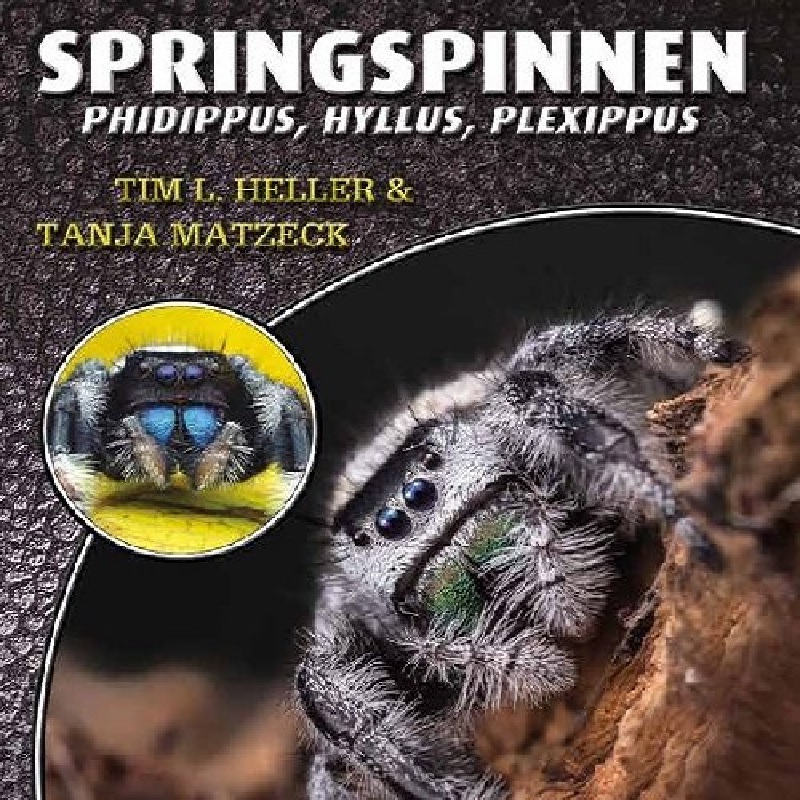
Jumping spiders Phidippus, Hyllus, Plexippus
Book Jumping Spiders - Phidippus, Hyllus & Plexippus A guide to keeping jumping spiders of the genera Phidippus, Hyllus & Plexippus. Who can resist the charm of jumping spiders? The childlike appearance of their expressive face simply leaves no one cold! In addition, their behavior is extremely exciting to observe, their colors are bright and their requirements for species-appropriate keeping are very easy to meet. No wonder these likeable jumpers are all the rage! This volume in the "Species by Species" series describes in detail what to look out for when buying and keeping them, introduces the most commonly kept species and color forms and provides plenty of tips on how to keep them successfully - so you can be sure they will breed well! Species by Species introduces you to the books in this series, which present the most popular terrarium animals. Each volume offers you detailed, practical care instructions and all the information you need to successfully breed your animals. All important questions from the required tank size to terrarium set-up, technical equipment, species-appropriate nutrition and disease prevention are answered with numerous tricks and tips. Experienced, long-standing breeders reveal how you can encourage the animals to reproduce and raise healthy young. All this in full color, generously illustrated and attractively designed - just about your terrarium animal - species by species

CHF 23.90

Book Breeding live food yourself
Book "Grow your own live food" - The perfect guide for pet owners Discover practical and detailed instructions on how you can easily breed food for your reptiles, birds, fish or other animals yourself in the book "Breeding live food yourself". With valuable tips on various food insects, their care and breeding, you can save money and ensure a species-appropriate diet for your pets. Contents of the book: Step-by-step instructions for breeding feeder insects Information on the best types of food for reptiles, birds and fish Care instructions and breeding conditions for various live food species Tips for sustainable and cost-effective food production Why breed your own live food? Get healthy, fresh food for your animals Save money and reduce dependence on pet shops Promote the health and well-being of your animals with species-appropriate food Whether you are a beginner or an experienced pet owner, this book provides you with everything you need to successfully breed live food yourself.

CHF 46.50

Marginata 69 - New Guinea tortoises
Marginata 69 - New Guinea tortoises – the genus ElseyaCover storyThe unrecognised beauties: New Guinea tortoises (Andreas S. Hennig)My experiences with Branderhorst's New Guinea tortoise, Elseya (Elseya) branderhorsti (Ouwens, 1914) (Andreas S. Hennig)Keeping and breeding of Rhodin's New Guinea tortoise, Elseya (Hanwarachelys) rhodini Thomson, Amepou, Anamiato & Georges, 2015 (Andreas S. Hennig)PortraitGeoemyda spengleri, Chinese serrated tortoise (Andreas S. Hennig)ReportageMacrochelys temminckii – Experiences and impressions with vulture tortoises part 2 (Reiner Praschag)KeepingAn alternative to year-round keeping of the Egyptian tortoise in the terrarium – my experiences with seasonal outdoor keeping of Testudo kleinmanni (Ricarda Schramm)EtymologySawbacks and living maps part 4: Graptemys gibbonsi, Pascagoula humpback tortoise (Holger Vetter)Classifieds & animal placement

CHF 16.50

Terraria No. 26 - Snakes of South America
Terraria No. 26 - Snakes of South America Peru-BuntleguanTheloderma leporosum > Inhalt: Südamerika ist Heimat einer überwältigenden Vielfalt an Schlangen. Einige davon zählen zu den begehrtesten, aber auch geheimnisvollsten Terrarienpfleglingen überhaupt, allen voran die Grünen Hundskopfschlinger der Gattung Corallus. Über sie berichtet einer der profiliertesten Züchter dieser faszinierenden Tiere, Harald Quirmbach. Weitere Einblicke in die reiche Schlangenfauna des Kontinents bietet Experte Christian Neumann, und TERRARIA-Redakteur Kriton Kunz porträtiert die Gattung Xenodon, zu der mit der bis vor kurzem als Lystrophis pulcher geführten Südamerikanischen Hakennasennatter einer der aktuellen Shootingstars der Terraristik gehört. EditorialMagazinGondwanaland – ein zukunftsweisendes Projekt im Zoo Leipzig. Teil 2: Bepflanzung und BaufortschritAndreas S. Hennig Neue Taxonomie für Gefleckte WalzenskinkeUwe Schlüter 15 Jahre HammKritón Kunz Erstimport des Pazifischen Schmuckhornfroschs, Ceratophrys stolzmanniKriton Kunz Rechtliches, Fehlende Sachkunde: Gewerbsmäßige Zucht und Handel mit Tieren können untersagt werden!Dietrich Rössel Mäuse-Bombardement gegen Braune NachtbaumnatterKriton Kunz „Most Wanted“ – die Suche nach 100 verschwundenen AmphibienartenAxel Kwet TERRAglobalIm Zauberwald der Anden Maik Dobiey TitelthemaVon Froschfressern und Schlangenjägern – Biogeografie und Anpassung südamerikanischer Schlangen Christian Neumann Die Königinnen Südamerikas: Corallus batesii und Corallus caninus Harald Quirmbach Südamerikanische Hakennasennattern und ihre Verwandten Kriton Kunz Erstnachzucht des Moosfroschs Theloderma leporosum Alexei A. Evsyunin, Sergei A. Ryabov & Kriton Kunz Der Peruanische Buntleguan, Polychrus peruvianus (Noble, 1924) Uwe Schlüter Zoropsis spinimana im Terrarium Reinhard Hübers Reise Die Herpetofauna auf Samos – außergewöhnliche Artenvielfalt auf einer InselHans-Jürgen Luef Neue ArtenWinzling in KannenpflanzenAxel Kwet Neue Blindschleichen in EuropaAxel Kwet Unter Forschern Herpetologie im Untergrund: globale Feldforschungen an Blindwühlen Alexander Kupfer Blickfang Von Halbaffen, Pfeilgiftfröschen und Geckos. Zu Gast bei Ute Thut und Dennis Peukert Teil 2Michael Wirth In Ihrer NäheAbo & ServiceVorschau Brutkasten Nächte mit Charlene Ludger Hogeback

CHF 12.00

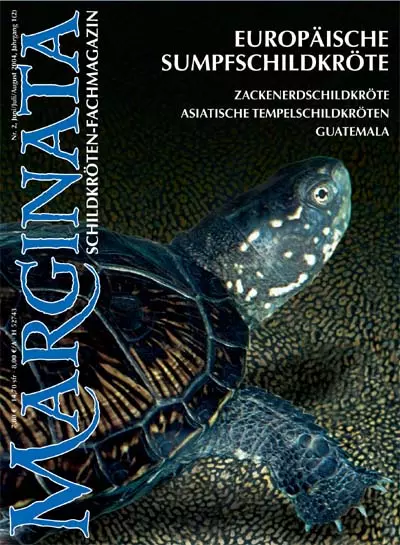
Marginata 02 - European Pond Turtle
Marginata 02 - European pond turtle Serrated terrapinsAsian Temple TurtlesGuatemala Contents: 2 EDITORIAL 3 THE TEAM INTRODUCES ITSELF 4 READER LETTERS 5 MAGAZINE 9 DATES 10 PHOTO REPORTAGEEuropean pond turtles (Emys orbicularis LINNAEUS, 1758)Hans - Dieter Philippen 14 REPORTAGEObservations and experiences regarding the keeping and breeding of the European pond turtle (Emys orbicularis LINNAEUS, 1758)Bernd Wolff 24 REPORTAGEThe relationship between origin, currently known phylogeny (evolutionary history) and habitat of the European pond turtle (Emys orbicularis) using three populations as examplesJens Poschadel 31 PORTRAITMadagascan flat-tailed turtlePyxis [Acinixys] planicauda (GRANDIDIER, 1867)Matthias Mähn 36 REPORTAGESpecies protection on the dream beach –The projects of the organisation ARCAS in GuatemalaKriton Kunz 46 REPORTAGEThe fascination of serrated terrapins (genus GeoemydaSome aspects of their keeping and biologyIngo Schaefer 52 REPORTAGEIntensively exploited without protection: Amyda cartilaginea (BODDART, 1770) and Dogania subplana (GEOFFROY ST.-HILAIRE, 1809) Mark Auliya 56 BOOK TIP 57 CLASSIFIEDS 58 REPORTAGESalmonellosis – Measures to prevent turtle-related transmissionTessa E. H. Römkens and Frank Stam 62 REGIONAL GUIDE 64 AGATHA MARGINATA

CHF 14.70

Reptilia 24 - Stick insects
Reptilia 24 - Stick insects Incubation of turtle eggsTerrarium photographyArch-snakes Contents: Page 2 - EditorialPage 3 - Letters to the editorPage 6 - MagazinePage 13 - DatesPage 16 - Western Herp Perspectives: Tribute to the Frog, by B. LovePage 18 - Photo report: Stick and ghost grasshoppers, by O. ZomproPage 24 - Keeping and breeding: Ghost insects of the family Heteropterygidae in the terrariumPage 30 - Report: Food animal and terrarium ornament at the same time: The Indian stick insect (Carausius morosus), by F. GastPage 34 - Journey: On a big game hunt for the sticks - Insights into the joys and dangers of a collecting trip, by I. FritzschePage 40 - Herpetology and culture: On the utilisation of some amphibian and reptile species in Peru, by T. EisenbergPage 47 - Portrait and poster: Anolis roquet, by M. SchmidtPage 51 - Herpetofauna: Observations on the ecology and terrarium keeping of the arch-snake Chalcides chalcides mertensi, Klausewitz 1954, by H. EsterbauerPage 55 - Keeping and breeding: Incubation of turtle eggs, by M. MähnPage 63 - Terrarium studies: Herpetological photography – ABC of reptile and amphibian photography for beginners and advanced, by U. StrathemannPage 70 - Herpetofauna: Asaccus – The leaf-fingered geckos of the Oman mountains, by R. LeptienPage 79 - Reptilia on the road: Zoological Garden of the City of Wuppertal, by A. HauschildPage 82 - Advice and actionPage 89 - LibraryPage 96 - Gloss: Forget fighting dogs! A friend for life, by K. Kunz

CHF 9.80

Reptilia 62 - Gopher tortoises
Reptilia 62 - Gopher tortoises Giant crab spiderAgalychnis moreletiiAmeives Contents: 2 EDITORIAL 3 MAGAZINE 16 DATES 18 WESTERN HERP PERSPECTIVESHerp Art - a sign of maturityBy B. Love 20 PHOTO REPORTAGEThe tortoises of North AmericaAn overview of the genus GopherusBy S. Winchell 28 HERPETOFAUNAGopherus flavomarginatus, the Mexican gopher tortoiseBy R. Gonzáles Trápaga & G. Aguirre León 35 HERPETOFAUNAThe gopher tortoise (Gopherus polyphemus) – a civil engineerBy H. R. Mushinsky & E. D. McCoy 41 REPORTAGEScrew trees (Pandanaceae) as microhabitats for reptiles and amphibians in MadagascarBy P.-S. Gehring 43 TRAVELHerpetological excursion to YbbstalBy S. Fallend 51 PORTRAIT AND POSTERRhacophorus pardalisBy M. Gaulke 56 PRACTICEThe diet of ameives and monitor tegus inthe wild and in captivityBy U. Schlüter 63 KEEPING AND BREEDINGKeeping and breeding of Morelet’s leaffrog, Agalychnis moreletii (Duméril, 1853)By T. Eisenberg 72 PRACTICE North American aquatic turtles in the outdoor terrarium Part 3: Description of an outdoor enclosure for the seasonal keeping of North American aquatic turtlesBy A. S. Hennig & D. Symanski 76 KEEPING AND BREEDINGEight-eyed hunters of the nightBrief remarks on the keeping and breeding of Heteropoda venatoria and Holconia sp.By K. Kunz 86 FAQ - FREQUENTLY ASKED QUESTIONSQuestions about purchasing and keeping snakesBy D. Schmidt 92 TERRARIUM EXHIBITSParque "Reptilandia" near Dominical, Costa RicaBy T. Eisenberg 95 LIBRARY 104 INCUBATORHigh mountain hallucinationsBy H. Werning

CHF 11.20

Draco 25 - Garter snakes
Draco 25 - Garter snakes Contents: 2 Editorial 6 Overview of the genus ThamnophisMartin Hallmen & Daniel Grübner 25 Old and new developments regarding the San Francisco garter snake (Thamnophis sirtalis tetrataenia)Martin Hallmen 32 The most common garter snakes in the terrariumDaniel Grübner 40 The garter snakesJan Sonnenberg 50 Aids for distinguishing some subspecies and colour forms of garter snakesPart 1: Thamnophis sirtalis sirtalis “flame” andThamnophis sirtalis sirtalis “speckled flame”Martin HallmenPart 2: The red subspecies of Thamnophis sirtalisJan SonnenbergPart 3: Thamnophis sirtalis similis andThamnophis sirtalis sirtalis “Florida blue”Martin HallmenPart 4: Distinguishing between Thamnophis proximus and Thamnophis sauritus and differentiation fromThamnophis radix and Thamnophis sirtalis sirtalisJan Sonnenberg 60 Garter snakes in scienceJan Gebauer 66 The less frequently recognised garter snakesDaniel Grübner 77 Colour forms of garter snakesDaniel Grübner & Jan Sonnenberg 86 Field observations of garter snakes in North AmericaHerbert Bruchmann 94 Common diseases in garter snakesBirgit Rüschoff, Bettina Christian & Daniel Grübner 102 Garter snakes in outdoor terrariumsMartin Hallmen 114 10 years European Garter Snake AssociationMartin Hallmen 116 Book box 124 Magazine

CHF 18.40

Thick-toed geckos
All about the fat-fingered geckos by Mirko Barts 61 pages 14.8 x 21 cm 45 colour photos 2nd edition Author Mirko Barts Publisher NTV Contents: Fat-fingered geckos have been on the rise for years. Their attractive appearance, their endearing nature and the low demands they place on keeping in the terrarium have quickly boosted their popularity. The experienced and successful terrarium keeper Mirko Barts covers in this book of the “Species by Species” series the species-appropriate keeping and care of fat-fingered geckos in every detail, from correct housing to healthy feeding. And of course, this guide also tells you how to breed your geckos, incubate the eggs and raise the tiny young. Systematics and body structure The fascinating biology: From the life of the fat-fingered geckos All information on species-appropriate keeping: from suitable terrarium to equipment and technology to feeding Successful breeding: Mating stimulation, incubation of the eggs and raising the young Problem solving: How to avoid the most common mistakes in care and how to help sick animals Brilliant photos

CHF 21.90

Green spiny lizards
All about green spiny lizards from Mike Zawadzki 62 Seiten 14,8 x 21 cm zahlreiche Farbfotos 1. Auflage Autor Mike Zawadzki Verlag NTV Inhalt: Was kann es Schöneres geben, als ein munteres Pärchen Malachit-Stachelleguane zu pflegen und sich an der reizenden Schar der selbst nachgezogenen Jungtiere zu erfreuen? Die prächtig gefärbten Tiere lassen mit Sicherheit das Herz eines jeden Echsenfreundes höher schlagen, und ihre Haltung und Pflege gelingen auch dem Einsteiger. Seit vielen Jahren vermehrt Mike Zawadzki erfolgreich Malachit-Stachelleguane. In diesem Ratgeber geht er detailliert auf alle Arten dieser Leguangruppe ein und schildert anschaulich ihre artgerechte Haltung. Und natürlich fehlen auch keineswegs die wichtigen Informationen, wie Sie Ihre Stachelleguane zur Fortpflanzung anregen und wie Sie die Jungtiere aufziehen können. Systematik und Körperbau Die faszinierende Biologie: Aus dem Leben der Malachit-Stachelleguane Alle Informationen zur artgerechten Haltung: Vom geeigneten Terrarium über Einrichtung und Technik bis hin zur Fütterung Erfolgreich nachzüchten: Paarungsstimulation und Aufzucht der Jungtiere Problemlösungen: Wie man die häufigsten Fehler bei der Pflege vermeidet, und wie man kranken Tieren helfen kann Brillante Fotos

CHF 21.90