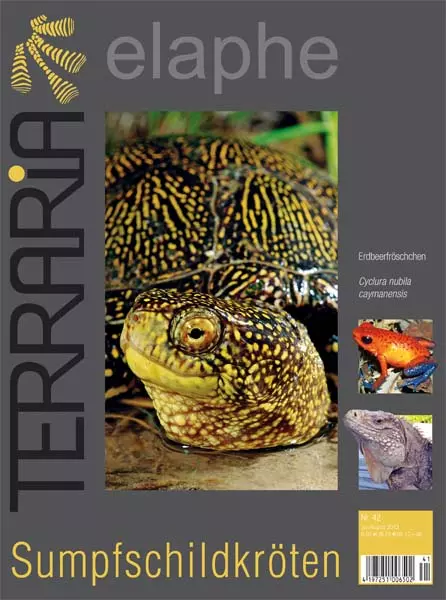
Marginata 47 - Turtles of Mexico

Article no: marginata47

CHF 16.50

Stock: 0

Ready for dispatch in 1-3 days, delivery time 7 working days

Delivery between Monday, 17 August and Tuesday, 18 August
Zahlungsarten
Product information "Marginata 47 - Turtles of Mexico"

Marginata 47 - Turtles of Mexico

Rarities from Vietnam
Searching for turtles in the Peloponnese
Leatherback turtle

Editorial
Magazine

TOPIC
The turtles of Mexico
Maik Shields

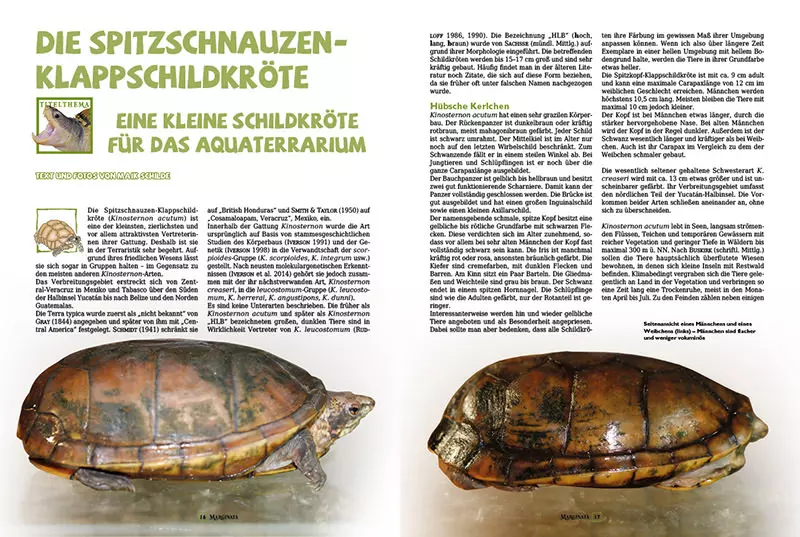
TOPIC
The pointed-snouted turtle. A small aquatic turtle for the terrarium
Maik Shields

TOPIC
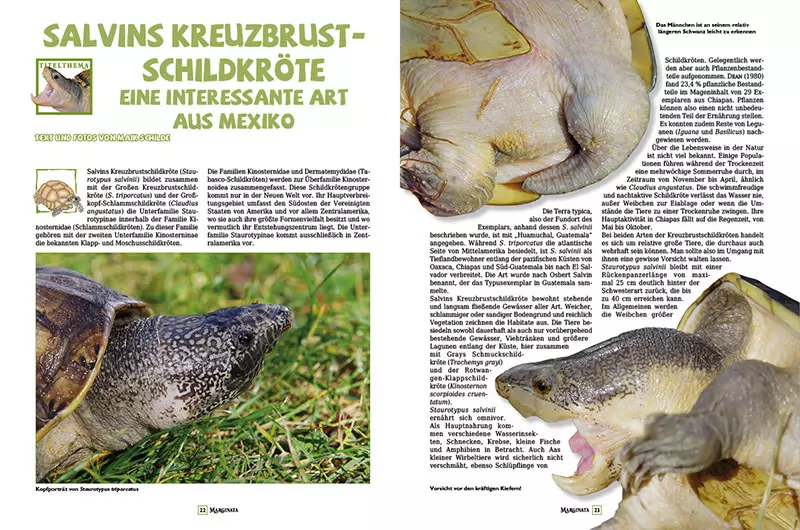
Salvin's cross-breasted tortoise. An interesting species from Mexico
Maik Shields

TOPIC
The Nayarit tortoise in nature and culture
Fabio Cupul

PORTRAIT
Dermochelys coricea Vandelli, 1761. Leatherback turtle
Kriton Kunz

TRAVEL
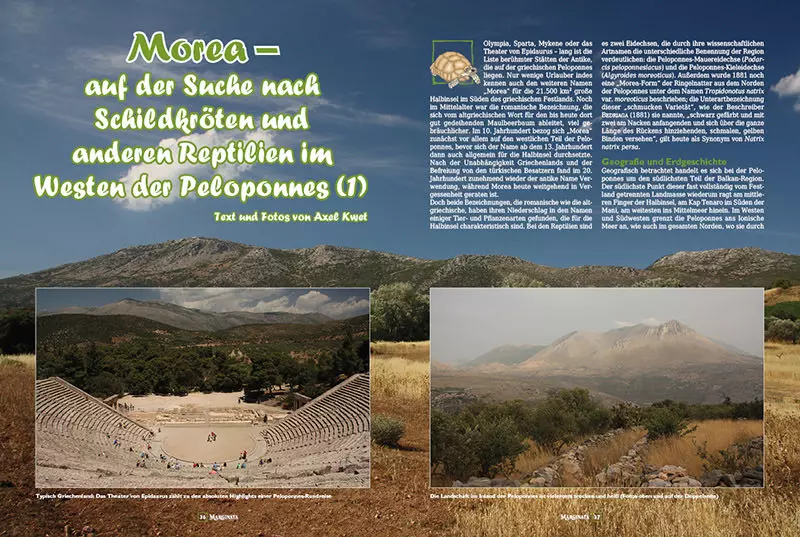
Morea – in search of turtles and other reptiles in the
west of the Peloponnese (1)
Axel Kwet

TRAVEL
In search of the "shy beauty" and the "cave turtles"
Torsten Blanck, Sebastian Braun, Timothy McCormack, Hoang Van Ha, Nguyen Tai Thang, Nguyen Van Luc & Minh Le

Subscription & Service
Regional guide

Composition
Feeding recommendation
Technical details
Size information

0 of 0 reviews

Give us a rating!

Share your experience with the product with other customers.


Suggested products

Handbook of food plants for tortoises and other reptiles
Handbook of forage plants 2nd revised editionMarion Minch is not only a successful breeder of diverse tortoises for many years, but also an excellent connoisseur of native wild herbs. She founded and runs samenkiste.de, which is well known to many tortoise keepers and nature lovers. Her name is inextricably linked with reptile care and species-appropriate nutrition for tortoises. Her handbook of food plants summarises the most important native food plants for herbivorous and omnivorous reptiles. She not only considers tortoises, but also iguanas, spiny-tailed dragons and even chameleons. From the basics of plant biology to native wild herbs to suitable food plants for hardy tropical reptile species, this comprehensive work provides the basis for species-appropriate keeping. In the expanded and supplemented 2nd edition, the plant section is divided according to flower colour. This makes it even easier to identify wild herbs. The work has also been supplemented with a wealth of additional information and many pictures.

CHF 46.50

Geckos
Geckos in the terrarium by Astrid FalkThe book offers a comprehensive introduction to geckos and their species-appropriate keeping in terrariums. It explains what you need to think about before buying a gecko and what preparations should be made. The book describes in detail how the terrarium is technically equipped and set up. The care of the animals, their special features and behaviour, their diet, reproduction and rearing of young animals are described, as well as diseases and husbandry problems with tried and tested suggestions for prevention and treatment. Individual gecko species that are particularly suitable for keeping and breeding in terrariums are portrayed in detail in the second part of the book.

CHF 28.50

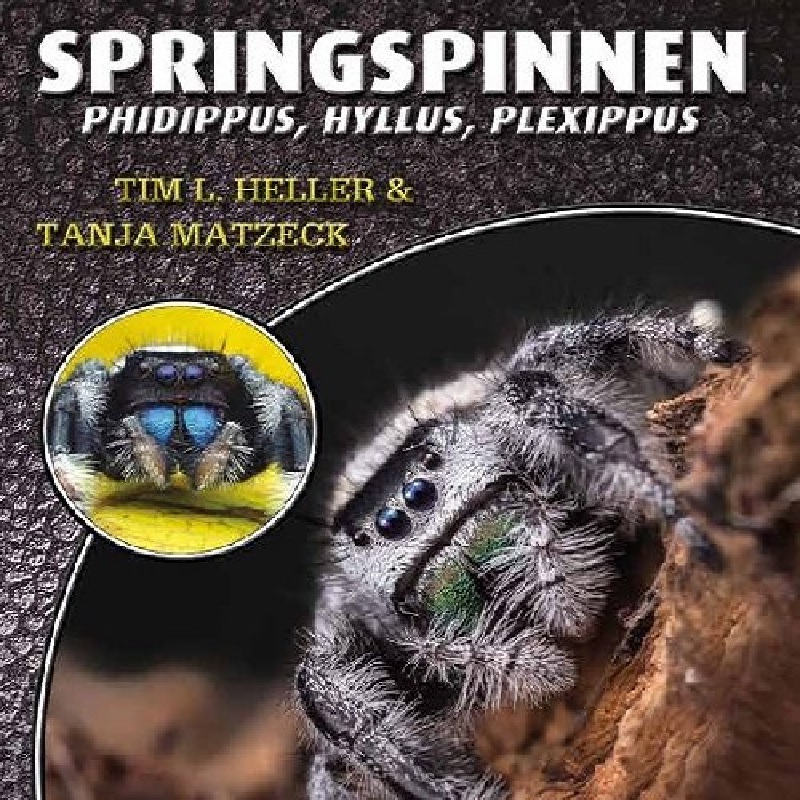
Jumping spiders Phidippus, Hyllus, Plexippus
Book Jumping Spiders - Phidippus, Hyllus & Plexippus A guide to keeping jumping spiders of the genera Phidippus, Hyllus & Plexippus. Who can resist the charm of jumping spiders? The childlike appearance of their expressive face simply leaves no one cold! In addition, their behavior is extremely exciting to observe, their colors are bright and their requirements for species-appropriate keeping are very easy to meet. No wonder these likeable jumpers are all the rage! This volume in the "Species by Species" series describes in detail what to look out for when buying and keeping them, introduces the most commonly kept species and color forms and provides plenty of tips on how to keep them successfully - so you can be sure they will breed well! Species by Species introduces you to the books in this series, which present the most popular terrarium animals. Each volume offers you detailed, practical care instructions and all the information you need to successfully breed your animals. All important questions from the required tank size to terrarium set-up, technical equipment, species-appropriate nutrition and disease prevention are answered with numerous tricks and tips. Experienced, long-standing breeders reveal how you can encourage the animals to reproduce and raise healthy young. All this in full color, generously illustrated and attractively designed - just about your terrarium animal - species by species

CHF 23.90

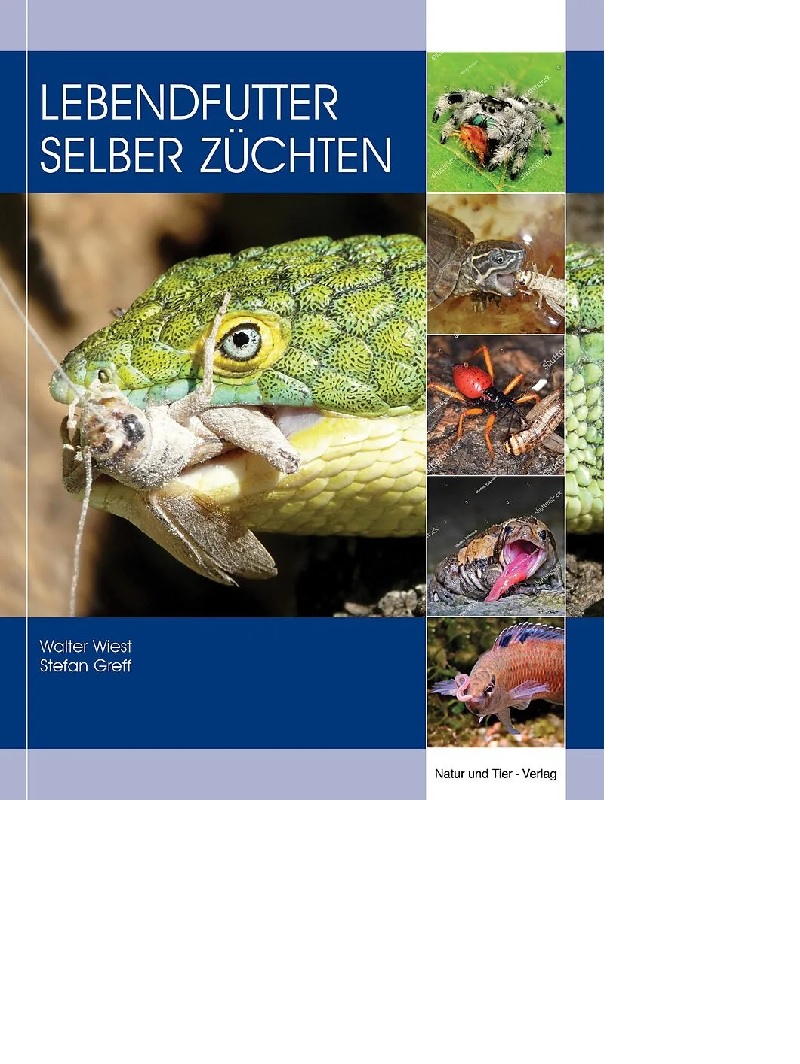
Book Breeding live food yourself
Book "Grow your own live food" - The perfect guide for pet owners Discover practical and detailed instructions on how you can easily breed food for your reptiles, birds, fish or other animals yourself in the book "Breeding live food yourself". With valuable tips on various food insects, their care and breeding, you can save money and ensure a species-appropriate diet for your pets. Contents of the book: Step-by-step instructions for breeding feeder insects Information on the best types of food for reptiles, birds and fish Care instructions and breeding conditions for various live food species Tips for sustainable and cost-effective food production Why breed your own live food? Get healthy, fresh food for your animals Save money and reduce dependence on pet shops Promote the health and well-being of your animals with species-appropriate food Whether you are a beginner or an experienced pet owner, this book provides you with everything you need to successfully breed live food yourself.

CHF 46.50

Marginata 69 - New Guinea tortoises
Marginata 69 - New Guinea tortoises – the genus ElseyaCover storyThe unrecognised beauties: New Guinea tortoises (Andreas S. Hennig)My experiences with Branderhorst's New Guinea tortoise, Elseya (Elseya) branderhorsti (Ouwens, 1914) (Andreas S. Hennig)Keeping and breeding of Rhodin's New Guinea tortoise, Elseya (Hanwarachelys) rhodini Thomson, Amepou, Anamiato & Georges, 2015 (Andreas S. Hennig)PortraitGeoemyda spengleri, Chinese serrated tortoise (Andreas S. Hennig)ReportageMacrochelys temminckii – Experiences and impressions with vulture tortoises part 2 (Reiner Praschag)KeepingAn alternative to year-round keeping of the Egyptian tortoise in the terrarium – my experiences with seasonal outdoor keeping of Testudo kleinmanni (Ricarda Schramm)EtymologySawbacks and living maps part 4: Graptemys gibbonsi, Pascagoula humpback tortoise (Holger Vetter)Classifieds & animal placement

CHF 16.50

Reptilia 88 - The Cryptopusics
Reptilia 88 - The Scheltopusik RhodesMeaning of UV irradiationColour forms of the western hook-nosed snakeContents:Europe's largest and at the same time strangest lizard captivates all reptile enthusiasts: the Scheltopusik. This equally awe-inspiring and elegant species, with its snake-like shape and lizard head, is one of the best-known reptiles and a classic in terrarium keeping. Nevertheless, reports of successful breeding remain rare. In the upcoming REPTILIA, Benny Trapp and Michael Wirth present Scheltopusiks from all parts of the range, both in text and fantastic photos, while Sascha Esser and his team from the Alexander Koenig Zoological Research Museum also report on breeding in indoor terrariums. This extraordinary cover story is rounded off by Peter Fritz, who describes in a very comprehensible way the construction of an outdoor enclosure for this species – something sure to interest every other outdoor terrarium keeper as well. Table of contents EditorialMAGAZINEDATES WESTERN HERP PERSPECTIVES Insufficiently recognised reptilesB. Love PHOTOSTORY Europe's largest lizard – the Scheltopusik, Pseudopus apodus M. Wirth PRACTICE An outdoor enclosure for the Scheltopusik, Pseudopus apodus P. Fritz REPORTAGE Keeping and breeding of the Scheltopusik, Pseudopus apodus, at the Alexander Koenig Zoological Research Museum S. Esser REPORTAGE The Scheltopusik in Croatia M. Wirth PORTRAIT AND POSTERGopherus polyphemusH. Werning ReportageColour forms of the western hook-nosed snake (Heterodon nasicus) F. Longhitano PRACTICE How important are UV light, vitamin and mineral supplements? New findings on bone metabolic diseases and their prevention using the example of the Yemen chameleon A. Kwet & S. Hoby TRAVEL The herpetofauna of Rhodes U. Schlüter Animals of our homeland. The dice snake R. Leptien TERRARIUM DISPLAYS The paradise of the unloved – the Scheidegg reptile zoo M. Wirth SUBSCRIPTION & SERVICE ALSO NEAR YOU PREVIEW  INCUBATOR  Ilha de Marchanteria   

CHF 12.00

Terraria 40 - Night-active Geckos
Terraria 40 - Nocturnal Geckos Majorca midwife toadEnclosure of tortoise outdoor enclosures Contents: Cover story: Nocturnal Geckos Nocturnal geckos are among the most popular terrarium animals of all. In the cover story of this issue of TERRARIA/elaphe, we take an in-depth look at the biology, care and breeding of three representatives of this vast group: the house geckos of the genus Hemidactylus, often scorned as “feed geckos”; the impressive green-eyed gecko Gekko siamensis; and finally the eye-spotted arched-toed gecko (Cyrtodactylus peguensis). TerritorialHerpetorama Cover storyHalf-finger geckos: Hemidactylus. The misunderstood genusBernd-Michael Zwanzig & Wolfgang Grossmann Keeping and breeding of Cyrtodactylus peguensisSiriporn Maier Experiences with the Thai green-eyed gecko, Gekko siamensisIngo Kober Panorama TerraglobalReptile search with obstacles - Part 1Joachim Bulian Pond frogs, pond newts, alpine newts. “Quantitative” side notes from our own gardenWerner & Yvonne Lantermann The herpetofauna of the Portuguese Star MountainsRudolf Malkmus Research New speciesList of amphibians newly described in 2012Axel Kwet Salamandra TerraristicsClassic. The smooth clawed frog Setting boundaries with understanding. The enclosure of an outdoor enclosure for European tortoisesPeter Buchert HomerangeIn snake country – A visit to Yvonne and Thomas KlesiusHeiko Werning Nature and species conservationField notes. Eyes bigger than the mouth – unsuccessful prey-catching attempt of a fire-bellied toadStefan Meyer Smooth newt or hybrid newt?Wolf-Rüdiger Grosse & Holger Wawrzyniak The Majorca midwife toad (Alytes muletensis). A fossil from the Ice AgeAxel Hilger MissingTurkestan angular-toothed newt (Hynobius turkestanicus)Alexander Gutsche Subscription & ServiceAlso in your neighbourhood GalleryWilly Wolterstorff – “Father of the newts” Preview IncubatorThe beagle of terraristicsJörg Hofmann

CHF 12.00

Draco 20 - Crocodiles
Draco 20 - Crocodiles Contents: 2 Editorial 4 The agamas of the worldMirko Barts & Thomas Wilms 24 On keeping Philippine sailfin lizards (Hydrosaurus pustulatus)Jiři Gábriš 34 On aggressive encounters among free-living butterfly agamas (genus Leiolepisy CUVIER), with a form of locomotion previously unknown in vertebrates/Wolfgang Böhme 40 In profile: the Vietnamese butterfly lizard (Leiolepis guttata CUVIER, 1829)Uwe Schlüter 42 On keeping and breeding two taxa from the Uromastyx-acanthinura complex: Uromastyx geyri MÜLLER, 1922 and Uromastyx dispar flavifasciata MERTENS, 1962 (Reptilia: Agamidae: Leiolepidinae: UromastyxThomas Wilms, Dieter Ruf & Beate Löhr 56 Agama impalearis (BOETTGER, 1874) – the Atlas agama, well-known and rare in the terrariumHans D. Müller 64Notes on keeping and breeding the lyre-headed lizard, Lyocephalus scutatus (LINNAEUS, 1758) Uwe Bartelt 70The agamas of southern AfricaMirko Barts 80 Experiences with the blue-throated angulate-headed lizard (Gonocephalus bellii) in the terrariumIngo Kober 87 Book box 94 Magazine

CHF 16.80

Reptilia 116 - Aquatic turtles - Perfect pets
Reptilia 116 - Aquatic turtles - Perfect pets Tarantula Oligoxystre diamantinensisChristmas in the African bushIntroduction to keeping venomous snakesContents: Cover story: Aquatic turtles – perfect petsAquatic turtles have enjoyed great popularity for decades. For a long time, however, small baby turtles were offered in pet shops for little money and ended up mainly with keepers who were not terrarium keepers and simply had no idea about these animals. The consequences are well known: overgrown red-eared sliders and other aquatic turtles that were abandoned or ended up in rescue centres. As a result, aquatic turtle keeping has fallen into disrepute. However, aquatic turtles are wonderful pets if you look after them properly and acquire the necessary expertise. We offer an overview of the species currently being kept and provide you with the tools you need to enjoy these charming turtles for a long time. EditorialMAGAZINEDATES WESTERN HERP PERSPECTIVESHerp photography goes crazyB. Love Photo storyFrequently kept aquatic turtle species – an overviewA. S. Hennig PracticeYellow stripes again and again …Information on the identification of commonly kept aquatic turtle speciesA. S. Hennig Keeping and breedingLarge salad with insect garnish. Nutritional advice for commonly kept ornamental, decorative and humpback turtlesA. S. Hennig Keeping and breedingFrom a five-mark piece to a soup plate. The successful rearing of aquatic turtlesA. S. Hennig Keeping and breedingNow also poisonous creatures! My introduction to keeping venomous snakesM. Hallmen Keeping and breedingOligoxystre diamantinensis. A gem in the middle of nowhere among the IschnocolinaeB. Rast & I. Wendt ServicesLIBRARYALSO NEAR YOU JourneyChristmas in the bush. Reptiles and more on Makutsi (South Africa)I. Kober PREVIEW BRUTKASTENLike a fish in waterH. Werning

CHF 12.00

Draco 60 - The reptiles of Europe
Draco 60 - The reptiles of Europe Contents: EditorialReptiles in Europe – a current overview Axel Kwet & Benny TrappThe Spanish reptile fauna Axel Kwet & Benny Trapp The vipers of EuropeAxel Kwet & Benny TrappReptiles of the Greek Aegean IslandsAxel Kwet & Benny TrappIberian mountain lizards and Spanish wall lizards – two evolutionary-biological model cases Axel Kwet & Benny TrappList of the reptiles of EuropeAxel Kwet & Benny Trapp

CHF 32.00

Bearded dragons
GU Bearded Dragon Book The expert beginner's guide to the "mini dragons" from Australia. 64 pages coloured photos Paperback Author Manfred Au Published by Gräfer & Unzer Like creatures from another planet! Bearded dragons are right at the top of the popularity scale for terrarium animals. They fascinate with their bizarre appearance and inquisitive nature. The mini dragons from Australia are also easy to care for and quickly become trusting. In GU Tierratgeber Bartagamen, bearded dragon expert Manfred Au explains everything you need to know about keeping these diurnal lizards: what to look out for when choosing them - detailed portraits of bearded dragons help with this -, how to acclimatise and care for them properly, what tastes good and keeps them fit. There are also tried and tested tips on health care, hibernation and care in the event of illness. In addition, there are many ideas and suggestions for species-appropriate and varied design of the terrarium, so that the animals are completely comfortable. The behaviour interpreter also explains typical bearded dragon behaviour. And with SOS - what to do? help is guaranteed in an emergency.

CHF 12.90

Reptilia 67 - Tiger Salamander, Axolotl & Co.
Reptilia 67 - Tiger Salamander, Axolotl & Co.Steve Irwin's legacyHusbandry problems with the green tree pythonBroad-shelled turtles in SardiniaContents: 2EDITORIAL 3MAGAZINE 11TERMINE 14WESTERN HERP PERSPECTIVESRevive the old passionFrom B. Love 6 PHOTO REPORTAGEAmbystomatidae Gray, 1850 ?transverse-toothed newtsBy T. Blanck 22HERPETOFAUNAThe cross-toothed newts, family Ambystomatidae Gray, 1850An overview of the speciesBy T. Blanck 36 KEEPING AND REPRODUCTIONKeeping and breeding the banded tiger salamander Ambystoma mavortiumBy T. Blanck & M. Braun 41HERPETOCULTUREThe axolotl in religion, magic and mythBy F. Cupul 45LETTERS11 years ReptiliaVisiting Bill LoveBy H. Werning 51PORTRAIT AND POSTERZamenis longissimusFrom A. Kwet 56 KEEPING AND REPRODUCTIONFringed-fingered lizards (Acanthodactylus) in the wild and in the terrariumPart 2: Basics of terrarium keeping and reproductive biologyBy U. Schlüter 67HERPETOFAUNATestudo marginata - A view of SardiniaBy E. Cimatti 77KEEPING AND REPRODUCTIONThe most common husbandry problems with the green tree python (Morelia viridis)By G. Maxwell 82TERRARIUM SHOW PLANTSCrickey! - A visit to Australia ZooBy K. Grießhammer 90FAQ - FREQUENTLY ASKED QUESTIONSGarter snakesBy M. Hallmen 94LIBRARY 104BROOD BOX The Silence of the Nose Frogs, Part 2 By H. Werning

CHF 11.20