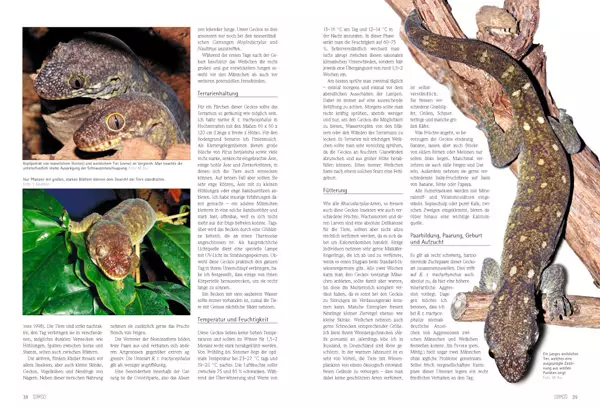
Draco 36 - New Caledonian Giant Geckos

Article no: draco36

CHF 18.40

Stock: 0

Ready for dispatch in 1-3 days, delivery time 7 working days

Delivery between Monday, 31 August and Tuesday, 1 September
Zahlungsarten
Product information "Draco 36 - New Caledonian Giant Geckos"

Draco 36 - New Caledonian Giant Geckos

Contents:

2   Editorial

4   The genus Rhacodactylus
     Patrick Schönecker
     & Stefanie Schönecker

14 Observations on New Caledonian
     Giant Geckos in the wild
     Friedrich Wilhelm Henkel

23 Goblins in the canopy – the crown gecko,
     Rhacodactylus ciliatus
     
Michael Wirth & Dennis Peukert

37 Keeping and breeding of
     Rhacodactylus trachyrhynchus trachycephalus
     
Yuri Kaverkin  37

42 Biology, keeping and breeding of
     Rhacodactylus leachianus henkeli
     
Patrick Schönecker & Stefanie Schönecker

50 Sarasin's Gecko – Rhacodactylus sarasinorum
     Friedrich Wilhelm Henkel

55 On keeping and breeding the
     hump-headed gecko, Rhacodactylus auriculatus
     
Michael Wirth & Dennis Peukert

64 The New Caledonian lichen gecko
     Rhacodactylus chahoua
     
Christian Langner

76 Book box

Composition
Feeding recommendation
Technical details
Size information

0 of 0 reviews

Give us a rating!

Share your experience with the product with other customers.


Suggested products

Handbook of food plants for tortoises and other reptiles
Handbook of forage plants 2nd revised editionMarion Minch is not only a successful breeder of diverse tortoises for many years, but also an excellent connoisseur of native wild herbs. She founded and runs samenkiste.de, which is well known to many tortoise keepers and nature lovers. Her name is inextricably linked with reptile care and species-appropriate nutrition for tortoises. Her handbook of food plants summarises the most important native food plants for herbivorous and omnivorous reptiles. She not only considers tortoises, but also iguanas, spiny-tailed dragons and even chameleons. From the basics of plant biology to native wild herbs to suitable food plants for hardy tropical reptile species, this comprehensive work provides the basis for species-appropriate keeping. In the expanded and supplemented 2nd edition, the plant section is divided according to flower colour. This makes it even easier to identify wild herbs. The work has also been supplemented with a wealth of additional information and many pictures.

CHF 46.50

Geckos
Geckos in the terrarium by Astrid FalkThe book offers a comprehensive introduction to geckos and their species-appropriate keeping in terrariums. It explains what you need to think about before buying a gecko and what preparations should be made. The book describes in detail how the terrarium is technically equipped and set up. The care of the animals, their special features and behaviour, their diet, reproduction and rearing of young animals are described, as well as diseases and husbandry problems with tried and tested suggestions for prevention and treatment. Individual gecko species that are particularly suitable for keeping and breeding in terrariums are portrayed in detail in the second part of the book.

CHF 28.50

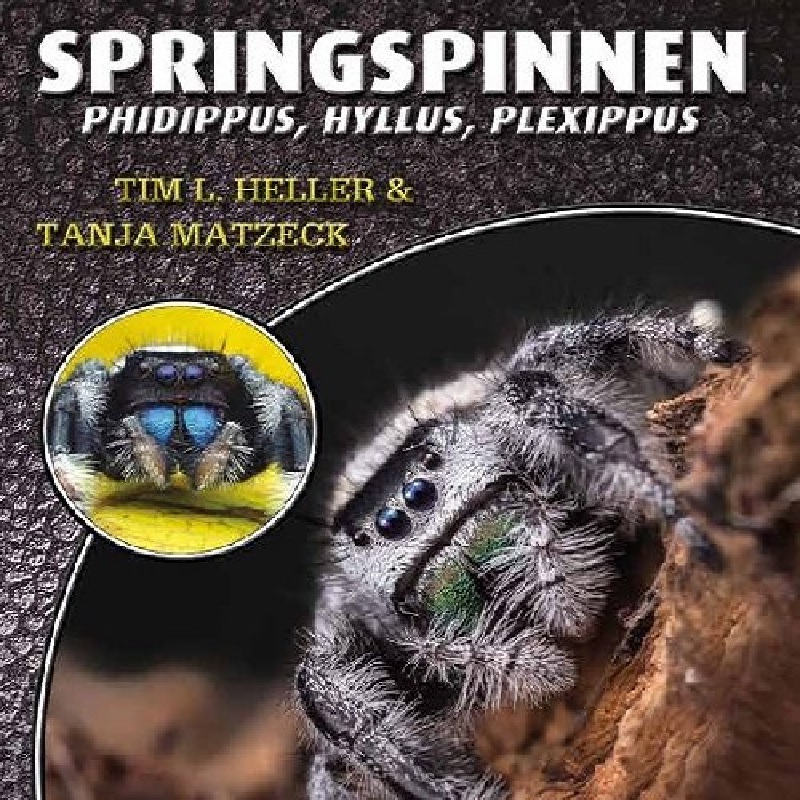
Jumping spiders Phidippus, Hyllus, Plexippus
Book Jumping Spiders - Phidippus, Hyllus & Plexippus A guide to keeping jumping spiders of the genera Phidippus, Hyllus & Plexippus. Who can resist the charm of jumping spiders? The childlike appearance of their expressive face simply leaves no one cold! In addition, their behavior is extremely exciting to observe, their colors are bright and their requirements for species-appropriate keeping are very easy to meet. No wonder these likeable jumpers are all the rage! This volume in the "Species by Species" series describes in detail what to look out for when buying and keeping them, introduces the most commonly kept species and color forms and provides plenty of tips on how to keep them successfully - so you can be sure they will breed well! Species by Species introduces you to the books in this series, which present the most popular terrarium animals. Each volume offers you detailed, practical care instructions and all the information you need to successfully breed your animals. All important questions from the required tank size to terrarium set-up, technical equipment, species-appropriate nutrition and disease prevention are answered with numerous tricks and tips. Experienced, long-standing breeders reveal how you can encourage the animals to reproduce and raise healthy young. All this in full color, generously illustrated and attractively designed - just about your terrarium animal - species by species

CHF 23.90

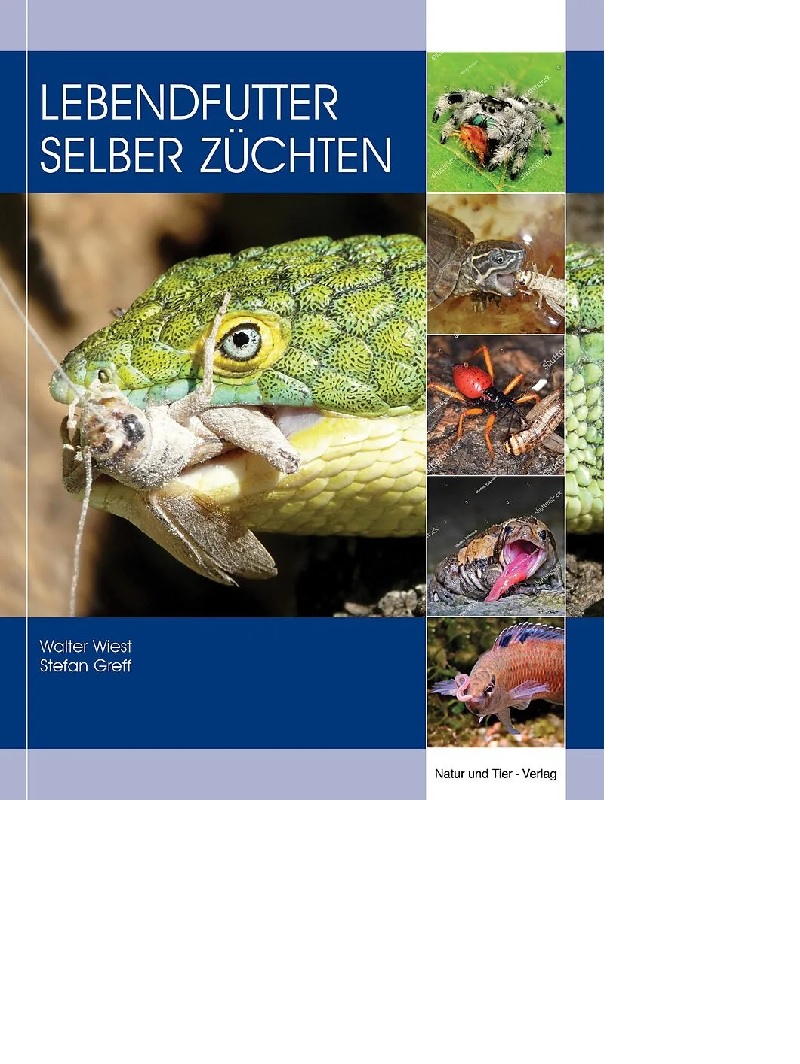
Book Breeding live food yourself
Book "Grow your own live food" - The perfect guide for pet owners Discover practical and detailed instructions on how you can easily breed food for your reptiles, birds, fish or other animals yourself in the book "Breeding live food yourself". With valuable tips on various food insects, their care and breeding, you can save money and ensure a species-appropriate diet for your pets. Contents of the book: Step-by-step instructions for breeding feeder insects Information on the best types of food for reptiles, birds and fish Care instructions and breeding conditions for various live food species Tips for sustainable and cost-effective food production Why breed your own live food? Get healthy, fresh food for your animals Save money and reduce dependence on pet shops Promote the health and well-being of your animals with species-appropriate food Whether you are a beginner or an experienced pet owner, this book provides you with everything you need to successfully breed live food yourself.

CHF 46.50

Marginata 69 - New Guinea tortoises
Marginata 69 - New Guinea tortoises – the genus ElseyaCover storyThe unrecognised beauties: New Guinea tortoises (Andreas S. Hennig)My experiences with Branderhorst's New Guinea tortoise, Elseya (Elseya) branderhorsti (Ouwens, 1914) (Andreas S. Hennig)Keeping and breeding of Rhodin's New Guinea tortoise, Elseya (Hanwarachelys) rhodini Thomson, Amepou, Anamiato & Georges, 2015 (Andreas S. Hennig)PortraitGeoemyda spengleri, Chinese serrated tortoise (Andreas S. Hennig)ReportageMacrochelys temminckii – Experiences and impressions with vulture tortoises part 2 (Reiner Praschag)KeepingAn alternative to year-round keeping of the Egyptian tortoise in the terrarium – my experiences with seasonal outdoor keeping of Testudo kleinmanni (Ricarda Schramm)EtymologySawbacks and living maps part 4: Graptemys gibbonsi, Pascagoula humpback tortoise (Holger Vetter)Classifieds & animal placement

CHF 16.50

The kingsnake
Alles über die Kettennatter von Dieter Schmidt 64 Seiten 14,8 x 21 cm zahlreiche Farbfotos Autor Dieter Schmidt Inhalt: Von kaum einer anderen Schlange gibt es derart viele verschiedene attraktive Farbvarianten wie von der Kettennatter. Dass es sich dazu auch noch um eine recht klein bleibende, friedliche Art handelt, die keine allzu grossen Ansprüche an die Terrarienhaltung stellt, macht sie zu einem äusserst beliebten und geeigneten Pflegling. Schlangenexperte Dieter Schmidt hält und züchtet diese Tiere seit Jahrzehnten und beschreibt in diesem Buch praxisnah ihre artgerechte Haltung und Pflege. Und wenn Sie seine Insider-Tipps zur Paarungsstimulation und zum Bebrüten der Eier beherzigen, werden Sie sicher bald eine Schar reizender Jungschlangen aufziehen können. Systematik und Körperbau Die faszinierende Biologie: Aus dem Leben der Kettennatter Alle Informationen zur artgerechten Haltung: Vom geeigneten Terrarium über Einrichtung und Technik bis hin zur Fütterung Erfolgreich nachzüchten: Paarungsstimulation, Inkubation der Eier und Aufzucht der Jungtiere Problemlösungen: Wie man die häufigsten Fehler bei der Pflege vermeidet, und wie man kranken Tieren helfen kann Brillante Fotos

CHF 21.90

Marginata No. 29 - Madagascan ray turtle
Marginata No. 29 - Madagascan ray turtle Schildkrötenforschung in den TropenSternschildkrötenzwillingeGallaguar-Schildkrötenschutz in Indonesien Inhalt: Editorial Magazin Termine REPORTAGEMadagaskars Südwesten – Heimat einer gestreiften ExotinJutta Hammer REPORTAGE Village des Tortues. Auffangstation für gewilderte Schildkröten Jutta Hammer HALTUNG UND ZUCHT Haltung und Nachzucht der Madagassischen Strahlenschildkröte. Teil 1 Michael Wirth & Peter Fritz POSTER Sulawesi-Sumpfschildkröte Leucocephalon yuwonoi Hans-Dieter Philippen REPORTAGE Zur Situation von Meeresschildkröten in Sri Lanka Sascha Pawlowski REPORTAGE Erfolgreiches Jahr 2010 im Internationalen Zentrum für Schildkrötenschutz (IZS) im Allwetterzoo Münster Elmar Meier, Martina Raffel & Hans-Dieter Philippen REPORTAGE Die Papua-Weichschildkröte (Carettochelys insculpta) und ihre Nachzucht in „Down Under“ Egon Heiss REPORTAGE Conrad Gesner und die Schildkröten Kriton Kunz REPORTAGE Ein nicht alltäglicher Doppelschlupf von Zwillingen bei der Sternschildkröte (Geo­chelone elegans) im Allwetterzoo Münster Jochen Scholdei BuchtippKleinanzeigen Abo & Service Regionalführer

CHF 16.50

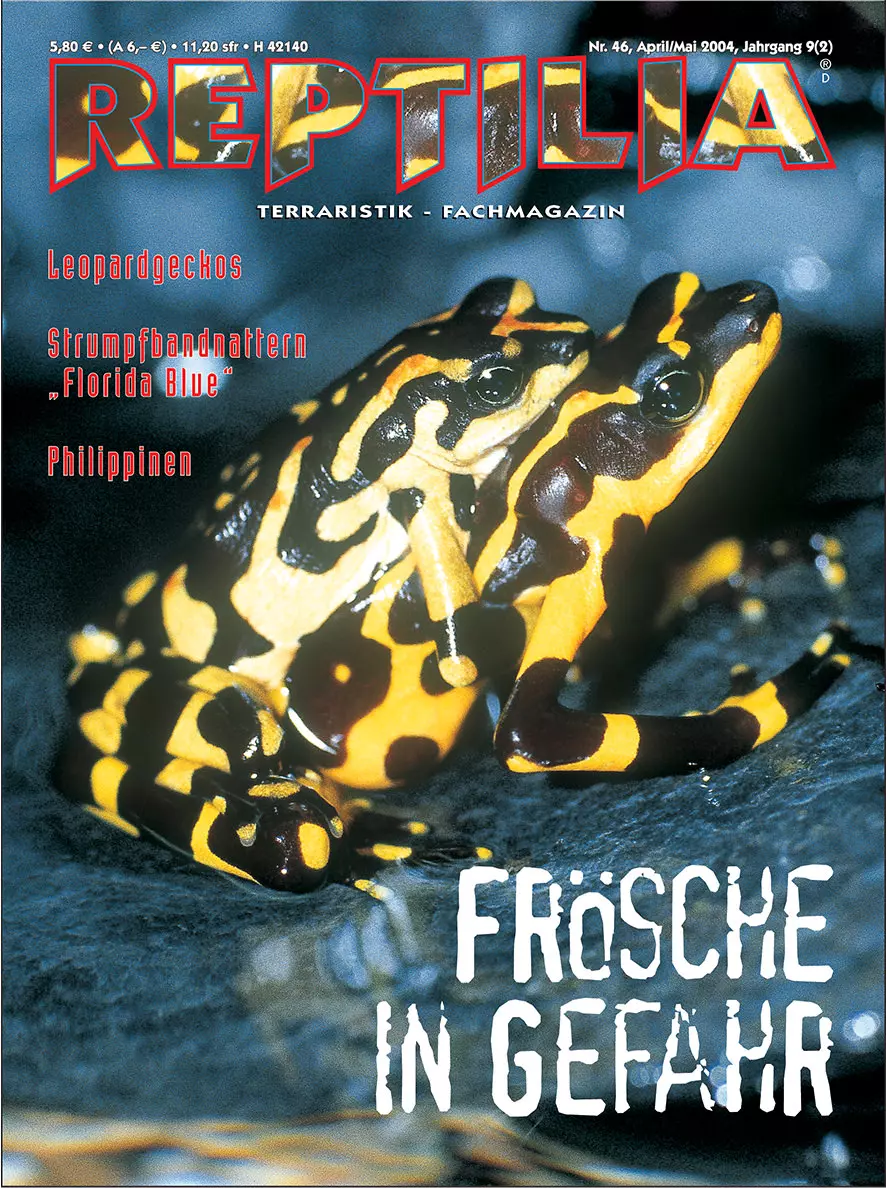
Reptilia 46 - Frogs in danger
Reptilia 46 - Frogs in danger Leopard geckosGarter snakes "Florida blue"Philippines Contents: 2 EDITORIAL 4 MAGAZINE 11 DATES 14 WESTERN HERP PERSPECTIVESSmall game in the sandby B. Love 16 PHOTO REPORTAGE Amphibian extinction: insight into the history and current researchby S. Lötters 24 REPORTAGENose frogs in danger - Hope for the semi-aquatic nose frog (Rhinoderma rufum)? by K. Busse & H. Werning 34 HERPETOFAUNAThe decline of frog populations in the high Andes of Venezuela by E. La Marca 39 REPORTAGEAmphibian extinction in African style by S. Schick 45 TRAVELClicking, ringing, whistling and shooting - the frogs of Panay by M. Gaulke 51 PORTRAIT AND POSTERTestudo hermanni boettgeriby B. Trapp 56 KEEPING AND BREEDINGThe leopard gecko - not just a beginner's animalKeeping and breeding of Eublepharis macularius in the terrariumby T. Wilms 63 HERPETOFAUNANot every blue garter snake is a "similis" - On distinguishing the blue forms of the common garter snake Thamnophis sirtalis sirtalis "florida blue" and the Florida garter snake Thamnophis sirtalis similisby M. Hallmen 70 KEEPING AND BREEDINGKeeping and breeding the red-eyed slender-headed turtle Emydura subglubosaby A. S. Hennig 74 HERPETOFAUNANorth America's king of rattlesnakes – Crotalus atrox – Part 2by D. Schmidt 80 REPORTAGEPlanning and construction of a reptile zoo: "Reptilium - Terrarium and Desert Zoo" in Landau - Part 1: The planning phaseby T. Wilms 86 SMALL ADVERTS 94 RAT & TAT 96 LIBRARY 104 GLOSSESThe Costa Cordalis of Weddingby H. Werning

CHF 11.20

Reptilia 102 - Poison dart frogs, newcomers and evergreens
Reptilia 102 - Poison dart frogs, newcomers and evergreens ChuckwallasGiant millipedesAngle-headed agamas Contents: Poison dart frogs are among the most popular terrarium animals of all. These colourful frogs fascinate with their behaviour and are ideal for keeping in lushly planted rainforest terrariums, which are an ornament for any living room. Some species have been successfully bred in terrariums for decades, while others have only recently found their way into the terrarium hobby and have yet to establish themselves. We present both groups: Newcomers and evergreens. EDITORIALMAGAZINEDATES WESTERN HERP PERSPECTIVES    Rattlesnake roundupsB. Love PHOTOREPORTAGEPoison dart frogs. Evergreens and newcomersM. Schmidt KEEPING AND REPRODUCTIONExperiences with keeping and breeding the Striped Leaf-climbing Frog (Phyllobates vittatus) in the terrariumT. Hofmann KEEPINGArmour-breaker – Ranitomeya benedicta, a rare guest in our terrariumsG. Elser TERRARIUM PRACTICEJewels in stainless steel. Building a terrarium for poison dart frogsPart 3: Keeping experiences with Phyllobates terribilisM. Schulte KEEPING AND BREEDINGKeeping tropical millipedesP. Ginal KEEPING A disastrous affairM. Rogner TERRARIUM PRACTICEThe dream of a jungle in the living room. Angle-headed agamas (Gonocephalus) in the terrariumM. Evers HERPETOFAUNAThe Chuckwalla – Sun worshipper in the rocky desertU. & J. Schimmelpfennig INTERVIEWThe corpse of StraubingREPTILIA in conversation with M. Baur TEST RUN TERRARIUM PRACTICEThe “Venom Defender” gloves. Development of an aid for handling dangerous animalsC. Kouijzer SERVICEALSO IN YOUR AREA TRAVELTo Sardinia in midsummerA. Schmid PREVIEW BRUTKASTEN Island of the iguanas. Part 1H. Werning

CHF 12.00

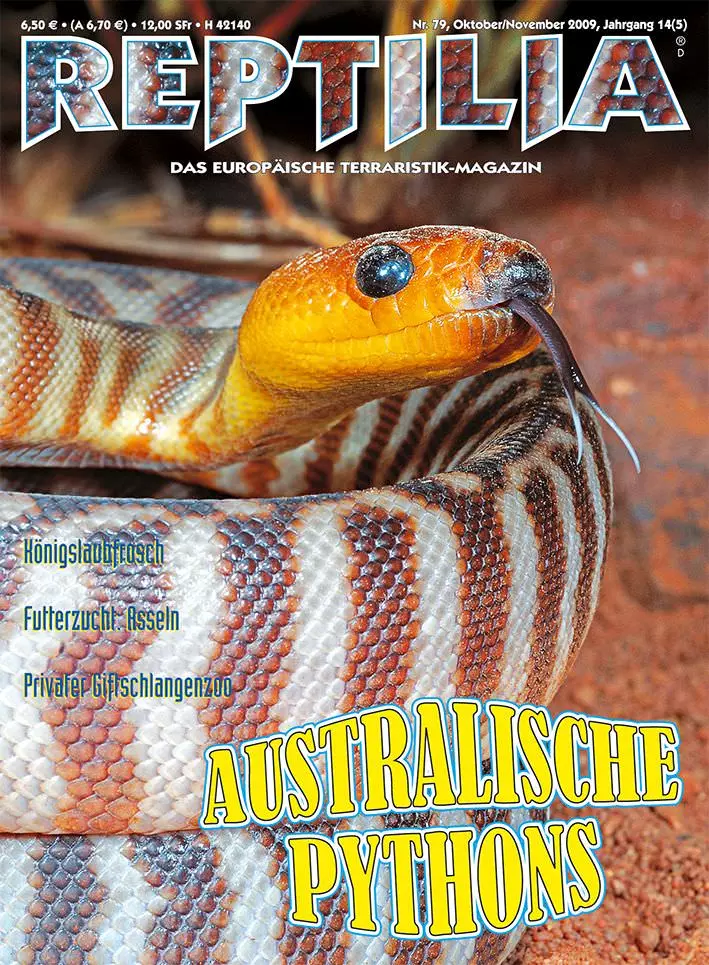
Reptilia 79 - Australian Pythons
Reptilia 79 - Australian PythonsRoyal tree frogFood breeding woodlicePrivate venomous snake zooContents:The unique herpetofauna of Australia is always at the centre of theInterest among terrarium keepers. This is particularly true of the giant snakes of the fifth continent. We report on them in detail, focussing on the rare forms Pilbara olive python (Liasis olivaceus barroni), Oenpelli's python (Morelia oenpelliensis) and the rough-scaled python (Morelia carinata).EDITORIALMAGAZINEDATES PHOTOSTORYPythons of Australiaby S. Winchell HERPETOFAUNARare and little-known pythons from Australia – Part 1: The rough-scaled python, Morelia carinataby S. Alcini HERPETOFAUNARare and little-known pythons from Australia – Part 2: The Pilbara olive python, Liasis olivacea barroniby S. Alcini HERPETOFAUNARare and little-known pythons from Australia – Part 3: The Oenpelli python, Morelia oenpelliensisby S. Alcini REPORTAGEThe most beautiful of them all – the leafhopper Ancylecha fenestrata von A. Schmidt PORTRAIT and posterChamaeleo hoehneliiby M. DobieyTRAVELIn the footsteps of Darwin through South America. Part 2: From Patagonia to Central Chileby H. Werning--> Literature on all three parts KEEPING AND REPRODUCTIONWoodlice as food animalsby J. Felka WESTERN HERP PERSPECTIVESHas the trade in reptiles and amphibians reached maturity?from B. Love KEEPING AND REPRODUCTIONThe King Tree Frog, Pseudacris regilla. Reintroduction of an old acquaintanceby R. Münzer TERRARIUM DISPLAYSThe serpentarium of the Snakeparadise in Eschlikon in Schweizerby H. Werning LIBRARYSUBSCRIPTION & SERVICEALSO NEAR YOUPREVIEW BRUTKASTEN Bear Country. Quasi live from Yellowstone National Parkby H. Werning

CHF 12.00

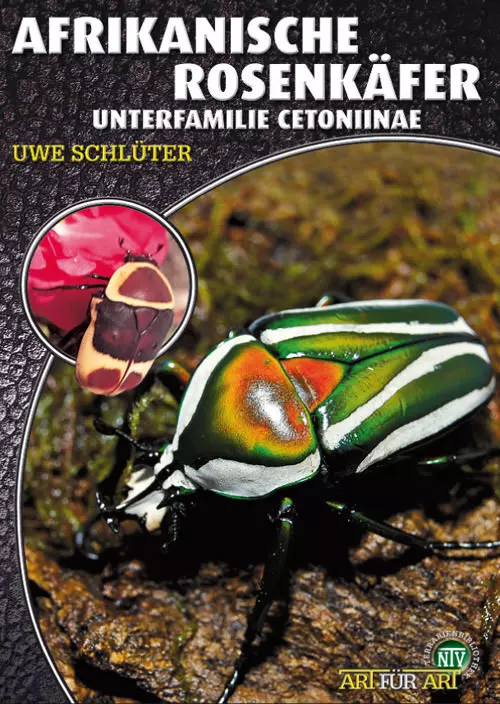
The african rose chafer
Not just food animals! Everything about keeping and caring for African rose chafer beetles at home. 64 pages Format: 14.8 x 21 cm numerous colour photos Author Uwe Schlüter Many terrarium keepers only know them as food animals: the larvae of rose chafer beetles. However, these beautiful insects are in turn fascinating, easy-to-keep terrarium animals. Uwe Schlüter presents tropical species of rose chafer beetles from Africa that are currently in vogue, including the impressive goliath beetles. Beetle care made easy! Contents: Foreword Classification Morphology of rose chafer beetles Imagines of the Cetoniinae Larvae of the Cetoniinae Rose chafer beetles in nature Lifestyle and behaviour Life cycle Care in the terrarium Acquisition and transport Terrarium equipment and climate Socialisation Feeding of imagines and larvae Reproduction in the terrarium Egg laying Rearing the larvae Pupation and hatching of imagines Descriptions of selected species Further information Further and used literature

CHF 19.90

The yellow-bellied slider
The yellow-cheeked tortoise is one of the most popular tortoises among young and old. 64 pages 14.8 x 21 cm numerous colour photos Author Andreas S. Hennig Contents: Hardly any other turtle species is as popular with young and old as the yellow-cheeked tortoise. And rightly so, as it is a beautifully coloured species with interesting behaviour that can also be recommended to beginners. Experienced tortoise keeper Andreas S. Hennig will give you lots of tips and tricks on how to keep and feed this attractive species correctly from the outset. Of course, you will also learn how to breed your turtles, hatch the eggs and raise the adorable young. Systematics and body structure The fascinating biology: From the life of the yellow-cheeked tortoise All information on species-appropriate keeping: from suitable terrariums to equipment and technology to feeding Successful breeding: Mating stimulation, incubation of the eggs and rearing the young Solutions to problems: How to avoid the most common mistakes in care and how to help sick animals Brilliant photos

CHF 11.90