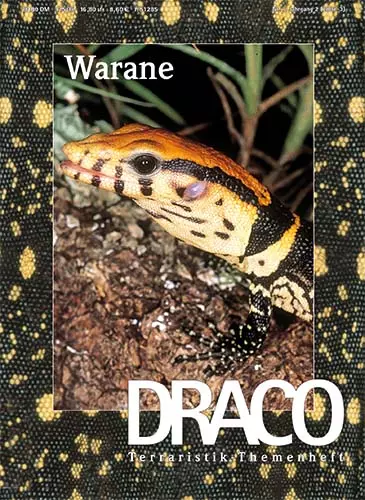

Draco 07 - Monitor

Article no: draco7

CHF 16.80

Stock: 0

This article is currently not available

Product information "Draco 07 - Monitor"

Draco 07 - Monitor lizards

Contents:

  • 2 Editorial
  • 4 On the taxonomy and biology of monitor lizards (Sauria: Varanidae), by Thomas Wilms & Wolfgang Böhme
  • 20 The most common monitor lizards in the pet trade - species and basics of keeping, by Jeff M. Lemm
  • 30 The monitor lizards of the Northern Territory, Australia, by Bernd Eidenmüller
  • 42 On the biology of the Raunacken-banded monitor lizard, by Maren Gaulke & Jochen Reiter
  • 50 Lifestyle and keeping of Varanus primordius, by G.A. Husband
  • 55 Overview of keeping and breeding Varanus panoptes panoptes Storr, 1980 in the next generation F2, by Michael Schardt
  • 62 Keeping and breeding of Varanus (Odatria) tristis orientalis Fry, 1913, by Michael Schardt
  • 67 The Cape monitor (Varanus albigularis): lifestyle, care and breeding at San Diego Zoo, by Jeff Lemm
  • 75 Knowledge, observations and breeding of the Duméril monitor Varanus dumerili (Schlegel, 1839), by Andree Hauschild
  • 78 Book box
  • 89 Magazine
Composition
Feeding recommendation
Technical details
Size information

0 of 0 reviews

Give us a rating!

Share your experience with the product with other customers.


Suggested products

Geckos
Geckos in the terrarium by Astrid FalkThe book offers a comprehensive introduction to geckos and their species-appropriate keeping in terrariums. It explains what you need to think about before buying a gecko and what preparations should be made. The book describes in detail how the terrarium is technically equipped and set up. The care of the animals, their special features and behaviour, their diet, reproduction and rearing of young animals are described, as well as diseases and husbandry problems with tried and tested suggestions for prevention and treatment. Individual gecko species that are particularly suitable for keeping and breeding in terrariums are portrayed in detail in the second part of the book.

CHF 28.50

Handbook of food plants for tortoises and other reptiles
Handbook of forage plants 2nd revised editionMarion Minch is not only a successful breeder of diverse tortoises for many years, but also an excellent connoisseur of native wild herbs. She founded and runs samenkiste.de, which is well known to many tortoise keepers and nature lovers. Her name is inextricably linked with reptile care and species-appropriate nutrition for tortoises. Her handbook of food plants summarises the most important native food plants for herbivorous and omnivorous reptiles. She not only considers tortoises, but also iguanas, spiny-tailed dragons and even chameleons. From the basics of plant biology to native wild herbs to suitable food plants for hardy tropical reptile species, this comprehensive work provides the basis for species-appropriate keeping. In the expanded and supplemented 2nd edition, the plant section is divided according to flower colour. This makes it even easier to identify wild herbs. The work has also been supplemented with a wealth of additional information and many pictures.

CHF 46.50

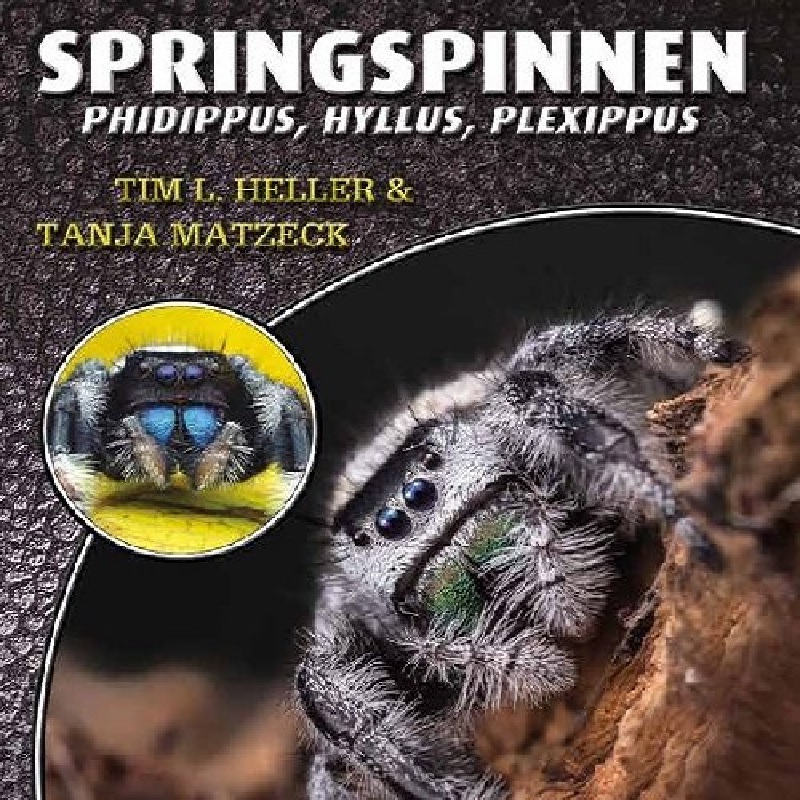
Jumping spiders Phidippus, Hyllus, Plexippus
Book Jumping Spiders - Phidippus, Hyllus & Plexippus A guide to keeping jumping spiders of the genera Phidippus, Hyllus & Plexippus. Who can resist the charm of jumping spiders? The childlike appearance of their expressive face simply leaves no one cold! In addition, their behavior is extremely exciting to observe, their colors are bright and their requirements for species-appropriate keeping are very easy to meet. No wonder these likeable jumpers are all the rage! This volume in the "Species by Species" series describes in detail what to look out for when buying and keeping them, introduces the most commonly kept species and color forms and provides plenty of tips on how to keep them successfully - so you can be sure they will breed well! Species by Species introduces you to the books in this series, which present the most popular terrarium animals. Each volume offers you detailed, practical care instructions and all the information you need to successfully breed your animals. All important questions from the required tank size to terrarium set-up, technical equipment, species-appropriate nutrition and disease prevention are answered with numerous tricks and tips. Experienced, long-standing breeders reveal how you can encourage the animals to reproduce and raise healthy young. All this in full color, generously illustrated and attractively designed - just about your terrarium animal - species by species

CHF 23.90

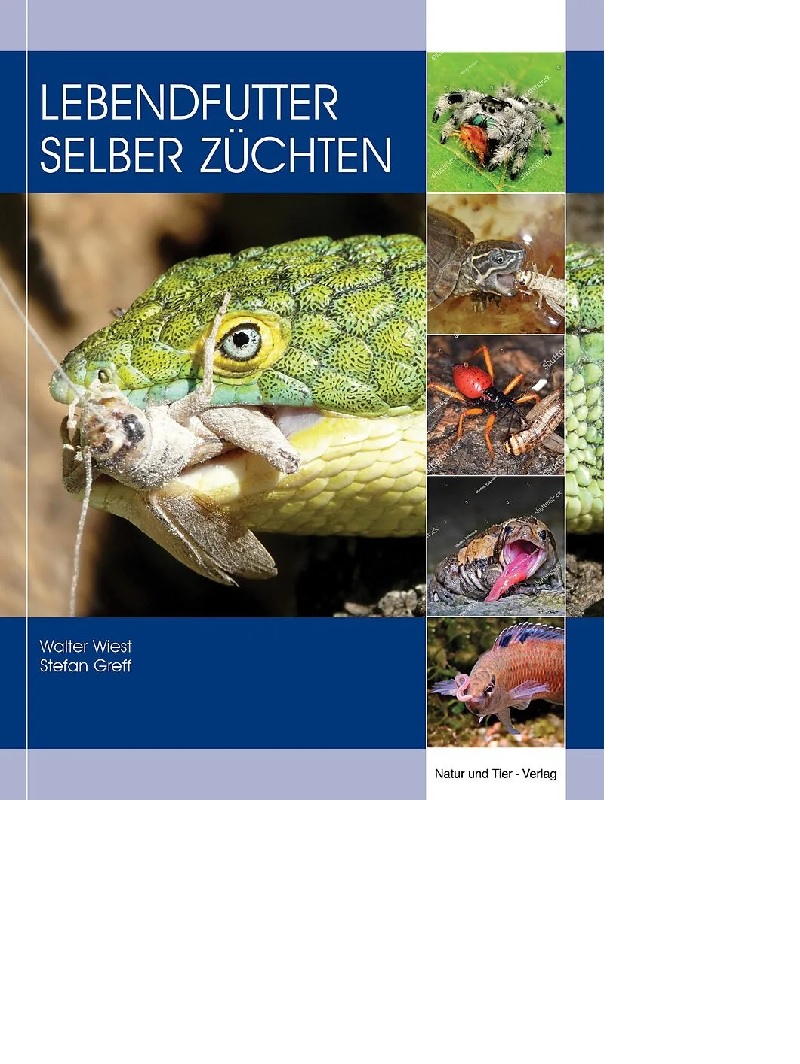
Book Breeding live food yourself
Book "Grow your own live food" - The perfect guide for pet owners Discover practical and detailed instructions on how you can easily breed food for your reptiles, birds, fish or other animals yourself in the book "Breeding live food yourself". With valuable tips on various food insects, their care and breeding, you can save money and ensure a species-appropriate diet for your pets. Contents of the book: Step-by-step instructions for breeding feeder insects Information on the best types of food for reptiles, birds and fish Care instructions and breeding conditions for various live food species Tips for sustainable and cost-effective food production Why breed your own live food? Get healthy, fresh food for your animals Save money and reduce dependence on pet shops Promote the health and well-being of your animals with species-appropriate food Whether you are a beginner or an experienced pet owner, this book provides you with everything you need to successfully breed live food yourself.

CHF 46.50

Marginata 69 - New Guinea tortoises
Marginata 69 - New Guinea tortoises – the genus ElseyaCover storyThe unrecognised beauties: New Guinea tortoises (Andreas S. Hennig)My experiences with Branderhorst's New Guinea tortoise, Elseya (Elseya) branderhorsti (Ouwens, 1914) (Andreas S. Hennig)Keeping and breeding of Rhodin's New Guinea tortoise, Elseya (Hanwarachelys) rhodini Thomson, Amepou, Anamiato & Georges, 2015 (Andreas S. Hennig)PortraitGeoemyda spengleri, Chinese serrated tortoise (Andreas S. Hennig)ReportageMacrochelys temminckii – Experiences and impressions with vulture tortoises part 2 (Reiner Praschag)KeepingAn alternative to year-round keeping of the Egyptian tortoise in the terrarium – my experiences with seasonal outdoor keeping of Testudo kleinmanni (Ricarda Schramm)EtymologySawbacks and living maps part 4: Graptemys gibbonsi, Pascagoula humpback tortoise (Holger Vetter)Classifieds & animal placement

CHF 16.50

Draco 57 - Snakes: Colour and drawing breeding
Draco 57 - Snakes: Colour and markings breedingsContents:Editorial Variety is the trump cardHans - Dieter Philippen Colour forms in garter snakes. A look into the past, the present and the trends of tomorrowDaniel GrübnerHurricane Season Hans-Jörg WinnerSturdy beauties. Colour and pattern variations in PituophisBernd SkubowiusThe latest trends in breeding the green tree python Marcel HoffmannChoose the diamond! Colour and pattern types of diamond pythonsMarc Mense A look at colour breeding in Pantherophis guttatusStephan Drees Colour and pattern forms in the western hook-nosed snakeFilip LonghitanoReal rarities: Colour varieties of the grey-banded king snake Malte Hornig

CHF 32.00

Day geckos
Alles über die Taggeckos der Gattung Phelsume von Hans-Peter Berghof 192Seiten mit zahlreichen Farbfotos 3. Auflage Über Lebensweise, Haltung und Nachzucht Autor Hans-Peter Berghof Verlag NTV Inhalt: Die Taggeckos der Gattung Phelsuma mit ihren bunten Farben und ihrem interessanten Verhalten zählen zu den absoluten Lieblingen der Terrarianer. Hans-Peter Berghof vermehrt diese Echsen seit langem erfolgreich und gibt hier sein gesammeltes Wissen über Haltung und Nachzucht dieser schönen Geckos weiter. Der spezielle Teil stellt detailliert sämtliche Arten mit ihren Pflegeansprüchen in Wort und Bild vor und gibt an, welche Tiere leichter und welche schwieriger zu halten sind. Die ideale Ergänzung zum Standardwerk von Hallmann et. al. von 1997, ergänzt um alle seither entdeckten Arten und neu erschienene Literatur.

CHF 42.90

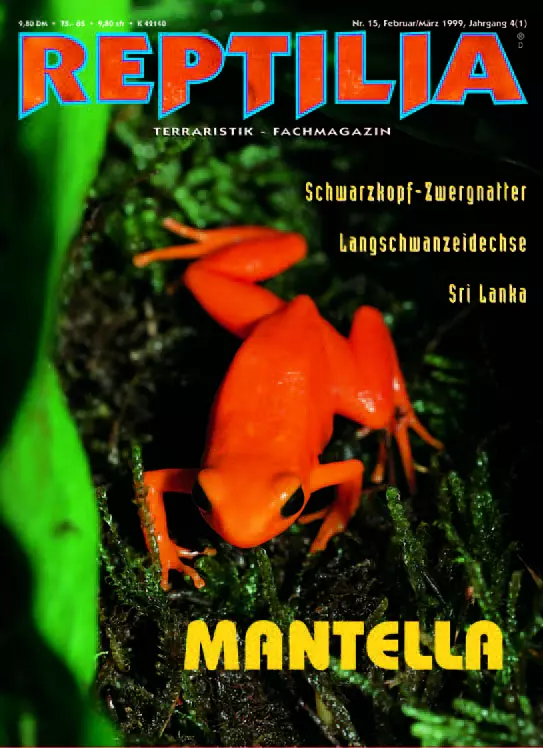
Reptilia 15 - Mantella
Reptilia 15 - MantellaBlack-headed dwarf snakeLong-tailed lizardSri LankaContents:Page 2 - EditorialPage 3 - MagazinePage 5 - Report: Can the turtles of Asia still be saved? by E. MeierPage 16 - DatesPage 18 - Western Herp Pespectives: First contact with Baja, by B. LovePage 20 - Photo report: MantellaPage 26 - Herpetofauna: Mantella - Interesting poison frogs from Madagascar, by K. SchmidtPage 35 - Report: Protection of Madagascan colour poison frogs and their habitats, by H. ZimmermannPage 40 - Travel report: In the dry zone of Sri Lanka, by Dr M. GaulkePage 47 - Portrait and poster: Tylototriton verrucosus, by M. Aresté and J. L. FarriolsPage 51 - Keeping and breeding: The South China long-tailed lizard, by U. SchlüterPage 55 - Keeping and breeding: Rhoptropus barnardi - a day gecko from Namibia, by Dr M. MeyerPage 60 - Report: Cockroaches (Blattoptera) - Rulers of the world? by A. HauschildPage 64 - Keeping and breeding: Observations on the black-headed dwarf snake Rhynchocalamus m. melanocephalus (Jan, 1862), by H. EsterbauerPage 69 - Report: King cobra bite with consequences, by T. Ziegler, H. X. Quang and N. Ba TrinhPage 74 - Herpetology and culture: The snake in Celtic mythology, part 2, by L. Batista Carissimi-PrioriPage 81 - Reptilia on the road: The vivarium at Chemnitz Zoo, by A. S. HennigPage 88 - Advice and actionPage 91 - LibraryPage 96 - Incubator: 5,995 characters Resentment

CHF 9.80

NTV, Discover the amphibians
NTV, Discover the amphibians and learn all about these animals. 56 pages colour photos throughout Large format: 20.7 x 28 cm Hardcover Author Kriton Kunz Contents: Every child knows a frog that swims around in its pond and croaks cheerfully, or the black and yellow fire salamander. But how do these friendly animals live? What do they eat, how do they survive the winter? How does a tadpole become a small frog? And what other amazing amphibians are there? "Entdecke die Amphibien" explains what amphibians are, their special features and their incredible abilities in an entertaining and child-friendly way. Fantastic records from the world of frogs, salamanders and the like are included, as well as an exciting quiz about these colourful survival artists. Including 20 great stickers 

CHF 17.90

Marginata 16 - African spurred tortoises
Marginata 16 - Spur-thighed tortoises Frozen food part 1Mauritius impressionsSea turtles Contents: 2 EDITORIAL 3 READER LETTERS 4 MAGAZINE 8 DATES 10 REPORTAGEThe spur-thighed tortoise - the largest tortoise of the African mainlandHans - Dieter Philippen 18 BREEDING IN HUMAN CAREBreeding of the spur-thighed tortoise(Centrochelys sulcata) at Pilsen Zoo, Czech RepublicVeronika Kodymová and Jan Konás 24 REPORTAGE A house for spur-thighed tortoises part 1Hilko Funsch 31 PORTRAITArgentine snake-necked turtles (Hydromedusa tectifera Pope, 1820)Hans - Dieter Philippen 35 REPORTAGEFrozen food part 1Hans - Dieter Philippen 40 BREEDING IN HUMAN CAREKeeping and breeding the Australian snake-necked turtle (Chelodina longicollis) part 2Stefan Thierfeldt & Sabine Höfler-Thierfeldt 48 REPORTAGEA visit to the giant tortoises in the "La Vanille Crocodile Park" of MauritiusPetra and Jens Jungnickel 54 REPORTAGEThe conservation status of the loggerhead sea turtle (Caretta caretta): an introduction to the current issuesJosé C. Báez, Raimundo Real & Juan A. Caminas 60 BOOK TIP 61 CLASSIFIEDS 62 REGIONAL GUIDE

CHF 14.70

Marginata 36 - Dwarf tortoises
Marginata 36 - Dwarf tortoisesBreeding Homopus areolatus Part 2Breeding of musk turtlesHibernation in Mediterranean tortoisesContents:EditorialMagazineDatesPHOTOSTORY"Dwarf tortoises" An overview of the smallest forms of tortoiseHans - Dieter PhilippenBreedingExperiences with the husbandry and breeding of the Areolate Flat-shelled Tortoise (Homopus areolatus) under different conditions in Namibia and Switzerland. Part 2: Husbandry and breeding of the species in SwitzerlandVictor MislinBREEDINGThe dwarf Pelomedus tortoise (Pelusios nanus) – the world’s smallest neck-turning tortoise. Experiences with acclimatisation, care and initial breeding attemptsHans - Dieter PhilippenPortraitKalahari tent or ray-eyed tortoise Psammobates oculiferusAlfred Schleicher & Hans - Dieter PhilippenReportageUnusual discovery of a female Okavango flap-breasted Pelomedus turtle (Pelusios bechuanicus)Alfred SchleicherReportageWith the giant tortoises of Prison Island, ZanzibarJens JungnickelReportageTurtles in a caseVienna ZooAttitudeHibernation of European tortoisesThorsten GeierReportageSiamese twin of Testudo graeca iberaBayram GöçmenReportageAs a turtle volunteer in the MaldivesSibylle GausBook tipClassifiedsSubscription & ServiceRegional guide

CHF 16.50

Reptilia 59 - Rose chafer
Reptilia 59 - Rose chafer South American tortoisesBuilding a desert terrariumReptile of the year: Forest lizard Contents: 4 EDITORIAL 6 MAGAZINE 17 DATES 20 PHOTO REPORTAGERose chaferBy M. Tomás Rafáles 28 KEEPING AND REPRODUCTIONCare and breeding of the rose chaferAmaurodes passeriniiBy M. Tomás Rafáles 33 REPORTAGEEuropean rose beetles (family Cetoniidae)By M. Yliana 39 TRAVELThin air – An excursion into the highlands ofIran and TurkeyBy B. Trapp 51 PORTRAIT AND POSTERPsammodynastes pulverulentusBy M. Gaulke 55 HERPETOFAUNAOn the "Reptile of the Year 2006" – The Eurasianforest or mountain lizard (Zootoca vivipara),the world's most successful terrestrial reptileBy W. Böhme & D. Rödder 62 PRACTICEUse of a conservatory as a terrariumlocation for a desert terrariumPart 1: Planning and building the terrariumBy T. Ackermann 71 HERPETOFAUNA The North African-Arab cat snakeTelescopus dhara (Forsskål, 1775)By U. Schlüter 77 REPORTAGEObservations on the occurrence ofGeochelone (Chelonoides) in southern BoliviaBy J. Knaack 87 CLASSIFIED ADS 92 RAT & TAT 96 WESTERN HERP PERSPECTIVESThe new "Good Guys"By B. Love 104 INCUBATORMaggot dispenserBy H. Werning

CHF 11.20