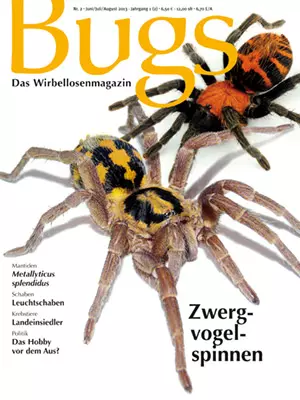
Bugs No. 02 - Miniature tarantulas

Article no: bugs02

CHF 12.00

Stock: 0

This article is currently not available

Product information "Bugs No. 02 - Miniature tarantulas"

Bugs No. 02 - Dwarf tarantulas

Metallyticus splendidus
Land hermits
Is the hobby on the brink of closure?

Table of contents

Editorial

Team introduction
Facets
Dates
Flown in

Cover story
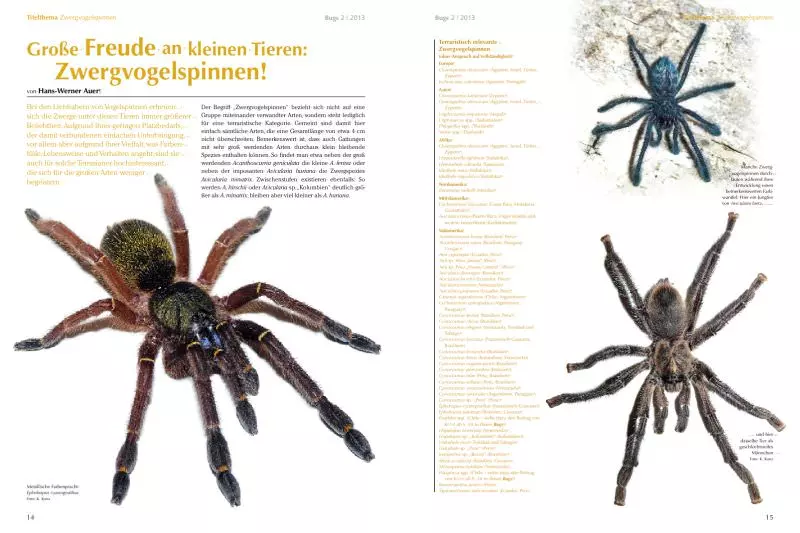
Great pleasure in small animals

Colourful dwarfs

“This girl is on fire!”

Fledged
In search of stag beetles in southern India

In the crosshairs
Metallic praying mantis

Reportage
On the trail of the field scorpion, part 2

Practice
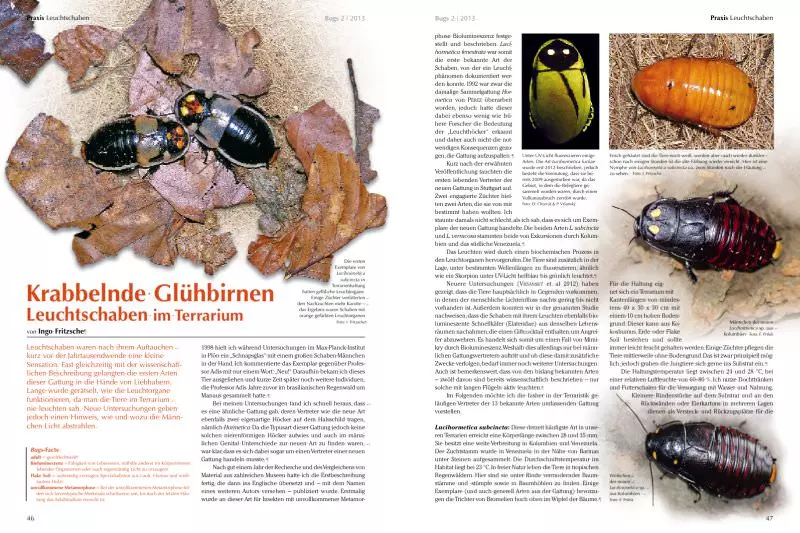
Luminous cockroaches in the terrarium

Practice
Breeding a new ghost stick insect from Sumatra

Culture
Insects as medicine
Practice
A life between land and sea

Potter bee
Safe handling of centipedes

Kids Corner
Nesting aid for wild bees

Showcase
Preserved for eternity – know-how!

Book scorpion

Also in your area

Service & Imprint

Preview

Metamorphoses

Football!

Composition
Feeding recommendation
Technical details
Size information

0 of 0 reviews

Give us a rating!

Share your experience with the product with other customers.


Suggested products

Handbook of food plants for tortoises and other reptiles
Handbook of forage plants 2nd revised editionMarion Minch is not only a successful breeder of diverse tortoises for many years, but also an excellent connoisseur of native wild herbs. She founded and runs samenkiste.de, which is well known to many tortoise keepers and nature lovers. Her name is inextricably linked with reptile care and species-appropriate nutrition for tortoises. Her handbook of food plants summarises the most important native food plants for herbivorous and omnivorous reptiles. She not only considers tortoises, but also iguanas, spiny-tailed dragons and even chameleons. From the basics of plant biology to native wild herbs to suitable food plants for hardy tropical reptile species, this comprehensive work provides the basis for species-appropriate keeping. In the expanded and supplemented 2nd edition, the plant section is divided according to flower colour. This makes it even easier to identify wild herbs. The work has also been supplemented with a wealth of additional information and many pictures.

CHF 46.50

Geckos
Geckos in the terrarium by Astrid FalkThe book offers a comprehensive introduction to geckos and their species-appropriate keeping in terrariums. It explains what you need to think about before buying a gecko and what preparations should be made. The book describes in detail how the terrarium is technically equipped and set up. The care of the animals, their special features and behaviour, their diet, reproduction and rearing of young animals are described, as well as diseases and husbandry problems with tried and tested suggestions for prevention and treatment. Individual gecko species that are particularly suitable for keeping and breeding in terrariums are portrayed in detail in the second part of the book.

CHF 28.50

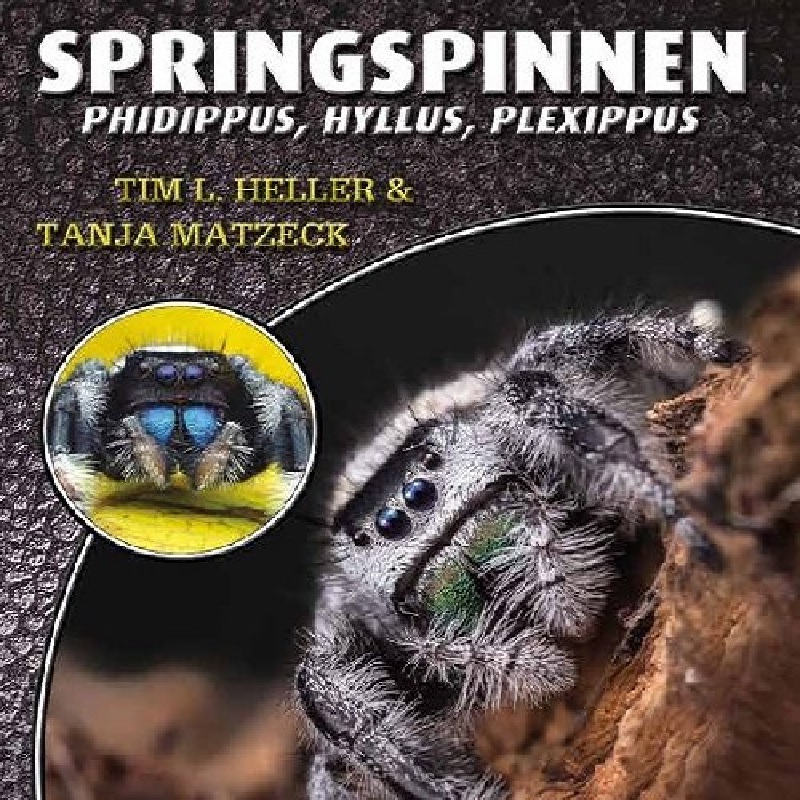
Jumping spiders Phidippus, Hyllus, Plexippus
Book Jumping Spiders - Phidippus, Hyllus & Plexippus A guide to keeping jumping spiders of the genera Phidippus, Hyllus & Plexippus. Who can resist the charm of jumping spiders? The childlike appearance of their expressive face simply leaves no one cold! In addition, their behavior is extremely exciting to observe, their colors are bright and their requirements for species-appropriate keeping are very easy to meet. No wonder these likeable jumpers are all the rage! This volume in the "Species by Species" series describes in detail what to look out for when buying and keeping them, introduces the most commonly kept species and color forms and provides plenty of tips on how to keep them successfully - so you can be sure they will breed well! Species by Species introduces you to the books in this series, which present the most popular terrarium animals. Each volume offers you detailed, practical care instructions and all the information you need to successfully breed your animals. All important questions from the required tank size to terrarium set-up, technical equipment, species-appropriate nutrition and disease prevention are answered with numerous tricks and tips. Experienced, long-standing breeders reveal how you can encourage the animals to reproduce and raise healthy young. All this in full color, generously illustrated and attractively designed - just about your terrarium animal - species by species

CHF 23.90

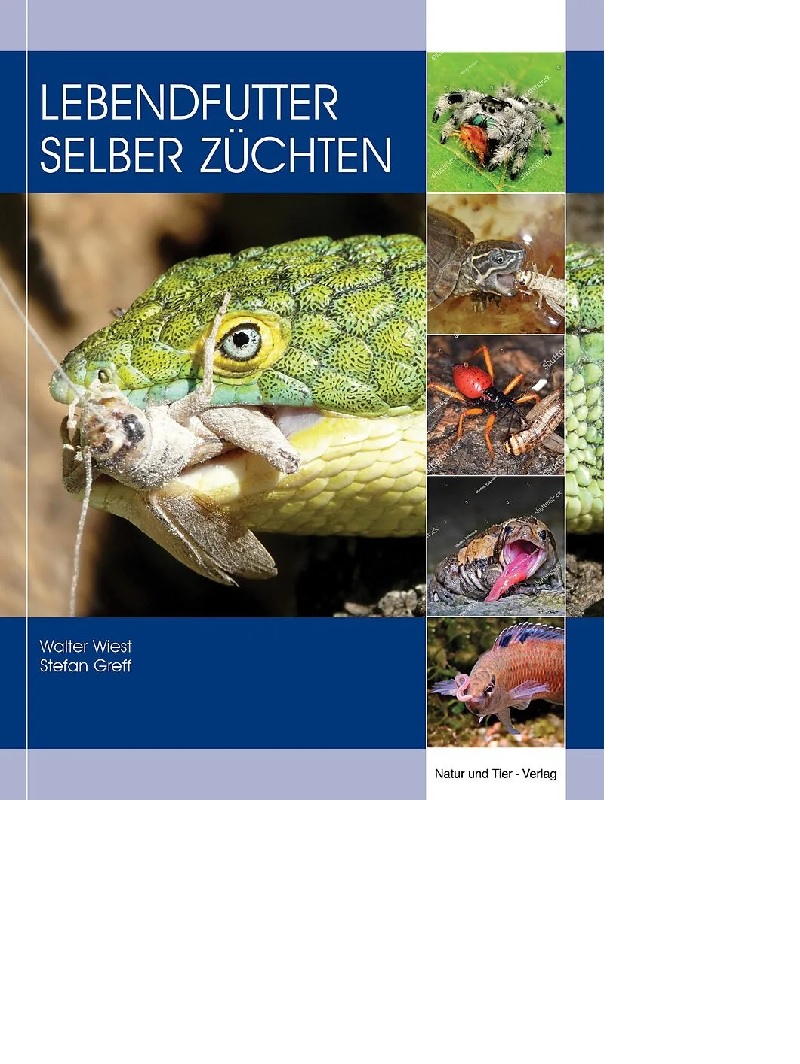
Book Breeding live food yourself
Book "Grow your own live food" - The perfect guide for pet owners Discover practical and detailed instructions on how you can easily breed food for your reptiles, birds, fish or other animals yourself in the book "Breeding live food yourself". With valuable tips on various food insects, their care and breeding, you can save money and ensure a species-appropriate diet for your pets. Contents of the book: Step-by-step instructions for breeding feeder insects Information on the best types of food for reptiles, birds and fish Care instructions and breeding conditions for various live food species Tips for sustainable and cost-effective food production Why breed your own live food? Get healthy, fresh food for your animals Save money and reduce dependence on pet shops Promote the health and well-being of your animals with species-appropriate food Whether you are a beginner or an experienced pet owner, this book provides you with everything you need to successfully breed live food yourself.

CHF 46.50

Marginata 69 - New Guinea tortoises
Marginata 69 - New Guinea tortoises – the genus ElseyaCover storyThe unrecognised beauties: New Guinea tortoises (Andreas S. Hennig)My experiences with Branderhorst's New Guinea tortoise, Elseya (Elseya) branderhorsti (Ouwens, 1914) (Andreas S. Hennig)Keeping and breeding of Rhodin's New Guinea tortoise, Elseya (Hanwarachelys) rhodini Thomson, Amepou, Anamiato & Georges, 2015 (Andreas S. Hennig)PortraitGeoemyda spengleri, Chinese serrated tortoise (Andreas S. Hennig)ReportageMacrochelys temminckii – Experiences and impressions with vulture tortoises part 2 (Reiner Praschag)KeepingAn alternative to year-round keeping of the Egyptian tortoise in the terrarium – my experiences with seasonal outdoor keeping of Testudo kleinmanni (Ricarda Schramm)EtymologySawbacks and living maps part 4: Graptemys gibbonsi, Pascagoula humpback tortoise (Holger Vetter)Classifieds & animal placement

CHF 16.50

Small mammals in terrariums
The book explains everything about the care and keeping of small animals. 144 pages 163 photos 2 graphics Format: 16.8 x 21.8 cm 2nd revised edition Author Christian Ehrlich Publisher NTV Contents: Away from the stuffy cage and towards modern and species-appropriate animal husbandry: many small mammals are best kept in a suitably equipped terrarium. This book presents the most suitable types of terrarium and provides a detailed and practical description of how to breed and care for the animals successfully. Anatomy, lineage and systematics Distribution, biotopes, adaptations All information on species-appropriate keeping: from suitable terrariums to equipment and technology to feeding Successful breeding: Mating stimulation and rearing of young animals Taming small mammals Topic free-range: This is how it is species-appropriate. Solutions to problems: How to avoid the most common mistakes in care, and how to help sick animals: Keeping animals healthy Huge species section with detailed portraits of 80 species of marsupials, predatory marsupials, true marsupials, xenarthrans, insectivores, bats, rodents and sengis Brilliant photos Many animal lovers no longer want to be satisfied with just the classic hamster in the equally classic hamster cage. If you want to keep and observe such exciting animals as hedgehogs, opossums, predatory marsupials, sugar gliders, armadillos, tenrecs, ground squirrels, squirrels, bats & co., this book is a must, because all of them and many more are best kept in a suitably equipped terrarium. Christian Ehrlich, editor of the specialist magazine RODENTIA, has now dealt with this topical subject in detail. The author is able to draw on his many years of experience in keeping and breeding small mammals from various related groups and shares his insights here in an easy-to-read but extremely expert manner. Ehrlich describes the biology of the animals, presents their specific husbandry requirements and gives plenty of tips on their successful care and breeding. The book offers detailed portraits of no less than 80 species of marsupials, predatory marsupials, true marsupials, xenarthrans, insectivores, bats, rodents and sengis. For all friends of very special animals and for all those who strive for species-appropriate animal husbandry, this book is an absolute must.

CHF 35.90

Terraria 19 - Diseases of tarantulas
Terraria 19 - Diseases of Tarantulas Northern Pine SnakeExpedition Tanzania Contents: While reptiles and amphibians have long been professionally treated by specialised veterinarians,unfortunately, there is still much to be done for invertebrate terrarium guests. However, our knowledge of these animals is gradually increasing. In this TERRARIA, expert Frank Schneider impressively summarises the current state of knowledge about diseases and parasites of tarantulas and offers approaches for treatment options.2Editorial   4Magazine Snake mites in reptiles: predatory mites as a biological control method/ Remarks on Pipa snethlegeae in French Guiana/Another wall lizard population threatened by a construction project/ "Benefiz-Terraristika" a great success/Vivarium Karlsruhe – "Climate and Habitats"/Phoresy in pseudo- scorpions in Baltic amber/ Legal 16TERRAglobal I, the Crocodile Hunter Joachim Bulian The snake with the mighty "Embrace" Fabio Cupul 20Diseases and parasites of tarantulas Frank Schneider 41On the keeping and breeding of the turnip-tailed viper gecko (Hemidactylus imbricatus or Teratolepis fasciata) in the terrarium Martin Dieckmann 50The Canary Island Mediterranean tree frog (Hyla meridionalis): Distribution, keeping and reproduction Manfred Rogner 54The Northern Pine Snake (Pituophis melanoleucus melanoleucus) In nature and terrarium. Part 1 Bernd Skubowius 61Travel "Exo Terra" Expedition Tanzania 2008 Part 1: In the realm of the turquoise blue dwarf day gecko (Lygodactylus williamsi) Roland Zobel 72New species New from Table Mountain: two dwarf tegus and a "miniature dragon" toadlet Axel Kwet 75Among researchers Amphibians and reptiles above the clouds – the decoding of species diversity in a forgotten world Philippe Kok 81Test run Heating mats Kriton Kunz 84 Near you 86Showcase In the Swiss cellar – A visit to Beat Akeret Heiko Werning 91 Subscription & Service 94Preview 96Incubator The "Rock Helga" – A Morocco adventure in two parts. Part 1 Mike Zawadzki

CHF 12.00

The Tokeh
All about the Tokeh by Wolfgang Grossmann 64 pages Format: 14.8 x 21 cm numerous colour photos Paperback Author Wolfgang Grossmann Contents: The size and strength of tokehs are impressive, as is the enormous defence capability of these geckos. Even after many years of care, specimens of both sexes do not completely shed their primitiveness and ferocity. Their sometimes very attractive colouring makes many other lizards pale in comparison.Tokehs are not beginner lizards, but present the keeper with challenges!In order to keep and breed them for many years, you need to fulfil a few but important basic requirements, which author Wolfgang Grossmann explains in detail and in an easy-to-understand manner in this volume of the "Species by Species" series. Systematics and body structure The fascinating biology: From the life of the Tokeh All information on species-appropriate keeping: from suitable terrariums to equipment and technology to feeding Successful breeding: Mating stimulation, incubation of the eggs and rearing the young Solutions to problems: How to avoid the most common mistakes in care and how to help sick animals Brilliant photos

CHF 21.90

Draco 35 - King Phytons
Draco 35 - King SphytonsContents:Editorial 2The king python - a snake with many faces Thomas Kölpin 4Keeping, care and breeding of the royal python in the terrarium Melanie Hartwig 18Professional king python breeding and the development cycle of the follicles Stefan Broghammer 30Design and set-up options for king python terrariums using the example of a private enclosureRené Bonke 34Rack keeping: pros and consFrank Bick 39Selective colour breeding of king pythons using the example of of the "Maze" lineHans-Jörg Winner 43Colour variations of the king pythonThomas Kölpin 48The utilisation of snakes and the associated economic and ecological consequences - the example of the king python in West AfricaJohannes Penner, Christain A.S. Toudonou, Brice Sinsin & Mark-Oliver Rödel 64Ranching the king python Stefan Broghammer 69Common diseases of the royal python in terrarium practice Dr med. vet. Frank Mutschmann 74Book box 87

CHF 18.40

Reptilia 144 - American Earth Turtles
Reptilia 144- American tortoises Photo storyAmerican tortoises of the genus Rhinoclemmys – from disposables to unicornsBy S. Ettmar REPORTAGEThe American tortoises of ColombiaBy J. Cañas-Orozco Keeping and breedingKeeping and breeding the Guerrero tortoise, Rhinoclemmys pulcherrima pulcherrimaBy C. Godart Keeping and breedingKeeping and breeding the tiger snake (Rhabdophis tigrinus)By A. Walter Keeping and breedingJewellery, supermodel, delicacy: the milkweed bugBy K. Kunz Keeping and breedingThe fascination of sail lizards – keeping and comparing different species of the genus Hydrosaurus Part 2By O. Fischer SERVICEALSO NEAR YOU         JourneyWe're staying at home! Herping in the Corona summer 2020By B. Trapp PREVIEW BRUTKASTEN And it made zoomBy H. Werning  

CHF 13.50

Marginata 05 - Musk turtles
Marginata 05 - Musk turtles> Yellow-headed tortoiseIncubationWater box turtle Contents: 2 EDITORIAL 3 READER LETTERS 4 MAGAZINE 7 DATES 10 PHOTO REPORTAGEThe North American musk turtles of the genus SternotherusHans - Dieter Philippen 13 REPORTAGEKeeping and breeding the Small Musk Turtle (Sternotherus minor AGASSIZ, 1857)Hubert Felsner 20 REPORTAGEThe Flat Musk Turtle (Sternotherus depressus TINKLE & WEBB, 1955)Reiner Praschag 31 PORTRAITMadagascan radiated tortoiseAstrochelys radiata (SHAW, 1802)Hans - Dieter Philippen 36 SCIENCETemperature-dependent sex fixation in marsh, water and land turtlesPart 2Claude Pieau & Mireille Dorizzi 42 REPORTOn an unusually light-coloured carapace of Indotestudo elegans BLYTH, 1854Wolfgang Grossmann 46 BREEDING IN HUMAN CAREKeeping and breeding the water box turtle (Terrapene coahuila (SCHMIDT & OWENS, 1944)Part 3Markus Baur and Irmtraud Jasser-Häger 54 BreedingThe rearing of hatchlings of different species of musk turtles Gerhard Schaffer 58 BOOK TIP LINE ADVERTISEMENTS 62 REGIONAL GUIDE 64 AGATHA MARGINATA

CHF 14.70

Bugs No. 06 - Asian Mantids
Bugs No. 06 - Asian Mantids African Harlequin CockroachRed Hainan crabThailandContents:The cover story of Bugs No. 6 is full of beauties, but they all have only three things on their minds: Eat, hide and reproduce. They are beautiful in their own right, but their perfect camouflage makes them hard to spot in their habitat - mantids from Asia! Find out new and interesting facts about species that live in mosses and lichens and read detailed breeding reports.Table of contents EditorialFacetsDatesFlown in      Cover storyAsian mantids Cover storySmall, colourful flower mantises Cover storyDemanding Dwarfs ReportageNative ‘tigers’ on a slimy trail  In the crosshairsBlood-red freshwater crab from China  FledgedIn search of scorpions in Morocco Keeping & BreedingSuccessful breeding of a roller spider CultureCuisine from Laos ShowcaseThe State Zoological Collection, Munich Kids CornerWhat’s crawling about in May? Potter beeHandling tarantulas Book scorpionAlso in your neighbourhoodService & ImprintPreview MetamorphosesThe Very Hungry Caterpillar

CHF 12.00