Product information "Ulmer, SMART Aquatic Turtles"
Ulmer - SMART Water Turtles
62 pages
numerous colour illustrations
3 edition
Author Wolfgang Praschag
This book describes the correct keeping and care of ornamental and decorative turtles. Using the example of the red-eared slider turtle, it shows what is important when keeping aquatic turtles in an aquarium. This book describes the conditions that should be met for keeping aquatic turtles in the home and also in the garden pond, which turtle species are particularly suitable and how they are cared for and kept healthy in an understandable, friendly and easy-to-follow format. A clear introduction for anyone thinking of bringing these attractive aquatic turtles into their home.
Composition
Feeding recommendation
Technical details
Size information
0 of 0 reviews
Give us a rating!
Share your experience with the product with other customers.
Login
No reviews found. Go ahead and share your findings with others.
Handbook of forage plants 2nd revised editionMarion Minch is not only a successful breeder of diverse tortoises for many years, but also an excellent connoisseur of native wild herbs. She founded and runs samenkiste.de, which is well known to many tortoise keepers and nature lovers. Her name is inextricably linked with reptile care and species-appropriate nutrition for tortoises. Her handbook of food plants summarises the most important native food plants for herbivorous and omnivorous reptiles. She not only considers tortoises, but also iguanas, spiny-tailed dragons and even chameleons. From the basics of plant biology to native wild herbs to suitable food plants for hardy tropical reptile species, this comprehensive work provides the basis for species-appropriate keeping. In the expanded and supplemented 2nd edition, the plant section is divided according to flower colour. This makes it even easier to identify wild herbs. The work has also been supplemented with a wealth of additional information and many pictures.
Geckos in the terrarium by Astrid FalkThe book offers a comprehensive introduction to geckos and their species-appropriate keeping in terrariums. It explains what you need to think about before buying a gecko and what preparations should be made. The book describes in detail how the terrarium is technically equipped and set up. The care of the animals, their special features and behaviour, their diet, reproduction and rearing of young animals are described, as well as diseases and husbandry problems with tried and tested suggestions for prevention and treatment. Individual gecko species that are particularly suitable for keeping and breeding in terrariums are portrayed in detail in the second part of the book.
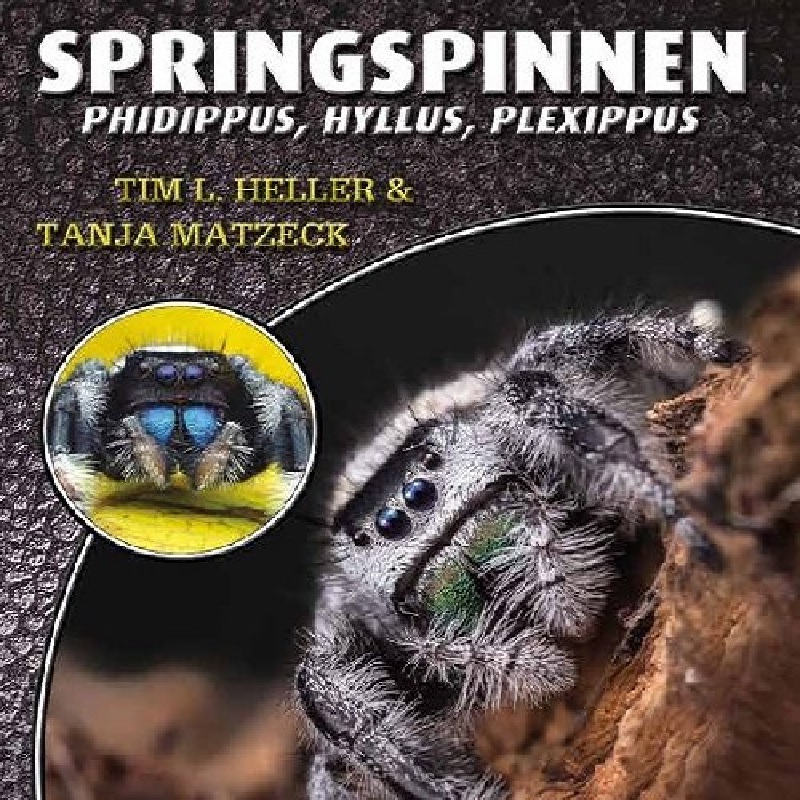
Book Jumping Spiders -
Phidippus, Hyllus & Plexippus
A guide to keeping jumping spiders of the genera Phidippus, Hyllus & Plexippus. Who can resist the charm of jumping spiders? The childlike appearance of their expressive face simply leaves no one cold! In addition, their behavior is extremely exciting to observe, their colors are bright and their requirements for species-appropriate keeping are very easy to meet. No wonder these likeable jumpers are all the rage!
This volume in the "Species by Species" series describes in detail what to look out for when buying and keeping them, introduces the most commonly kept species and color forms and provides plenty of tips on how to keep them successfully - so you can be sure they will breed well!
Species by Species introduces you to the books in this series, which present the most popular terrarium animals. Each volume offers you detailed, practical care instructions and all the information you need to successfully breed your animals.
All important questions from the required tank size to terrarium set-up, technical equipment, species-appropriate nutrition and disease prevention are answered with numerous tricks and tips.
Experienced, long-standing breeders reveal how you can encourage the animals to reproduce and raise healthy young.
All this in full color, generously illustrated and attractively designed - just about your terrarium animal - species by species
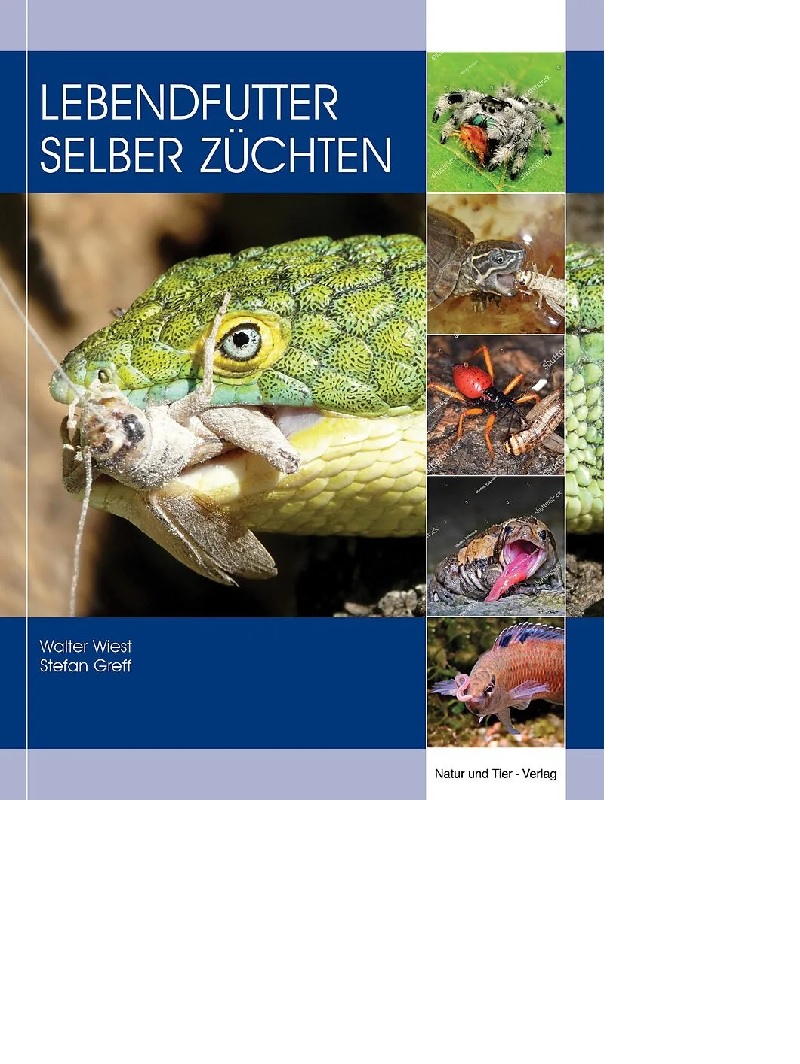
Book "Grow your own live food" - The perfect guide for pet owners
Discover practical and detailed instructions on how you can easily breed food for your reptiles, birds, fish or other animals yourself in the book "Breeding live food yourself". With valuable tips on various food insects, their care and breeding, you can save money and ensure a species-appropriate diet for your pets.
Contents of the book:
Step-by-step instructions for breeding feeder insects
Information on the best types of food for reptiles, birds and fish
Care instructions and breeding conditions for various live food species
Tips for sustainable and cost-effective food production
Why breed your own live food?
Get healthy, fresh food for your animals
Save money and reduce dependence on pet shops
Promote the health and well-being of your animals with species-appropriate food
Whether you are a beginner or an experienced pet owner, this book provides you with everything you need to successfully breed live food yourself.
Marginata 69 - New Guinea tortoises – the genus ElseyaCover storyThe unrecognised beauties: New Guinea tortoises (Andreas S. Hennig)My experiences with Branderhorst's New Guinea tortoise, Elseya (Elseya) branderhorsti (Ouwens, 1914) (Andreas S. Hennig)Keeping and breeding of Rhodin's New Guinea tortoise, Elseya (Hanwarachelys) rhodini Thomson, Amepou, Anamiato & Georges, 2015 (Andreas S. Hennig)PortraitGeoemyda spengleri, Chinese serrated tortoise (Andreas S. Hennig)ReportageMacrochelys temminckii – Experiences and impressions with vulture tortoises part 2 (Reiner Praschag)KeepingAn alternative to year-round keeping of the Egyptian tortoise in the terrarium – my experiences with seasonal outdoor keeping of Testudo kleinmanni (Ricarda Schramm)EtymologySawbacks and living maps part 4: Graptemys gibbonsi, Pascagoula humpback tortoise (Holger Vetter)Classifieds & animal placement
Marginata 25 - Cyrenaica tortoises
South African beaked tortoise part 3Argentine tortoisesSea turtles
Contents:
EditorialMagazineDatesREPORTAGEThe Cyrenaica tortoise (Testudo graeca cyrenaica)Alex PiehBREEDINGKeeping and breeding of the Cyrenaica tortoise (Testudo graeca cyrenaica) in an indoor terrariumBastian EsserBREEDINGOutdoor keeping and breeding of the Cyrenaica tortoise (Testudo graeca cyrenaica)Angelica H.POSTERThe Chaco flatback tortoise Acanthochelys pallidipectoris (Freiberg, 1945)Hans - Dieter PhilippenREPORTAGEThe African beaked tortoise (Chersina angulata). Part 3: Predators and other threats Michael WirthREPORTAGEThreats, protection and utilisation of sea turtles. Part 5: Conservation concepts and ways to sustainably utilise sea turtles Gerald & Christa BenyrBREEDINGKeeping and breeding the rarely kept Argentine tortoise (Trachemys d. dorbigni) Volker NathsBook tipClassifiedsSubscription & ServiceRegional guide
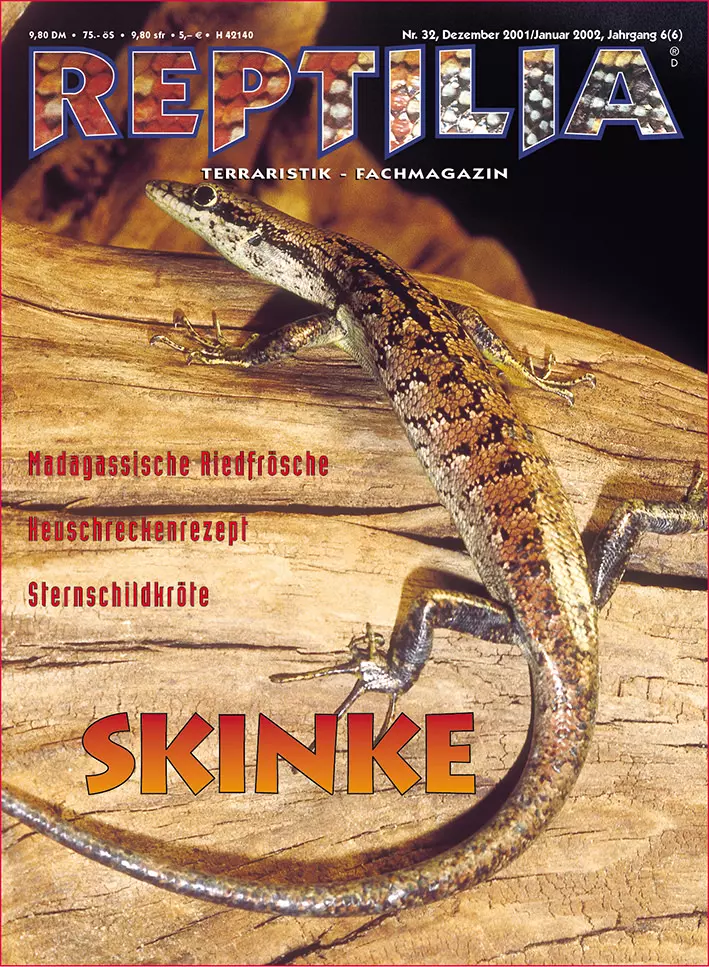
Reptilia 32 Skinks
Madagascan reed frogsGrasshopper recipeStar tortoise
Contents:
2 Editorial
3 Magazine
11 Dates
14 Western Herp PerspectivesThe value of the nature experiencefrom B. Love
16 Photo reportageSkinkby A. Hauschild
22 HerpetofaunaObservations on Eumeces (=Novoeumeces) schneideri aldrovandiifrom S. Wegner
28 Keeping and breedingOn the care and breeding of Algerian skinks (Eumeces [=Novoeumeces] algeriensis) Peters, 1864by R. Struijk
35 Keeping and breedingAustralian snail skink Cyclodomorphus gerradii Grav, 1845 – Care and breeding
41 ReportageDelicious, these grasshoppersby I. & B. Fritzsche
44 JourneyA journey to the United Arab Emirates - From the mangroves to the scree desertby R. Leptien
51 Portrait and posterElaphe quatorlineatafrom B. Trapp
56 Keeping and breedingThe Indian star tortoise Geochelone elegans (Schoepf, 1795) – a problematic tropical tortoise? Part 1: Appearance, distribution and local breeds, acclimatisation, introduction to the breeding groupby J. Bidmon
66 ReportageJapan in the year of the snakeby A. Kast & M. Mori
71 Herpetofauna The Madagascan marsh frogs of the genus Heterixalusby K. Schmidt, F. Glaw & M. Vences
80 Reptilia on the roadThe snake park "World of Snakes" in Grecia, Costa Ricaby R. Fenske
87 Classifieds
91 Advice and action
94 Library
104 GlossOur author Dr Spechtby H. Werning
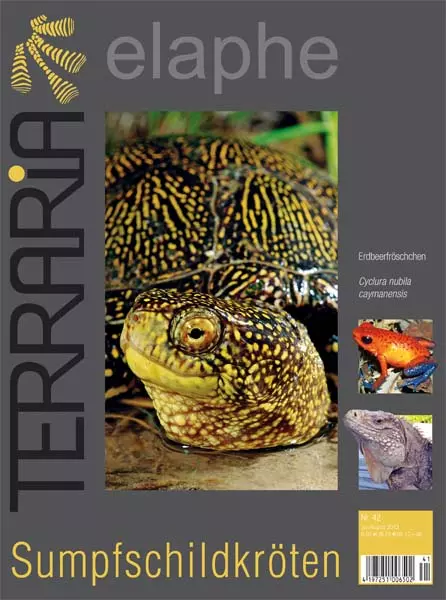
Terraria 42 - TerrapinsStrawberry FrogsCyclura nubila caymanensisContents:The Emydidae family includes some of the best-known and most popular turtles. In addition to our native European pond turtle, these include the North American ornamental and decorative turtles of the genera Pseudemys and Trachemys as well as the Terrapene box turtles. In the cover story, we provide an up-to-date overview of this interesting group and present a detailed article about the magnificent tortoise, Graptemys oculifera. We also shed light on the role that European pond turtles can play in biology lessons.TerritorialHerpetoramaCover storyThe New World terrapins of the family EmydidaeAndreas S. HennigGraptemys oculifera: Biology, Care and Breeding of the Splendid Box Turtle Part 1: Biology, Endangerment and Initial Care Experiences Ewald RoddewigThe European pond turtle (Emys orbicularis) in biology lessonsMichael FreundPanoramaTerraglobalOn safari in Zambia, or: Why do the pelomeduses flee?Alfred SchleicherPearl lizards (Timon lepidus) in the Sierra de Grazalema, AndalusiaWerner & Yvonne LantermannResearchNew speciesA Comorian gecko and the problem of the new online taxonomy Oliver HawlitschekTrachylepis cristinae, a new skink from Sokrota Axel KwetIn search of strawberry frogs in NicaraguaDiana Galindo Uribe, Javier Sunyer, Adolfo Amézquita, Gunther Köhler, Heiko Pröhl & Miguel VencesSalamandraTerraristicsClassicsThe North African spiny-tailed dragonBothriopsis taeniata, a beauty from the South American rainforestJuan TimmsHomerangeIn the realm of the little lizards. A visit to the terrarium facility of Katrin and Dietmar MistlerPatrick SchöneckerNature and species conservationField notesSubmerging under water as an escape strategy for the common lizardRudolf MalkmusGrass snakes and slow worms - hunters and huntedAndreas OchsenbeinThe smooth snake (Coronella austriaca). Reptile of the Year 2013Dirk Alfermann, Axel Kwet & Richard PodlouckyThreatened in paradiseKathrin Sawannia, Matthias Goetz & Katharina FoersterMissingVogl’s Stump-footed Frog (Atelopus vogli)Also in your neighbourhoodSubscription & ServiceGalleryHave a nice holiday! The journey is the rewardBenny TrappPreviewIncubatorExpired part 2Heiko Werning
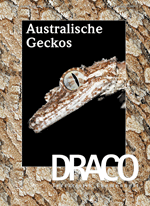
Draco 29 - Australian Gecko
Contents:
2 Editorial 4 The "Geckos" of AustraliaChristian Langner & Andreas Laube22 Observations on the Australian velvet geckosof the genus OeduraGunther Schmida 31 Biology, keeping and breeding of the Australianground gecko Dilodactylus damaeus Lucas & Frost, 1896Patrick Schönecker 39 Biology, keeping and breeding of the Australian knob-tailed gecko Nephrurus amyae Couper & Gregson, 1994Patrick Schönecker 44 The Australian fat-tailed gecko, Nephrurus milii(Underwoodisaurus milii)Dirk Duscha 49 The genus StrophurusAndreas Laube & Christian Langner 67 The Australian giant leaf-tailed geckos of the genera Saltuarius and OrrayaChristian Langner & Andreas Laube 78 In search of geckos in AustraliaSandra Fallend 88 Book box
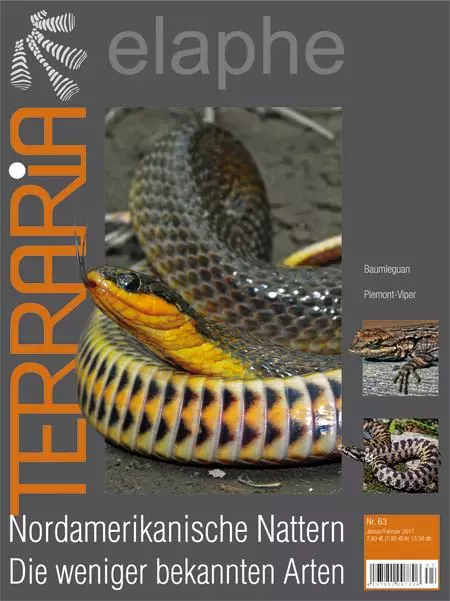
Terraria 63 - North American vipers
Contents:
Cover story: North American vipers – the lesser known species
Everyone immediately thinks of corn and ground snakes, king snakes and perhaps bull snakes when the colubrids of North America are mentioned. However, in addition to these stars of the terrarium hobby, the continent is actually home to a whole range of species that are less popular but no less fascinating and interesting for keeping in terrariums. We go on an excursion to an amazingly species-rich snake habitat and take a closer look at queen snakes, mud snakes and Trans-Pecos rat snakes.
Also in TERRARIA/elaphe 1/2017:
Observations on a newly discovered European pit viper: Vipera walser
What effect does the use of pesticides have on amphibians?
Keeping and breeding the arboreal iguana Urosaurus ornatus
and much more
Territorial
HerpetoramaIt's all about the sausage – Aga toads in AustraliaPrehistoric food chain: snake eats lizard eats beetleCultural followers: Famous basilica inhabitants in CataloniaBlattsteiger: A Nazi frog for Donald TrumpThorny devil: Motorzinho frogs from Brazil
Cover storyHidden treasuresIn search of snakes in Cape Cod, MassachusettsLeo Spinner
The hidden life of mud snakesLeo Spinner
The gentle one from the desert mountainsKeeping and breeding the Trans-Pecos rat snakeLeo Spinner
Long live the Queen! Lifestyle and keeping of the queen snakeLeo Spinner
PanoramaFrogs need friends!Heiko Werning
ResearchNew species. New anoles from Hispaniola: green and lichen-coloured anolesAxel Kwet
Among researchersYears of expeditions in MadagascarFrank Glaw
What effect does the use of pesticides have on amphibian larvae?Norman Wagner
Salamandra
TerraristicsA terrarium classic returns. The Ornate Iguana, Urosaurus ornatusJoschka Schulz
Nature and species conservationField notesFishing water frog in HungaryTamás Tóth
Mass death in larvae of yellow-bellied toadsAxel Kwet
In search of a newly described viper in the Italian Alps: the Piedmont viper (Vipera walser)Benny Trapp
Terrarino – the children's page The "dazzler" among the lizards: The slow wormAlexa Sabarth
Subscription & ServiceAlso in your areaPreview
IncubatorMedia education, part 1Heiko Werning
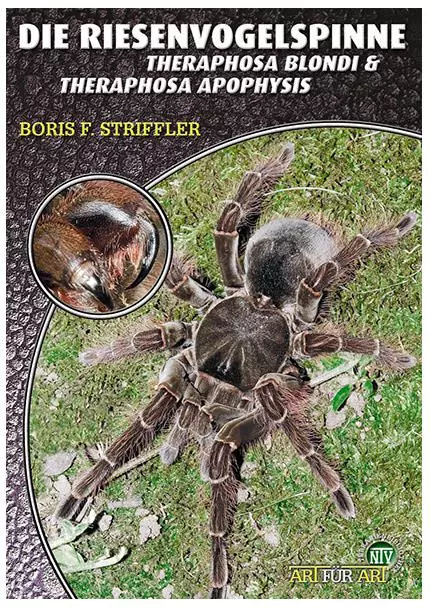
The book about the giant tarantulas Theraphosa blondi and Theraphosa apophysis
64 pages
many colour photos
Theraphosa blondi and Theraphosa apophysis
Author Boris F. Striffler
Publisher NTV
In this book, the author explains everything about the two giant tarantulas. It describes how to keep and care for these large eight-legged creatures, as well as the terrarium and how to handle these animals.
The following is described:
Systematics and body structure
The fascinating biology: From the life of giant tarantulas
All information on species-appropriate keeping: from suitable terrariums to equipment and technology to feeding
Successful breeding: Mating stimulation, various methods for egg laying and rearing the young
Solutions to problems: How to avoid the most common mistakes in care and how to help sick animals
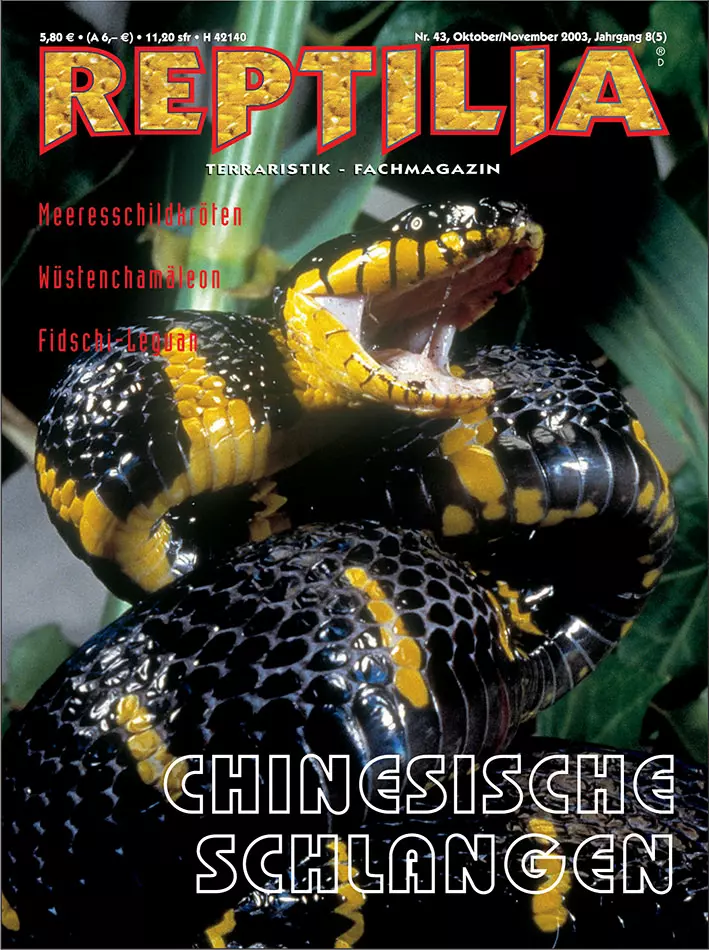
Reptilia 44 - Chinese snakesSea turtlesDesert chameleonFiji IguanaContents:
2 EDITORIAL
4 READER LETTERS
5 MAGAZINE
16 DATES
18 WESTERN HERP PERSPECTIVESReform backlog also for species protection lawsby B. Love
20 PHOTO REPORTAGE The diverse world of Chinese snakesby S. Winchell
30 HERPETOFAUNAThe venomous snakes of southern China
by N. Orlov, N. Ananjeva, S. Ryabov & Ding-qi Rao
37 HERPETOFAUNANotes on the Chinese climbing snakes of the genus Elaphe (sensu lato) FITZINGER, 1833
by A. Gumprecht
42 TRAVELNamibia - In search of the desert chameleon
by R. Leptien
47 HERPETOFAUNAMorphology and colouration of the Caribbean green iguana (Iguana delicatissima)
by M. Schardt
51 PORTRAIT AND POSTERPodarcis peloponnesiacaby B. Trapp
56 KEEPING AND BREEDINGCare and Breeding of the Banded Fiji Iguana (Brachylophus fasciatus BRONGNIART, 1800)by J. Schmidt
64 KEEPING AND BREEDINGOn the mating behaviour of tropical clawed frogs Silurana sp. – Part 1by K. Kunz
72 REPORTAGETurtle Island Part 2: The Barbados Sea Turtle Projectby M. Kuhn & D. Schmidt
78 HERPETOFAUNAParthenogenesis in the Dark Tiger Python (Python molurus bivittatus)by M. Kuhn & D. Schmidt
86 SMALL ADVERTS
90 RAT & TAT
94 LIBRARY
104 GLOSSESAll the happiness on earth - Part 1: Ascentby H. Werning
CHF 11.20
❅
❆
❅
❆
❅
❆
❅
❆
❅
❆
❅
❆
This website uses cookies to ensure the best experience possible. More information...