Tortoises Volume 3 - Outdoor enclosures

Article no: BZ-36073172

CHF 28.90

Stock: 1

Available, delivery time: 1-3 days

Delivery between Wednesday, 23 September and Thursday, 24 September
Zahlungsarten
Product information "Tortoises Volume 3 - Outdoor enclosures"

Outdoor enclosures for European tortoises

A guide to natural husbandry in your own garden – 14–99 years

Fortunately, the design of natural enclosures for European tortoises has increasingly become a focus for many tortoise owners in recent years. The tortoises’ natural habitat should serve as a model for keeping them in your own garden. The third volume in the series ‘Guide to Keeping European Tortoises’ deals with the topic of outdoor enclosures. In this book, authors Torsten Kiefer and Thorsten Geier share their many years of experience in designing tortoise enclosures. Taking nature as a model, this book provides a wealth of information on enclosure size, fencing and creating as diverse an environment as possible. The topic of cold frames and greenhouses is also presented in detail, including the necessary equipment. Furthermore, there is extensive information on food and enclosure plants (as well as unsuitable or poisonous plants) and a description of various enclosures for breeding, balcony enclosures, emergency enclosures, etc. Numerous photos showcase outdoor enclosures of all kinds and are intended to provide inspiration for your own garden. Other topics include accidents in enclosures, protection against predators and common mistakes in tortoise enclosures. This book aims to highlight the importance of natural husbandry in outdoor enclosures and to present the ‘European tortoises’ (Hobby) from a very special perspective. A book packed with ideas for designing outdoor enclosures.

Composition
Feeding recommendation
Technical details
Size information

0 of 0 reviews

Give us a rating!

Share your experience with the product with other customers.


Suggested products

Handbook of food plants for tortoises and other reptiles
Handbook of forage plants 2nd revised editionMarion Minch is not only a successful breeder of diverse tortoises for many years, but also an excellent connoisseur of native wild herbs. She founded and runs samenkiste.de, which is well known to many tortoise keepers and nature lovers. Her name is inextricably linked with reptile care and species-appropriate nutrition for tortoises. Her handbook of food plants summarises the most important native food plants for herbivorous and omnivorous reptiles. She not only considers tortoises, but also iguanas, spiny-tailed dragons and even chameleons. From the basics of plant biology to native wild herbs to suitable food plants for hardy tropical reptile species, this comprehensive work provides the basis for species-appropriate keeping. In the expanded and supplemented 2nd edition, the plant section is divided according to flower colour. This makes it even easier to identify wild herbs. The work has also been supplemented with a wealth of additional information and many pictures.

CHF 46.50

Geckos
Geckos in the terrarium by Astrid FalkThe book offers a comprehensive introduction to geckos and their species-appropriate keeping in terrariums. It explains what you need to think about before buying a gecko and what preparations should be made. The book describes in detail how the terrarium is technically equipped and set up. The care of the animals, their special features and behaviour, their diet, reproduction and rearing of young animals are described, as well as diseases and husbandry problems with tried and tested suggestions for prevention and treatment. Individual gecko species that are particularly suitable for keeping and breeding in terrariums are portrayed in detail in the second part of the book.

CHF 28.50

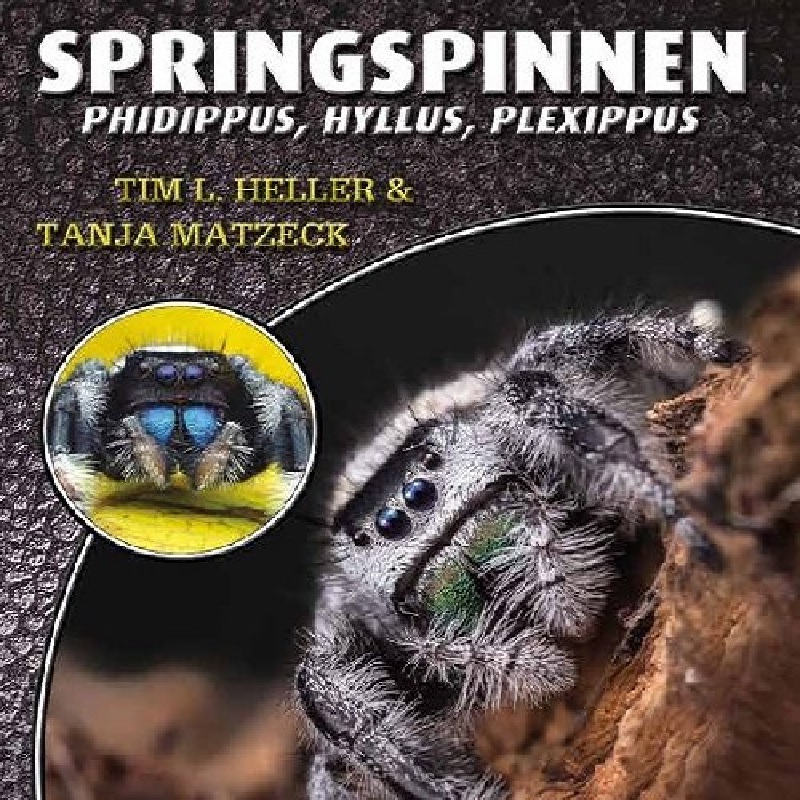
Jumping spiders Phidippus, Hyllus, Plexippus
Book Jumping Spiders - Phidippus, Hyllus & Plexippus A guide to keeping jumping spiders of the genera Phidippus, Hyllus & Plexippus. Who can resist the charm of jumping spiders? The childlike appearance of their expressive face simply leaves no one cold! In addition, their behavior is extremely exciting to observe, their colors are bright and their requirements for species-appropriate keeping are very easy to meet. No wonder these likeable jumpers are all the rage! This volume in the "Species by Species" series describes in detail what to look out for when buying and keeping them, introduces the most commonly kept species and color forms and provides plenty of tips on how to keep them successfully - so you can be sure they will breed well! Species by Species introduces you to the books in this series, which present the most popular terrarium animals. Each volume offers you detailed, practical care instructions and all the information you need to successfully breed your animals. All important questions from the required tank size to terrarium set-up, technical equipment, species-appropriate nutrition and disease prevention are answered with numerous tricks and tips. Experienced, long-standing breeders reveal how you can encourage the animals to reproduce and raise healthy young. All this in full color, generously illustrated and attractively designed - just about your terrarium animal - species by species

CHF 23.90

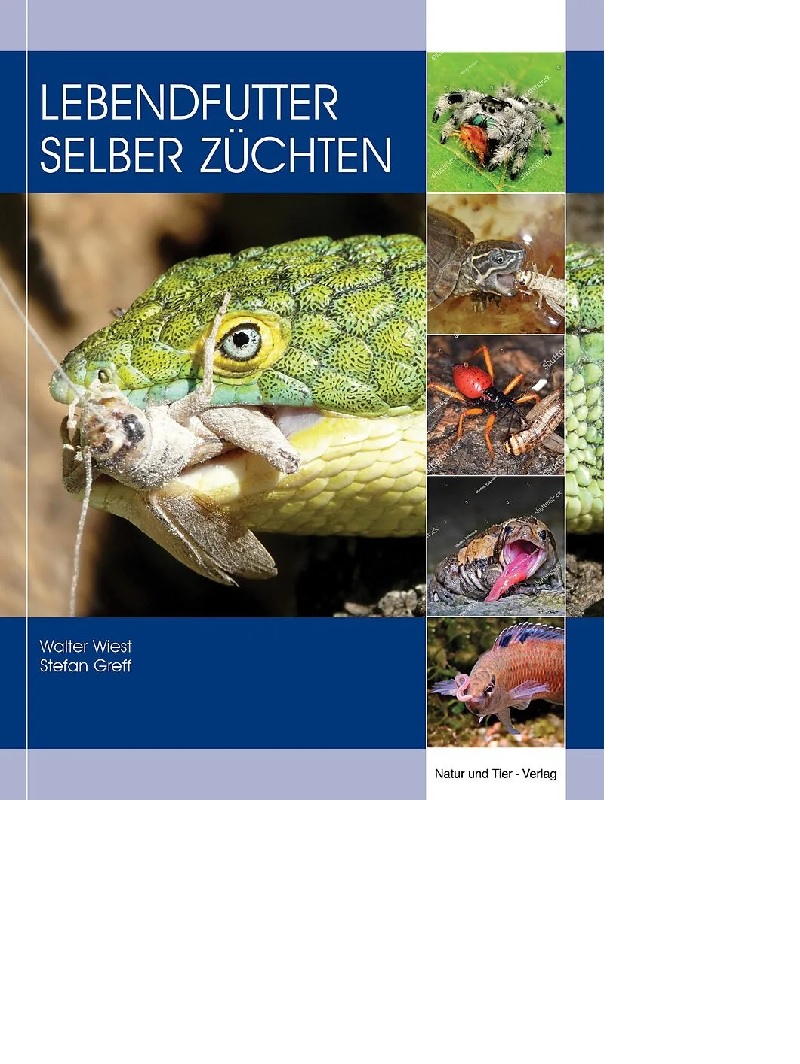
Book Breeding live food yourself
Book "Grow your own live food" - The perfect guide for pet owners Discover practical and detailed instructions on how you can easily breed food for your reptiles, birds, fish or other animals yourself in the book "Breeding live food yourself". With valuable tips on various food insects, their care and breeding, you can save money and ensure a species-appropriate diet for your pets. Contents of the book: Step-by-step instructions for breeding feeder insects Information on the best types of food for reptiles, birds and fish Care instructions and breeding conditions for various live food species Tips for sustainable and cost-effective food production Why breed your own live food? Get healthy, fresh food for your animals Save money and reduce dependence on pet shops Promote the health and well-being of your animals with species-appropriate food Whether you are a beginner or an experienced pet owner, this book provides you with everything you need to successfully breed live food yourself.

CHF 46.50

Marginata 69 - New Guinea tortoises
Marginata 69 - New Guinea tortoises – the genus ElseyaCover storyThe unrecognised beauties: New Guinea tortoises (Andreas S. Hennig)My experiences with Branderhorst's New Guinea tortoise, Elseya (Elseya) branderhorsti (Ouwens, 1914) (Andreas S. Hennig)Keeping and breeding of Rhodin's New Guinea tortoise, Elseya (Hanwarachelys) rhodini Thomson, Amepou, Anamiato & Georges, 2015 (Andreas S. Hennig)PortraitGeoemyda spengleri, Chinese serrated tortoise (Andreas S. Hennig)ReportageMacrochelys temminckii – Experiences and impressions with vulture tortoises part 2 (Reiner Praschag)KeepingAn alternative to year-round keeping of the Egyptian tortoise in the terrarium – my experiences with seasonal outdoor keeping of Testudo kleinmanni (Ricarda Schramm)EtymologySawbacks and living maps part 4: Graptemys gibbonsi, Pascagoula humpback tortoise (Holger Vetter)Classifieds & animal placement

CHF 16.50

Reptilia 101 - Outdoor terrariums
Reptilia 101 - Outdoor terrariums Planting of poison dart frog terrariumsSouth American tarantulasTravelling through the USA in a motorhome Contents: Many terrarium animals flourish in natural sunlight and fresh air. Keeping them outdoors, even if only for a few weeks in summer, is good for almost all of our reptiles. However, many species can also live outside all year round.REPTILIA presents the most beautiful outdoor enclosures, documents the construction of two different terrariums as examples and deals with keeping lizards in the garden. EDITORIALMAGAZINEDATES PHOTOREPORTAGELet's get out! The fascination of outdoor terrariumsMartin Hallmen HOLDINGOutdoor keeping of pearl lizardsIngo Kober TERRARIUM PRACTICEUp close to the little adders - building a raised terrarium in the garden and first experiencesH. Kreyerhoff TERRARIUM PRACTICEFear of loss - the protection of outdoor enclosures for tortoisesMichael Wirth KEEPING AND BREEDINGUnusual South American tarantulas of the genus EphebopusKarin Manns TERRARIUM PRACTICEJewels in stainless steel Building a terrarium for poison dart frogs Part 2: PlantingMichael Schulte Animals of our homelandThe yellow-bellied toadRolf Leptien LIBRARYTIPS AND TRICKS WESTERN HERP PERSPECTIVESBoa fantasiesBill Love ServiceALSO NEAR YOU JourneyBest of Southwest. Travelling with the family in search of reptiles. A small travel guide through the south-west of the USAHeiko Werning PREVIEW BRUTKASTENProblem discussionJörg Hofmann

CHF 12.00

Marginata 20 - North American Box Turtles
Marginata 20 - North American Box TurtlesTurtles of Nova Scotia Part 2Emys orbicularis twinsThe world's largest broad-shelled turtleContents:2 Editorial3 letters to the editor4 Magazine8 dates10 REPORTAGE The box turtles of the genus Terrapene Hans - Dieter Philippen16 BREEDING IN HUMAN CARE The Mexican representatives of the Carolina- Group from the genus Terrapene Markus Baur & Irmtraud Jasser-Häger26 REPORTAGE Notes on the ecology of Terrapene ornata ornata in the area of Great Plains Michael Wirth & Hans-Peter Mattern31 PORTRAIT Aldabra giant tortoise, Dipsochelys dussumieri (Gray, 1831) Michael Wirth35 REPORTAGE Influence of calcium concentrations in the Food on the digestibility of calcium, Magnesium and phosphorus in Testudo hermanni Annette Liesegang, Jean Michael Hatt & Marcel Wanner42 REPORT Twin births in the European box turtle European pond turtle (Emys orbicularis) Hans - Dieter Philippen44 REPORTAGE "Ötzi", or: The turtle that emerged from the Cold came .. A remarkable incubation experience Jutta Jähne & Hans - Dieter Philippen46 REPORT A journey to the turtles of Nova Scotia (Nova Scotia), Canada Part 2: Forests, streams, forest stream turtles Herbert Becker, Andreas Gräf & Urs Landweer57 REPORTAGE "Il Gigante" - the largest living broad-shelled turtle tortoise (Testudo marginata) Hans - Dieter Philippen60 Book tip 61 Classifieds62 Regional guide

CHF 16.50

Draco 21 - Lizards
Draco 21 - Lizards Contents: 2 Editorial 4 The true lizards of the family Lacertidae – an overviewWolfgang Bischoff 28 Lizards in the terrariumMichael Kroninger & Mike Zawadski 38 The lizards of GreeceBenny Trapp 43 On the ecology and terrarium husbandry of the Eastern Giant Green Lizard, Lacerta media israelica PETERS, 1964Hans Esterbauer 48 The Canary Island lizard Gallotia galloti (OUDART, 1839)Ingo Kober 60 Es Vedrá – a mystical island and its lizardsMike Zawadski & Michael Kroninger 68The greens from the KaiserstuhlWalther Rohdich 72 Omanosaura – the Arabian collared lizardsRolf Leptien 76Observations on an Aschaffenburg wall lizard populationMartin Felke 82 The Mongolian Desert Runner, Eremias argus PETERS, 1869Uwe Schlüter 87 Book box 94 Magazine

CHF 16.80

Marginata 13 - False map turtles
Marginata 13 - False map turtles Food plants for aquatic turtles 1The power of scentsKyrgyz four-toed tortoise Contents: 2 EDITORIAL 3 READER LETTERS 4 MAGAZINE 8 DATES 10 REPORTAGE False map turtles – colourful and easy-to-keep humpback turtles Hans - Dieter Philippen 16 BREEDING IN HUMAN CARE Keeping and breeding the false map turtle Siegbert Schulz 24 BREEDING IN HUMAN CARE The Mississippi humpback turtle in human care Elmar Meier 31 PORTRAIT South African beaked tortoise Erica Staelenberg & Hans - Dieter Philippen 35 REPORTAGE Food plants for aquatic turtles (Part I) Susanne Vogel 40 REPORTAGE The language of scents: European pond turtles use water-soluble messengers Jens R. Poschadel & Martin Plath 48 REPORTAGE Hope for the four-toed steppe tortoise Valentina Ismailovna Toropova, Thorsten Harder & Heike Finke 51 SHORT REPORT Discovery of an unusually marked brown tortoise on the island of Sumatra Elva Gemita 52 REPORTAGE Distribution of Cuora pani aurocapitata Part 1 Torsten Blanck & Tanja Kremser 57 SHORT REPORT The slider turtle issue Thomas Türbl, Markus Baur, Rudolf Hoffmann, Tobias Friz, Sabine Öfner & Friederike Weinzierl 60 BOOK TIP 61 CLASSIFIED ADS 62 REGIONAL GUIDE

CHF 14.70

Terraria 19 - Diseases of tarantulas
Terraria 19 - Diseases of Tarantulas Northern Pine SnakeExpedition Tanzania Contents: While reptiles and amphibians have long been professionally treated by specialised veterinarians,unfortunately, there is still much to be done for invertebrate terrarium guests. However, our knowledge of these animals is gradually increasing. In this TERRARIA, expert Frank Schneider impressively summarises the current state of knowledge about diseases and parasites of tarantulas and offers approaches for treatment options.2Editorial   4Magazine Snake mites in reptiles: predatory mites as a biological control method/ Remarks on Pipa snethlegeae in French Guiana/Another wall lizard population threatened by a construction project/ "Benefiz-Terraristika" a great success/Vivarium Karlsruhe – "Climate and Habitats"/Phoresy in pseudo- scorpions in Baltic amber/ Legal 16TERRAglobal I, the Crocodile Hunter Joachim Bulian The snake with the mighty "Embrace" Fabio Cupul 20Diseases and parasites of tarantulas Frank Schneider 41On the keeping and breeding of the turnip-tailed viper gecko (Hemidactylus imbricatus or Teratolepis fasciata) in the terrarium Martin Dieckmann 50The Canary Island Mediterranean tree frog (Hyla meridionalis): Distribution, keeping and reproduction Manfred Rogner 54The Northern Pine Snake (Pituophis melanoleucus melanoleucus) In nature and terrarium. Part 1 Bernd Skubowius 61Travel "Exo Terra" Expedition Tanzania 2008 Part 1: In the realm of the turquoise blue dwarf day gecko (Lygodactylus williamsi) Roland Zobel 72New species New from Table Mountain: two dwarf tegus and a "miniature dragon" toadlet Axel Kwet 75Among researchers Amphibians and reptiles above the clouds – the decoding of species diversity in a forgotten world Philippe Kok 81Test run Heating mats Kriton Kunz 84 Near you 86Showcase In the Swiss cellar – A visit to Beat Akeret Heiko Werning 91 Subscription & Service 94Preview 96Incubator The "Rock Helga" – A Morocco adventure in two parts. Part 1 Mike Zawadzki

CHF 12.00

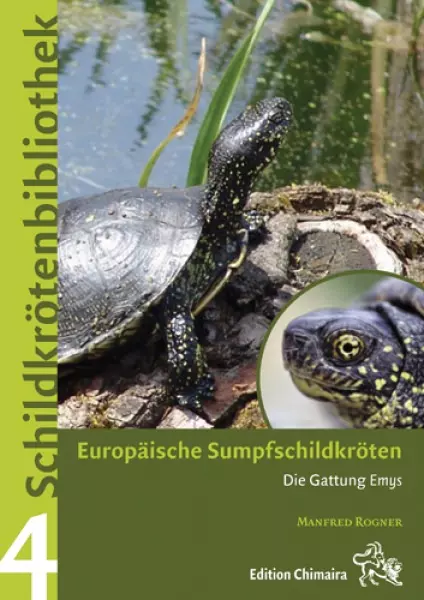
Turtle Library 4 - European Pond Turtle
European Pond Turtle - Emys orbicularis Turtle Library 4 This book covers everything from tried-and-tested advice on successful breeding to a scientific overview of current populations in the countries where they are found. The book includes a short article on the following countries and regions: North Africa (Morocco, Algeria, Tunisia); the Iberian Peninsula (including the Balearic Islands); France (including Corsica); the Benelux countries; Switzerland; Germany; Italy (including Sicily and Sardinia);  Denmark; Austria; Czech Republic; Slovenia, Poland; Hungary; Slovakia; Albania; Greece; Romania; Lithuania; Latvia; Bulgaria; Ukraine; Belarus; Turkey; Russia and the Caucasus region.

CHF 46.90

Reptilia 108 - Manless
Reptilia 108 Unlabelled AmazonasPraying mantisMotorised brooderContents:Cover story: Masterless! – About animal shelters, rescue centres and fire brigade operationsWith the increasing popularity of terrarium keeping, problems have also arisen that were previously only known from classic pets. Overburdened owners abandon animals or let them fall into neglect, and when personal circumstances change, there is suddenly no space for a terrarium. Traditional animal shelters are overwhelmed, and animal welfare activists use this as an argument against the keeping of wild animals. We examine the issue, show solution approaches, present the largest German reptile rescue centre in Munich along with its spectacular new project “Chelonia”, and see how firefighters prepare to rescue a snake as well as a cat. EditorialMAGAZINEEVENTS WESTERN HERP PERSPECTIVESNew horizonsB. Love ReportageTerrarium animals – a problem for animal shelters?K. Kunz REPORTAGENot just home, but a home for a while. The reptile rescue centre MunichH. Werning ReportageExotic emergency call. How the professional fire brigade equips itself for operations with reptilesS. Müller          ReportageDifferent continents – similar problems:? About the work of a reptile rescue centre in ArizonaS. Kalopp HUSBANDRYThe praying mantis Mantis religiosa. An insect of superlativesU. & J. Schimmelpfennig PracticeConcept and construction of a motorised brooderP. Schönecker ALSO IN YOUR AREA ANIMALS OF OUR HOMEThe tree frogR. Leptien Service TravelAlong the mighty Amazonas. In the herpetological paradiseK.-H. Switak PREVIEW INCUBATOR Television is coming – Part 1H. Werning

CHF 12.00

Customers also saw

Base tray for OpenAir Vivarium PRO
Size (1): small | Size (4): small
Base tray for OpenAir Vivarium PRO The base tray can be used as additional protection against moisture for the OpenAir Vivarium. Available sizes:small 40 x 40 x 5 cmmedium: 48 x 48 x 5 cmlarge: 58 x 58 x 5 cm Material: PVC

CHF 14.90