Handbook of forage plants 2nd revised editionMarion Minch is not only a successful breeder of diverse tortoises for many years, but also an excellent connoisseur of native wild herbs. She founded and runs samenkiste.de, which is well known to many tortoise keepers and nature lovers. Her name is inextricably linked with reptile care and species-appropriate nutrition for tortoises. Her handbook of food plants summarises the most important native food plants for herbivorous and omnivorous reptiles. She not only considers tortoises, but also iguanas, spiny-tailed dragons and even chameleons. From the basics of plant biology to native wild herbs to suitable food plants for hardy tropical reptile species, this comprehensive work provides the basis for species-appropriate keeping. In the expanded and supplemented 2nd edition, the plant section is divided according to flower colour. This makes it even easier to identify wild herbs. The work has also been supplemented with a wealth of additional information and many pictures.
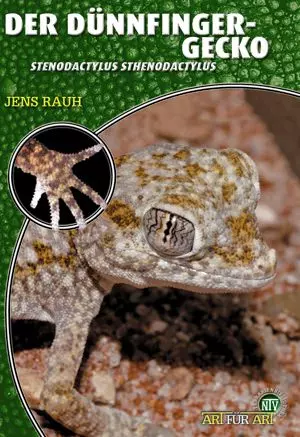
Geckos in the terrarium by Astrid FalkThe book offers a comprehensive introduction to geckos and their species-appropriate keeping in terrariums. It explains what you need to think about before buying a gecko and what preparations should be made. The book describes in detail how the terrarium is technically equipped and set up. The care of the animals, their special features and behaviour, their diet, reproduction and rearing of young animals are described, as well as diseases and husbandry problems with tried and tested suggestions for prevention and treatment. Individual gecko species that are particularly suitable for keeping and breeding in terrariums are portrayed in detail in the second part of the book.
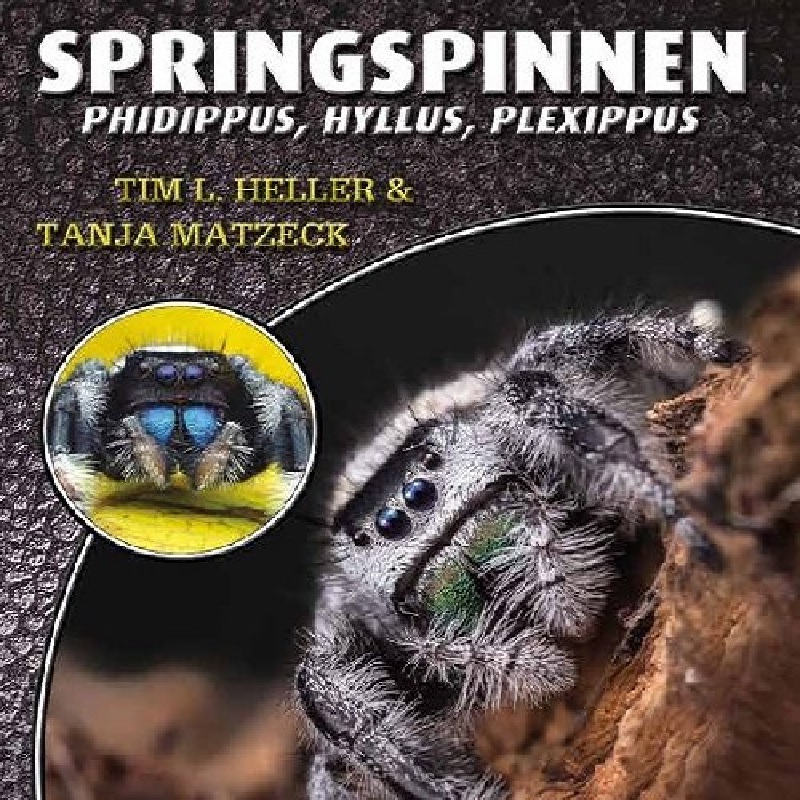
Book Jumping Spiders -
Phidippus, Hyllus & Plexippus
A guide to keeping jumping spiders of the genera Phidippus, Hyllus & Plexippus. Who can resist the charm of jumping spiders? The childlike appearance of their expressive face simply leaves no one cold! In addition, their behavior is extremely exciting to observe, their colors are bright and their requirements for species-appropriate keeping are very easy to meet. No wonder these likeable jumpers are all the rage!
This volume in the "Species by Species" series describes in detail what to look out for when buying and keeping them, introduces the most commonly kept species and color forms and provides plenty of tips on how to keep them successfully - so you can be sure they will breed well!
Species by Species introduces you to the books in this series, which present the most popular terrarium animals. Each volume offers you detailed, practical care instructions and all the information you need to successfully breed your animals.
All important questions from the required tank size to terrarium set-up, technical equipment, species-appropriate nutrition and disease prevention are answered with numerous tricks and tips.
Experienced, long-standing breeders reveal how you can encourage the animals to reproduce and raise healthy young.
All this in full color, generously illustrated and attractively designed - just about your terrarium animal - species by species
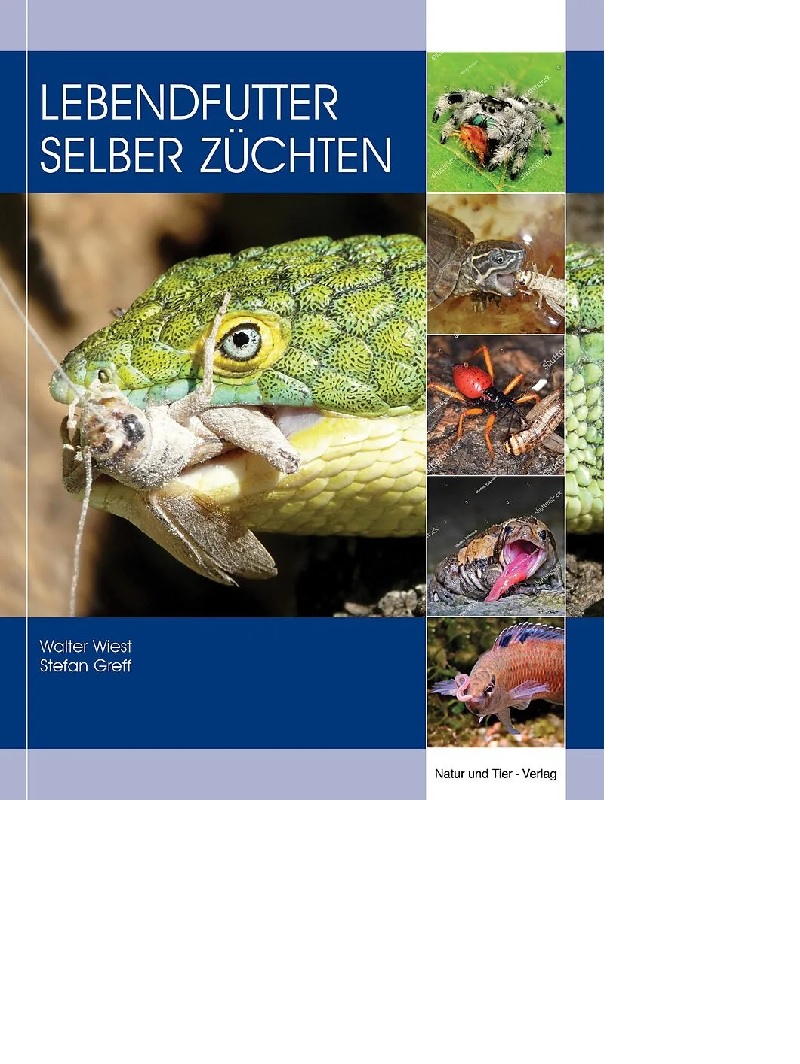
Book "Grow your own live food" - The perfect guide for pet owners
Discover practical and detailed instructions on how you can easily breed food for your reptiles, birds, fish or other animals yourself in the book "Breeding live food yourself". With valuable tips on various food insects, their care and breeding, you can save money and ensure a species-appropriate diet for your pets.
Contents of the book:
Step-by-step instructions for breeding feeder insects
Information on the best types of food for reptiles, birds and fish
Care instructions and breeding conditions for various live food species
Tips for sustainable and cost-effective food production
Why breed your own live food?
Get healthy, fresh food for your animals
Save money and reduce dependence on pet shops
Promote the health and well-being of your animals with species-appropriate food
Whether you are a beginner or an experienced pet owner, this book provides you with everything you need to successfully breed live food yourself.
Marginata 69 - New Guinea tortoises – the genus ElseyaCover storyThe unrecognised beauties: New Guinea tortoises (Andreas S. Hennig)My experiences with Branderhorst's New Guinea tortoise, Elseya (Elseya) branderhorsti (Ouwens, 1914) (Andreas S. Hennig)Keeping and breeding of Rhodin's New Guinea tortoise, Elseya (Hanwarachelys) rhodini Thomson, Amepou, Anamiato & Georges, 2015 (Andreas S. Hennig)PortraitGeoemyda spengleri, Chinese serrated tortoise (Andreas S. Hennig)ReportageMacrochelys temminckii – Experiences and impressions with vulture tortoises part 2 (Reiner Praschag)KeepingAn alternative to year-round keeping of the Egyptian tortoise in the terrarium – my experiences with seasonal outdoor keeping of Testudo kleinmanni (Ricarda Schramm)EtymologySawbacks and living maps part 4: Graptemys gibbonsi, Pascagoula humpback tortoise (Holger Vetter)Classifieds & animal placement
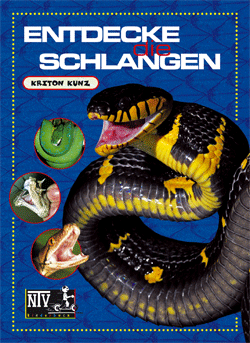
NTV, Discover the Snakes!
48 pages
colour photos throughout
Large format: 20.7 x 28 cm, hardcover
Author Kriton Kunz
Contents:
Discover the Snakes!Snakes are fascinating animals. Children are particularly aware of this because they still have an unprejudiced view of the beauties and secrets of nature as well as an innate urge to explore and simply want to know everything about these mysterious and beautiful animals. REPTILIA editor Kriton Kunz is completely in tune with the views and needs of his young readers and conveys everything worth knowing about these animals in an exciting way that answers children's questions in an easily understandable and simply fun way. What are snakes, what species are there? How does their body work, why do they flick their tongues? Why do snakes shed their skin, how do they hunt and eat? Are all snakes poisonous? What can you do to protect snakes? And, of course, what particularly interests children: What records exist in the world of snakes, which is the longest, which is the most venomous, which has the most babies...?The author not only deals with these and all other questions in detail and in a child-friendly way, but also offers two Extras on: Portraits of all native snake species to get to know and a big snake quiz in which the young experts can test their knowledge!Conclusion: A highly valuable educational book with a high fun factor!
Reptilia 43 - Australian monitor lizards
Dendrobates claudiaeBrown snakesKruger Park
Contents:
2 EDITORIAL
4 READER LETTERS
6 MAGAZINE
12 DATES
16 WESTERN HERP PERSPECTIVESImprove your reptile photos – it's easyby B. Love
18 PHOTO REPORTAGE Australian monitor lizardsby D. F. Bennet
26 HERPETOFAUNAThe Varanus-gouldii-complex
by D. F. Bennet
29 HERPETOFAUNAThe monitor lizards of the Australian desert
by E. R. Pianka
36 KEEPING AND BREEDINGKeeping and continuous breeding of King’s rock monitor, Varanus kingorum STORR, 1980), including the first breeding of an albino juvenile.
by B. Eidenmüllser
41 KEEPING AND BREEDINGVaranus glauerti – the “Scaly Jewel”
by F. Izaber
41 KEEPING AND BREEDINGStoreria dekayi – the Northern brown snake
by M. Held
47 TRAVELIn Kruger National Park – not because of the big onesby W. Rohdich
51 PORTRAIT AND POSTERBungarus f. flavicepsby A. Gumprecht
56 REPORTAGETurtle Island Part 1: Personal experiences with the sea turtles of Barbadosby M. Hallmen
62 REPORTAGEExperiences and difficulties in caring for and “breeding” the common agama (Agama agamaby J. Rauh and T. Gaubies
68 REPORTAGEMale or female? ROPS e. V. – First results of the research work of the years 1999–2003by B. Röll and F. W. Henkel
29 HERPETOFAUNADendrobates claudiae & Phyllobates lugubris – two poison dart frogs from Panama in the same outfit
by T. Ostrowski
76 HERPETOLOGY AND CULTUREDead animals in Tunisia – On the souvenir trade in North Africaby K. Kunz
85 CLASSIFIED ADS
90 RAT & TAT
93 LIBRARY
104 GLOSSBiblical plague on the ICEby H. Werning
Draco 37 - Florida
Contents:
2 Editorial
4 Florida – a small herpetological travel guide Heiko Werning
24 Under and above water through the karst waters of Florida Beat Akeret
30 In search of gopher and box turtles Michael Wirth & Hans-Dieter Philippen
38 The National Breeders’ Expo – the catalyst for terraristics in the USA and worldwide Hans-Dieter Philippen
44 Exotic diary Rolf Leptien & Heiko Werning
56 Keeping and breeding of chain snakes, Lampropeltis getula, Florida Bernd Skubowius
64 The Florida pine snake, Pituophis melanoleucus mugitus Barbour, 1921 – so far still a rare terrarium inhabitant Bernd Skubowius
74 Turtle breeding in Central Florida Hans-Dieter Philippen
Im Biotop der Großkopf-Schienenschildkröte?Zucht von Kinosternon bauriiHaltung und Zucht von Astrochelys radiata Teil 6
Inhalt:
Editorial
Magazin
Termine
FOTOSTORY
Die Gattung Kinixys. Schildkröten mit „Knick“ im Panzer
Hans-Dieter Philippen
NACHZUCHT
Gemischte Erfahrungen bei Haltung und Nachzucht der Madagassischen oder Dormergues Glattrand Gelenkschildkröte
Viktor Mislin & Hans-Dieter Philippen
NACHZUCHT
Haltung und Nachzucht der Stutz-Gelenkschildkröte (Kinixys homeana) bis zur F2-Generation
John Zoran
PORTRÄT
Weissingers Breitrandschildkröte, Testudo marginata weissingeri
Hans-Dieter Philippen
HALTUNG UND NACHZUCHT
Haltung und Nachzucht der Madagassischen Strahlenschildkröte. Teil 6
Michael Wirth & Peter Fritz
REPTORTAGE
Im Biotop der Großkopf-Schienenschildkröte (Peltocephalus dumerilianus)
Mario Herz
ZUCHT
Haltung, Pflege und Nachzucht der Dreistreifen-Klappschildkröte, Kinosternon baurii
Nicolas Pellegrin
Buchtipp
Kleinanzeigen
Abo & Service
Regionalführer
Terraria No. 35 - Reptile search
Rhacophorus feaeTrugnattern
Inhalt:
Titelthema: Reptiliensuche in der NaturReptilien in freier Natur zu suchen und zu beobachten, macht nicht nur Spaß, sondern dabei lassen sich auch viele wichtige Erkenntnisse für die Haltung der betreffenden Arten sammeln. Allerdings ist es nicht einfach damit getan, rauszugehen und darauf zu hoffen, dass einem die Tiere nur so über den Weg laufen. Worauf es ankommt, um bei der Suche nach Reptilien auch wirklich Erfolg und damit schöne Erlebnisse zu haben, das erfahren Sie in den ausführlichen Beiträgen des Titelthemas der nächsten TERRARIA/elaphe-Ausgabe. TerritorialHerpetoramaTitelthema„Fieldherping“. Die erfolgreiche Suche nach Reptilien im FreilandMichael WirthVon Kratzern, gutem Müll und gebräunten Nacken. Praxistipps für die ReptiliensucheMichael WirthBitte nicht stören! Verantwortungsbewusstes Verhalten bei der Suche nach ReptilienBenny TrappPanoramaTerraglobal. Reptilien rund um Haus und GartenAlfred Schleicher Reptilienerinnerungen à la GuatemalaLester MeléndezForschungUnter Forschern. Vielfalt zwischen Tempeln und Landminen – Herpetologische Feldarbeit in KambodschaTimo HartmannNeue ArtenListe der im Jahr 2011 neu beschriebenen Reptilien Axel KwetSalamandraTerraristikKlassikerDer Grüne LeguanBasiliscus plumifrons, der Stirnlappenbasilisk: Erfahrungen aus 20 Jahren Haltung und Vermehrung im Terrarium. Teil 2: Pflege und NachzuchtIngo KoberGiftbisse von giftigen und „harmlosen“ Schlangen. Teil 2Dieter SchmidtErstnachzucht von Feas Riesenruderfrosch, Rhacophorus feae, im Leningrad Zoo Anna A. Bagaturova & Mikhail F. BagaturovNatur- und ArtenschutzFeldnotizen. Die Rote Liste der Amphibien und Reptilien Deutschlands. Teil 2: Verantwortlichkeit, Gefährdungsursachen, Schutz- und HilfsmaßnahmenKlaus-Detlef Kühnel, Arno Geiger & Richard PodlouckyVermisstHalbschwimmer-Nasenfrosch (Rhinoderma rufum)Alexander GutscheAuch in Ihrer NäheAbo & ServiceGalerie100 Jahre Herpetologia EuropaeaAxel Kwet
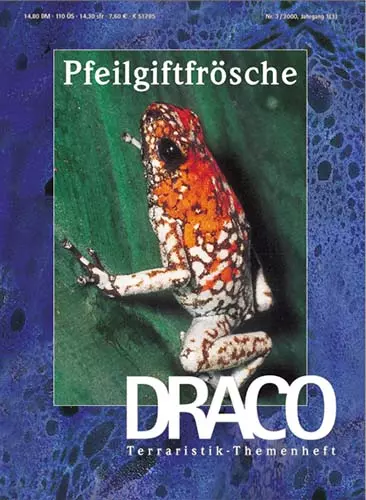
Draco 03 - Poison dart frogs
Contents:
2 Editorial
4 Poison dart frogs - An introduction to biology, systematics and distribution, by S. Lötters
16 Brood care in poison dart frogs, by A. Quiguango-Ubillus
24 Reproductive behaviour in poison dart frogs, by K.-H. Jungfer
29 The poison dart frogs of Bolivia and their distribution, by S. Lötters and S. Reichle
32 Poison dart frogs in the terrarium, by M. Schmidt
50 Building an artificial waterfall from polystyrene, by D. Löhmann
58 The Web-climbing Tree Frog - A small jewel from the rainforest, by H. Divossen
62 Keeping and breeding Dendrobates histrionicus, by E. Schoop
70 Colourful encounters in the Choco, by J. Stelder
73 Infectious diseases - a constant threat to dendrobatid keeping? by M. Mutschmann
83 Book box
89 Magazine
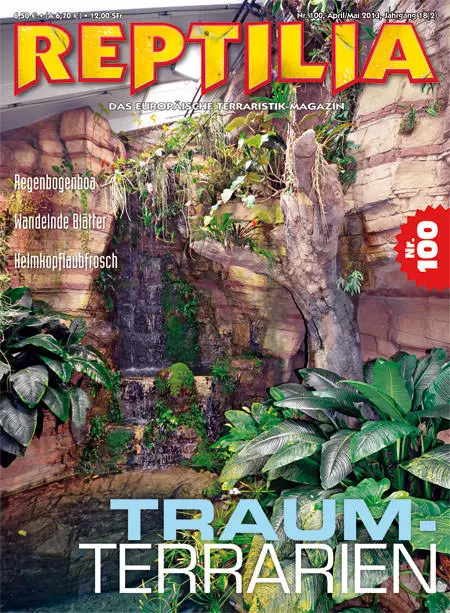
Reptilia 100 - Dream terrariums
Rainbow boaChanging leavesHelmeted tree frog
Contents:
What could be more fitting for the 100th issue of our magazine, than to showcase the very best the hobby has to offer: dream terrariums! We show you the most extraordinary tanks owned by private keepers, and they’ll leave you speechless. We’ve also included building guides with plenty of ideas so that you too can make your dream of the perfect terrarium a reality.
EDITORIALMAGAZINEDATES
AROUND THE WORLD IN 5 YEARSThe end is nearA. Pachmann
PHOTOREPORTAGEDream terrariums
REPORTAGEPack your swimming trunks – a visit to Georg Reitmaier’s superlative terrariumH. Werning
TERRARIUM PRACTICE“A Dream comes true”. Building a terrarium for keeping Morelia boeleniM. Uhlhaas, P. Pohlscheid & L. Schilling
TERRARIUM PRACTICEJewels in stainless steel. Building a terrarium for poison dart frogs. Part 1: Planning, construction and manufactureM. Schulte
REPORTAGEThe first world championship in terrascapingL. Barkam
Readers’ competition“Your dream terrarium”
KEEPING AND BREEDINGOn the knowledge, care and breeding of the Yucatán shovel-headed tree frog Triprion petasatusT. Eisenberg
KeepingKeeping and care of changing leaves, using Phyllium siccifolium from the Philippines as an exampleM. Friend
REPORTAGEFringed-finger lizards (Acanthodactylus) in the wild and in the terrarium. Part 7: The Acanthodactylus-erythrurus group and conclusionU. Schlüter
KEEPING AND BREEDINGOn the biology and care of the Guyana rainbow boa (Epicrates maurus guyanensis)M. Schwederski & L. Trutnau
Animals of our homelandThe European pond turtleR. Leptien
WESTERN HERP PERSPECTIVESThe safe world syndrome – protection from everything and everyoneB. Love
TIPS AND TRICKSSUBSCRIPTION & SERVICETest runALSO NEAR YOU
JourneyAdventure holiday in the PhilippinesM. Gaulke
PREVIEW
BRUTKASTENI would even let myself be locked up for the REPTILIA – part 2H. Werning
CHF 12.00
❅
❆
❅
❆
❅
❆
❅
❆
❅
❆
❅
❆
This website uses cookies to ensure the best experience possible. More information...