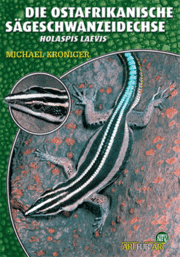
The East African saw-tailed lizard

Article no: 978-3-937285-17-7

CHF 21.90

Stock: 0

Ready for dispatch in 1-3 days, delivery time 14 working days

Delivery between Monday, 9 November and Tuesday, 10 November
Zahlungsarten
Product information "The East African saw-tailed lizard"

NTV The East African saw-tailed lizard

All about the East African saw-tailed lizard by Michael Kroninger

  • 61 pages
  • 14.8 x 21 cm
  • numerous colour photos
  • 1st edition
  • Author Michael Kroninger
  • Publisher NTV

Contents:

They are brightly coloured, the always agile and lively saw-tailed lizards. It's no wonder that they are currently becoming increasingly popular, as these endearing, attractive animals are not only highly interesting reptiles, but also very easy to care for.
Michael Kroninger is an experienced terrarium keeper and has been successfully breeding saw-tailed lizards for many years. In this volume of the "Species by Species" series, you will therefore find all the information you need for the species-appropriate care of these beautiful lizards. The fact that you will also learn how to breed your animals, hatch the eggs and raise the little ones makes this book an indispensable guide.

  • Systematics and body structure
  • The fascinating biology: From the life of the saw-tailed lizard
  • All information on species-appropriate keeping: from suitable terrariums to equipment and technology to feeding
  • Successful breeding: Mating stimulation, incubation of the eggs and rearing the young
  • Solutions to problems: How to avoid the most common mistakes in care and how to help sick animals
  • Brilliant photos
Composition
Feeding recommendation
Technical details
Size information

0 of 0 reviews

Give us a rating!

Share your experience with the product with other customers.


Suggested products

Handbook of food plants for tortoises and other reptiles
Handbook of forage plants 2nd revised editionMarion Minch is not only a successful breeder of diverse tortoises for many years, but also an excellent connoisseur of native wild herbs. She founded and runs samenkiste.de, which is well known to many tortoise keepers and nature lovers. Her name is inextricably linked with reptile care and species-appropriate nutrition for tortoises. Her handbook of food plants summarises the most important native food plants for herbivorous and omnivorous reptiles. She not only considers tortoises, but also iguanas, spiny-tailed dragons and even chameleons. From the basics of plant biology to native wild herbs to suitable food plants for hardy tropical reptile species, this comprehensive work provides the basis for species-appropriate keeping. In the expanded and supplemented 2nd edition, the plant section is divided according to flower colour. This makes it even easier to identify wild herbs. The work has also been supplemented with a wealth of additional information and many pictures.

CHF 46.50

Geckos
Geckos in the terrarium by Astrid FalkThe book offers a comprehensive introduction to geckos and their species-appropriate keeping in terrariums. It explains what you need to think about before buying a gecko and what preparations should be made. The book describes in detail how the terrarium is technically equipped and set up. The care of the animals, their special features and behaviour, their diet, reproduction and rearing of young animals are described, as well as diseases and husbandry problems with tried and tested suggestions for prevention and treatment. Individual gecko species that are particularly suitable for keeping and breeding in terrariums are portrayed in detail in the second part of the book.

CHF 28.50

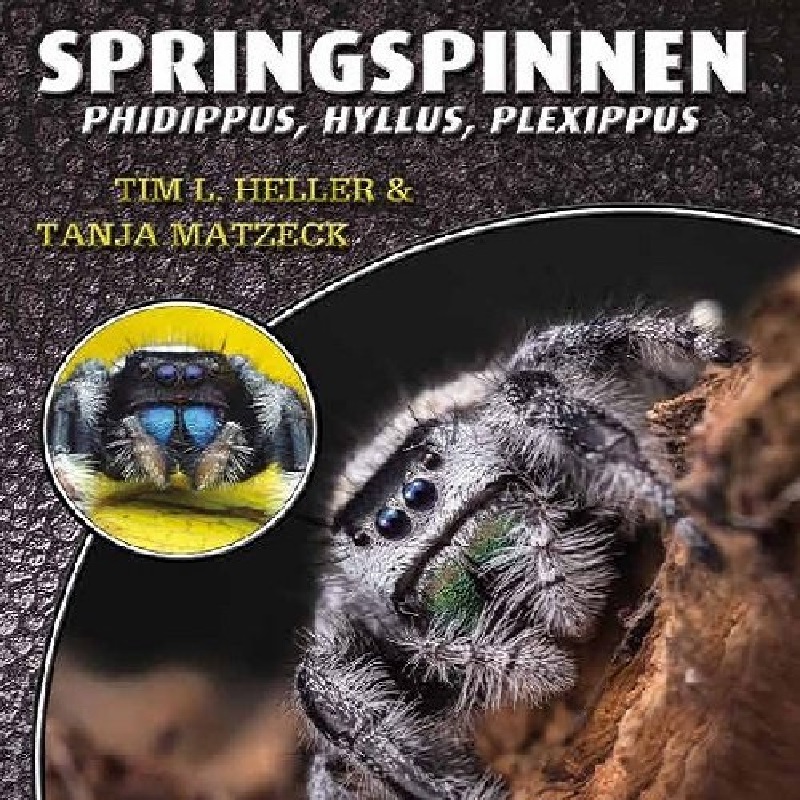
Jumping spiders Phidippus, Hyllus, Plexippus
Book Jumping Spiders - Phidippus, Hyllus & Plexippus A guide to keeping jumping spiders of the genera Phidippus, Hyllus & Plexippus. Who can resist the charm of jumping spiders? The childlike appearance of their expressive face simply leaves no one cold! In addition, their behavior is extremely exciting to observe, their colors are bright and their requirements for species-appropriate keeping are very easy to meet. No wonder these likeable jumpers are all the rage! This volume in the "Species by Species" series describes in detail what to look out for when buying and keeping them, introduces the most commonly kept species and color forms and provides plenty of tips on how to keep them successfully - so you can be sure they will breed well! Species by Species introduces you to the books in this series, which present the most popular terrarium animals. Each volume offers you detailed, practical care instructions and all the information you need to successfully breed your animals. All important questions from the required tank size to terrarium set-up, technical equipment, species-appropriate nutrition and disease prevention are answered with numerous tricks and tips. Experienced, long-standing breeders reveal how you can encourage the animals to reproduce and raise healthy young. All this in full color, generously illustrated and attractively designed - just about your terrarium animal - species by species

CHF 23.90

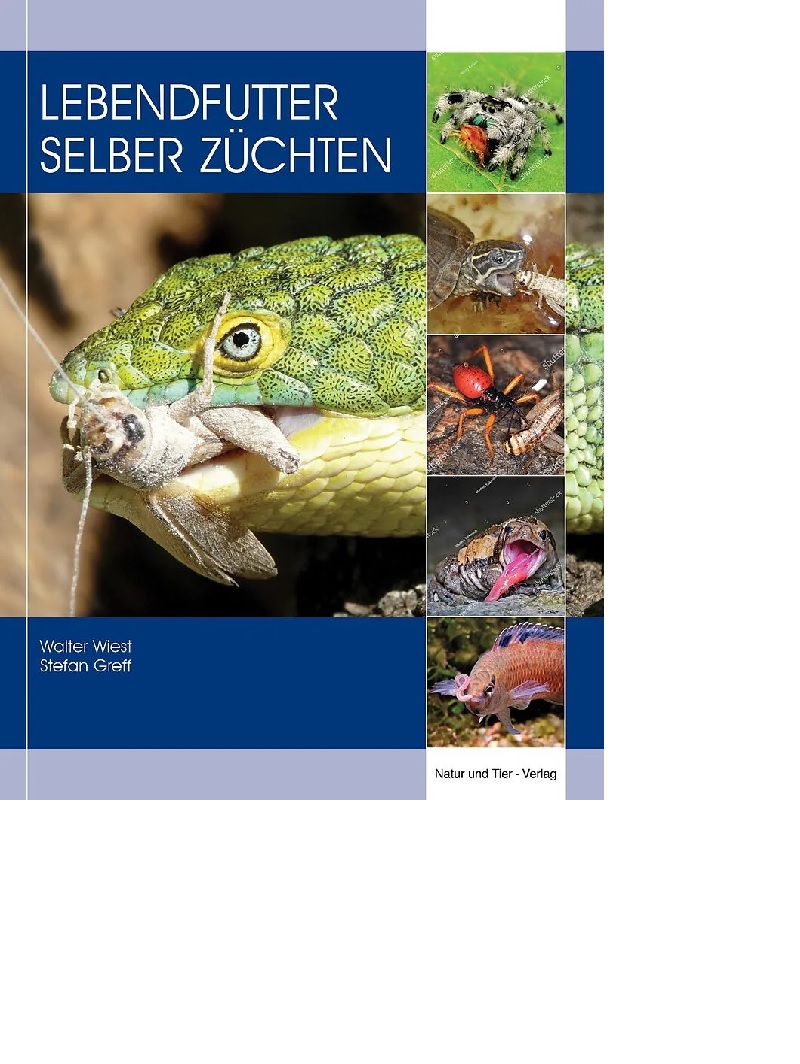
Book Breeding live food yourself
Book "Grow your own live food" - The perfect guide for pet owners Discover practical and detailed instructions on how you can easily breed food for your reptiles, birds, fish or other animals yourself in the book "Breeding live food yourself". With valuable tips on various food insects, their care and breeding, you can save money and ensure a species-appropriate diet for your pets. Contents of the book: Step-by-step instructions for breeding feeder insects Information on the best types of food for reptiles, birds and fish Care instructions and breeding conditions for various live food species Tips for sustainable and cost-effective food production Why breed your own live food? Get healthy, fresh food for your animals Save money and reduce dependence on pet shops Promote the health and well-being of your animals with species-appropriate food Whether you are a beginner or an experienced pet owner, this book provides you with everything you need to successfully breed live food yourself.

CHF 46.50

Marginata 69 - New Guinea tortoises
Marginata 69 - New Guinea tortoises – the genus ElseyaCover storyThe unrecognised beauties: New Guinea tortoises (Andreas S. Hennig)My experiences with Branderhorst's New Guinea tortoise, Elseya (Elseya) branderhorsti (Ouwens, 1914) (Andreas S. Hennig)Keeping and breeding of Rhodin's New Guinea tortoise, Elseya (Hanwarachelys) rhodini Thomson, Amepou, Anamiato & Georges, 2015 (Andreas S. Hennig)PortraitGeoemyda spengleri, Chinese serrated tortoise (Andreas S. Hennig)ReportageMacrochelys temminckii – Experiences and impressions with vulture tortoises part 2 (Reiner Praschag)KeepingAn alternative to year-round keeping of the Egyptian tortoise in the terrarium – my experiences with seasonal outdoor keeping of Testudo kleinmanni (Ricarda Schramm)EtymologySawbacks and living maps part 4: Graptemys gibbonsi, Pascagoula humpback tortoise (Holger Vetter)Classifieds & animal placement

CHF 16.50

Draco 18 - Geckos
Draco 18 - Geckos Contents: 2 Editorial 4 The geckos of the worldMirko Barts and Felix Hulbert 18 Diurnal dwarf geckos from Africa and Madagascar: the genus LygodactylusBeate Röll 28 The Madagascar big-headed geckos (Paroedura)Klaus Liebel, Michael Mayer and Wolfgang Schmidt 40 News from Madagascar: care, breeding and way of life of Uroplatus pietschmanni BÖHLE & SCHÖNECKEr, 2004Patrick Schönecker and Andreas Böhle 45 Narrow-fingered geckos, Stenodactylus sthenodactylus (LIECHTENSTEIN, 1823), in the terrariumKarsten Grießhammer 52 Dwarf geckos (Tropiocolotes PETERS, 1880) from North Africa - Habitats, behaviour, care and breedingUwe Schlüter 59 Agamura persica – The spider gecko from the Middle EastMichael Meyer 64 Experiences with the house gecko (Hemidactylus frenatus) Peter Maria Müller 68 The fringed-tailed house gecko (Cosymbotus platyurus): keeping and breeding in the terrarium and free-rangeIngo Kober 76A tiger in the terrarium – keeping and breeding Goniurosaurus araneus (GRISMER; VIETS & BOYLE, 1999)Andreas Dickhoff 82 Keeping and breeding the knob-headed gecko, Rhacodactylus auriculatus BAVAY, 1869 Stefanie Bach 90 Book box 95 Magazine

CHF 16.80

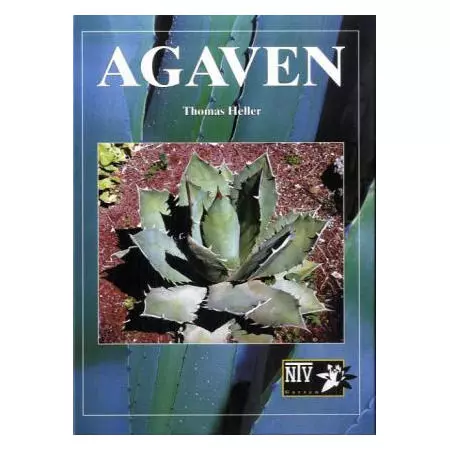
NTV, Agaves
NTV, Agaves - All about the magnificent and attractive show plants 168 pages 199 colour photos 2 cards Format: 17.5 x 23.2 cm, hardcover 2nd enlarged edition Author Thomas Heller  Contents: Agaves are magnificent, extremely attractive show plants with a high decorative value. Many people only know them from botanical gardens, where they are among the centrepieces of exhibitions. However, these plants can also be kept at home, and the different size classes of the countless species allow even plant lovers with little space to choose the right species for them. Agave expert Thomas Heller describes everything to do with the biology and culture of agaves in this standard reference work and does not omit any aspects of cultural history. Anyone who also wants to learn something about tequila & co. will also be well served here. The excellent photos, many of which are of original locations, also make the book a feast for the eyes. Botanical-geographical basics Economic importance and utilisation All information about successful cultivation: location and temperature, plant pots and substrate, watering and fertilising, diseases and pests, propagation Extensive species section with all relevant agave species Brilliant colour photos

CHF 35.90

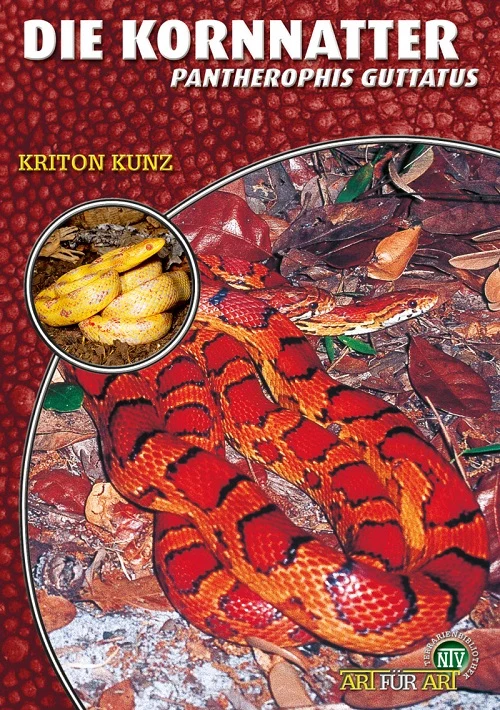
The corn snake
All about corn snakes from Kriton Kunz 64 Seiten 14,8 x 21 cm zahlreiche Farbfotos Autor Kriton Kunz Inhalt: Vielleicht der Klassiker der Terraristik schlechthin ist die Kornnatter. Sie vereint in sich alle Eigenschaften, die eine Schlange zu einem geeigneten und auch dem Einsteiger empfehlenswerten Pflegling machen: Wunderschöne Färbung, attraktive Farbvarianten, ruhiges, umgängliches Wesen und leichte Haltbarkeit. Damit Sie Ihre Kornnattern vom ersten Tag an richtig und artgerecht pflegen können, vermittelt Ihnen Kriton Kunz, REPTILIA-Redakteur und erfahrener Schlangenhalter, in diesem Band der Reihe „Art für Art“ ausführlich und leicht verständlich alles, was Sie für die erfolgreiche Haltung dieser faszinierenden Art wissen müssen. Selbstverständlich erfahren Sie auch, wie Sie Ihre Tiere zur Vermehrung bringen, die Eier ausbrüten und die Jungtiere aufziehen können. Systematik und Körperbau Die faszinierende Biologie: Aus dem Leben der Kornnatter Alle Informationen zur artgerechten Haltung: Vom geeigneten Terrarium über Einrichtung und Technik bis hin zur Fütterung Erfolgreich nachzüchten: Paarungsstimulation, Inkubation der Eier und Aufzucht der Jungtiere Problemlösungen: Wie man die häufigsten Fehler bei der Pflege vermeidet, und wie man kranken Tieren helfen kann Brillante Fotos

CHF 21.90

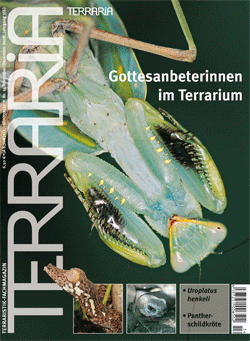
Terraria 14 - Praying Mantises in the Terraria
Terraria 14 - Praying Mantises in the Terrarium Uroplatus henkeliPanther tortoise Contents: 2 Editorial Kriton Kunz4 Magazine Gondwanaland – a future-orientated project at Leipzig Zoo / New findings on the taxonomy of pythons / snakes and culture at the Potsdam Natural History Museum / The Frankfurt Zoological Society and their activities on Galápagos12 TERRAglobal Snake dealer Joachim Bulian On the road in the Andes Maik Dobiey Cover story: Praying Mantises16 Praying Mantises: Fascinating terrarium inhabitants Timm Adam 28 A terrarium for praying mantises Timm Adam33 How to: Tips for species-appropriate care for praying mantises Timm Adam42 Breeding of Mantodea Timm Adam46 Lampropeltis triangulum andesianus – rare terrarium jewel with a dubious reputation Part 2: Reproduction Thorsten Schmidt54 Grey giants among themselves – about panther tortoises and elephants in Addo Elephant National Park, South Africa Part 3: Reproduction and lifestyle of the panther tortoise Michael Wirth63 Biology, keeping and breeding of Henkel's flat-tailed gecko, Uroplatus henkeli Christian Müttherthies71 Travel Herpetological impressions during iguana search on the French Antilles: Martinique Stefanie Bach & Patrick Schönecker82 New Species Greek wall lizards with a new name / Two new tree frogs from New Guinea85 Among Researchers In the valleys of the Andes: still unknown and already threatened Claudia Koch89 Test run Aquarium internal filter for terrarium keepers Kriton Kunz95 Eye-catcher Visiting Betty Heiko Werning99 Near You 103 Preview 104 Incubator The invasion of the stray mantises Heiko Werning

CHF 12.00

Terraria No. 34 - Basilisks
Terraria No. 34 - Basilisks ArabienNeu beschriebenen Amphibien 2011 Inhalt: Basilisk, Jesus-Christus-Echse – kaum ein Reptil ist mystisch so aufgeladen, wie die kleine mittel- und südamerikanische Leguangattung Basiliscus. Ihr bizarres Äußeres schlägt Menschen seit jeher in den Bann, ebenso ihre spektakuläre Fähigkeit, über das Wasser zu laufen. Und als Terrarientiere gehören sie zu den Klassikern, die in geräumigen Terrarien über Generationen erfolgreich zu halten und zu vermehren sind und eine wirkliche Augenweide für jedes Regenwald-Schauterrarium darstellen. Wir stellen Ihnen diese faszinierende Gattung vor, berichten über die faszinierende Freilandbiologie im „Basilisken-Land“ Costa Rica und beschreiben ausführlich die Terrarienhaltung dieser wunderschönen Echsen. TerritorialHerpetoramaChytrid – eine durch den Amphibienhandel menschengemachte Katastrophe?Axel KwetTitelthemaBasilisken. Spektakuläre Vertreter der LeguaneMichael WirthÖkologie der Basilisken und Freilandbeobachtungen in Costa RicaMichael WirthBasiliscus plumifrons, der Stirnlappenbasilisk: Erfahrungen aus 20 Jahren Haltung und Vermehrung im Terrarium. Teil 1: Einrichtung und TechnikIngo KoberTerraglobalRespekt vor GiftschlangenMirco SoléBangkok, die Flut und Grüne MambasJoachim BulianÜberraschendes Arabien 2.0. Teil 2Wolfgang Grossmann, Thomas Kowalski & Hans-Jürgen ZilgerUnter ForschernEin neues Schildkrötenschutzprojekt im Südosten Nepals – das „Budoholi Turtle Conservation Centre“Markus Baur, KaluRam Rai & Henk ZwartepoorteNeue ArtenListe der im Jahr 2011 neu beschriebenen AmphibienAxel KwetSalamandraKlassikerDie Fransenschildkröte oder Mata-MataAlexander GutscheGiftbisse von giftigen und „harmlosen“ Schlangen. Teil 1Dieter SchmidtHomerangeUnd das alles für die Schildkröten …Michael WirthNatur- und Artenschutz FeldnotizenRiesenquappe im TeichDie Rote Liste der Amphibien und Reptilien Deutschlands. Teil 1: Werdegang und ErgebnisseKlaus-Detlef Kühnel, Arno Geuger & Richard PodlouckyVermisstStuarts Wurmsalamander (Oedipina stuarti)Alexander GutscheAbo & ServiceAuch in Ihrer NäheGalerieGeschmeidige SchlangenKriton Kunz VorschauBrutkastenZimmer freiHeiko Werning  

CHF 12.00

Tortoises Volume 1 - Hibernation
Hibernation in European tortoises Natural preparation and successful hibernation. Guide to keeping European tortoises, Volume 1 (2nd edition) A challenge for tortoise lovers, a necessity for their pets: the annual hibernation. This guide is aimed at readers who are looking for basic information as well as experienced keepers. It provides clear and concise information on the fundamental importance of hibernation for the species and their health. A separate chapter also deals with naturalised keeping in outdoor enclosures, which is a prerequisite for successful hibernation. Preparing for, carrying out and ending hibernation, including associated problems and mistakes, are described in detail. There is also important information from vet Frank Mittenzwei, a monthly overview of hibernation and lots of helpful illustrations. A really helpful guide for tortoise lovers.

CHF 23.90

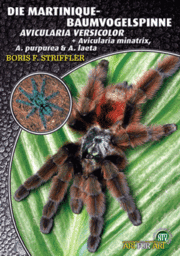
Martinique Tree Tarantula
All about the Martinique tarantula "Avicularia versicolor" and other Avicularia species by  Boris F. Striffler 64 pages Format: 14.8 x 21 cm 46 colour photos About Avicularia versicolor, Avicularia minatrix, Avicularia purpurea and Avicularia laeta Author Boris F. Striffler Publisher NTV Contents: Tarantulas of the genus Avicularia have long been among the most popular terrarium invertebrates. This is not only due to their very attractive colouring, but also to the generally very calm nature of these spiders.Boris F. Striffler has long been involved with tarantulas, both scientifically and as a terrarium keeper. In this volume of the "Species by Species" series, he goes into detail and in an easy-to-understand way about all the aspects of keeping and caring for Martinique tarantulas that are worth knowing. And, of course, he also tells you how to breed your favourites and raise the young spiders. Systematics and body structure The fascinating biology: From the life of the Martinique tarantula All information on species-appropriate keeping: from suitable terrariums to equipment and technology to feeding Successful breeding: Mating stimulation, various methods for egg laying and rearing the young Solutions to problems: How to avoid the most common mistakes in care and how to help sick animals Brilliant photos

CHF 21.90