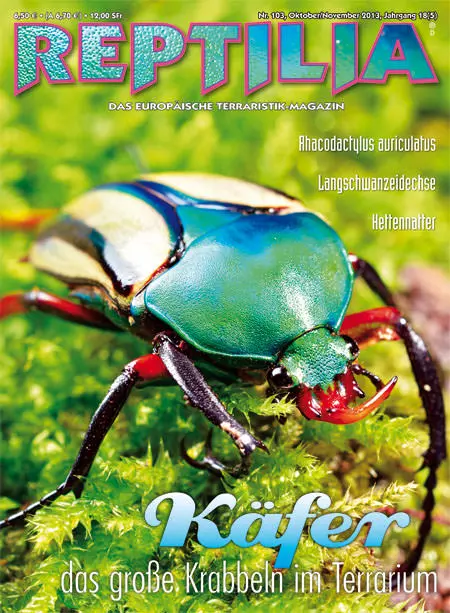

Terraria 55 - Snakes eating invertebrates

Article no: terraria55

CHF 12.00

Stock: 0

Ready for dispatch in 1-3 days, delivery time 7 working days

Delivery between Tuesday, 28 April and Wednesday, 29 April
Zahlungsarten
Product information "Terraria 55 - Snakes eating invertebrates"

Terraria 55 - Snakes that eat invertebrates

Túngara frog
East Madagascar

Contents:

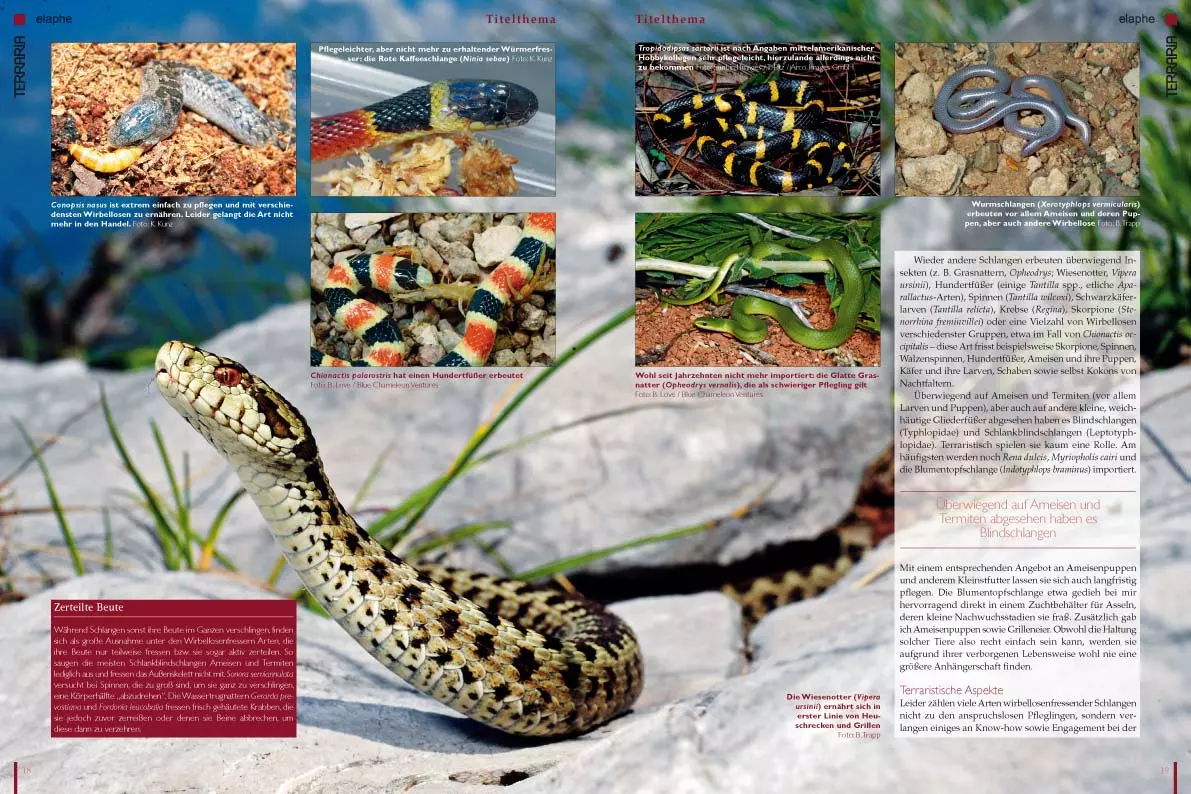
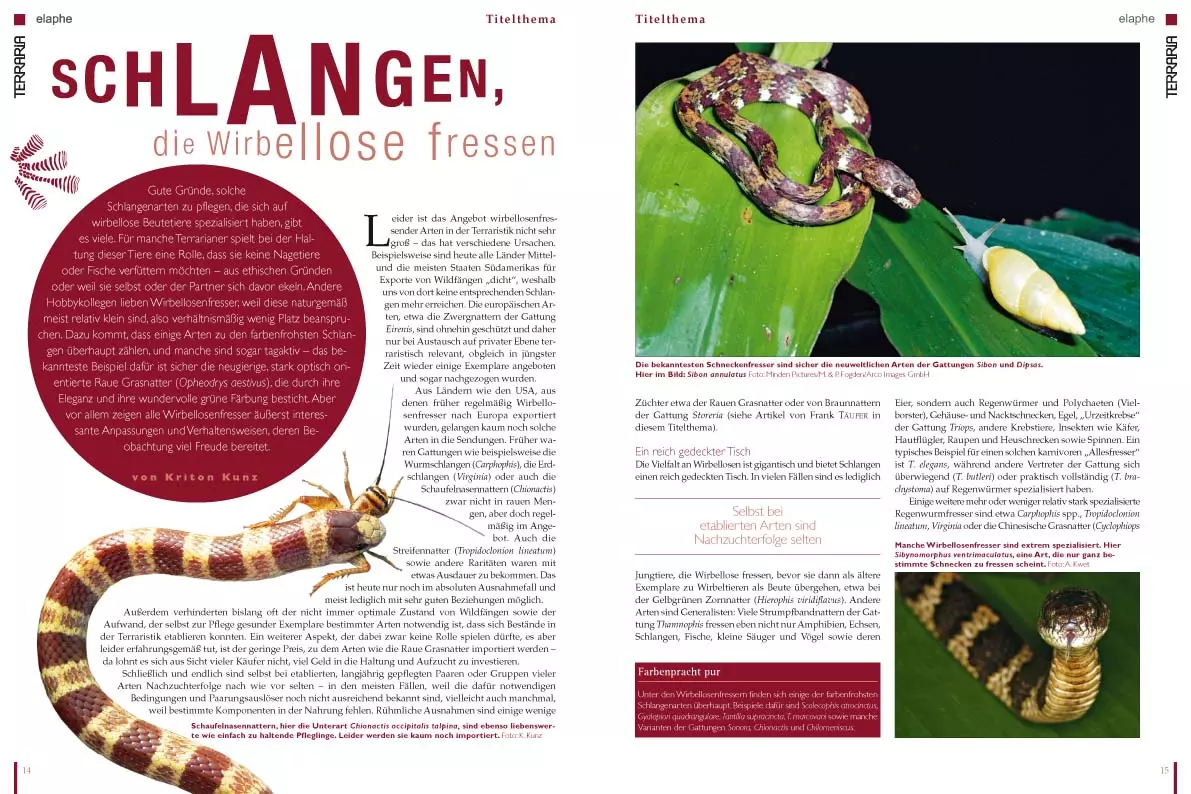
Cover story: It works without mice: Snakes that eat invertebrates

Most snakes in terraria have to be fed on rodents. However, there are a whole range of often lesser known but highly interesting species that exclusively eat invertebrates such as insects, snails and others. We present a selection of the most interesting representatives and discuss in detail the dwarf snakes of the genus Eirenis and the brown snakes of the genus Storeria. We also reveal how to breed slugs for feeding snail-eating snakes.


Territorial

Herpetorama
World's first reproduction of an endangered clawed frog species: Xenopus longipes

Species diversity on the display

Thorny devil: Kermit frog in Costa Rica

Cultural followers: The reign of the terror lizards

Pappochelys – a 240 million year old “turtle grandpa”

Poison dart frog: Death of a turtle breeder

Cover story
Snakes that eat invertebrates
Kriton Kunz

Terraristic remarks on the snakes of the genus Storeria
Frank Täufer

Habitat and terrarium observations on dwarf snakes of the genus Eirenis from south-west Syria
Hans Esterbauer

Collect and breed slugs
Herbert Stern

Panorama
Diary of a trip to eastern Madagascar. Visiting the Marojejy National Park and the Betampona Nature Reserve
Peter Baert

Research

New species
New moccasin snakes in North America
Axel Kwet

Among researchers
Herpetology in theory and practice

A journey to the Caribbean north of Colombia
Claudia Koch

Salamandra

Terraristics
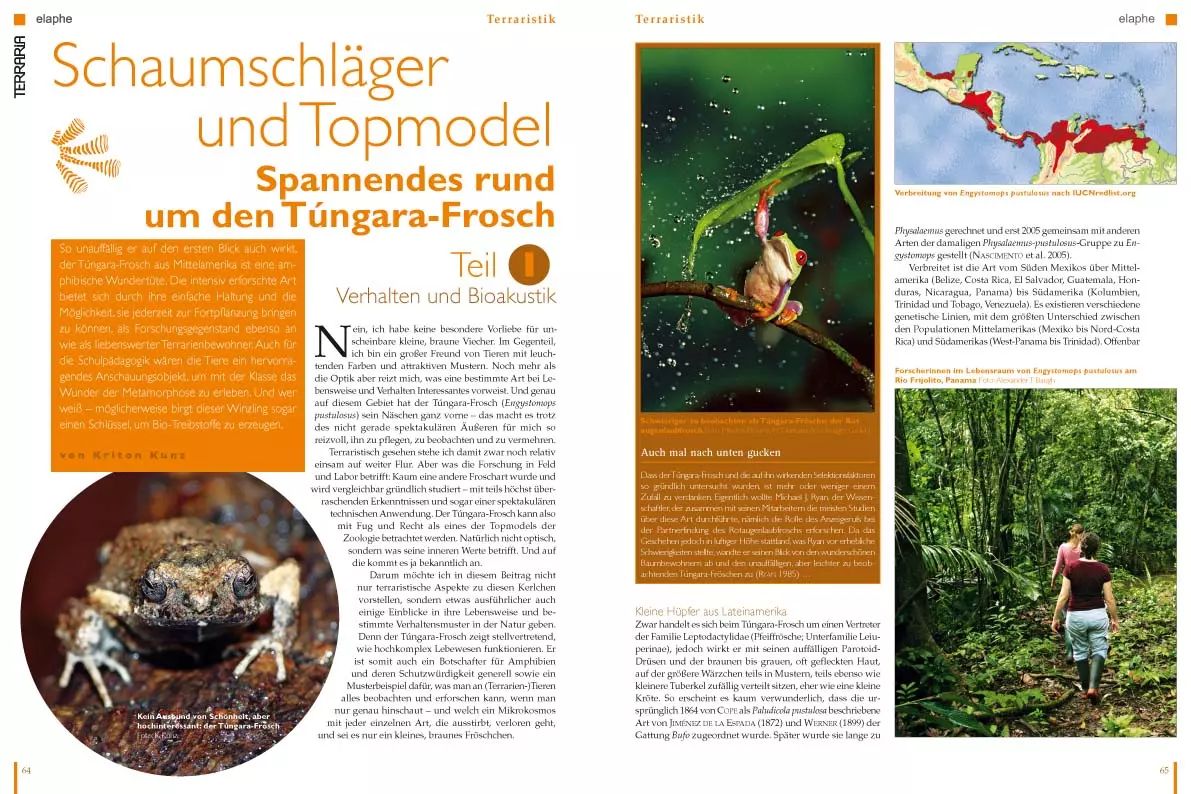
Foam maker and top model. Exciting things surrounding the Túngara frog.
Part 1: Behaviour and bioacoustics
Kriton Kunz

Bibliography

Ophiophagy in snakes in terraria
Dieter Schmidt

Nature and species protection

Field notes
Grass snakes hunting newts
Rudolf Malkmus

Common toad clings to common carp
Jörn Krütgen

Children's page on the reptile of the year: The European pond turtle

The snake plague
Axel Hilger & Axel Kwet

Amphibian action plan for northwest Brazil
Mirco Solé

Also in your area
Subscription & Service
Preview

Incubator
No gecko at all
Rolf Leptien

Composition
Feeding recommendation
Technical details
Size information

0 of 0 reviews

Give us a rating!

Share your experience with the product with other customers.


Suggested products

Handbook of food plants for tortoises and other reptiles
Handbook of forage plants 2nd revised editionMarion Minch is not only a successful breeder of diverse tortoises for many years, but also an excellent connoisseur of native wild herbs. She founded and runs samenkiste.de, which is well known to many tortoise keepers and nature lovers. Her name is inextricably linked with reptile care and species-appropriate nutrition for tortoises. Her handbook of food plants summarises the most important native food plants for herbivorous and omnivorous reptiles. She not only considers tortoises, but also iguanas, spiny-tailed dragons and even chameleons. From the basics of plant biology to native wild herbs to suitable food plants for hardy tropical reptile species, this comprehensive work provides the basis for species-appropriate keeping. In the expanded and supplemented 2nd edition, the plant section is divided according to flower colour. This makes it even easier to identify wild herbs. The work has also been supplemented with a wealth of additional information and many pictures.

CHF 46.50

Geckos
Geckos in the terrarium by Astrid FalkThe book offers a comprehensive introduction to geckos and their species-appropriate keeping in terrariums. It explains what you need to think about before buying a gecko and what preparations should be made. The book describes in detail how the terrarium is technically equipped and set up. The care of the animals, their special features and behaviour, their diet, reproduction and rearing of young animals are described, as well as diseases and husbandry problems with tried and tested suggestions for prevention and treatment. Individual gecko species that are particularly suitable for keeping and breeding in terrariums are portrayed in detail in the second part of the book.

CHF 28.50

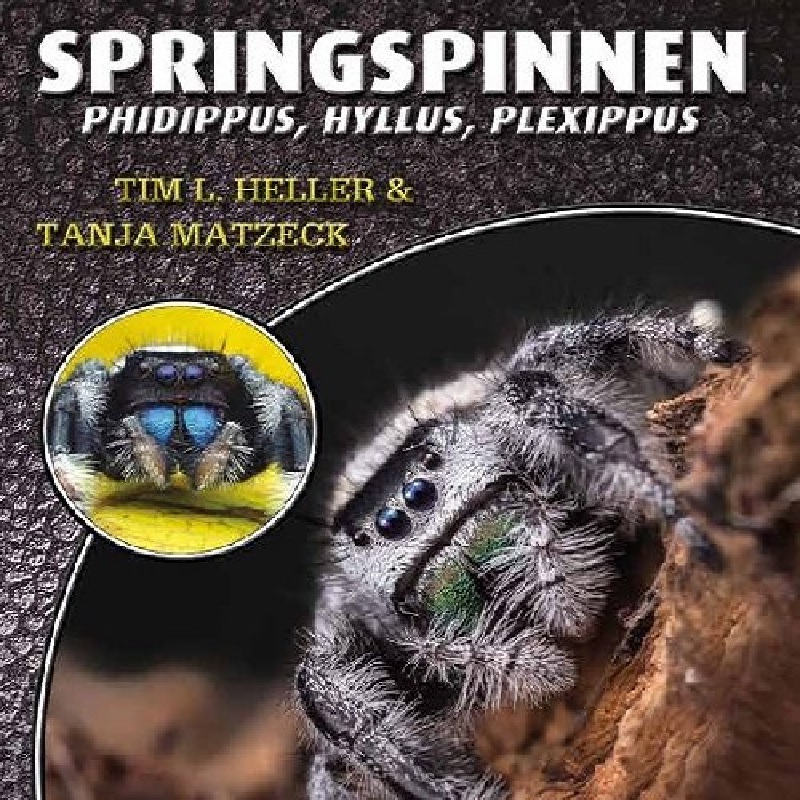
Jumping spiders Phidippus, Hyllus, Plexippus
Book Jumping Spiders - Phidippus, Hyllus & Plexippus A guide to keeping jumping spiders of the genera Phidippus, Hyllus & Plexippus. Who can resist the charm of jumping spiders? The childlike appearance of their expressive face simply leaves no one cold! In addition, their behavior is extremely exciting to observe, their colors are bright and their requirements for species-appropriate keeping are very easy to meet. No wonder these likeable jumpers are all the rage! This volume in the "Species by Species" series describes in detail what to look out for when buying and keeping them, introduces the most commonly kept species and color forms and provides plenty of tips on how to keep them successfully - so you can be sure they will breed well! Species by Species introduces you to the books in this series, which present the most popular terrarium animals. Each volume offers you detailed, practical care instructions and all the information you need to successfully breed your animals. All important questions from the required tank size to terrarium set-up, technical equipment, species-appropriate nutrition and disease prevention are answered with numerous tricks and tips. Experienced, long-standing breeders reveal how you can encourage the animals to reproduce and raise healthy young. All this in full color, generously illustrated and attractively designed - just about your terrarium animal - species by species

CHF 23.90

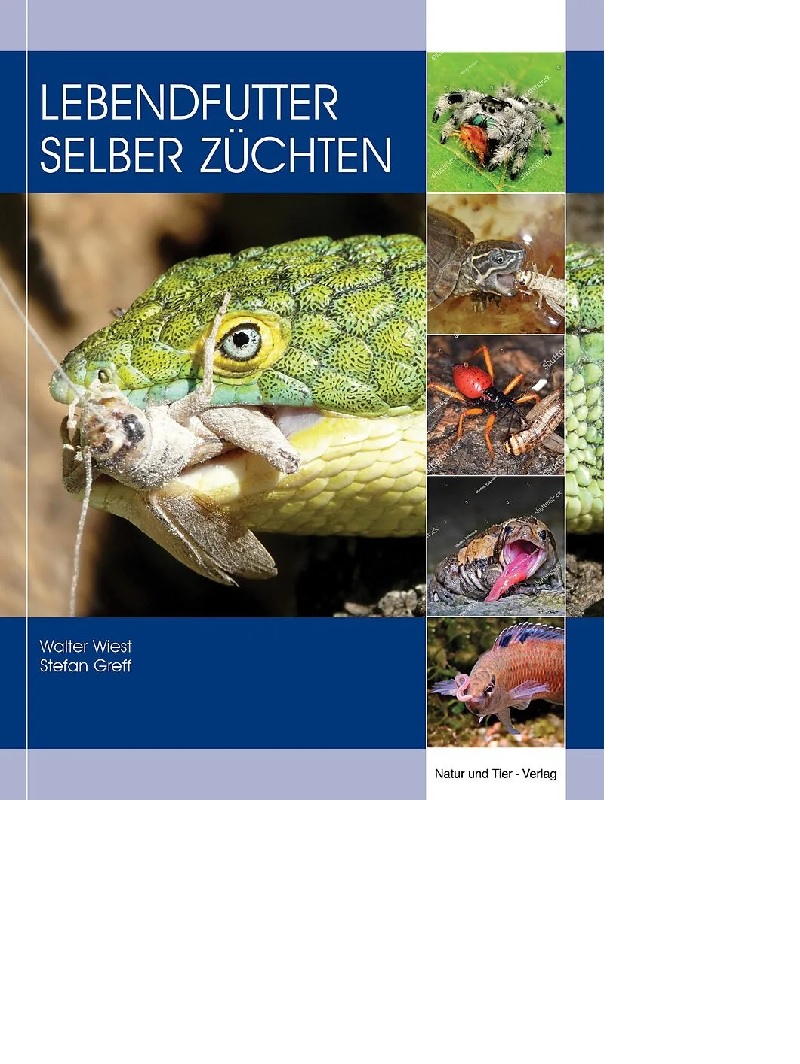
Book Breeding live food yourself
Book "Grow your own live food" - The perfect guide for pet owners Discover practical and detailed instructions on how you can easily breed food for your reptiles, birds, fish or other animals yourself in the book "Breeding live food yourself". With valuable tips on various food insects, their care and breeding, you can save money and ensure a species-appropriate diet for your pets. Contents of the book: Step-by-step instructions for breeding feeder insects Information on the best types of food for reptiles, birds and fish Care instructions and breeding conditions for various live food species Tips for sustainable and cost-effective food production Why breed your own live food? Get healthy, fresh food for your animals Save money and reduce dependence on pet shops Promote the health and well-being of your animals with species-appropriate food Whether you are a beginner or an experienced pet owner, this book provides you with everything you need to successfully breed live food yourself.

CHF 46.50

Marginata 69 - New Guinea tortoises
Marginata 69 - New Guinea tortoises – the genus ElseyaCover storyThe unrecognised beauties: New Guinea tortoises (Andreas S. Hennig)My experiences with Branderhorst's New Guinea tortoise, Elseya (Elseya) branderhorsti (Ouwens, 1914) (Andreas S. Hennig)Keeping and breeding of Rhodin's New Guinea tortoise, Elseya (Hanwarachelys) rhodini Thomson, Amepou, Anamiato & Georges, 2015 (Andreas S. Hennig)PortraitGeoemyda spengleri, Chinese serrated tortoise (Andreas S. Hennig)ReportageMacrochelys temminckii – Experiences and impressions with vulture tortoises part 2 (Reiner Praschag)KeepingAn alternative to year-round keeping of the Egyptian tortoise in the terrarium – my experiences with seasonal outdoor keeping of Testudo kleinmanni (Ricarda Schramm)EtymologySawbacks and living maps part 4: Graptemys gibbonsi, Pascagoula humpback tortoise (Holger Vetter)Classifieds & animal placement

CHF 16.50

Reptilia 72 - Grasshoppers, crickets, house crickets
Reptilia 72 - Grasshoppers, Crickets, House Crickets Jamaican AnoleIndochinese Hinged TurtleSunglow Boas Contents: 2    EDITORIAL 4    REPORTAGE      Potential Dangers of Giant Snakes      by B. Akeret 13  MAGAZINE 21  DATES 24  PHOTOSTORY      Crickets and Grasshoppers      by F. Tomasinelli 32  REPORTAGE      Grasshoppers:      Defence and Survival      by F. Tomasinelli 36  KEEPING AND BREEDING      The Egyptian Migratory Locust     Anacridium aegyptium     by A. Mangoni 40  REPORTAGE      Lord of the Bugs      Visiting Europe’s Largest       Breeding Facility for Feeder Insects      by H. Werning 54  HERPETOFAUNA      The European Tree Frog (Hyla arborea)      “Frog of the Year” in the “Year of the       Frog 2008”      by A. Kwet, A. Nöllert & A. Geiger 64  KEEPING AND BREEDING      Successful Keeping and Offspring of      Cistoclemmys (galbinifrons) bouretti,      the Indochinese Hinged Turtle      by W. & K. Heuberger 73  TRAVEL/KEEPING AND BREEDING      Jamaica, its Iguanas and the      Giant Anole Anolis garmani      by T. Baum 81  KEEPING AND BREEDING      And the Sun Rises … the Sunglow Boa      by R. Ihle & J. Bergman 86  WESTERN HERP PERSPECTIVES      A Turtle Story      by B. Love 91  LIBRARY 104 BRUTKASTEN      Thoughts on the Day of Milk Suffering      by H. Werning

CHF 12.00

Reptilia 100 - Dream terrariums
Reptilia 100 - Dream terrariums Rainbow boaChanging leavesHelmeted tree frog Contents: What could be more fitting for the 100th issue of our magazine, than to showcase the very best the hobby has to offer: dream terrariums! We show you the most extraordinary tanks owned by private keepers, and they’ll leave you speechless. We’ve also included building guides with plenty of ideas so that you too can make your dream of the perfect terrarium a reality. EDITORIALMAGAZINEDATES AROUND THE WORLD IN 5 YEARSThe end is nearA. Pachmann PHOTOREPORTAGEDream terrariums REPORTAGEPack your swimming trunks – a visit to Georg Reitmaier’s superlative terrariumH. Werning TERRARIUM PRACTICE“A Dream comes true”. Building a terrarium for keeping Morelia boeleniM. Uhlhaas, P. Pohlscheid & L. Schilling TERRARIUM PRACTICEJewels in stainless steel. Building a terrarium for poison dart frogs. Part 1: Planning, construction and manufactureM. Schulte REPORTAGEThe first world championship in terrascapingL. Barkam Readers’ competition“Your dream terrarium” KEEPING AND BREEDINGOn the knowledge, care and breeding of the Yucatán shovel-headed tree frog Triprion petasatusT. Eisenberg KeepingKeeping and care of changing leaves, using Phyllium siccifolium from the Philippines as an exampleM. Friend REPORTAGEFringed-finger lizards (Acanthodactylus) in the wild and in the terrarium. Part 7: The Acanthodactylus-erythrurus group and conclusionU. Schlüter KEEPING AND BREEDINGOn the biology and care of the Guyana rainbow boa (Epicrates maurus guyanensis)M. Schwederski & L. Trutnau Animals of our homelandThe European pond turtleR. Leptien WESTERN HERP PERSPECTIVESThe safe world syndrome – protection from everything and everyoneB. Love TIPS AND TRICKSSUBSCRIPTION & SERVICETest runALSO NEAR YOU JourneyAdventure holiday in the PhilippinesM. Gaulke PREVIEW BRUTKASTENI would even let myself be locked up for the REPTILIA – part 2H. Werning

CHF 12.00

Terraria 13 - Overwintering of terrarium animals
Terraria 13 - Hibernation of terrarium animals Breeding the palmatogecko from the NamibKeeping and reproducing the Andean kingsnake Contents: 2 Editorial by Heiko Werning4 Magazine Dangerous animals in Saarland / Zoo Days in Frankfurt / Liability for escaped pets / Climbing ability of snakes at different temperatures / First imports of vipers12 TERRAglobal The finest hour of Bolivian television: Herpetologist on Canal 21 by Martin Jansen The discovery of a new species by Karl-Heinz Switak 16 Cover story: Hibernation of terrarium animals Hibernation – Adaptations to cold climatic conditions by Beat Akeret23 Hibernation of reptiles and amphibians in the outdoor terrarium by Martin Hallmen32 The refrigerator method by Hans-Dieter Philippen37 Hibernation of turtles in the cellar light well by Xaver Wapelhorst 40 Hibernation in tarantulas Hans-Werner Auer44 Grey giants among themselves – of leopard tortoises and elephants in the Addo Elephant National Park, South Africa Part 2: Size and population ecology by Michael Wirth54 Lampropeltis triangulum andesianus – rare terrarium jewel with a dubious reputation Part 1: Biology and keeping by Thorsten Schmidt60 On keeping and breeding the palmatogecko Pachydactylus rangei Andersson, 1908 by Sebastian Schenk & Sebastian Wolf66 Frog die-off in the hotspot – a case study in eastern Brazil by Dennis Rödder70 Travel Costa Rica’s Hitoy Cerere, the gateway to the land of Sibú by Ivonne Meuche82 New species Leaf-fingered geckos of the genus Phyllodactylus/ Three tree frogs from southern Brazil84 Among researchers Bolivia: still a “terra incognita” of herpetology by Martin Jansen88 Test run Irrigation systems by Kriton Kunz94 Eye-catcher A turtle paradise – from the garden to the bathroom by Kriton Kunz99 Near you103 Preview104 Incubator The child does not speak by Heiko Werning

CHF 12.00

Reptilia 08 - Grasping frogs
Reptilia 08 - Grasping frogsDay geckos on the MascarenesRoyal pythonArizonaContents:Page 2 - EditorialPage 3 - Letters to the editorPage 5 - MagazinePage 14 - Western Herp Perspectives: Albino turtles, by B. LovePage 16 - Photo report: Griffin frogs, by C. ProyPage 23 - Report: Sleepyheads - Maci frogs, by Dr H. HermannPage 28 - Keeping and breeding: Keeping and breeding the red-eyed frog, by H. Birkhahn and K. WassmannPage 33 - Travelogue: Arizona, by H. WerningPage 39 - Portrait and poster: Laudakia stellio, by D. Modry and P. NecasPage 43 - Report: The genus Neurergus - Fascinating mountain stream salamanders, by S. Steinfartz and G. SchultschickPage 49 - Keeping and breeding: Keeping and breeding the royal python, by W. WenglerPage 54 - Report: Day geckos on the Mascarene Islands, by G. TrautmannPage 60 - Herpetology and culture: The reptile cult in the realm of the pharaohs, by L. Batista Carissimi-PrioriPage 69 - Reptilia on the road: Zoo-Aquarium in Berlin, by H. WerningPage 74 - Advice and actionPage 77 - LibraryPage 80 - Incubator: Glossary by H. Evers

CHF 9.80

Reptilia 48 - Dwarf chameleons
Reptilia 48 Dwarf Chameleons Rail turtlesEl SalvadorRing-tailed boas Contents: 2 EDITORIAL 4 MAGAZINE 12 DATES 16 WESTERN HERP PERSPECTIVESThe Cutsby B. Love 18 PHOTO REPORTAGE Mysterious mini-dragons – The ground and stub-tailed chameleons of the genera Brookesia and Rhampholeonby P. Necas and W. Schmidt 28 KEEPING AND BREEDINGKeeping and breeding of the short-tailed chameleon Rhampholeon brevicaudatus? by N. Lutzmann, S. Esser, A. Flamme & H. Schneider 34 HERPETOFAUNAThe low-frequency vibration of chameleons – New findings about a peculiar behaviour by N. Lutzmann 38 REPORTAGEPiggyback to the weddingWhy do some female chameleons carry the males on their backs? by N. Lutzmann 41 REPORTAGEThe desert in your own house by H. Zorn 45 TRAVELEl Imposible – The impossible is possibleThe national park "El Imposible" in El Salvador by T. Leenders 51 PORTRAIT AND POSTERMantis religiosaby B. Trapp 56 HERPETOFAUNAComments on the current situation of the rail turtles Podocnemis expansa and Podocnemis unifilis in Boliviaby J. Knaak 65 KEEPING AND BREEDINGThe ring-tailed boa (Corallus annulatus annulatus)A little-known jewel in the terrarium by S. Wirz 72 REPORTAGEEndemic terrestrial salamanders of the Italian mainlandby F. Pasmans and S. Bogaerts 80 REPORTAGEPlanning and construction of a reptile zoo: "Reptilium - Terrarium and Desert Zoo" in Landau - Part 3: The Openingby H. Werning 90 LIBRARY 91 CLASSIFIEDS 96 RAT & TAT 104 GLOSSA family history. Part 2by H. Werning

CHF 11.20

Reptilia 07 - Climbing snakes
Reptilia 07 - Climbing snakesTurtle conservation in NepalStump crocodiles in the CongoRed-footed tarantulaContents:Page 2 - EditorialPage 4 - Letters to the editorPage 5 - MagazinePage 16 - Photo reportagePage 22 - Keeping and breeding: The Persian Climbing Snake Elaphe persica, by K.-D. SchulzePage 25 - Report: Endangerment and protection of the Aesculapian snake in Germany, by M. WaitzmannPage 29 - Keeping and breeding: Elaphe guttata, by J. BergadáPage 33 - Travel report: Stump crocodiles in the Congo, by A. Brieger, F. W. Huchzermeyer and J. RileyPage 39 - Portrait and poster: Corucia zebrata, by M. Aresté and J. L. FarriolsPage 43 - Report: A species conservation programme for tortoises in Nepal, by K. Ernst, K. B. Shah and H. SchleichPage 49 - Keeping and breeding: Dendrobates galactonotus, by R. and B. PieperPage 53 - Keeping and breeding: Avicularia avicularia, by J. M. Marínez NadalPage 57 - Herpetology and Culture: Traditional Chinese Medicine, Part 2: Turtles as fire extinguishers, by G. PetersPage 62 - Western Herp Perspectives, by B. LovePage 64 - Prize puzzlePage 69 - Reptilia on the road: Arizona Sonora Desert Museum Tucson, by H. WerningPage 74 - Advice and actionPage 77 - LibraryPage 80 - Incubator: Glossary by H. Werning

CHF 9.80

Bede your hobby chameleons
Bede - Your Hobby Chameleons Rolf Müller and Ulrike Walbröl have been successfully breeding chameleons for years. As members of the DGHT’s Chameleon Working Group and contact persons for the Chameleon Hotline, they are thoroughly familiar with the problems faced by beginners in chameleon keeping. Here, they have brought together their knowledge and experience for the first time and, in collaboration with Dominik Kieselbach, have created a book for beginners unlike any other previously available on the German market.

CHF 23.50