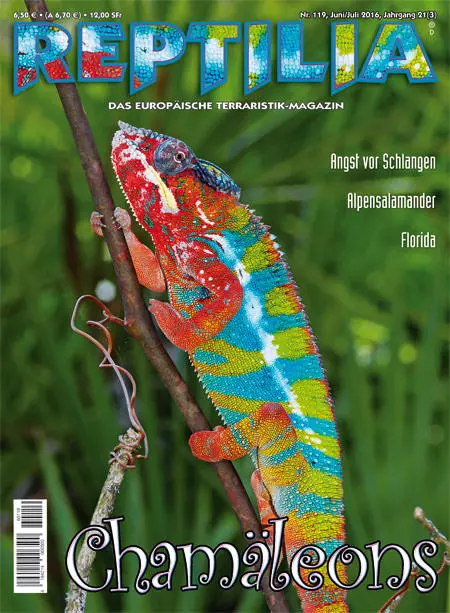
Reptilia 119 - Chameleons

Article no: reptilia119

CHF 12.00

Stock: 0

Ready for dispatch in 1-3 days, delivery time 7 working days

Delivery between Tuesday, 28 April and Wednesday, 29 April
Zahlungsarten
Product information "Reptilia 119 - Chameleons"

Reptilia 119 - Chameleons

Fear of snakes
Alpine salamander
Florida

Contents:

Cover story: Chameleons

They used to be considered untenable, but today they are among the most popular terrarium animals. Chameleons, the "dragons of our time". We indulge in pictures of these extremely photogenic animals, present in detail the keeping and breeding of one of the most prominent representatives of this group, the lobed chameleon, and devote ourselves to the legendary colour-changing ability of these lizards.

Editorial
Magazine
Dates

Photo story
Chameleons. Always something new
N. Lutzmann

Keeping and breeding
Keeping and breeding the elephant-eared chameleon (Trioceros melleri)
C. Malberg & A. Schäberle

Research
Influence of various factors on colour change in the Yemen chameleon (Chamaeleo calyptratus) and the Madagascar giant chameleon (Furcifer oustaleti)
A. Schmidt

MAN AND ANIMAL
Fear of snakes: innate, learnt or groundless?
D. Schmidt

Reportage
Viper snakes for breakfast. Observations of Natrix maura in southern Portugal
W. & Y. Lantermann

SERVICE
ALSO NEAR YOU

Animals of our homeland
The Alpine Salamander
R. Leptien

LIBRARY

WESTERN HERP PERSPECTIVES
Europeans are known for …
B. Love

TRAVEL
The great trek.  Part 2: Spring rivers and eternal swamps
H. Werning

PREVIEW

BRUTKASTEN
The spider's web (or: Stuttgart 21 will not be the last victim of these green lizard spiders)
Ancestor

Composition
Feeding recommendation
Technical details
Size information

0 of 0 reviews

Give us a rating!

Share your experience with the product with other customers.


Suggested products

Handbook of food plants for tortoises and other reptiles
Handbook of forage plants 2nd revised editionMarion Minch is not only a successful breeder of diverse tortoises for many years, but also an excellent connoisseur of native wild herbs. She founded and runs samenkiste.de, which is well known to many tortoise keepers and nature lovers. Her name is inextricably linked with reptile care and species-appropriate nutrition for tortoises. Her handbook of food plants summarises the most important native food plants for herbivorous and omnivorous reptiles. She not only considers tortoises, but also iguanas, spiny-tailed dragons and even chameleons. From the basics of plant biology to native wild herbs to suitable food plants for hardy tropical reptile species, this comprehensive work provides the basis for species-appropriate keeping. In the expanded and supplemented 2nd edition, the plant section is divided according to flower colour. This makes it even easier to identify wild herbs. The work has also been supplemented with a wealth of additional information and many pictures.

CHF 46.50

Geckos
Geckos in the terrarium by Astrid FalkThe book offers a comprehensive introduction to geckos and their species-appropriate keeping in terrariums. It explains what you need to think about before buying a gecko and what preparations should be made. The book describes in detail how the terrarium is technically equipped and set up. The care of the animals, their special features and behaviour, their diet, reproduction and rearing of young animals are described, as well as diseases and husbandry problems with tried and tested suggestions for prevention and treatment. Individual gecko species that are particularly suitable for keeping and breeding in terrariums are portrayed in detail in the second part of the book.

CHF 28.50

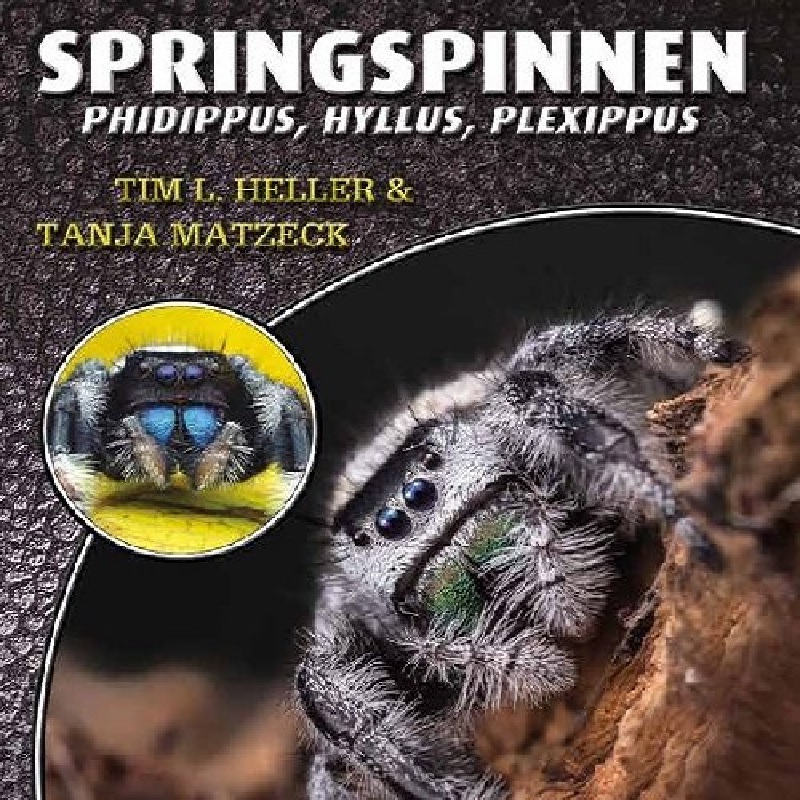
Jumping spiders Phidippus, Hyllus, Plexippus
Book Jumping Spiders - Phidippus, Hyllus & Plexippus A guide to keeping jumping spiders of the genera Phidippus, Hyllus & Plexippus. Who can resist the charm of jumping spiders? The childlike appearance of their expressive face simply leaves no one cold! In addition, their behavior is extremely exciting to observe, their colors are bright and their requirements for species-appropriate keeping are very easy to meet. No wonder these likeable jumpers are all the rage! This volume in the "Species by Species" series describes in detail what to look out for when buying and keeping them, introduces the most commonly kept species and color forms and provides plenty of tips on how to keep them successfully - so you can be sure they will breed well! Species by Species introduces you to the books in this series, which present the most popular terrarium animals. Each volume offers you detailed, practical care instructions and all the information you need to successfully breed your animals. All important questions from the required tank size to terrarium set-up, technical equipment, species-appropriate nutrition and disease prevention are answered with numerous tricks and tips. Experienced, long-standing breeders reveal how you can encourage the animals to reproduce and raise healthy young. All this in full color, generously illustrated and attractively designed - just about your terrarium animal - species by species

CHF 23.90

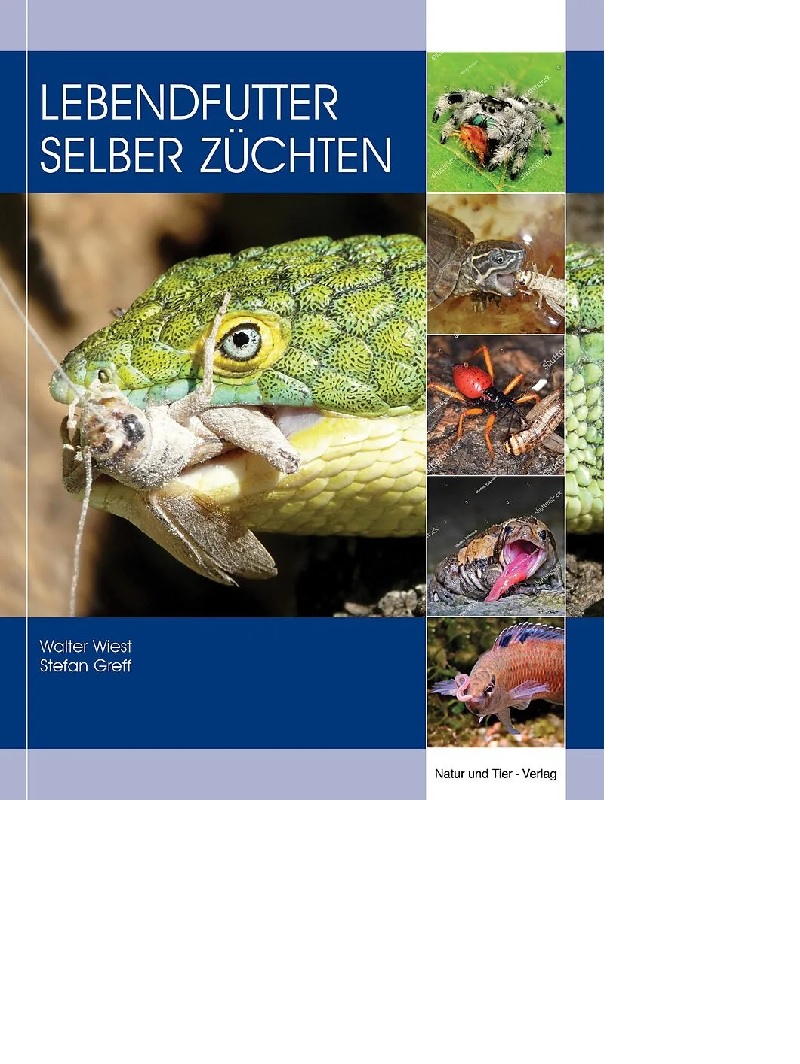
Book Breeding live food yourself
Book "Grow your own live food" - The perfect guide for pet owners Discover practical and detailed instructions on how you can easily breed food for your reptiles, birds, fish or other animals yourself in the book "Breeding live food yourself". With valuable tips on various food insects, their care and breeding, you can save money and ensure a species-appropriate diet for your pets. Contents of the book: Step-by-step instructions for breeding feeder insects Information on the best types of food for reptiles, birds and fish Care instructions and breeding conditions for various live food species Tips for sustainable and cost-effective food production Why breed your own live food? Get healthy, fresh food for your animals Save money and reduce dependence on pet shops Promote the health and well-being of your animals with species-appropriate food Whether you are a beginner or an experienced pet owner, this book provides you with everything you need to successfully breed live food yourself.

CHF 46.50

Marginata 69 - New Guinea tortoises
Marginata 69 - New Guinea tortoises – the genus ElseyaCover storyThe unrecognised beauties: New Guinea tortoises (Andreas S. Hennig)My experiences with Branderhorst's New Guinea tortoise, Elseya (Elseya) branderhorsti (Ouwens, 1914) (Andreas S. Hennig)Keeping and breeding of Rhodin's New Guinea tortoise, Elseya (Hanwarachelys) rhodini Thomson, Amepou, Anamiato & Georges, 2015 (Andreas S. Hennig)PortraitGeoemyda spengleri, Chinese serrated tortoise (Andreas S. Hennig)ReportageMacrochelys temminckii – Experiences and impressions with vulture tortoises part 2 (Reiner Praschag)KeepingAn alternative to year-round keeping of the Egyptian tortoise in the terrarium – my experiences with seasonal outdoor keeping of Testudo kleinmanni (Ricarda Schramm)EtymologySawbacks and living maps part 4: Graptemys gibbonsi, Pascagoula humpback tortoise (Holger Vetter)Classifieds & animal placement

CHF 16.50

Draco 28 - Live food
Draco 28 - Live food Contents: 2 Editorial 4 Live food for amphibians and reptiles– History and basicsUrsula Friedrich 22 The professional handling of food animals – Basic requirement for a species- and animal-appropriate diet for reptiles and amphibiansThomas Wilms 32 Some aspects of breeding your own food animalsStefan Ziesmann 39 The pea aphid – an unusual food animalLars Österdahl 42 Breeding the common fruit fly (Drosophila melanogaster)– Many paths lead to successMarco Wagemann 50 Tropical cockroaches – lively insect lovers, valuable food animals or even both?Andreas Bauer 58 Oven fish breeding – a way to provide a little variety in the diet of our vivarium animals with little effort!Marco Wagemann 64 The breeding of aquatic snails Cornelia Gabler 67 Agate snails – not only an extraordinary food animalUwe Geissel 71 Tubifex breedingCornelia Gabler 74 Small mammals as food animals – using the house mouse (Mus musculus) as an exampleThomas Wilms & Beate Löhr 86 Book box

CHF 18.40

Terraria 25 - Livebearers
Terraria 25 - Livebearing Reptiles Breeding of tarantulasDiadem snakeSpur-thighed tortoise Contents: Not all reptiles lay eggs. A whole range of species bear live young, to the delight of many terrarium enthusiasts. However, even though the often problematic artificial incubation of clutches is no longer necessary: Even with livebearing reptiles, many things can go wrong when breeding them in the terrarium, and keepers often find it difficult to recognise the causes of problems. Uwe Schlüter presents the different forms of livebearing in reptiles and explains everything you need to know to breed these species as successfully as possible. In addition, we present some livebearing reptiles in the terrarium, including the Madagascar dog-headed boa, Sanzinia madagascariensis, or the strange crocodile night lizard, Lepidophyma flavimaculatum. EditorialMagazineHatching of a completely healthy hatchling of the North African spiny-tailed agama from a mould-infested eggColour change in the monocled cobra from juvenile to adultLuminous heavy metal detectorsDinosaurs with braking assistance?Hundreds of Madagascan tortoises confiscated in MalaysiaPhotosynthesis in salamandersLegal TERRAglobal specialLizards of the Barkly TablelandGunther Schmida Cover storyLivebearing reptilesUwe Schlüter The crocodile night lizard. Lepidophyma flavimaculatum (Duméril, 1851) Jochen Meyer Care and breeding of the northern Canary Islands skink (Chalcides viridanus) Uwe Schlüter Keeping and breeding a crowned beauty: the diadem snake (Spalerosophis diadema [Schlegel, 1837]) Sascha & Stefanie Esser Giants of the desert. The African spurred tortoiseLeo Spinner JourneyCuc Phuong. Spiders and other animals in Vietnam's oldest national parkGordon Ackermann Breeding of tarantulas Karin Manns New speciesDiversity of Philippine banded monitors deciphered – and three new taxa described André Koch Among researchers Searching for venomous snakes in Austria Johannes Hill Eye-catcher Of prosimians, poison dart frogs and geckos. Visiting Ute Thut and Dennis Peukert Michael Wirth Near youSubscription & ServicePreview Incubator On the wall, on the lookout Mike Zawadzki

CHF 12.00

Terraria 03 - Anolis in the terrarium
Terraria 03 - Anolis in the Terrarium Ornate TurtlesNamaqualand Contents: 2 Editorial Mike ZawadzkiMAIN TOPICAnolis in the Terrarium 4 Anolis – Keeping, Care and Breeding Manfred Rogner 14 A Terrarium for Eternity Design of Rot-Resistant Walls and Epiphyte Branches of a Paludarium for Anolis Holger Herfurth 18 Terrarium Keeping of Anolis – A Field Report Based on the Example of Anolis bahorucoensis bahorucoensis Dieter Bundt 32 Anolis loysianus, a Spiny-Scaled Bark Anole from Cuba Axel Fläschendräger SCIENCE 36 Herpetorama Beware of Conspecifics! / Hydraulic Pump / On the Trail of the Blind 38 New Species Bronchocela vietnamensis / Snakes from Northern Madagascar / Scaphiophryne menabensis 41 Among Researchers In the Centre of the Corridor Philipp Wagner 45 Ornate Turtles – The Genus Pseudemys Part 2: The Species and Subspecies with Information on Distribution and Lifestyle Andreas S. Hennig 54 Melanophryniscus – Not Just Black Toads Part 3: The “Brazilians” Axel Kwet 62 The Devil’s Flower Idolomantis diabolica (SAUSSURE, 1869) Part 2 Christian J. Schwarz, Jürgen E. Mehl & Jürg Sommerhalder 70 The Forgotten Beauty A Few Words on Keeping and Breeding Diadophis punctatus Kriton Kunz 74 TRAVEL Namaqualand Mats BlohmTERRARIUM PRACTICE 82 Test Run Fixing Rod for Snakes from M&S ReptilesMesh Cover from Exo Terra 84 Prelude Understanding Literature – No Problem Timo Plochowietz 87 Eye-Catcher Madagascar in Saxony – Visiting the Phelsuma Breeder Hans-Peter Berghof Heiko Werning 93 Also in Your Area 96 TERRAnet Macro Photography / Anolis Page 98 TERRAglobal The Reptiles in the Culture of Mexico Fabio Cupul Mouse Breeding, a Self-Service Store? Joachim Bulian 104 TERRAwinn

CHF 11.20

Reptilia 56 - African land tortoises
Reptilia 56 - African tortoises Red bamboo snakeFisher's ChameleonXenagama taylori Contents: 2 EDITORIAL 6 MAGAZINE & READERS' LETTERS 14 DATES 16 WESTERN HERP PERSPECTIVES  The blue Mexican  From B. Love 18  PHOTO REPORTAGE  African tortoises  By J. Valverde 26 REPORTAGE  The tortoises of Africa – diversity through  Adaptation to extreme habitats  By T. & S. Vinke 31 HERPETOFAUNA  Taxonomy, ecology and protection of the   Panther tortoise (Stigmochelys pardalis)  By J. S. Massana & A. M. Silvestre 36 KEEPING AND BREEDING  The areola tortoise Hompus areola-  tus (THUNBERG, 1787) – Observations   and experiences: Lifestyle, husbandry,   Breeding and rearing  By A. Schleicher 42 TRAVEL  Excursion in western Cuba   By L. Geißler 51 PORTRAIT AND POSTER  Bradypodion occidentale  By M. Dobiey 56 KEEPING AND BREEDING  Keeping, care and breeding of Taylors   Beavertail dragon, Xenagama taylori   (PARKER, 1935)  By P. M. Müller 62 KEEPING AND BREEDING  Terrarium keeping of the Thai Red bamboo snake (Oreophis porphyraceus coxi)  and a rare birth of twins   By V. Knietsch 67 HERPETOFAUNA On the breeding of the red broad-banded bamboo snake, Oreophis porphyraceus laticinctus SCHULZ & HELFENBERGER 1998   By J. Bulian, B Siebert & M. Ansermet 72 HERPETOFAUNA   Chameleons in the western Usambara-  Mountains in northern Tanzania   By W. & Y. Lantermann 78 REPORTAGE  A cyclone in Sri Lanka   By P. Janzen 86 CLASSIFIED ADS 91 RAT & TAT 94 LIBRARY 104 BRUTKASTEN  My flat-sharing community  Part 1: I wouldn't have any time at all,  Set cars on fire!  By H. Werning

CHF 11.20

Reptilia 26 – Amazonas
Reptilia 26 - Amazonas Grasshopper breedingToad tree frogsHook-nosed snakes Contents: 2 Editorial 3 Letters to the editor 6 Magazine 12 Dates 14 Western Herp Perspectives: The Evolution of Hunting, by B. Love 16 Photo report: Amazonas, by H. Werning 24 Vibrant Forests – The Flooded Forests of the Amazonas, by H. Werning and H. Kreibich 30 Report: In search of the largest anaconda, by L. Dirksen and P. Strimple 35 Report: Seeing the wood for the trees – What to do on the Amazonas, by H. Werning 42 Terrarium keeping: Breeding feeder insects: The Egyptian Migratory Locust Locusta migratoria, by T. Eisenberg 47 Care and breeding: The Mexican Hook-nosed Snake Heterodon nsicus kennerlyi, by D. Hasselberg 51 Portrait and poster: Geochelone sulcata, by M. Aresté 55 Care and breeding: The "flying lizard" – Care and breeding of Holaspis guentheri laevis, by Dr. M. Meyer 58 Care and breeding: Care and breeding of the tree cavity-dwelling toad tree frog (Phrynohyas resinifictrix GOELDI 1907) in the terrarium 65 Terrarium keeping: Construction of a snake-free enclosure, Part 2: Execution of the work 70 Herpetology and culture: "The dragon's old brood lives in caves", A look at ideas about dragons in East and West, part 2, by K. Kunz 75 Reptilia on tour: The Snake Park in Nairobi, Kenya, by A. S. Henning 82 Advice and action 97 Library 104 Gloss: Anaconda! (Part 1), by H. Werning

CHF 9.80

Draco 10 - Animals, Terrariums, Habitats
Draco 10 - Animals, Terrariums, Habitats Contents: 2 Editorial4 Deserts – cold land under a hot sunSurvival strategies of desert-dwelling amphibians and reptilesThomas Wilms & Heiko Werning26 Planning, building and setting up a desert terrariumThomas Ackermann41 Colourful jewels in the terrarium – experiences with the long-term care and breeding of Uromastyx ornata (Heyden, 1827) up to the second filial generationThomas Wilms, Hans Dietmar Müller & Beate Löhr 50 The bearded toadhead Phrynocephalus mystaceus (Pallas, 1776) in the terrariumHans Dietmar Müller58 The fringed-fingered lizards (Acanthodactylus) of North AfricaUwe Schlüter 66 The kings of the North American desert: ChuckwallasHeiko Werning74The horned vipers (Cerastes) of North AfricaUwe Schlüter79 Namibia – hot land on a cold currentFelix Hulbert & Mirko Barts 94 Magazine

CHF 16.80

Marginata 15 - Snake-necked turtles
Marginata 15 - Snake-necked turtles Genetic variability of western tortoisesTuscan tortoises part 2Food plants for aquatic turtles part 3 Contents: 2 EDITORIAL 3 READER LETTERS 4 MAGAZINE 8 DATES 10 REPORTAGEThe snake-necked turtles of Indo-AustraliaHans - Dieter Philippen 18 BREEDING IN HUMAN CAREKeeping and breeding the Australian long-necked turtle (Chelodina longicollis)Stefan Thierfeldt & Sabine Höfler-Thierfeldt 24 BREEDING IN HUMAN CAREKeeping and breeding the white-nosed snake-necked turtle (Chelodina spec.) Steffen Szymanski 31 PORTRAITSouth African tent-footed tortoise (Psammobates tentorius, BELL 1828)Irmtraud Jasser-Häger & Matts Blohm 35 REPORTAGEFood plants for aquatic turtles (Part III)Susanne Vogel 40 REPORTAGETuscany – In search of Eurotestudo hermanni (Part II)Michael Wirth & Walter Matzanke 48 REPORTAGEGenetic studies on western tortoisesGiorgio Berorelle, Vassili Goutner, Barbara Livoreill and Stefano Mazzotti 54 REPORTAGENotes on incubation and hatching of a wet clutch of red-bellied slider turtles Martin Leonard Voss 58 SHORT REPORTAGEComments on frequent carcass findings of leatherback turtlesAlfred Schleicher 60 BOOK TIP 61 CLASSIFIEDS 62 REGIONAL GUIDE

CHF 14.70