18 WESTERN HERP PERSPECTIVES: Reptile Television, By B. Love
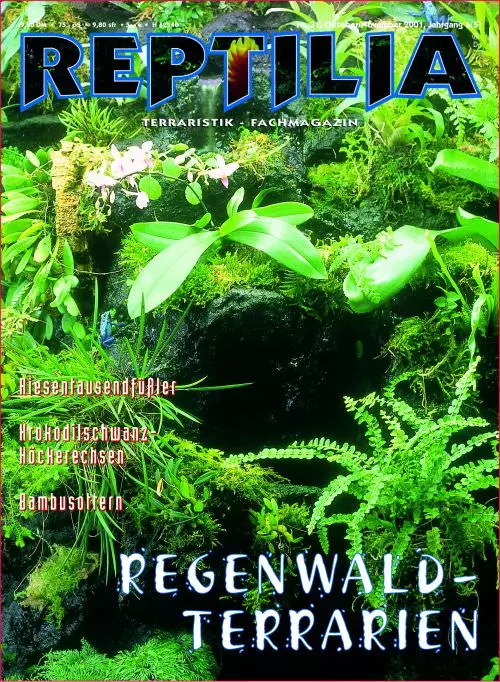
20 PHOTOREPORTAGE: Rainforest terrariums, By M. Schmidt
28 REPORTAGE: Rain for the rainforest – Mist and irrigation in the rainforest terrarium, By P. Nowark
32 REPORTAGE: Materials for back wall design in rainforest terrariums, By T. Doussier
37 REPORTAGE: Plants in the rainforest terrarium, By B. & W. Schwarz
43 TRAVEL: The herpetofauna of south-west Morocco, By U. Schlüter
51 PORTRAIT AND POSTER: Natrix natrix, By H. P. Eckstein & B. Trapp
55 KEEPING AND BREEDING: On the lifestyle, keeping, care and reproduction of the crocodile-tailed humpback lizard Shinisaurus crocodilurus, By M. Rogner
62 HERPETOFAUNA: Information on the lifestyle and husbandry of the bamboo otter Trimeresurus kanburiensis, By J. Bulian
67 REPORTAGE: Saving the giant tortoises on Galápagos, By H. W. Köhler
74 KEEPING AND BREEDING: Tropical giant millipedes, By F. Gast
77 HERPETOCULTURE: Devilish, divine snake. Aspects of snake symbolism from a psychological perspective Part 2: Psychological foundations, the snake as a symbol of the unconscious, ambivalence of the snake symbol, By K. Kunz
87 CLASSIFIED ADS
91 ADVICE AND ACTION
93 LIBRARY
104 GLOSSE: An autumn morning dream, By L. Hogeback
Composition
Feeding recommendation
Technical details
Size information
0 of 0 reviews
Give us a rating!
Share your experience with the product with other customers.
Login
No reviews found. Go ahead and share your findings with others.
Handbook of forage plants 2nd revised editionMarion Minch is not only a successful breeder of diverse tortoises for many years, but also an excellent connoisseur of native wild herbs. She founded and runs samenkiste.de, which is well known to many tortoise keepers and nature lovers. Her name is inextricably linked with reptile care and species-appropriate nutrition for tortoises. Her handbook of food plants summarises the most important native food plants for herbivorous and omnivorous reptiles. She not only considers tortoises, but also iguanas, spiny-tailed dragons and even chameleons. From the basics of plant biology to native wild herbs to suitable food plants for hardy tropical reptile species, this comprehensive work provides the basis for species-appropriate keeping. In the expanded and supplemented 2nd edition, the plant section is divided according to flower colour. This makes it even easier to identify wild herbs. The work has also been supplemented with a wealth of additional information and many pictures.
Geckos in the terrarium by Astrid FalkThe book offers a comprehensive introduction to geckos and their species-appropriate keeping in terrariums. It explains what you need to think about before buying a gecko and what preparations should be made. The book describes in detail how the terrarium is technically equipped and set up. The care of the animals, their special features and behaviour, their diet, reproduction and rearing of young animals are described, as well as diseases and husbandry problems with tried and tested suggestions for prevention and treatment. Individual gecko species that are particularly suitable for keeping and breeding in terrariums are portrayed in detail in the second part of the book.
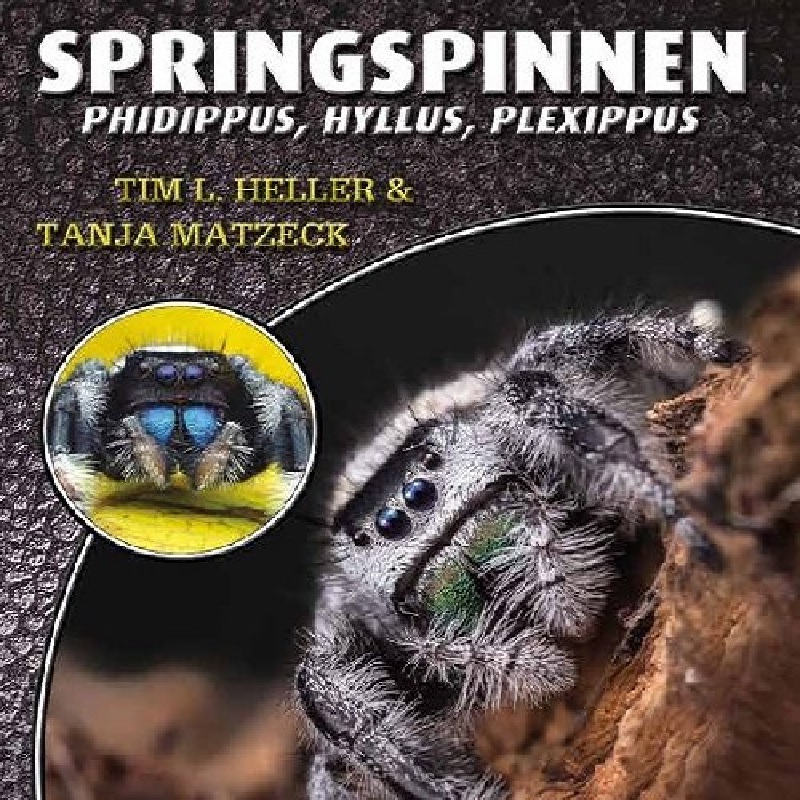
Book Jumping Spiders -
Phidippus, Hyllus & Plexippus
A guide to keeping jumping spiders of the genera Phidippus, Hyllus & Plexippus. Who can resist the charm of jumping spiders? The childlike appearance of their expressive face simply leaves no one cold! In addition, their behavior is extremely exciting to observe, their colors are bright and their requirements for species-appropriate keeping are very easy to meet. No wonder these likeable jumpers are all the rage!
This volume in the "Species by Species" series describes in detail what to look out for when buying and keeping them, introduces the most commonly kept species and color forms and provides plenty of tips on how to keep them successfully - so you can be sure they will breed well!
Species by Species introduces you to the books in this series, which present the most popular terrarium animals. Each volume offers you detailed, practical care instructions and all the information you need to successfully breed your animals.
All important questions from the required tank size to terrarium set-up, technical equipment, species-appropriate nutrition and disease prevention are answered with numerous tricks and tips.
Experienced, long-standing breeders reveal how you can encourage the animals to reproduce and raise healthy young.
All this in full color, generously illustrated and attractively designed - just about your terrarium animal - species by species
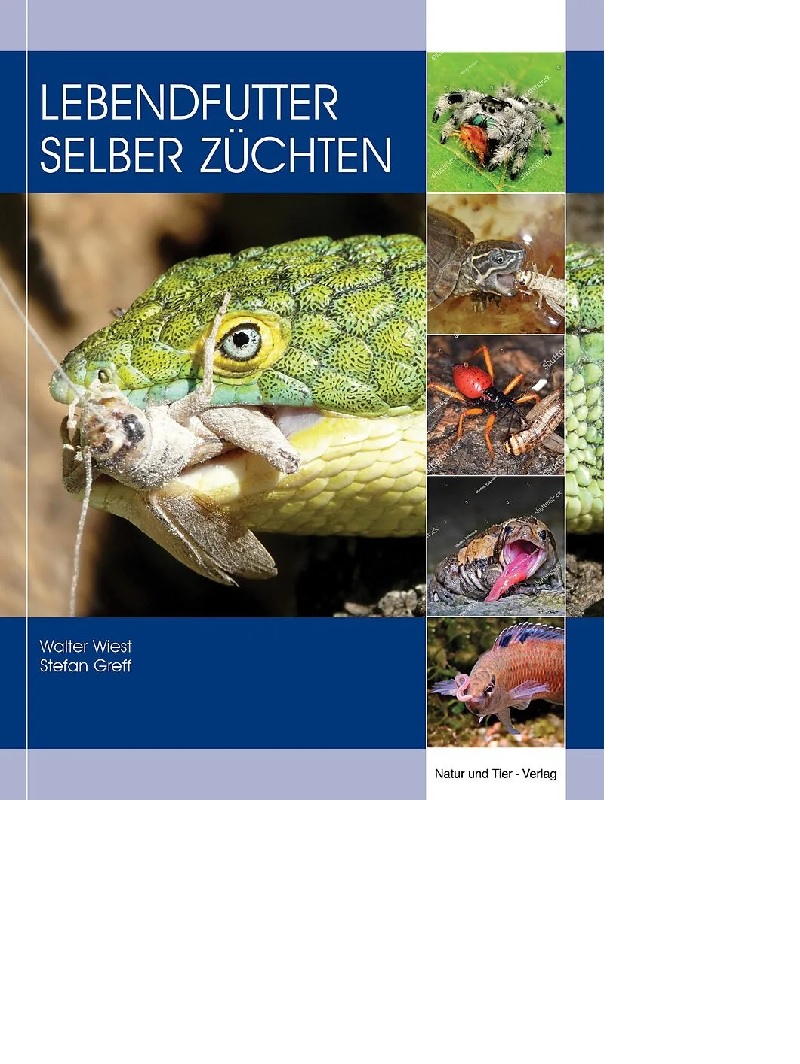
Book "Grow your own live food" - The perfect guide for pet owners
Discover practical and detailed instructions on how you can easily breed food for your reptiles, birds, fish or other animals yourself in the book "Breeding live food yourself". With valuable tips on various food insects, their care and breeding, you can save money and ensure a species-appropriate diet for your pets.
Contents of the book:
Step-by-step instructions for breeding feeder insects
Information on the best types of food for reptiles, birds and fish
Care instructions and breeding conditions for various live food species
Tips for sustainable and cost-effective food production
Why breed your own live food?
Get healthy, fresh food for your animals
Save money and reduce dependence on pet shops
Promote the health and well-being of your animals with species-appropriate food
Whether you are a beginner or an experienced pet owner, this book provides you with everything you need to successfully breed live food yourself.
Marginata 69 - New Guinea tortoises – the genus ElseyaCover storyThe unrecognised beauties: New Guinea tortoises (Andreas S. Hennig)My experiences with Branderhorst's New Guinea tortoise, Elseya (Elseya) branderhorsti (Ouwens, 1914) (Andreas S. Hennig)Keeping and breeding of Rhodin's New Guinea tortoise, Elseya (Hanwarachelys) rhodini Thomson, Amepou, Anamiato & Georges, 2015 (Andreas S. Hennig)PortraitGeoemyda spengleri, Chinese serrated tortoise (Andreas S. Hennig)ReportageMacrochelys temminckii – Experiences and impressions with vulture tortoises part 2 (Reiner Praschag)KeepingAn alternative to year-round keeping of the Egyptian tortoise in the terrarium – my experiences with seasonal outdoor keeping of Testudo kleinmanni (Ricarda Schramm)EtymologySawbacks and living maps part 4: Graptemys gibbonsi, Pascagoula humpback tortoise (Holger Vetter)Classifieds & animal placement
Draco 09 - Invertebrates in the terrarium
Content:
2 - Editorial
3 - Invertebrates, by Dieter Masberg
20 - The Landing Crab, by Harry Wölfel
27 - Phasmids (ghost insects, stick insects and walking leaves), by Sven Bradler and Christoph Seiler
33 - Phasmids as pets, by Christoph Seiler and Sven Bradler
38 - The Australian Pfeffermins stick insect Megacrania batesii - no simple fosterling, by Christoph Seiler and Sven Bradler
41 - essence of darkness - essence of light: The Mysterious Life of the Giant and Rose Beetles, by Arndt Löwenberg
55 - Exotic cord feet in the terrarium, by Timm Adam
67 - Safety in scorpion keeping: 10 golden rules, by Herbert Schiejok
70 - Own experiences with the keeping of Euscorpius carpaticus mauretanicus (THORELL, 1876), by Mario Schedel
74 - Pseudoscorpions in nature and in small terrariums, by Kriton Kunz
82 - Book case
94 - Magazine
The content at a glance:Invertebrates - the large army of the animal world, fascinatingly multi-layered, mostly hardly researched and weathered by the otherness to the vertebrates and to us humans since ancient mystery. Dieter Mahsberg's introduction to this unusual DRACO fans out the entire prism of the invertebrates: What characterizes all invertebrates, what groups are there, how do they live? After this overview you will also find a list of all taxa with species numbers that are relevant for keeping - a huge potential of highly interesting animals that will certainly not leave your thirst for research cold!Phasmids (ghost insects, stick insects and wandering leaves)Phasmids are certainly among the stars of the invertebrate boom: Sven Bradler and Christoph Seiler present the basics of the systematics and biology of these interesting animals, which include the longest insect still living today. Learn everything you need to know about the way of life of the well camouflaged invertebrates, marvel at sophisticated protection and defence mechanisms or unusual reproductive strategies. By the way, an extra section of the richly illustrated article is dedicated to the European species: so why not keep your eyes open during your next holiday!Phasmids as petsAnd on we go with the phasmids, because Christoph Seiler and Sven Bradler naturally also explain to you the keeping and breeding of the insects, which are often quite easy to care for, and which as pure herbivores make the time-consuming breeding of feed animals superfluous. The authors name the most important food plants, describe the types of terrariums with which you can meet the different requirements of the animals, and give insider tips on how to reproduce the beautiful insects - and of course they also point out possible sources of error that should be avoided! For beginners in phasmid breeding as well as for old hands an absolute must!The Australian peppermint stick insect Megacrania batesii - no simple fosterlingAnd to make sure that the absolute phasmid experts also get their money's worth, Seiler and Bradler go into detail about the keeping and breeding of this little kept and quite difficult to reproduce species in this article, in which especially the young animals captivate with their rich colors. The secret of the success in the reproduction of the Australian peppermint stick insect begins already with the suitable food, because the animals are very choosy. Seiler and Bradler will give you tips on how to get the plants you need to breed this very special stick insect without spending a lot of money. And, of course, the authors also give you insight into their successful breeding methods, so that after reading this article you have acquired all the prerequisites to try your hand at cultivating this Australian jewel yourself!The hermit crabThey often appear in pet shops and on dealer lists, these cute crustaceans, but hardly anyone knows how to keep them successful. Harry Wölfel presents amazing facts from the biology of these crustaceans, which are not very species-rich but all the more interesting - or did you know that the largest species in this group can reach a range of up to 1 m? Our DRACO author will not only tell you where the land hermit crabs occur and how they "function", but will also explain what to look out for when keeping them, how to set up the terrarium adequately, and he will even give you hints on how to breed them, which is not easy. One of the very few articles in the relevant literature, and in addition so expert and detailed - it's your own fault who as a crab fan escapes this treat!Beings of darkness - Beings of light. The mysterious life of the giant and rose beetlesThese magnificent beetles are certainly among the most beautiful insects of all, and even people who otherwise have nothing to do with "crawling animals" cannot escape the aesthetics of the animals. Did you know why nature has endowed many species of rose beetles with such lavish splendour? Arndt Löwenberg will not only tell you this, but will also give you a comprehensive introduction to the biology of these increasingly cultivated animals. And he gives a practical description of where these pearls and giants of the beetle world come from, how they are kept and bred and what the key to success is!Exotic cord feet in the terrariumUnfortunately, there is almost nothing to be found in the literature about keeping and breeding the quaint string feet. Timm Adam is a competent remedy. What is a string foot, how do these bizarre animals live? The author does not only go into detail about the stars of his contribution, but also about their relatives, for example the Skolopender. But the focus is clearly on the string feet and the role they play in science and terraristics. Are string feet poisonous? How can I set up a suitable terrarium, what do I have to consider with the climatic conditions, how can I feed the animals? And how do you breed these interesting invertebrates? Timm Adam has all the answers ready and does not leave out any hints of problems with their breeding. In short: The ultimate string foot hit!Own experiences with the keeping of Euscorpius carpaticus mauretanicus (Thorell, 1876)If you are fascinated by scorpions, but don't want to bring the most poisonous ones into your house, you are well advised to use specimens of this small species. Their keeping and breeding are not particularly difficult and can therefore be recommended to beginners in scorpion keeping. To make sure that you do everything right from the start, Mario Schedel will show you what to look out for. From the suitable terrarium over aspects like socialization up to the successful offspring all important aspects are covered!Safety in keeping scorpionsTopic number 1 in the keeping of these fascinating arachnids is, of course, always safety, which must be absolutely guaranteed. Scorpion expert Herbert Schiejok points out all the important parameters that have to be observed for a safe keeping, gives tips on which terrarium types are best suited, what has to be taken into account when setting up the tank and what has to be observed when handling the animals in the terrarium. How, for example, do you catch a scorpion safely, how do you move it, and what do I do if the animal has been stabbed in spite of all caution? A responsible terrarium keeper who cares about his own protection and that of his fellow human beings will certainly not miss this contribution!Pseudoscorpions in nature and in the smallest terrariumDo you find scorpions fascinating, but shy away from the risk of a poison sting? You would like to take care of really special animals? How about pseudoscorpions? These tiny creatures, which you can easily find in your garden, in the forest or perhaps even in your house, are very similar to their big relatives, but unlike them they do not have a "tail" with a poison sting. Kriton Kunz overhears with you the secret activities of the funny little guys, presents them fascinating details from the widely unknown biology of the unusual arachnids and gives you tips on where and how you can capture the dwarves. And anyone who has ever maintained or even recreated the bizarre "mini scorpions" in a neatly furnished mini-terrarium will certainly not be able to get rid of them in a hurry!
Marginata No. 29 - Madagascan ray turtle
Schildkrötenforschung in den TropenSternschildkrötenzwillingeGallaguar-Schildkrötenschutz in Indonesien
Inhalt:
Editorial Magazin Termine
REPORTAGEMadagaskars Südwesten – Heimat einer gestreiften ExotinJutta Hammer
REPORTAGE Village des Tortues. Auffangstation für gewilderte Schildkröten Jutta Hammer
HALTUNG UND ZUCHT Haltung und Nachzucht der Madagassischen Strahlenschildkröte. Teil 1 Michael Wirth & Peter Fritz
POSTER Sulawesi-Sumpfschildkröte Leucocephalon yuwonoi Hans-Dieter Philippen
REPORTAGE Zur Situation von Meeresschildkröten in Sri Lanka Sascha Pawlowski
REPORTAGE Erfolgreiches Jahr 2010 im Internationalen Zentrum für Schildkrötenschutz (IZS) im Allwetterzoo Münster Elmar Meier, Martina Raffel & Hans-Dieter Philippen
REPORTAGE Die Papua-Weichschildkröte (Carettochelys insculpta) und ihre Nachzucht in „Down Under“ Egon Heiss
REPORTAGE Conrad Gesner und die Schildkröten Kriton Kunz
REPORTAGE Ein nicht alltäglicher Doppelschlupf von Zwillingen bei der Sternschildkröte (Geochelone elegans) im Allwetterzoo Münster Jochen Scholdei
BuchtippKleinanzeigen Abo & Service Regionalführer
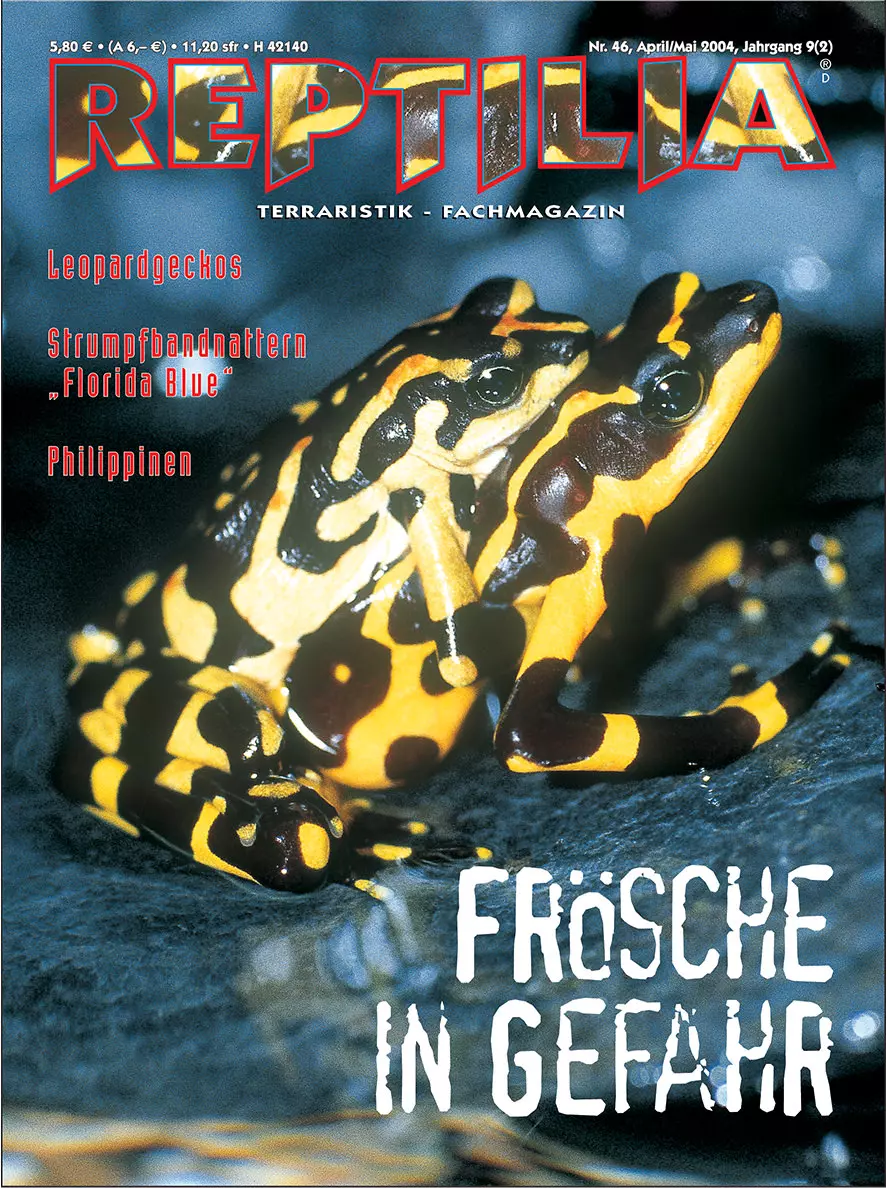
Reptilia 46 - Frogs in danger
Leopard geckosGarter snakes "Florida blue"Philippines
Contents:
2 EDITORIAL
4 MAGAZINE
11 DATES
14 WESTERN HERP PERSPECTIVESSmall game in the sandby B. Love
16 PHOTO REPORTAGE Amphibian extinction: insight into the history and current researchby S. Lötters
24 REPORTAGENose frogs in danger - Hope for the semi-aquatic nose frog (Rhinoderma rufum)?
by K. Busse & H. Werning
34 HERPETOFAUNAThe decline of frog populations in the high Andes of Venezuela
by E. La Marca
39 REPORTAGEAmphibian extinction in African style
by S. Schick
45 TRAVELClicking, ringing, whistling and shooting - the frogs of Panay
by M. Gaulke
51 PORTRAIT AND POSTERTestudo hermanni boettgeriby B. Trapp
56 KEEPING AND BREEDINGThe leopard gecko - not just a beginner's animalKeeping and breeding of Eublepharis macularius in the terrariumby T. Wilms
63 HERPETOFAUNANot every blue garter snake is a "similis" - On distinguishing the blue forms of the common garter snake Thamnophis sirtalis sirtalis "florida blue" and the Florida garter snake Thamnophis sirtalis similisby M. Hallmen
70 KEEPING AND BREEDINGKeeping and breeding the red-eyed slender-headed turtle Emydura subglubosaby A. S. Hennig
74 HERPETOFAUNANorth America's king of rattlesnakes – Crotalus atrox – Part 2by D. Schmidt
80 REPORTAGEPlanning and construction of a reptile zoo: "Reptilium - Terrarium and Desert Zoo" in Landau - Part 1: The planning phaseby T. Wilms
86 SMALL ADVERTS
94 RAT & TAT
96 LIBRARY
104 GLOSSESThe Costa Cordalis of Weddingby H. Werning
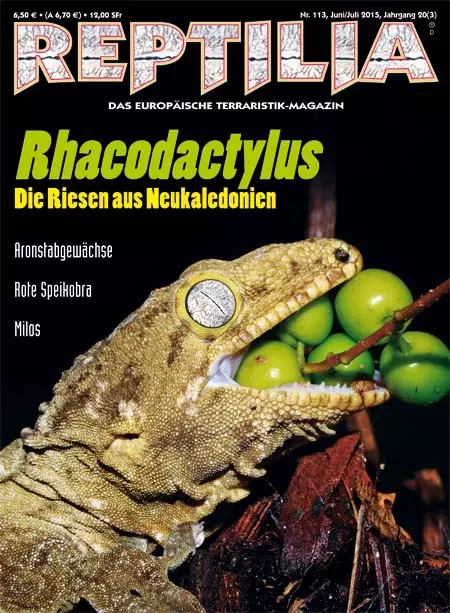
Reptilia 113 - RhacodactylusThe giants of New Caledonia
Arum familyRed spitting cobraMilos Cover story: Rhacodactylus, the giants of New Caledonia.
EditorialMAGAZINEDATES
Photo storyRhacodactylus – Diverse giants from New CaledoniaP. Schoenecker
Keeping and breedingDark giants in the terrarium: keeping and breeding Rhacodactylus leachianus , the local form from Mont KoghisP. Schoenecker
ReportageIn search of New Caledonian giant geckosC. Langner
Keeping and breedingThe local variants of Rhacodactylus leachianus in terrarium keeping Part 1: Grande TerreS. Cemelli
PlantsArum plants in the terrarium Part 1: Species diversity, biology and special featuresB. Akeret
Keeping and breedingThe jewel of venomous snake keeping. The red spitting cobra, Naja pallida, as a pet in the terrariumO. S. Rudolphi
ReportageQueensland's spiders and their venoms Part 2: The araneomorph spiders T. J. Hauke
ALSO NEAR YOUService
Animals of our homelandThe fire-bellied toadR. Leptien
WESTERN HERP PERSPECTIVESWalk the boardsB. Love
JourneyFeta cheese, sun and snakes. Welcome to Milos!A. Schmid
PREVIEW
BRUTKASTENChuckwalla anecdotes. Part 2H. Werning
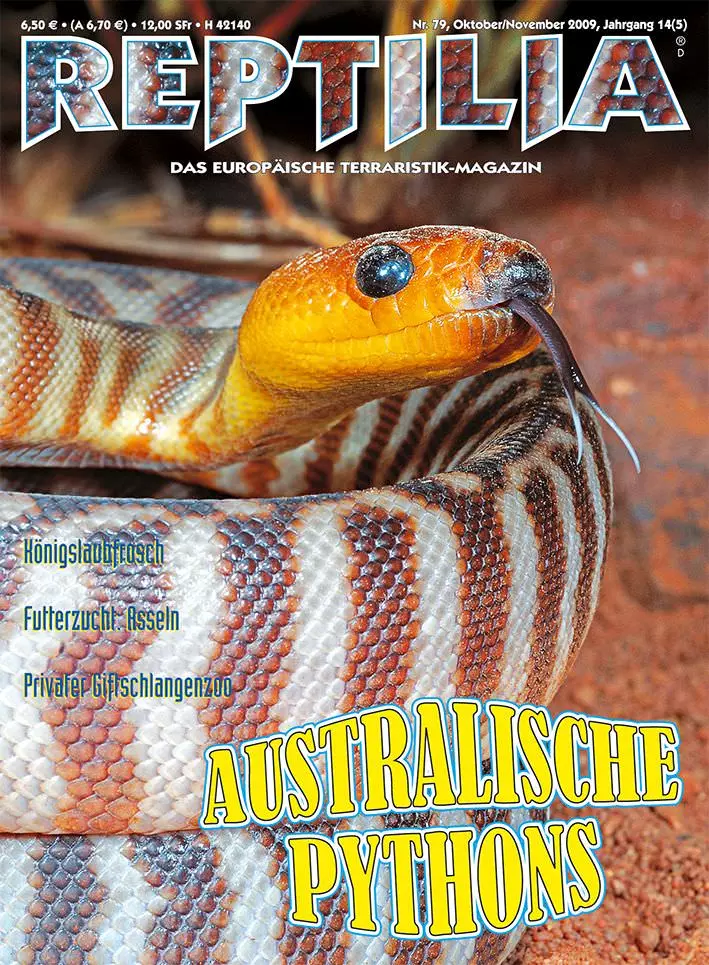
Reptilia 79 - Australian PythonsRoyal tree frogFood breeding woodlicePrivate venomous snake zooContents:The unique herpetofauna of Australia is always at the centre of theInterest among terrarium keepers. This is particularly true of the giant snakes of the fifth continent. We report on them in detail, focussing on the rare forms Pilbara olive python (Liasis olivaceus barroni), Oenpelli's python (Morelia oenpelliensis) and the rough-scaled python (Morelia carinata).EDITORIALMAGAZINEDATES PHOTOSTORYPythons of Australiaby S. Winchell HERPETOFAUNARare and little-known pythons from Australia – Part 1: The rough-scaled python, Morelia carinataby S. Alcini HERPETOFAUNARare and little-known pythons from Australia – Part 2: The Pilbara olive python, Liasis olivacea barroniby S. Alcini HERPETOFAUNARare and little-known pythons from Australia – Part 3: The Oenpelli python, Morelia oenpelliensisby S. Alcini REPORTAGEThe most beautiful of them all – the leafhopper Ancylecha fenestrata von A. Schmidt PORTRAIT and posterChamaeleo hoehneliiby M. DobieyTRAVELIn the footsteps of Darwin through South America. Part 2: From Patagonia to Central Chileby H. Werning--> Literature on all three parts KEEPING AND REPRODUCTIONWoodlice as food animalsby J. Felka WESTERN HERP PERSPECTIVESHas the trade in reptiles and amphibians reached maturity?from B. Love KEEPING AND REPRODUCTIONThe King Tree Frog, Pseudacris regilla. Reintroduction of an old acquaintanceby R. Münzer TERRARIUM DISPLAYSThe serpentarium of the Snakeparadise in Eschlikon in Schweizerby H. Werning LIBRARYSUBSCRIPTION & SERVICEALSO NEAR YOUPREVIEW BRUTKASTEN Bear Country. Quasi live from Yellowstone National Parkby H. Werning
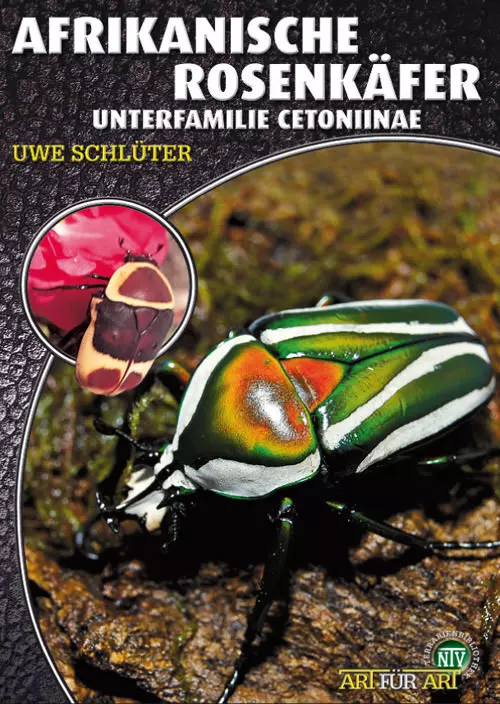
Not just food animals! Everything about keeping and caring for African rose chafer beetles at home.
64 pages
Format: 14.8 x 21 cm
numerous colour photos
Author Uwe Schlüter
Many terrarium keepers only know them as food animals: the larvae of rose chafer beetles. However, these beautiful insects are in turn fascinating, easy-to-keep terrarium animals. Uwe Schlüter presents tropical species of rose chafer beetles from Africa that are currently in vogue, including the impressive goliath beetles. Beetle care made easy! Contents:
Foreword
Classification
Morphology of rose chafer beetles
Imagines of the Cetoniinae
Larvae of the Cetoniinae
Rose chafer beetles in nature
Lifestyle and behaviour
Life cycle
Care in the terrarium
Acquisition and transport
Terrarium equipment and climate
Socialisation
Feeding of imagines and larvae
Reproduction in the terrarium
Egg laying
Rearing the larvae
Pupation and hatching of imagines
Descriptions of selected species
Further information
Further and used literature
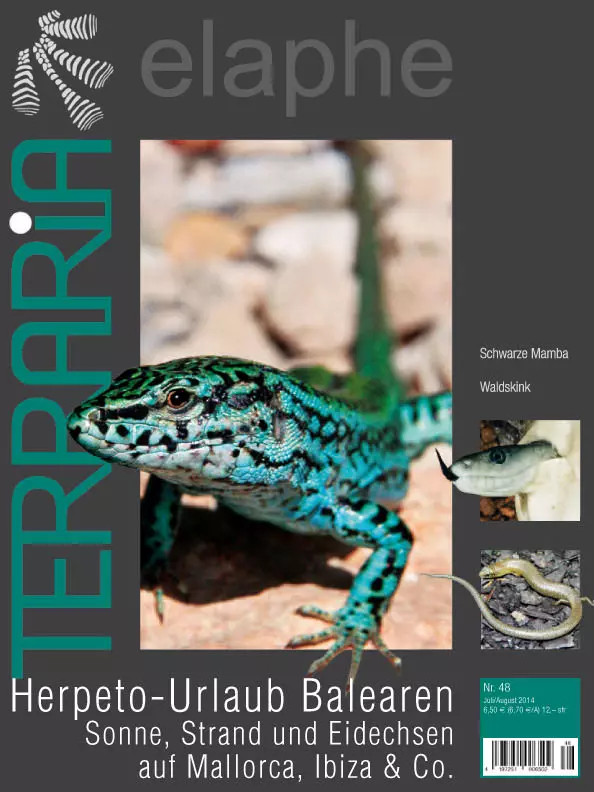
Terraria 48 - Herpeto holiday Balearic IslandsBlack MambaForest skinkContents:TerritorialHerpetoramaCover storyHerpeto holiday Balearic Islands. Sun, beach and lizards on Mallorca, Ibiza & Co.Mike ZawadzkiIbiza - Sun, beach and lizardsMike ZawadzkiFormentera - Beyond timeMike ZawadzkiMenorca - Blown by the windMike ZawadzkiCabrera - Spain's little GalápagosMike ZawadzkiMallorca - The unrecognised islandMike ZawadzkiPanoramaIn search of mountain vipers (Monitvipera xanthina) in north-eastern Greece – Part 2Michael Wirth"Just Remember that Death is not the End". Taxidermy of reptilesJörg PetzoldWilly Wolterstorff. The "father of the newt" was born 150 years agoWolfgang BischoffResearchAmong researchers"Harmless" snake on the road or the discovery of a new pit viper in the HimalayasGernot VogelNew speciesThe relict-like leaf toad or the discovery of a new frog speciesMirko SoléSalamandraTerraristicsKeeping and breeding the Madagascar forest skink Amphiglossus macorcercusJochen MeyerSubscription & ServiceObservations of the black mamba, Dendroaspis polylepis, in the terrariumLudwig Trutnau & Alfred WallnerNature and species conservationField notesGreek vipersHans PichlerGrass frogs in VilsalpseeAxel KwetEasy help for the amphibian of the year, the yellow-bellied toadAndreas OchsenbeinAlso in your neighbourhoodPreviewIncubator The boys in the swampRolf Leptien
CHF 12.00
❅
❆
❅
❆
❅
❆
❅
❆
❅
❆
❅
❆
This website uses cookies to ensure the best experience possible. More information...