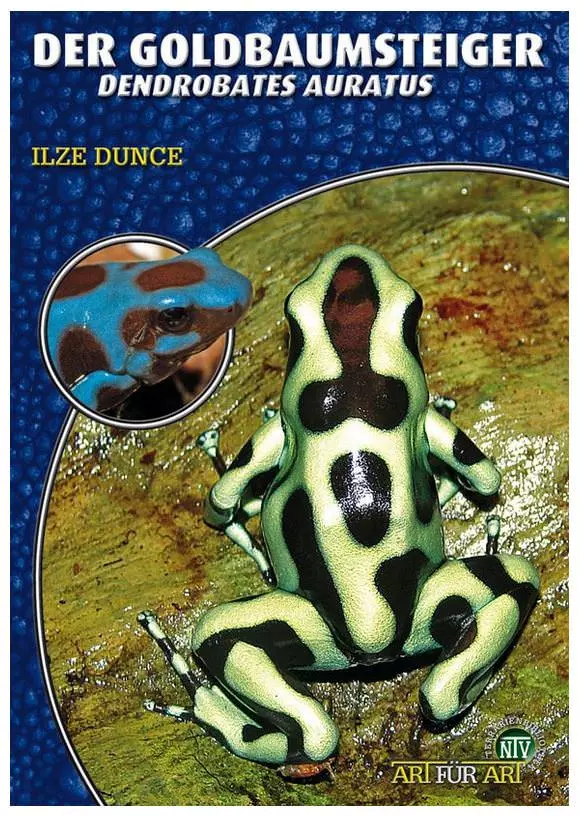
Product information "NTV - The golden tree climber"
Dendrobates auratus - All about the golden treecreeper
64 pages
many colour photos
all about the golden treecreeper
Author Ilze Dunce
Publisher NTV
The book explains everything about keeping and caring for these interesting amphibians. The set-up of the terrarium and feeding are explained in detail.
Table of contents:
Foreword
Classification
Natural habitat
Skin venoms
Behaviour
Description of the colour variants or morphs
Endangerment
Terrarium
Substrate
Water
Furnishings
Planting
Lighting
Temperatures and heating
Food and feeding
Vitamins and minerals
Propagation
Incubation of the eggs
Rearing the young frogs
Diseases and their treatment
Further information
Literature used and further reading
Composition
Feeding recommendation
Technical details
Size information
0 of 0 reviews
Give us a rating!
Share your experience with the product with other customers.
Login
No reviews found. Go ahead and share your findings with others.
Handbook of forage plants 2nd revised editionMarion Minch is not only a successful breeder of diverse tortoises for many years, but also an excellent connoisseur of native wild herbs. She founded and runs samenkiste.de, which is well known to many tortoise keepers and nature lovers. Her name is inextricably linked with reptile care and species-appropriate nutrition for tortoises. Her handbook of food plants summarises the most important native food plants for herbivorous and omnivorous reptiles. She not only considers tortoises, but also iguanas, spiny-tailed dragons and even chameleons. From the basics of plant biology to native wild herbs to suitable food plants for hardy tropical reptile species, this comprehensive work provides the basis for species-appropriate keeping. In the expanded and supplemented 2nd edition, the plant section is divided according to flower colour. This makes it even easier to identify wild herbs. The work has also been supplemented with a wealth of additional information and many pictures.
Geckos in the terrarium by Astrid FalkThe book offers a comprehensive introduction to geckos and their species-appropriate keeping in terrariums. It explains what you need to think about before buying a gecko and what preparations should be made. The book describes in detail how the terrarium is technically equipped and set up. The care of the animals, their special features and behaviour, their diet, reproduction and rearing of young animals are described, as well as diseases and husbandry problems with tried and tested suggestions for prevention and treatment. Individual gecko species that are particularly suitable for keeping and breeding in terrariums are portrayed in detail in the second part of the book.
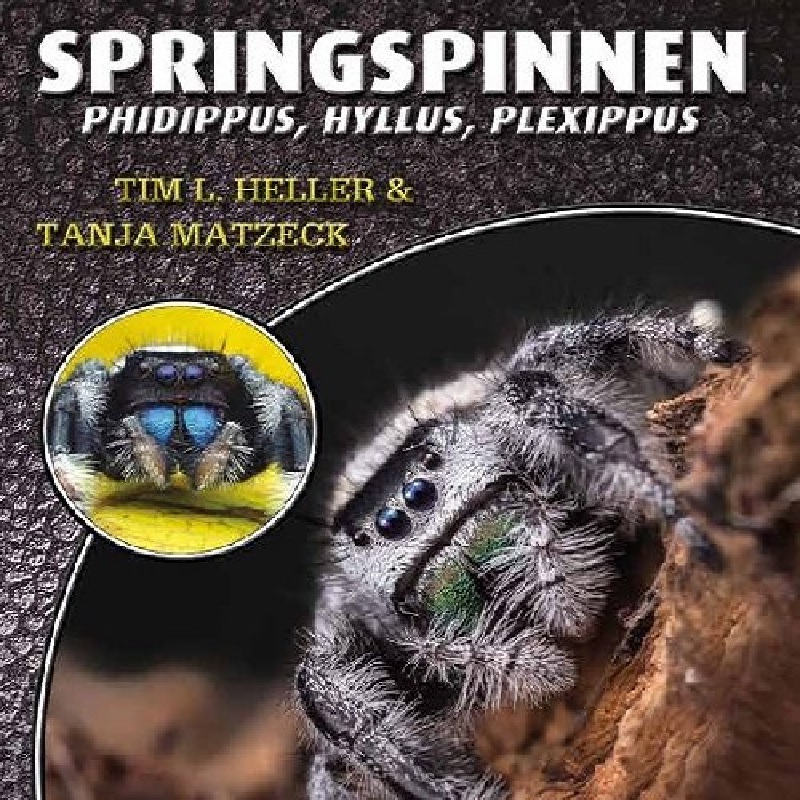
Book Jumping Spiders -
Phidippus, Hyllus & Plexippus
A guide to keeping jumping spiders of the genera Phidippus, Hyllus & Plexippus. Who can resist the charm of jumping spiders? The childlike appearance of their expressive face simply leaves no one cold! In addition, their behavior is extremely exciting to observe, their colors are bright and their requirements for species-appropriate keeping are very easy to meet. No wonder these likeable jumpers are all the rage!
This volume in the "Species by Species" series describes in detail what to look out for when buying and keeping them, introduces the most commonly kept species and color forms and provides plenty of tips on how to keep them successfully - so you can be sure they will breed well!
Species by Species introduces you to the books in this series, which present the most popular terrarium animals. Each volume offers you detailed, practical care instructions and all the information you need to successfully breed your animals.
All important questions from the required tank size to terrarium set-up, technical equipment, species-appropriate nutrition and disease prevention are answered with numerous tricks and tips.
Experienced, long-standing breeders reveal how you can encourage the animals to reproduce and raise healthy young.
All this in full color, generously illustrated and attractively designed - just about your terrarium animal - species by species
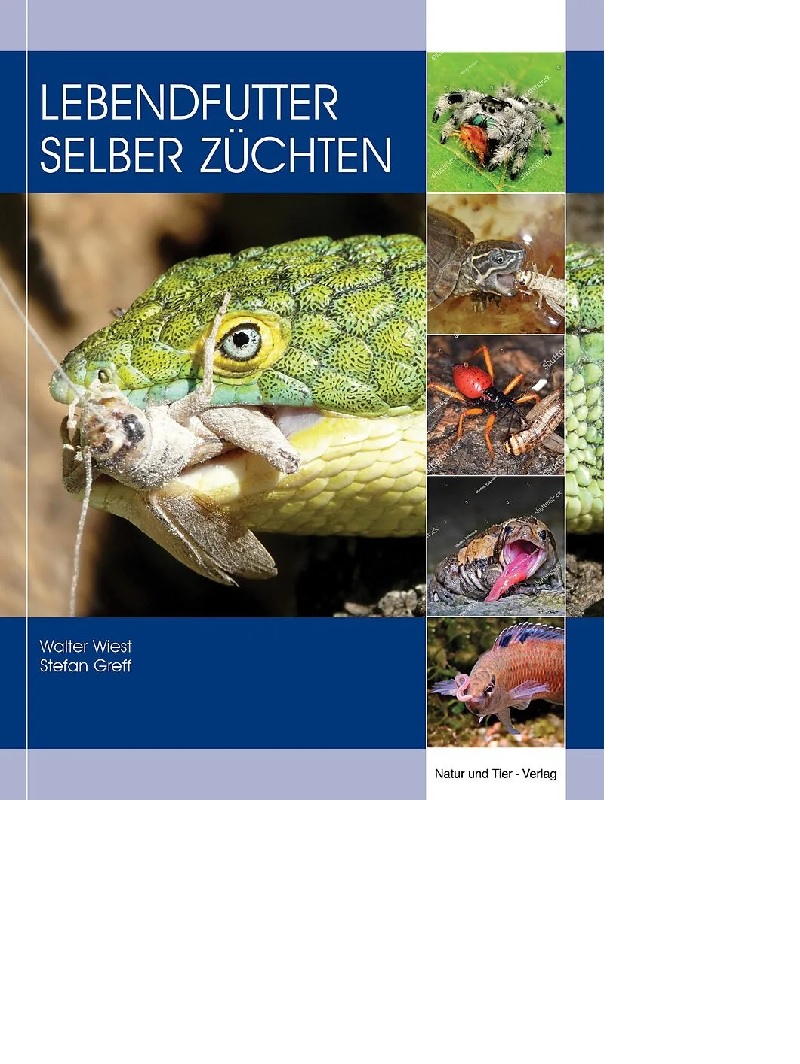
Book "Grow your own live food" - The perfect guide for pet owners
Discover practical and detailed instructions on how you can easily breed food for your reptiles, birds, fish or other animals yourself in the book "Breeding live food yourself". With valuable tips on various food insects, their care and breeding, you can save money and ensure a species-appropriate diet for your pets.
Contents of the book:
Step-by-step instructions for breeding feeder insects
Information on the best types of food for reptiles, birds and fish
Care instructions and breeding conditions for various live food species
Tips for sustainable and cost-effective food production
Why breed your own live food?
Get healthy, fresh food for your animals
Save money and reduce dependence on pet shops
Promote the health and well-being of your animals with species-appropriate food
Whether you are a beginner or an experienced pet owner, this book provides you with everything you need to successfully breed live food yourself.
Marginata 69 - New Guinea tortoises – the genus ElseyaCover storyThe unrecognised beauties: New Guinea tortoises (Andreas S. Hennig)My experiences with Branderhorst's New Guinea tortoise, Elseya (Elseya) branderhorsti (Ouwens, 1914) (Andreas S. Hennig)Keeping and breeding of Rhodin's New Guinea tortoise, Elseya (Hanwarachelys) rhodini Thomson, Amepou, Anamiato & Georges, 2015 (Andreas S. Hennig)PortraitGeoemyda spengleri, Chinese serrated tortoise (Andreas S. Hennig)ReportageMacrochelys temminckii – Experiences and impressions with vulture tortoises part 2 (Reiner Praschag)KeepingAn alternative to year-round keeping of the Egyptian tortoise in the terrarium – my experiences with seasonal outdoor keeping of Testudo kleinmanni (Ricarda Schramm)EtymologySawbacks and living maps part 4: Graptemys gibbonsi, Pascagoula humpback tortoise (Holger Vetter)Classifieds & animal placement
Philippinen-KrokodilCumberland-SchmuckschildkröteHalsbandleguane im Freilandterrarium
Inhalt:
Die Terraristik bietet eine unendliche Fülle wunderbarer Fotomotive, ein Eldorado für Hobby-Fotografen! Und wohl jeder Halter hat den Wunsch, seine Pfleglinge, seine Nachzuchten und seine Anlage im Bild festzuhalten. Zumal Fotografieren nie einfacher war als heute, wo jedes Telefon die schnelle Aufnahme erlaubt, die dann direkt ins virtuelle Fotoalbum auf Facebook hochgeladen werden kann, wo alle Freunde sie anschauen können.Profi-Fotograf Benny Trapp aber gibt zahlreiche Tipps und Tricks, wie Sie zu Bildern kommen, bei denen garantiert jeder den „Gefällt mir“-Button drückt, ganz gleich, ob Sie mit einer Kompaktkamera oder einer hochwertigen Spiegelreflexkamera arbeiten. EDITORIALMAGAZINTERMINEIN 5 JAHREN UM DIE WELT Menschen und SchildkrötenA. PachmannWESTERN HERP PERSPECTIVESBörsenbesuch down under B. LoveFOTOSTORYBild schön! Fotografie von Terrarientieren K. KunzPRAXISTerrarientiere fotografieren. Einsatz von Licht und Blitz bei SpiegelreflexkamerasB. TrappPRAXISTipps für bessere Bilder mit KompaktkamerasB. TrappHALTUNG UND VERMEHRUNGPhilippinenkrokodile (Crocodylus mindorensis) im Aquarium des Kölner Zoos. Teil 1: Erfahrungen mit „Off-Exhibit“- Haltung einer der am stärksten bedrohten Krokodilarten der Welt T. Ziegler, R. Sommerlad, W. Brass, K. van der Straeten, D. Karbe & A. RauhausHERPETOFAUNAAuf dem Weg ins All. Die Welt der Buchstaben-Schmuckschildkröte, Trachemys scripta Teil 4: Cumberland- und Südtexas-Schmuckschildkröte A. S. HennigWIRBELLOSEDie Isles of Scilly. Ein Paradies nicht nur für Phasmidenfreunde H.-J. LuefHALTUNG UND VERMEHRUNGErfahrungen mit der Haltung von Halsbandleguanen im FreilandterrariumM. DieckmannTIERE UNSERER HEIMATDie AspisviperR. LeptienBIBLIOTHEKTIPPS & TRICKSTESTLAUFABO & SERVICEAUCH IN IHRER NÄHEREISEThe Rock. Die Herpetofauna GibraltarsU. SchlüterVORSCHAUBRUTKASTENIguana chilenaH. Werning
Terraria 46 - Iguanas in the "Wild West"
Abronia deppiiNew amphibians 2013
Contents:
The small iguanas from the North American arid regions are among the most popular pets in our terrariums. They include such prominent representatives as collared iguanas, chuckwallas, desert iguanas, toad lizards, leopard iguanas and spiny iguanas. We report on these sun-worshippers in the wild and present examples of successful terrarium keeping.Table of contents:TerritorialHerpetoramaCover storyIguanas in the “Wild West”Heiko WerningThe leopard among the reptilesKarl-Heinz SwitakPhrynosoma modestum. Tiny little creatures with interesting behaviourJörg Wernicke & Klaus HaaseAlways hugging the wall: The Baja California rock iguana, Petrosaurus repens, in the terrariumPeter Schulze NiehoffPanoramaHerpetological observations in the habitat of Abronia deppii in the Valle de Bravo, State of Mexico, MexicoChristian LangnerResearchNew speciesList of new amphibians described in 2013Axel KwetSalamandraAlso in your neighbourhoodTerraristicsThe animal world in human handsWalter SachsseNature and species conservationField notesStartle response in the common frog (Rana temporaria)Rudolf MalkmusTerrestrial hibernation of Pelophylax ridibundus in a garden bedAndreas Nöllert Long-term data on the reproductive biology of the grass frog under the influence of global warmingRudolf MalkmusSubscription & ServicePreviewIncubator Tasty giraffeHeiko Werning
All about the flat-tailed gecko by Patrick Schönecker
64 pages
Format: 14.8 x 21 cm
numerous colour photos
1st edition
Author Patrick Schönecker
Publisher NTV
Contents:
Flat-tailed geckos are interesting pets for the more advanced lizard keeper who has already gained some experience with the care and breeding of other species and now wants to venture into these bizarre reptiles with his well-founded knowledge.This book is not intended to be an all-encompassing work on uroplatus care. Rather, it is intended to make it easier for beginners interested in keeping species of the genus to get started and select a suitable species by presenting four recommended species.The content of the book is also intended as a practical aid for these animals.
Systematics and body structure
The fascinating biology: From the life of the flat-tailed gecko
All information on species-appropriate keeping: from suitable terrariums to equipment and technology to feeding
Successful breeding: Mating stimulation, rearing of young animals
Solutions to problems: How to avoid the most common mistakes in care, and how to help sick animals
Brilliant photos
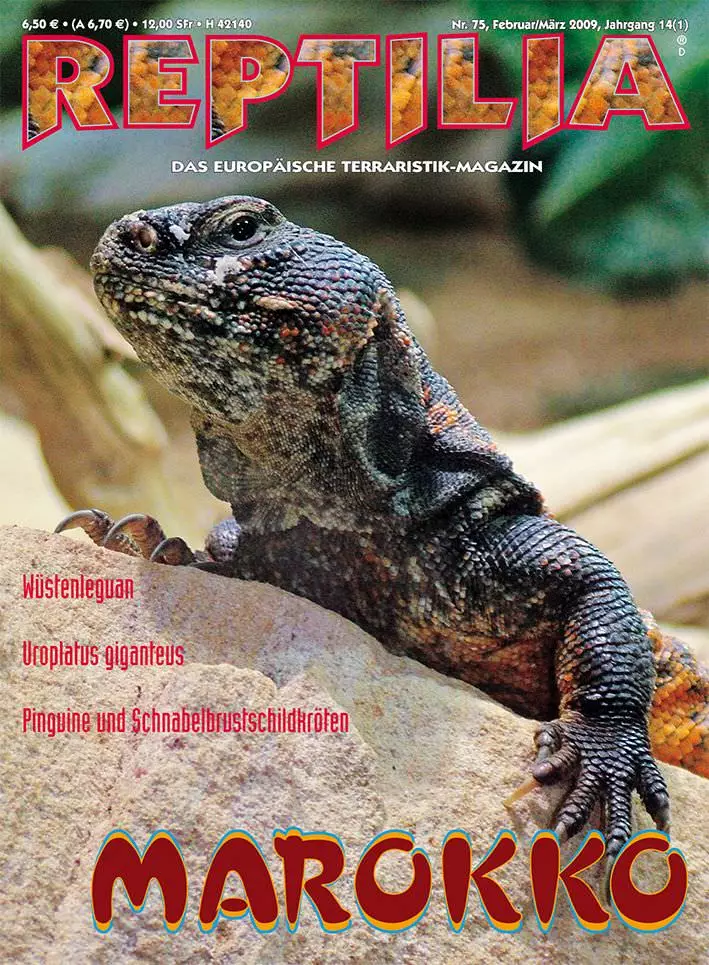
Reptilia 75 - Morocco
FAQ Terrarium lightingTransport of terrarium animalsPenguins and beaked-breasted tortoises
Contents:
Morocco - so close to Europe, and yet a completely different world. Culturallyof course, but also in its animal world the country withits vast deserts and the mighty Atlas Mountains is of particular interest. Arabia expert and spinytail researcher ThomasWilms introduces you to Morocco, its spectacular landscapes and the very special herpetofauna. Stephanie de Pury, Sascha Esser and Michel Aymerich report on their exciting search for the lizard snake there, Rolf Leptien has travelled to the south of the country, and finally Hemmo Nickel portrays the remarkable scorpions of Morocco.
2 EDITORIAL3 MAGAZINE11 DATES14 WESTERN HERP PERSPECTIVES The "crisis" of the Florida soft-shelled turtle by B. Love16 PHOTOSTORY Morocco Treasure trove in north-west Africa by T. Wilms24 TRAVEL Morocco: In search of the lizard snake by S. de Pury, S. Esser & M. Aymerich32 TRAVEL On an excursion to the south of Morocco by R. Leptien38 REPORTAGE The scorpions of Morocco Part 1 by H. Nickel, J. Hornung & M. Koch47 PORTRAIT and POSTER Uroplatus giganteus by P. Schönecker51 HERPETOFAUNA The Big Bend National Park and its reptiles. Part 2: Snakes by P. M. Kornacker & U. Dederichs59 TERRARIUM PRACTICE Animal-friendly transport of reptiles by S. Knauf66 HERPETOFAUNA African beauty among penguins Ecological relationships of the beaked-breasted tortoise in the Cape of South Africa by M. Wirth79 FAQ – Frequently Asked Questions Terrarium lighting – Part 1 by I. Kober & U. Geissel86 ALSO NEAR YOU91 SUBSCRIPTION & SERVICE94 PREVIEW96 BRUTKASTEN Travel snippets from the Caribbean – Part 2 by H. Werning
Reptilia 83 - ArgentinaAmphibian of the year: the pond newtUsambara bush viperPoison dart frog Ameerega trivittata - the orange variety Contents:Argentina is still an insider tip among travellers. The Pampa state is one of the most diverse countries in the world and is home to an extremely rich herpetofauna. In this huge South American country, you can marvel at sub-Antarctic glaciers, climb mountains almost reaching the 7,000 metre mark, hike through steaming rainforests, marvel at perhaps the most spectacular waterfalls in the world, traverse gigantic swamps or sweat in some of the hottest spots on the planet. And eat more fantastic beef than anywhere else. REPTILIA has asked leading Latin American experts on the country's reptiles and amphibians to introduce us to this "blank spot" on the map, which is not only home to some terraristic or well-known highlights such as the southern boa, black caiman, yellow anaconda or Argentine tortoise, but also to a large number of species that are largely unknown to us but are extremely interesting and fascinating - from the high-mountain iguana to the black toad.Table of contentsEDITORIALMAGAZINESeveral amphibian and reptile species newly included in the Washington Convention on International Trade in Endangered Species of Wild Fauna and Flora (CITIS)Alexander Gutsche Conservation status WA II for the entire genus AgalychnisTobias Eisenberg The earthquake in Chile in 2010Johara Bourke Information conference "Dangerous animals - keeping, trade and risks"Florian GieseDATESWESTERN HERP PERSPECTIVES"Florgia Herping"from B. LovePHOTOSTORYThe reptiles of Argentinaby S. WinchellHERPETOFAUNAThe Southern Boa or Argentine Boa, Boa constrictor occidentalisby T. & S. VinkeTERRARIUM PRACTICEThe Southern Boa (Boa constrictor occidentalis) and the mandatory marking requirementby H. & E. StöcklHERPETOFAUNAThe Red Teju, Tupinambis rufescensby T. & S. VinkeKEEPING AND REPRODUCTIONFringed-finger lizards (Acanthodactylus) in the wild and in the terrariumPart 5a: The Acanthodactylus scutellatus groupby U. SchlüterPORTRAIT and posterEpidalea calamita (Bufo calamita) (Laurenti, 1768). Natterjack toadvon J. M. Dehling & D. M. DehlingTRAVELThe orange variant of the poison dart frog Ameerega trivittata from the Nassau Mountains in Surinameby H. DivossenKEEPING AND REPRODUCTIONCare and breeding of the Usambara bush viper Atheris ceratophoraby Georg JachanKEEPING AND REPRODUCTIONThe Macrothele genus in the terrarium. Description, care and breedingvon R. HübersHERPETOFAUNAThe common newt (Lissotriton vulgaris) – Amphibian of the Year 2010by A. Kwet, A. Nöllert & J. HillLIBRARYBook review: Whistling frogs in Peru, Duellman & Lehr (2009): Terrestrial-breeding frogs (Strabomanidae) in PeruAndreas SchlüterBook review: Henkel & Schmidt (2009): Leopard GeckosMartin DieckmannSUBSCRIPTION & SERVICEALSO NEAR YOUPREVIEW
Terraria 05 - Asian bamboo vipersGreen frogsEuropean ScorpionsContents:
2 Editorial Kriton KUNZ
TOPIC
4 Asian bamboo vipers - Biology and distribution Andreas GUMPRECHT
9 On the current taxonomy and systematics of the Asian bamboo vipers Andreas GUMPRECHT
13 Husbandry and continuous breeding of the Asian bamboo viper Popeia popeiorum (SMITH, 1937) Andreas GUMPRECHT
20 Wild Yunnan - in search of bamboo vipers in the southwestChinas Andreas GUMPRECHT
28 Cited or recommended literature on bamboo shrews Andreas GUMPRECHT
SCIENCE
30 Herpetorama Colour change of the green tree pyhton / Goodbye "Azureus
32 new species Bungarus slowinskii / Cordylus meculae / Calotes htunwini & C. irawadi
35 Among researchers Crocodile research in the peat swamp forests of Borneo René BONKE
39 The Slit-shelled Turtle, Malacochersus tornieri (SIEBENROCK, 1903) – Distribution, Lifestyle and Reproduction Manfred ROGNER
44 Observed with the camera: Water frog life at the pond Dietmar SCHUPHAN
54 European scorpions of the genus Euscorpius THORELL, 1876 Alexander TIETZ
61 The day geckos of Oman Rolf LEPTIEN
64 Melanophryniscus – not just black toadsPart 4 (conclusion): The species in Argentina, Paraguay and Bolivia Axel KWET
TRAVEL74 The Greek mainland - European Eldorado for reptilesand amphibians Benny TRAPP
TERRARIUM PRACTICE
84 test run Hatching boxes Kriton KUNZ & Heiko WERNING Vitamin-mineral preparation Eurital Silvia MACINA
86 Prelude Checklist for the acquisition of a chameleon Nicolá LUTZMANN
90 Eye-catcherA journey through the terrarium hobby - a visit to Paul-Heinz Grünwaldt Mike ZAWADZKI
94 Also in your neighbourhood
97 TERRAnet Serum-Depot Berlin / Dwarf Bearded Dragons
99 TERRAglobal Where is the TERRARIA? Joachim BULIAN The snake in my life - and in the life of my family Fabio CUPUL
104 TERRAwinn
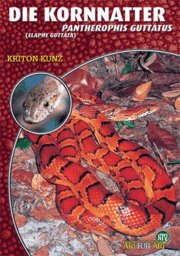
All about corn snakes from Kriton Kunz
64 Seiten
14,8 x 21 cm
zahlreiche Farbfotos
Autor Kriton Kunz
Inhalt:
Vielleicht der Klassiker der Terraristik schlechthin ist die Kornnatter. Sie vereint in sich alle Eigenschaften, die eine Schlange zu einem geeigneten und auch dem Einsteiger empfehlenswerten Pflegling machen: Wunderschöne Färbung, attraktive Farbvarianten, ruhiges, umgängliches Wesen und leichte Haltbarkeit. Damit Sie Ihre Kornnattern vom ersten Tag an richtig und artgerecht pflegen können, vermittelt Ihnen Kriton Kunz, REPTILIA-Redakteur und erfahrener Schlangenhalter, in diesem Band der Reihe „Art für Art“ ausführlich und leicht verständlich alles, was Sie für die erfolgreiche Haltung dieser faszinierenden Art wissen müssen. Selbstverständlich erfahren Sie auch, wie Sie Ihre Tiere zur Vermehrung bringen, die Eier ausbrüten und die Jungtiere aufziehen können.
Systematik und Körperbau
Die faszinierende Biologie: Aus dem Leben der Kornnatter
Alle Informationen zur artgerechten Haltung: Vom geeigneten Terrarium über Einrichtung und Technik bis hin zur Fütterung
Erfolgreich nachzüchten: Paarungsstimulation, Inkubation der Eier und Aufzucht der Jungtiere
Problemlösungen: Wie man die häufigsten Fehler bei der Pflege vermeidet, und wie man kranken Tieren helfen kann
Brillante Fotos
CHF 21.90
❅
❆
❅
❆
❅
❆
❅
❆
❅
❆
❅
❆
This website uses cookies to ensure the best experience possible. More information...