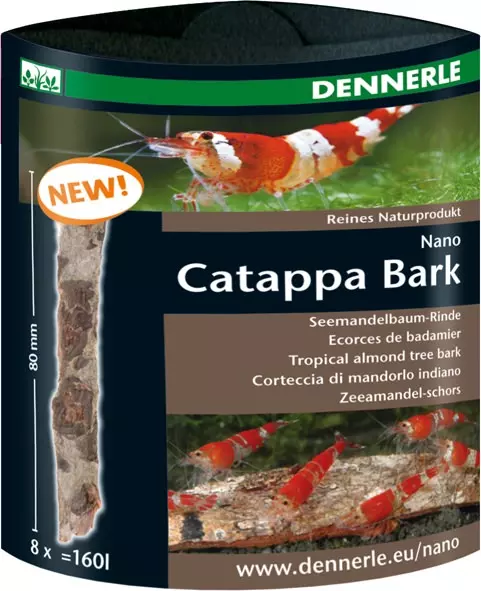
Nano Catappa Bark - Tropical almond tree bark
Natural water care and decoration at the same time
For aquarium water similar to the tropical aquatic habitat
For shrimps, crabs, crayfish and fish
Protects the mucous membrane and prevents infections
Particularly recommendable for aquaria with very large stocks of fish and plants
100% pure natural product
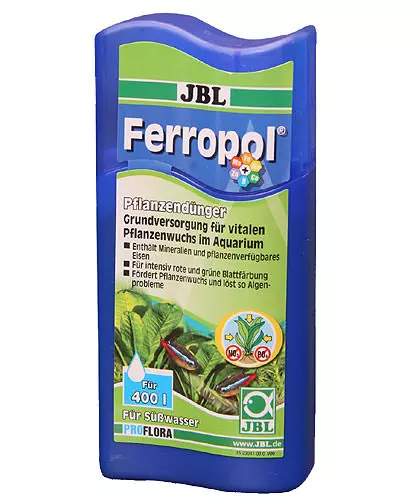
JBL Ferropol - Plant fertilizer for freshwater aquariums
Basic supply for aquatic plants: Basic fertilizer for freshwater aquariums
Vital plant growth, no deficiency symptoms: Important minerals through iron, potassium and other trace elements
Intense leaf coloration thanks to optimum iron concentration and composition
Optimum promotion of plant growth means fewer algae problems. Without phosphates and nitrates. Harmless to freshwater crayfish and shrimps
Application: 10 ml/40 l water.
Environmentally friendly refill bag available
Food for aquarium plantsHealthy plants prevent algae growth, supply oxygen, remove pollutants, provide hiding places and reduce pathogens.
Healthy plants = healthy fishThe following needs should be met for plants to thrive:Light as an energy source for photosynthesisCO2, nutrients and trace elements as growth promoters.
JBL plant care products provide the plants with all the main nutrients and essential trace elements. In this way the plants receive all the nutrients they need for absorption via the leaves and roots in order to prevent deficiency symptoms (e.g. iron deficiency).
Alternanthera reineckii 'Mini' Alternathera Reineckii 'Mini' is a medium sized red plant that will add variety to the background of your aquarium. Difficulty of cultivation: demandingLight requirements: strongCO₂ requirements: strongHeight of mature plant: up to 10 cmGrowth rate: moderateTemperature: 23-28°CPlacement in aquarium: second levelOrigin: South AmericaShell diameter 6 cmAlternathera Reineckii (Alternantera Reineka) is native to the tropical regions of South America. It grows in swamps on the banks of rivers and lakes. The mini variety is a low plant with red leaves that grows bushy in the background of the aquarium. It looks its best in front of green plants. It brings an interesting variety to a planted tank. It grows moderately fast and develops a moderate root system. With fertilizers containing micronutrients, especially iron and CO₂ in gaseous form, it grows much stronger and needs regular pruning. It is advisable to prune the plant every 2 weeks, depending on the current growth. Often in the place of pruning two new shoots grow, so the plant quickly becomes denser. It is very easy to propagate. Simply plant the cut branch directly into the substrate, it quickly takes root and begins to grow.
Alternathera needs a lot of light. In too little light, it may start to turn green and lose its leaves.It is comfortable in a fine substrate and will accept an active substrate without problems. It is best to choose a location where it gets plenty of light. In partial shade and shade it can wither and lose its color. Planting: The plant must be removed from the cup and thoroughly rinsed from the gel under running water. This is best done by placing the plant in a container of lukewarm water. Most of the gel will then fall off by itself. Divide the contents of the cup in clusters with a small distance..
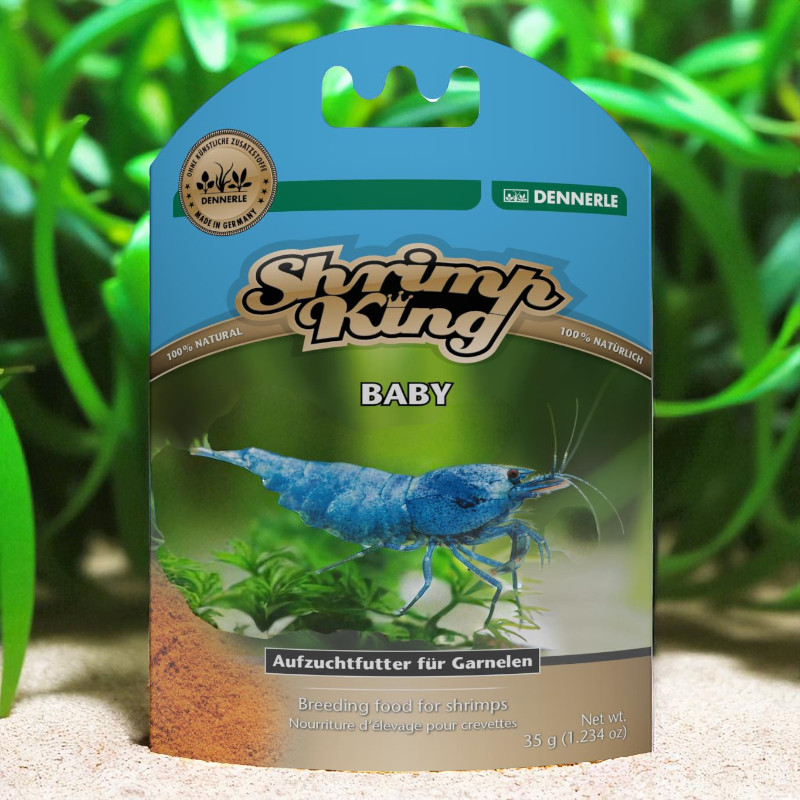
Dennerle Shrimp King Baby - Shrimp food
Premium Shrimp Food - rearing food for shrimps - microgranules for daily feeding
Dennerle Shrimp King Baby is the ideal food for baby shrimps in freshwater aquariums. Specially developed for sensitive and growing shrimps, this high-quality food provides the small aquarium inhabitants with all the nutrients they need to promote healthy development and strong growth.
Product features:
Ideal for baby shrimps: Specially balanced nutrient composition for the first stages of shrimp life.
High-quality ingredients: Contains valuable proteins, vitamins and minerals that support the growth of shrimp.
Gently dried: The food is gently dried to preserve all the natural nutrients.
Natural ingredients: Free from artificial colors and preservatives, ideal for a healthy diet.
Promotes vitality and resistance: The specially balanced recipe makes the shrimps strong and resistant to disease.
Dennerle Shrimp King Baby is suitable for all types of baby shrimps, such as Neocaridina and Caridina. Simply add a small amount of food to the aquarium. As shrimps eat small portions, only give as much food as the animals can eat in a short time to avoid water pollution.
Why should you buy Dennerle Shrimp das King Baby?
High-quality shrimp food: Developed by experts for the specific needs of shrimp.
For healthy breeding: Promotes the growth and reproduction of shrimps in the aquarium.
Trust in Dennerle: As a leading supplier of shrimp care products, Dennerle offers the highest quality for your aquarium inhabitants.
GioiaShrimps Bactoshrimps liquid 100mlGioiaShrimps Bactoshrimps liquid is the ideal solution to sustainably promote the health and well-being of your shrimps in the aquarium. With a specially developed formula, this preparation contains valuable probiotic cultures that support the natural balance in the water and have a positive effect on shrimp growth.
Thanks to its liquid consistency, Bactoshrimps can be dosed easily and precisely, ensuring optimum distribution in the aquarium. Visible improvements in the behavior and vitality of your shrimps can be seen after just a short period of use.
The product is free from harmful additives and has been carefully tailored to the needs of freshwater shrimps. It helps to keep the aquarium water stable, strengthen the animals' immune system and improve the water quality in the long term.
Use Bactoshrimps regularly to ensure the long-term health of your shrimps and create a lively, colorful aquarium. For best results, we recommend using it in combination with a balanced diet and proper aquarium care
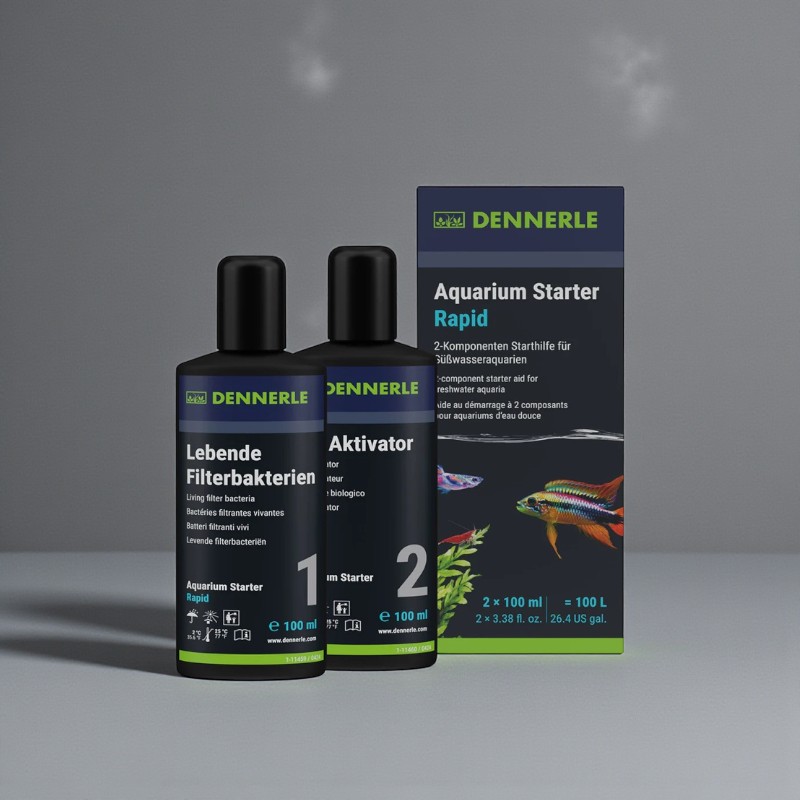
Dennerle Aquarium Starter RapidMixed culture of live cleaning and filter bacteria.Concentrate for rapid, biological activation of filter material and substrate in the aquariumFor a quick and safe aquarium startWith a guaranteed 500 million bacteria per milliliter when filledRemoves toxins (e.g. ammonia, nitrite) quickly and efficientlyFirst fish stocking possible after just 24 hoursMixed culture
from
living
cleaning
and
filter bacteriaDennerle Aquarium Starter Rapid is a highly effective product for the fast, safe start of newly set up aquariums.It consists of two components:1. live filter bacteria - they settle on filter material and gravel and immediately start breaking down pollutants. The bacteria solution is highly concentrated, with a guaranteed 500 million bacteria per milliliter (when bottled).2. bacteria booster nutrient solution - the specially developed "bacteria food" ensures rapid growth and reproduction. Mode of action: Powerful nitrifying bacteria (Nitrosomonas, Nitrobacter) convert dangerous ammonia via nitrite into nitrate and thus detoxify the water Denitrifying bacteria (Paracoccus) convert nitrate into gaseous nitrogen in the anaerobic areas of the aquarium - especially in the substrate and filter - and thus reduce the nitrate content.
At the same time, the filter bacteria break down plant and food residues, fish excrement, organic turbidity, proteins, fats, carbohydrates, organic pollutants and organic sludge.Dosage and application1. filter starter bacteria: Dosage: 100 ml for 50 - 100 L of aquarium water. Add half of the starter bacteria to the filter material and the other half to the aquarium water (25 °C).2. bacteria booster nutrient solution 1st day: 50 ml per 100 L aquarium water (25 ml / 50 L) 2nd - 6th day: 10 ml per 100 L aquarium water (5 ml / 50 L) Do not overdose!
Salvinia auriculataSalvinia Auriculata (Brazilian salvinia) is a floating plant native to South America. It grows moderately quickly so that its population can be controlled. Easy to grow. Absorbs nitrogen to combat algae. Propagates by spreading.Difficulty of cultivation: easy to mediumLight requirement: medium to highCO₂ requirement: lowHeight of the adult plant: 0.5 cmGrowth: moderate to fastTemperature: 22 - 24°CPlacement in the aquarium: SurfaceOrigin: South and Central AmericaCup diameter 6 cmSalvinia Auriculata (Brazilian Salvinia) is a floating ornamental plant. It is native to the calm, still waters of South and Central America. It can be found from Paraguay to Cuba. It owes its popularity above all to its original appearance. Its small oval leaves with a diameter of 10 mm cm are arranged opposite each other on an elongated leaf stalk. These leaves are covered with fine hairs that trap air bubbles, allowing them to float. Depending on the light intensity, they are wavy or flat. Salvinia forms a third type of underwater leaves on which the spores are deposited.Like all floating plants, Salvinia is recommended for shady waters . Its great appetite for nitrogen and phosphorus compounds makes this plant a good ally in the fight against algae.
Salvinia has low light and nutrient requirements. It grows well in both moderate and strong light. As a floating plant, it does not require a substrate but draws all the necessary nutrients directly from the water. During the vegetation period, it reproduces by spreading, whereby the growth rate is moderate. This makes it easy to control its growth and remove excess plants. It grows to a length of 3-6 cm and likes warm, humid air, so it is advisable to use a glass or cover when growing it.It should be placed in such a way that no condensation falls on the plants. It adapts very quickly to the new parameters. However, it should be borne in mind that it will die if there is too little light. It thrives best in soft to medium-hard water at 22-24°C.
The in vitro culture of plants is carried out in tissue culture laboratories. Thanks to the sterile production conditions, the cuttings are free from snails, algae or pathogens.Planting:The plant must be removed from the cup and thoroughly rinsed of the gel under running water. This is best done by placing the plant in a container of lukewarm water. Most of the gel will then fall off by itself. Place the plant on the surface of the water.
Invitro Anubias sp. Pangolino aquarium plantAnubias sp. 'Pangolino' is one of the smallest Anubias species in the world and is an exclusive choice for aquascapers with a love of detail and lovers of rare aquarium plants. The in-vitro cultivated form provides you with a guaranteed snail and pesticide-free plant, perfect for sensitive shrimp tanks and nano aquariums.
With its extremely compact growth and tiny, bright green leaves, Pangolino is ideal for attaching to roots, rocks or as an accent in the foreground. Undemanding and easy to care for - grows even in low light and without the addition of CO₂.
Advantages at a glance:
✅ Extremely small-growing Anubias - ideal for nano-scapes
Cultivated in vitro - sterile & pesticide-free
✅ Shrimp-friendly & robust
✅ No planting necessary - grows on hardscape
✅ Easy to care for & slow-growingProduct details:
Name: Anubias sp. 'Pangolino'
Type: Perennial plant
Position in aquarium: Foreground, on hardscape
Growth height: 1-3 cm
Light requirement: Low to medium
CO₂ supply: Not required
Delivery form: In vitro cup (grown sterile)
Special feature: One of the smallest Anubias species in the worldThe plant must be removed from the cup and thoroughly
rinsed thoroughly from the gel under running water. This is best done
best done by placing the plant in a container with lukewarm water.
lukewarm water. Most of the gel will then fall off by itself. Divide
the contents of the cup into 1-2 cm clumps and place these a short distance apart in the
then place them a short distance apart in the substrate or on the selected
objects.
Anubias Barteri Nana 'Petite'
Anubias Barteri Nana 'Petite' is a very small, uniformly filigree Anubias variety. Selection has resulted in a miniature form that is ideal for nano aquariums.Difficulty of cultivation: easy Light requirement: low CO₂ requirement: low Height of the adult plant: up to 5 cm Growth slow Temperature: 20-30 °C Placement in aquarium: In the foreground Origin: cultivation 6 cm cup diameter Anubias barteri is a succulent green plant of the rhizome family, naturally native to the swamps of Cameroon and Nigeria, growing in fast-flowing waters. It can grow both under and above water. "Petite" is a selected cultivar of Anubias barteri. This species does not occur in nature in such a miniature form. Consistent selection by Singapore botanists has resulted in a delicate, compact version of Anubias barteri for nano-aquariums. The variety is rarely seen in the trade and represents a kind of rarity. The plant has a rhizome that forms roots that strongly entwine the area in which it is planted. It is therefore ideal for planting on roots or rocks, such as volcanic lava.The very decorative, tiny, heart-shaped leaves are stiff and fleshy, shiny on the surface and have a velvety texture on the underside. At the same time, they are very hard and stiff, so herbivorous fish are not interested in them. The height of this miniature plant is less than 5 cm. Therefore, it is well suited for the foreground. However, it can also be used for eye-catching trees in the background. Under good conditions, it can produce a delicate white flower. Anubias Barteri Nana 'Petite' can handle a variety of temperatures. It can thrive in cooler tanks as well as in warm, tropical aquariums with discus fish, for example. It likes water with a pH of 5.5-8.0, up to 15 ° dH. it prefers weak, diffuse lighting, reaching more like 0.3 W/l. In case of prolonged and intense lighting, it may become overgrown with algae. Therefore, it is advisable to plant it in darker or even shaded areas of the tank. The plant does not like neglected aquariums, it prefers water that is changed regularly and does not leave dirt on its leaves. It grows slowly, but forms a very attractive shape, especially when it grows in a group to form a green, decorative clump. It is very comfortable in tanks with low water levels and looks great in nano aquariums. Therefore, it is a popular plant for many aquascapers. With it can create very interesting miniature compositions. It also does well in aquariums with cichlids and other herbivorous fish. It is often used in shrimp tanks and nano aquariums for fighting fish. It does not require special care, it is enough to remove older leaves, which stimulates the rhizome to form offshoots. If you want to get new cuttings, you can divide the rhizome into 2-3 cm long sections from time to time. To attach the Anubias to roots or stones, it is enough to use very thin string, thread or special glue for fixing aquarium plants.
Planting: The plant must be removed from the cup and thoroughly rinsed from the gel under running water. This is best done by placing the plant in a container of lukewarm water. Most of the gel will then fall off by itself.
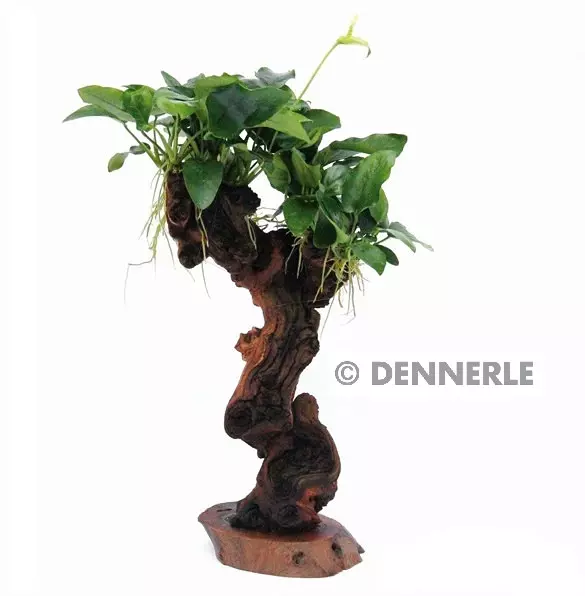
Mbuna - Mopani root with stand and Anubias nana
max. growth height
5-10cm
Country of origin
West Africa
Suitability
community aquarium, perch aquarium
Type
perching plant
family
Araceae
genus
Anubias
Propagation
Division of the rhizome
Growth rate
slow
pH
5-9
Water hardness
very soft to very hard
Notes
Anubias barteri var. nana 'Bonsai' - Smallest dwarf spear leafDennerle A21.3
max. growth height
- 5 cm
Country of origin
Cultivated form
Suitability
Aquascaping, perch aquarium, community aquarium, NanoCube
Type
Epiphytic plant
Family
Araceae
Genus
Anubias
Propagation
Lateral shoots on the rhizome
Growth rate
slow
pH
5 - 9
Water hardness
0 - 30 °dh
Notes
Tie onto a stone or a root.
It really couldn't get any smaller! It is probably the smallest Anubias in the world and a real enrichment for any underwater landscape. In cultivation and care it is just as robust as the parent form, but needs a little more light to form beautiful, compact cushions. The dwarf form can already be used in a 10 L Nano Cube. The plants look very natural when tied onto delicate roots. The red bogwood is best suited for this. But the Bonsai Anubias also cuts a fine figure on decorative stones.
Anubias barteri nana
Dwarf spear leaf, multi-stemmed - XXL - Mother plant
Dennerle A21
max. growth height
5 - 10 cm
Country of origin
West Africa
Suitability
Aquascaping, perch aquarium, community aquarium, NanoCubes
Type
Perennial plant
family
Araceae
Genus
Anubias
Propagation
Division of the rhizome
Growth rate
slow
pH
5 - 9
Water hardness
0 - 30 °dh
Hints
Tie to a stone or root. Easy to care for and undemanding.
The dwarf spear leaf, as it is known by its German trade name, is one of the most popular aquarium plants of all. It is an excellent foreground plant that requires very little care. When planting, attention must be paid to the rhizome. This thickened shoot must not be covered with substrate. The small Anubias grows best when tied up on stones and roots (see Mbuna trees on page 78). The dwarf spear leaves are very often used for cichlids from Lake Malawi and Lake Tanganyika. Here they look particularly decorative between the stone structures.
Anubias nana on stone (dwarf spear leaf on lava stone)
The dwarf spear leaf is one of the most popular aquarium plants. This is an excellent foreground plant with very low requirements. The rhizome, a thickened shoot, must not be covered with substrate. It is best to tie the Anubias barteri nana to a stone or root. This is the best way for the plant to grow. It is not only suitable for community aquaria or nano cubes, but is also ideal for cichlids from Lake Malawi or Lake Tanganyika. The small Anubias barteri nana look beautiful and very decorative between these stone structures.
max. growth height
5-10 cm / foreground
Country of origin
West Africa
Suitability
Community aquarium, NanoCube and cichlid aquarium (cichlids)
Type
Epiphyte
Family
Araceae
Genus
Anubias
Propagation
Division of the rhizome
Growth rate
slowly
pH
5-9
Water hardness
very soft to very hard
Notes
Tie onto a stone or root
Anubias barteri (broad-leaved spear leaf)
max. growth height
- 40 cm
Country of origin
West Africa
Suitability
Perch aquarium, community aquarium
Type
Perennial plant
family
Araceae
Genus
Anubias
Propagation
Division of the rhizome
Growth rate
slow
pH
5 - 9
Water hardness
0 - 30 °dh
Notes
Tie onto a stone or root.
Anubias species are very slow-growing marsh plants for shady areas. They cannot tolerate too much light in the long term. Anubias barteri is a very variable species with different, more or less large leaves. With its dark green, somewhat firm leaves, it is often used for cichlid aquariums. In the wild, Anubias species grow in shady to semi-shady areas of fast-flowing water, partly in the splash zone of stones and roots as well as semi-submerged.
Anubias barteri on root with suction cup - aquarium plant
max. growth height
- cm
Country of origin
Suitability
Community aquarium
Type
family
Genus
Propagation
Growth rate
pH
-
Water hardness
- °dh
Notes
Microsorium pteropus (on root with suction cup)
max. growth height
up to 40cm
Country of origin
Southeast Asia
Suitability
Community aquariumPerch aquarium
Type
Perennial plant
Family
Scrophulariaceae
Genus
Microsorium
Propagation
Daughter plants from leaves and roots
Growth rate
slowly
pH
5-8
Water hardness
very soft to hard
Notes
Anubias barteri nana - Dwarf spear leaf, multi-stemmed
Dennerle A21
max. growth height
5 - 10 cm
Country of origin
West Africa
Suitability
Aquascaping, perch aquarium, community aquarium, NanoCube
Type
Perennial plant
family
Araceae
Genus
Anubias
Propagation
Division of the rhizome
Growth rate
slow
pH
5 - 9
Water hardness
0 - 30 °dh
Notes
Tie onto a stone or root.
The dwarf spear leaf, as it is known commercially, is one of the most popular aquarium plants of all. It is an excellent foreground plant that requires very little care. When planting, attention must be paid to the rhizome. This thickened shoot must not be covered with substrate. The small Anubias grows best when tied up on stones and roots (see Mbuna trees on page 78). The dwarf spear leaves are very often used for cichlids from Lake Malawi and Lake Tanganyika. Here they look particularly decorative between the stone structures.
Anubias nana on root with sucker – aquarium plant from West Africa
max. growth height
5-10cm
Country of origin
West Africa
Suitability
community aquarium, perch aquarium
Type
Perennial plant
Family
Araceae
Genus
Anubias
Propagation
Division of the rhizome
Growth rate
slowly
pH
5-9
Water hardness
very soft to very hard
Notes
Anubias nana on root (dwarf spear leaf on root)
The dwarf spear leaf is one of the most popular aquarium plants. This is an excellent foreground plant with very low requirements. The rhizome, a thickened shoot, must not be covered with substrate. It is best to tie the Anubias barteri nana to a stone or a root. This is the best way for the plant to grow. It is not only suitable for community aquaria or nano cubes, but is also ideal for cichlids from Lake Malawi or Lake Tanganyika. The small Anubias barteri nana look beautiful and very decorative between these stone structures.
max. growth height
5-10 cm
Country of origin
West Africa
Suitability
Community aquarium, NanoCube and cichlid aquarium (cichlids)
Type
Epiphyte
Family
Araceae
Genus
Anubias
Propagation
Division of the rhizome
Growth rate
slow
pH
5-9
Water hardness
very soft to very hard
Notes
Tie onto a stone or a root.
CHF 28.90
❅
❆
❅
❆
❅
❆
❅
❆
❅
❆
❅
❆
This website uses cookies to ensure the best experience possible. More information...