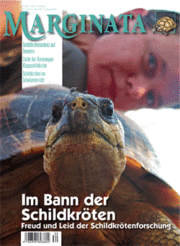
Marginata No. 34 - Hinge-back Tortoises, the turtles with the crease in the tank

Article no: marginata34

CHF 16.50

Stock: 0

Ready for dispatch in 1-3 days, delivery time 14 working days

Delivery between Tuesday, 14 July and Wednesday, 15 July
Zahlungsarten
Product information "Marginata No. 34 - Hinge-back Tortoises, the turtles with the crease in the tank "


Im Biotop der Großkopf-Schienenschildkröte?
Zucht von Kinosternon baurii
Haltung und Zucht von Astrochelys radiata Teil 6

Inhalt:

Editorial
Magazin
Termine

FOTOSTORY
Die Gattung Kinixys. Schildkröten mit „Knick“ im Panzer
Hans-Dieter Philippen

NACHZUCHT
Gemischte Erfahrungen bei Haltung und Nachzucht der Madagassischen oder Dormergues Glattrand Gelenkschildkröte
Viktor Mislin & Hans-Dieter Philippen

NACHZUCHT
Haltung und Nachzucht der Stutz-Gelenkschildkröte (Kinixys homeana) bis zur F2-Generation
John Zoran

PORTRÄT
Weissingers Breitrandschildkröte, Testudo marginata weissingeri
Hans-Dieter Philippen

HALTUNG UND NACHZUCHT
Haltung und Nachzucht der Madagassischen Strahlenschildkröte. Teil 6
Michael Wirth & Peter Fritz

REPTORTAGE
Im Biotop der Großkopf-Schienenschildkröte (Peltocephalus dumerilianus)
Mario Herz

ZUCHT
Haltung, Pflege und Nachzucht der Dreistreifen-Klappschildkröte, Kinosternon baurii
Nicolas Pellegrin

Buchtipp
Kleinanzeigen
Abo & Service
Regionalführer



Composition
Feeding recommendation
Technical details
Size information

0 of 0 reviews

Give us a rating!

Share your experience with the product with other customers.


Suggested products

Handbook of food plants for tortoises and other reptiles
Handbook of forage plants 2nd revised editionMarion Minch is not only a successful breeder of diverse tortoises for many years, but also an excellent connoisseur of native wild herbs. She founded and runs samenkiste.de, which is well known to many tortoise keepers and nature lovers. Her name is inextricably linked with reptile care and species-appropriate nutrition for tortoises. Her handbook of food plants summarises the most important native food plants for herbivorous and omnivorous reptiles. She not only considers tortoises, but also iguanas, spiny-tailed dragons and even chameleons. From the basics of plant biology to native wild herbs to suitable food plants for hardy tropical reptile species, this comprehensive work provides the basis for species-appropriate keeping. In the expanded and supplemented 2nd edition, the plant section is divided according to flower colour. This makes it even easier to identify wild herbs. The work has also been supplemented with a wealth of additional information and many pictures.

CHF 46.50

Geckos
Geckos in the terrarium by Astrid FalkThe book offers a comprehensive introduction to geckos and their species-appropriate keeping in terrariums. It explains what you need to think about before buying a gecko and what preparations should be made. The book describes in detail how the terrarium is technically equipped and set up. The care of the animals, their special features and behaviour, their diet, reproduction and rearing of young animals are described, as well as diseases and husbandry problems with tried and tested suggestions for prevention and treatment. Individual gecko species that are particularly suitable for keeping and breeding in terrariums are portrayed in detail in the second part of the book.

CHF 28.50

Jumping spiders Phidippus, Hyllus, Plexippus
Book Jumping Spiders - Phidippus, Hyllus & Plexippus A guide to keeping jumping spiders of the genera Phidippus, Hyllus & Plexippus. Who can resist the charm of jumping spiders? The childlike appearance of their expressive face simply leaves no one cold! In addition, their behavior is extremely exciting to observe, their colors are bright and their requirements for species-appropriate keeping are very easy to meet. No wonder these likeable jumpers are all the rage! This volume in the "Species by Species" series describes in detail what to look out for when buying and keeping them, introduces the most commonly kept species and color forms and provides plenty of tips on how to keep them successfully - so you can be sure they will breed well! Species by Species introduces you to the books in this series, which present the most popular terrarium animals. Each volume offers you detailed, practical care instructions and all the information you need to successfully breed your animals. All important questions from the required tank size to terrarium set-up, technical equipment, species-appropriate nutrition and disease prevention are answered with numerous tricks and tips. Experienced, long-standing breeders reveal how you can encourage the animals to reproduce and raise healthy young. All this in full color, generously illustrated and attractively designed - just about your terrarium animal - species by species

CHF 23.90

Book Breeding live food yourself
Book "Grow your own live food" - The perfect guide for pet owners Discover practical and detailed instructions on how you can easily breed food for your reptiles, birds, fish or other animals yourself in the book "Breeding live food yourself". With valuable tips on various food insects, their care and breeding, you can save money and ensure a species-appropriate diet for your pets. Contents of the book: Step-by-step instructions for breeding feeder insects Information on the best types of food for reptiles, birds and fish Care instructions and breeding conditions for various live food species Tips for sustainable and cost-effective food production Why breed your own live food? Get healthy, fresh food for your animals Save money and reduce dependence on pet shops Promote the health and well-being of your animals with species-appropriate food Whether you are a beginner or an experienced pet owner, this book provides you with everything you need to successfully breed live food yourself.

CHF 46.50

Marginata 69 - New Guinea tortoises
Marginata 69 - New Guinea tortoises – the genus ElseyaCover storyThe unrecognised beauties: New Guinea tortoises (Andreas S. Hennig)My experiences with Branderhorst's New Guinea tortoise, Elseya (Elseya) branderhorsti (Ouwens, 1914) (Andreas S. Hennig)Keeping and breeding of Rhodin's New Guinea tortoise, Elseya (Hanwarachelys) rhodini Thomson, Amepou, Anamiato & Georges, 2015 (Andreas S. Hennig)PortraitGeoemyda spengleri, Chinese serrated tortoise (Andreas S. Hennig)ReportageMacrochelys temminckii – Experiences and impressions with vulture tortoises part 2 (Reiner Praschag)KeepingAn alternative to year-round keeping of the Egyptian tortoise in the terrarium – my experiences with seasonal outdoor keeping of Testudo kleinmanni (Ricarda Schramm)EtymologySawbacks and living maps part 4: Graptemys gibbonsi, Pascagoula humpback tortoise (Holger Vetter)Classifieds & animal placement

CHF 16.50

Marginata 9 - Ornate tortoises
Marginata 9 - Ornate tortoises Food plants 4Breeding of spider tortoisesFlorida gopher tortoise Contents: 2 EDITORIAL3 MAGAZINE7 READERS' LETTERS8 DATES10 PHOTO REPORTAGE Lettered ornate tortoises, Trachemys scripta (Schoepff, 1792) Hans - Dieter Philippen16 BREEDING IN HUMAN CARE Keeping and breeding of the red-cheeked tortoise, Trachemys srcipta elegans (Wied, 1839) Hubert Felsner22 BREEDING IN HUMAN CARE The yellow-cheeked tortoise, Trachemys scripta scripta (Schoepff, 1792) – a fascinating keeper Iris Mörs31 PORTRAIT Siebenrock's snake-necked tortoise, Macrochelodina siebenrocki (Werner, 1902) Hans - Dieter Philippen35 REPORTAGE Food plants for tortoises part 4 Susanne Vogel42 BREEDING IN HUMAN CARE Keeping and successful reproduction of the Madagascan spider tortoise (Pyxis arachnoides arachnoides) Part 1 Peggy Ahr51 REPORTAGE In search of Florida gopher tortoises, Gopherus polyphemus (Daudin, 1802) Hans - Dieter Philippen58 SHORT REPORTAGE The ingestion of an unusually large "stomach stone" by a female of the broad-margined tortoise (Testudo marginata) Heinz Frühauf60 BOOK TIP61 CLASSIFIEDS62 REGIONAL GUIDE64 AGATHA MARGINATA

CHF 14.70

Bearded dragons
GU Bearded Dragon Book The expert beginner's guide to the "mini dragons" from Australia. 64 pages coloured photos Paperback Author Manfred Au Published by Gräfer & Unzer Like creatures from another planet! Bearded dragons are right at the top of the popularity scale for terrarium animals. They fascinate with their bizarre appearance and inquisitive nature. The mini dragons from Australia are also easy to care for and quickly become trusting. In GU Tierratgeber Bartagamen, bearded dragon expert Manfred Au explains everything you need to know about keeping these diurnal lizards: what to look out for when choosing them - detailed portraits of bearded dragons help with this -, how to acclimatise and care for them properly, what tastes good and keeps them fit. There are also tried and tested tips on health care, hibernation and care in the event of illness. In addition, there are many ideas and suggestions for species-appropriate and varied design of the terrarium, so that the animals are completely comfortable. The behaviour interpreter also explains typical bearded dragon behaviour. And with SOS - what to do? help is guaranteed in an emergency.

CHF 12.90

The magnificent tortoise of splendor
The magnificent tortoise impresses with its behaviour and body shape 64 pages Format: 14.8 x 21 cm numerous colour photos Author Maik Schilde Contents: There are species of tortoises that impress not only with their behaviour and body shape, but especially with their splendid colouring.These striking colours, combined with a size that is comfortable for keeping, make the magnificent tortoise an attractive purchase.However, this species of tortoise is very demanding when it comes to terrarium conditions – and yet it is a very pleasant pet, the keeping of which is great fun and enables a meaningful engagement with nature.Tortoise expert Maik Schilde provides the reader in this volume with all the important fundamentals for the successful keeping and, if required, breeding of this fascinating species of tortoise. Systematics and body structure The fascinating biology: From the life of the magnificent tortoise All information on species-appropriate keeping: From suitable terrarium, equipment and technology to feeding Successful breeding: Mating stimulation, incubation of the eggs and rearing of the young Problem solving: How to avoid the most common mistakes in care and how to help sick animals Brilliant photos

CHF 19.90

Draco 57 - Snakes: Colour and drawing breeding
Draco 57 - Snakes: Colour and markings breedingsContents:Editorial Variety is the trump cardHans - Dieter Philippen Colour forms in garter snakes. A look into the past, the present and the trends of tomorrowDaniel GrübnerHurricane Season Hans-Jörg WinnerSturdy beauties. Colour and pattern variations in PituophisBernd SkubowiusThe latest trends in breeding the green tree python Marcel HoffmannChoose the diamond! Colour and pattern types of diamond pythonsMarc Mense A look at colour breeding in Pantherophis guttatusStephan Drees Colour and pattern forms in the western hook-nosed snakeFilip LonghitanoReal rarities: Colour varieties of the grey-banded king snake Malte Hornig

CHF 32.00

Reptilia 61 - The snakes of Costa Rica
Reptilia 61 - The snakes of Costa Rica Philippine Geckos Chaco Whistling Frog Oklahoma Contents: 2 EDITORIAL 3 MAGAZINE 15 DATES 18 WESTERN HERP PERSPECTIVESAlligator snapperFrom B. Love 20 PHOTO REPORTAGEThe snakes of Costa Rica By L. W. Porras & A. Solórzano 28 HERPETOFAUNAThe snakes of the Osa PeninsulaFrom A. Solórzano 32 HERPETOFAUNAThe snakes of the Costa RicanDry forestsBy L. W. Porras 38 KEEPING AND REPRODUCTIONA diamond in the rough: the hissing snake(Pseustes poecilonotus)By L. W. Porras & A. Solórzano 43 TRAVELHerpetological observations in the US state of OklahomaBy M. Barts 51 PORTRAIT AND POSTERHomopus signatus signatusBy M. Dobiey 56 KEEPING AND REPRODUCTIONKeeping and breeding of the South AmericanChaco Whistling Frog, Lepidobatrachus laevis Budgett, 1899By E. Hirtenlehner, J. Hirtenlehner and J. Hirtenlehner 64 REPORTAGEForest geckos in the house - to the gecko fauna of PanayBy M. Gaulke & A. V. Allenbach 72 PRACTICE North American water turtles in the Outdoor terrarium Part 2: Suitable speciesBy A. S. Hennig 78 KEEPING AND REPRODUCTIONFor keeping and breeding the AustralianSpiny-tailed skinks Egernia stokesii stokesii (Gray, 1845), with notes on feeding-management. Part 2From S. Knauf 88 FAQ - FREQUENTLY ASKED QUESTIONSHibernation of Mediterranean tortoisesBy T. Wilms & B. Löhr 91 LIBRARY 104 BRUTKASTENHonour to whom honour is dueFrom H. Werning

CHF 11.20

Reptilia 77 - Moss frogs - the genus Theloderma
Reptilia 77 - Moss frogs - the genus Theloderma Travelling antsStar tortoiseAnolis roquet summus Contents: The fantastic masters of camouflage of the Asian frog genus Theloderma (moss or lichen frogs) are highly sought-after, extremely attractive terrarium inhabitants. Several species are endangered and urgently require conservation breeding projects – another reason to strive for their propagation. And the fact that their representatives also display many interesting behaviours, such as waving with the hind legs or “toe-twitching” in the context of catching prey, makes working with them even more exciting.REPTILIA editor Kriton KUNZ, who maintains one of the world’s most species-rich Theloderma collections, along with the Russian Theloderma experts Sergei RYABOV and Ivan ARININ, present these remarkable frogs in detail in the feature topic of this REPTILIA. Table of contents: EDITORIAL MAGAZINEBreakthrough in REPTILIA’s nose frog project: opening of a research and breeding station in Conceptión/Chile in collaboration with Leipzig Zoovby H. Werning DATES WESTERN HERP PERSPECTIVESThe hidden value of reptile excursions vby B. Love PHOTOSTORYMarvellous masters of camouflage. The moss frogs of the genus Thelodermaby K. Kunz KEEPING AND BREEDINGKeeping and breeding of Theloderma gordoni in the terrarium vby I. Arinin KEEPING AND BREEDING Experience with the first breeding of paddle frogs of the species Theloderma horridum in the Exotic Terrarium of the City of Tula vby A. A. Evsyunin TRAVEL EPiece of paradise. The Pouso Alegre in the Brazilian Pantanal from the perspective of a reptile friend. Part 2by M. Hallmen PORTRAIT and posterKinabalu bamboo viper. Parias malcolmiby J. M. Dehling KEEPING AND BREEDING The banded hook-nosed snake of the genus Lystrophis. Keeping and breeding a little beauty by A. Hutwalker REPORT First confiscated, then bred: Star tortoises (Geochelone elegans) at Allwetterzoo Münster vby J. Scholdei REPORTTravelling ants. Predatory nomads of the tropics vby D. J. C. Kronauer KEEPING AND BREEDINGBeauty has a name: Anolis roquet summus (Lazell, 1972) vby H. Herfurth LIBRARY ALSO IN YOUR AREA SUBSCRIPTION & SERVICE PREVIEW INCUBATOR In wild Wedding. An Eastern in two parts for three young men of “southern appearance”, a reptile researcher and a cockroach – Part 2 vby H. Werning

CHF 12.00

NTV, Discover the amphibians
NTV, Discover the amphibians and learn all about these animals. 56 pages colour photos throughout Large format: 20.7 x 28 cm Hardcover Author Kriton Kunz Contents: Every child knows a frog that swims around in its pond and croaks cheerfully, or the black and yellow fire salamander. But how do these friendly animals live? What do they eat, how do they survive the winter? How does a tadpole become a small frog? And what other amazing amphibians are there? "Entdecke die Amphibien" explains what amphibians are, their special features and their incredible abilities in an entertaining and child-friendly way. Fantastic records from the world of frogs, salamanders and the like are included, as well as an exciting quiz about these colourful survival artists. Including 20 great stickers 

CHF 17.90