Draco 55 - How to winter terrarium animals

Article no: draco55

CHF 32.00

Stock: 0

Ready for dispatch in 1-3 days, delivery time 7 working days

Delivery between Monday, 17 August and Tuesday, 18 August
Zahlungsarten
Product information "Draco 55 - How to winter terrarium animals"

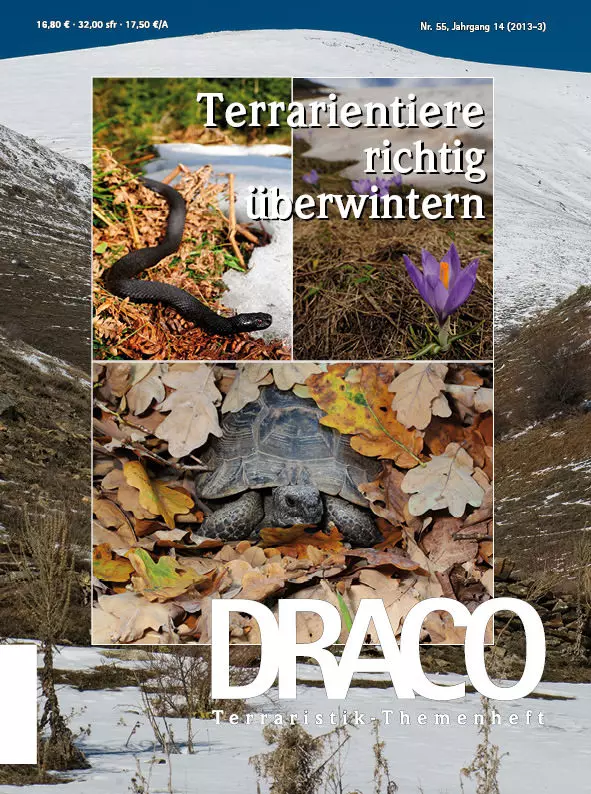
Draco 55 - Correct wintering of terrarium animals

Contents:

Editorial  

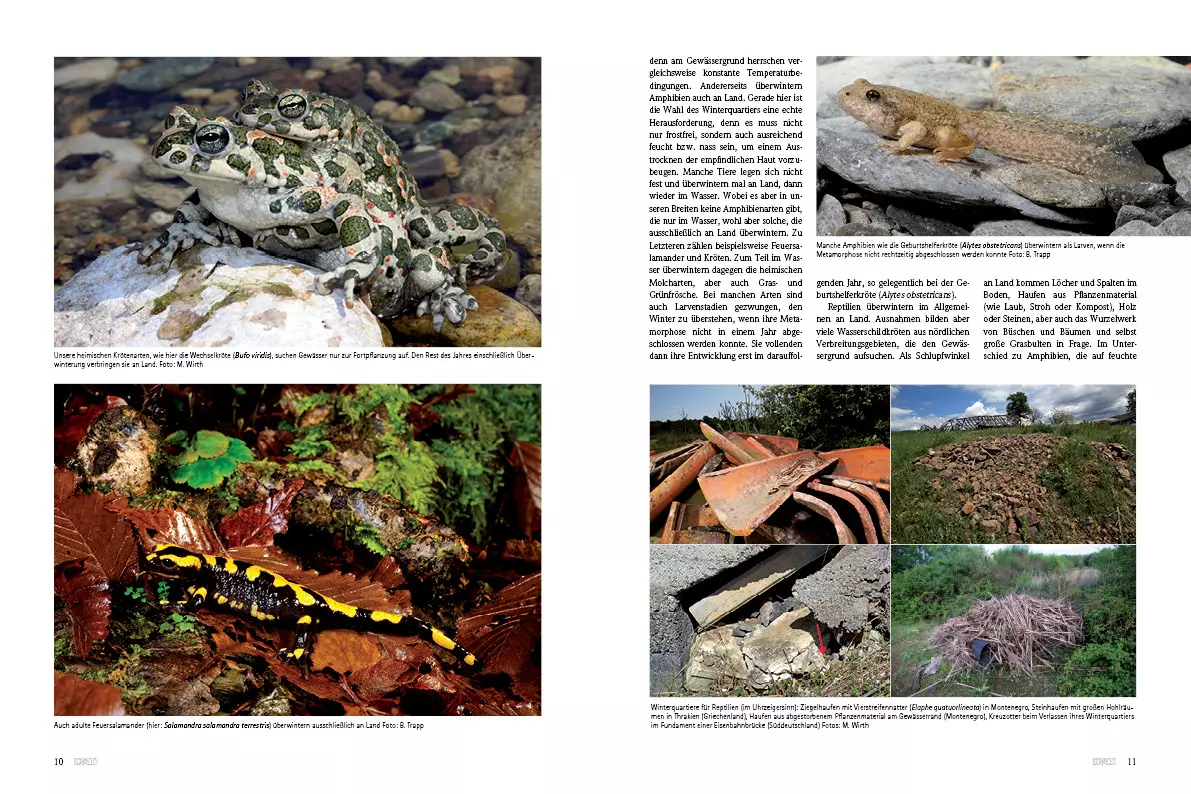
Every year again – Ecology of hibernation of amphibians and reptiles
Michael Wirth   

Hibernation of reptiles – what are the most suitable media for the resting period?
Hans - Dieter Philippen   

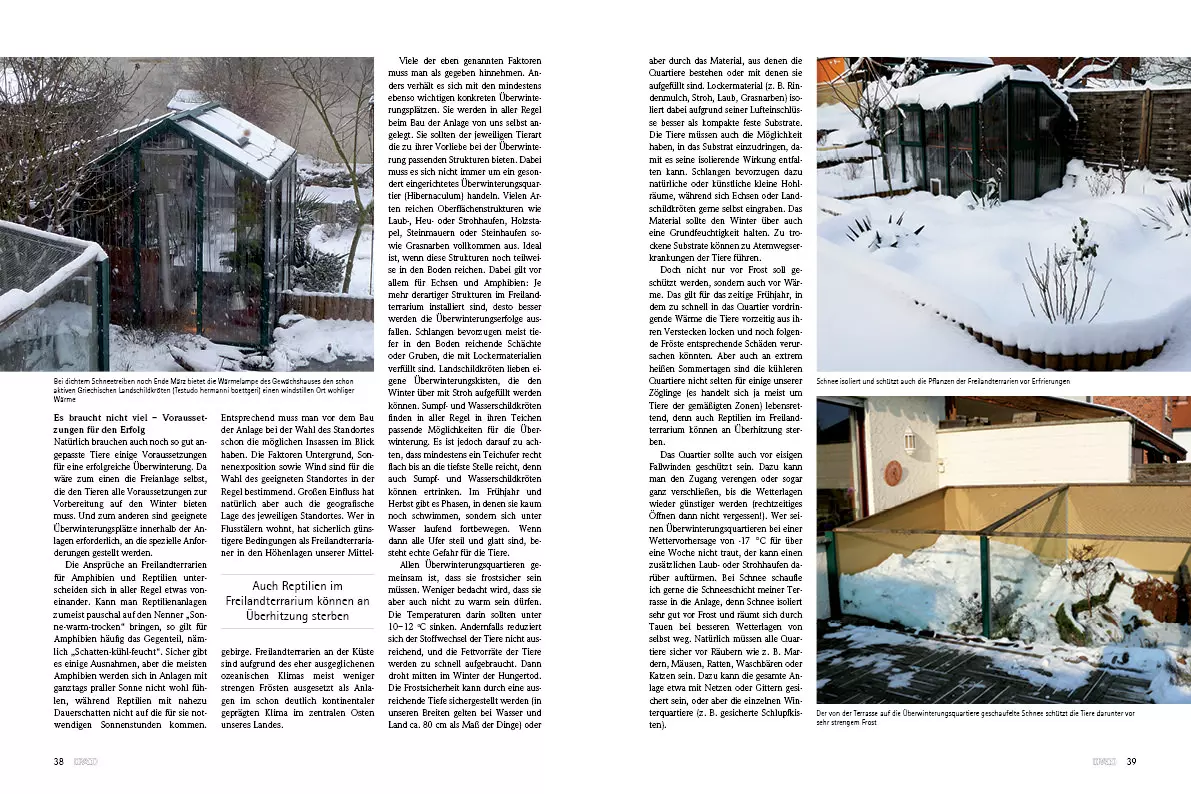
Minus fifteen degrees, so what? Successful hibernation of amphibians and reptiles in outdoor terrariums
Martin Hallmen   

The hibernation of lizards
Mike Zawadzki   

When the cold comes – the hibernation of snakes
Thomas Klesius   

Hibernation of aquatic turtles
Andreas S. Hennig   

Hibernation of European tortoises - natural or controlled?
Michael Wirth   

The hibernation of amphibians at Riga Zoo
Ilze Dunce, Ginta Jansone & Elvira Hrscenovica  

Book box   
In your neighbourhood    
Services

Composition
Feeding recommendation
Technical details
Size information

0 of 0 reviews

Give us a rating!

Share your experience with the product with other customers.


Suggested products

Handbook of food plants for tortoises and other reptiles
Handbook of forage plants 2nd revised editionMarion Minch is not only a successful breeder of diverse tortoises for many years, but also an excellent connoisseur of native wild herbs. She founded and runs samenkiste.de, which is well known to many tortoise keepers and nature lovers. Her name is inextricably linked with reptile care and species-appropriate nutrition for tortoises. Her handbook of food plants summarises the most important native food plants for herbivorous and omnivorous reptiles. She not only considers tortoises, but also iguanas, spiny-tailed dragons and even chameleons. From the basics of plant biology to native wild herbs to suitable food plants for hardy tropical reptile species, this comprehensive work provides the basis for species-appropriate keeping. In the expanded and supplemented 2nd edition, the plant section is divided according to flower colour. This makes it even easier to identify wild herbs. The work has also been supplemented with a wealth of additional information and many pictures.

CHF 46.50

Geckos
Geckos in the terrarium by Astrid FalkThe book offers a comprehensive introduction to geckos and their species-appropriate keeping in terrariums. It explains what you need to think about before buying a gecko and what preparations should be made. The book describes in detail how the terrarium is technically equipped and set up. The care of the animals, their special features and behaviour, their diet, reproduction and rearing of young animals are described, as well as diseases and husbandry problems with tried and tested suggestions for prevention and treatment. Individual gecko species that are particularly suitable for keeping and breeding in terrariums are portrayed in detail in the second part of the book.

CHF 28.50

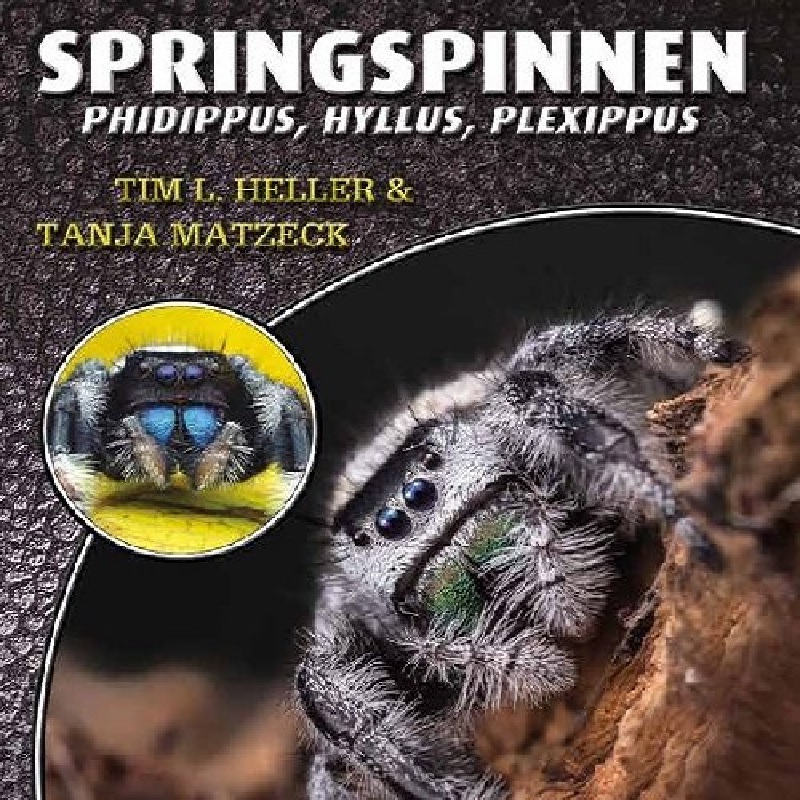
Jumping spiders Phidippus, Hyllus, Plexippus
Book Jumping Spiders - Phidippus, Hyllus & Plexippus A guide to keeping jumping spiders of the genera Phidippus, Hyllus & Plexippus. Who can resist the charm of jumping spiders? The childlike appearance of their expressive face simply leaves no one cold! In addition, their behavior is extremely exciting to observe, their colors are bright and their requirements for species-appropriate keeping are very easy to meet. No wonder these likeable jumpers are all the rage! This volume in the "Species by Species" series describes in detail what to look out for when buying and keeping them, introduces the most commonly kept species and color forms and provides plenty of tips on how to keep them successfully - so you can be sure they will breed well! Species by Species introduces you to the books in this series, which present the most popular terrarium animals. Each volume offers you detailed, practical care instructions and all the information you need to successfully breed your animals. All important questions from the required tank size to terrarium set-up, technical equipment, species-appropriate nutrition and disease prevention are answered with numerous tricks and tips. Experienced, long-standing breeders reveal how you can encourage the animals to reproduce and raise healthy young. All this in full color, generously illustrated and attractively designed - just about your terrarium animal - species by species

CHF 23.90

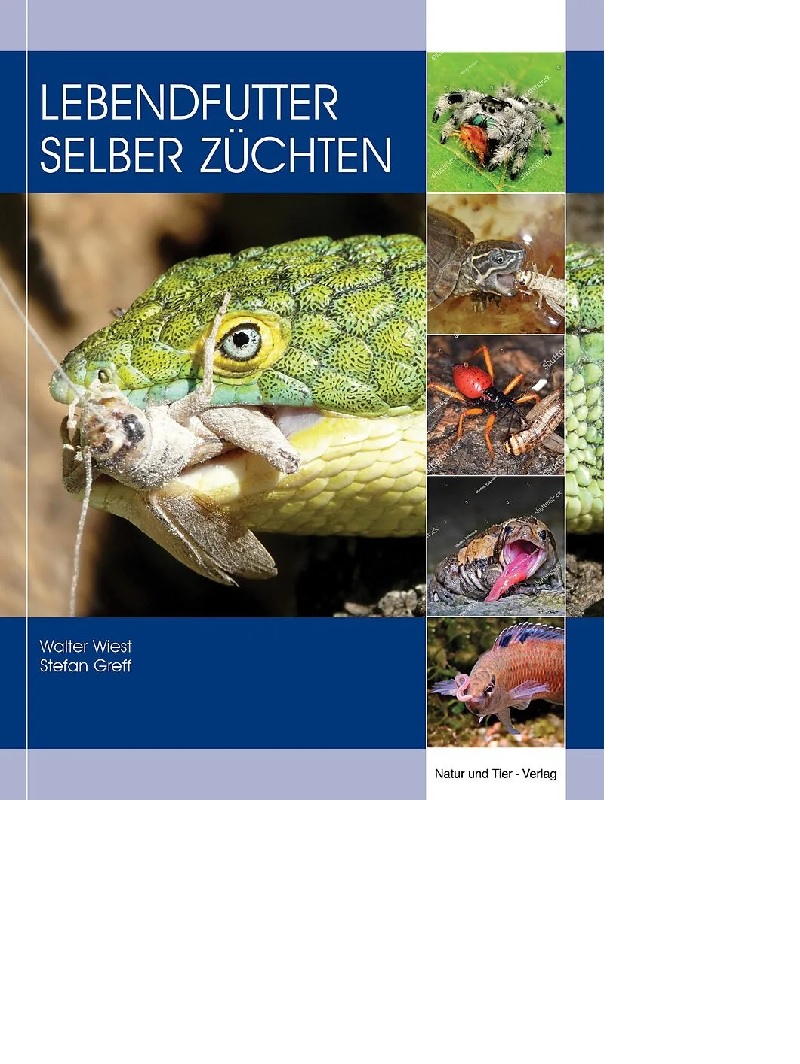
Book Breeding live food yourself
Book "Grow your own live food" - The perfect guide for pet owners Discover practical and detailed instructions on how you can easily breed food for your reptiles, birds, fish or other animals yourself in the book "Breeding live food yourself". With valuable tips on various food insects, their care and breeding, you can save money and ensure a species-appropriate diet for your pets. Contents of the book: Step-by-step instructions for breeding feeder insects Information on the best types of food for reptiles, birds and fish Care instructions and breeding conditions for various live food species Tips for sustainable and cost-effective food production Why breed your own live food? Get healthy, fresh food for your animals Save money and reduce dependence on pet shops Promote the health and well-being of your animals with species-appropriate food Whether you are a beginner or an experienced pet owner, this book provides you with everything you need to successfully breed live food yourself.

CHF 46.50

Marginata 69 - New Guinea tortoises
Marginata 69 - New Guinea tortoises – the genus ElseyaCover storyThe unrecognised beauties: New Guinea tortoises (Andreas S. Hennig)My experiences with Branderhorst's New Guinea tortoise, Elseya (Elseya) branderhorsti (Ouwens, 1914) (Andreas S. Hennig)Keeping and breeding of Rhodin's New Guinea tortoise, Elseya (Hanwarachelys) rhodini Thomson, Amepou, Anamiato & Georges, 2015 (Andreas S. Hennig)PortraitGeoemyda spengleri, Chinese serrated tortoise (Andreas S. Hennig)ReportageMacrochelys temminckii – Experiences and impressions with vulture tortoises part 2 (Reiner Praschag)KeepingAn alternative to year-round keeping of the Egyptian tortoise in the terrarium – my experiences with seasonal outdoor keeping of Testudo kleinmanni (Ricarda Schramm)EtymologySawbacks and living maps part 4: Graptemys gibbonsi, Pascagoula humpback tortoise (Holger Vetter)Classifieds & animal placement

CHF 16.50

Hard armour - soft heart
The turtle expert Thorsten Geier would like to inspire you as a turtle enthusiast to keep these special animals as close to nature as possible. Based on his almost 20 years of in-depth experience with European tortoises, he provides a wealth of practical advice and tips for practical use: using nature as a model, he explains that the animals should be spared a life in a terrarium. His guide contains over 180 pages of detailed suggestions for keeping animals close to nature. Thorsten Geier explains the design of outdoor enclosures and presents suitable and less suitable food plants. Other topics include: optimal nutrition, caring for hatchlings and young animals, winter torpor, animal health, successful reproduction, species protection, but also mistakes in keeping tortoises and much more. Over 200 photos of the animals' habitat, enclosure photos, plant pictures etc. make this book a particularly valuable read. In a separate chapter, the author addresses our youngest turtle friends. Thorsten Geier would like to encourage them (and their parents) in particular to treat turtles in a species-appropriate manner.

CHF 21.90

Draco 34 - The global amphibian crisis
Draco 34 - The global amphibian crisis Contents: 2 Editorial4 The global amphibian crisis by Axel Kwet & Stefan Lötters 18 Of zoos and frogs by Peter Dollinger 22 Batrachochytrium dendrobatidis – a small fungus causes big problems by Dr med vet Frank Mutschmann 28 The case of Atelopus – extinction at a high level by Stefan Lötters 31 The threat status of anurans in Peru by Edgar Lehr & Andreas Schlüter 37 Dangerous guests – The role of invasive species in global amphibian decline by Ivan Arinin 46 Climate change as a catalyst for the amphibian decline by Dennis Rödder & Wolfgang Böhme 52 Afrotropical amphibians: far from conservation breeding by Stefan Lötters 55 African anurans: unexplored and highly endangered? by Mark-Oliver Rödel 62 Amphibian decline in Canada and the USA by Andreas Nöllert 70 Project “Mountain Chicken” – the Antillean bullfrog (Leptodactylus fallax) by Gerardo Garcia 80 Chytrid in snouted frogs – news from the REPTILIA project by Mirco Solé, Johara Bourke & Heiko Werning 87 The contribution of Cologne Zoo to the Amphibian Ark: breeding projects, research and educational work for the conservation of amphibians by Thomas Ziegler & Theo Pagel

CHF 18.40

Reptilia 54 - Terrarium construction
Reptilia 54 - Terrarium construction PrachtskinkAtelopus zetekiRainbow boas Contents: 2 EDITORIAL 6 MAGAZINE 14 DATES 18 PHOTO REPORTAGE Terrarium constructionby H. Werning 26 REPORTAGEBiotopArt - the terrariums of the Dresden artist Andreas Deißig by J. Jungnickel & U. Prokoph 28 REPORTAGEDetermining the weight of terrariums by P.M. Müller 34 REPORTAGEThe rock wall in the living room on I. Kober 39 REPORTAGEA conservatory for iguanas by S. Winkle 44 TRAVELHerpetological observations in the Dalyan delta by U. Thieme 51 PORTRAIT AND POSTERQuedenfeldtia trachyblepharusby U. Schlüter 56 KEEPING AND BREEDINGKeeping and breeding the Red Rainbow Boa (Epicrates cenchria cenchria) by H. Bellosa 62 KEEPING AND BREEDINGArgentine rainbow boa (Epicrates cenchria alvarezi) by V. Knietsch 66 KEEPING AND BREEDINGOn keeping and breeding the Prachtskink(Mochlus fernandi)by I. Veltum El Copé - In the forest of the Atelopus zetekiby P. Janzen 76 KEEPING AND BREEDINGA pirate's lifeKeeping and breeding Ancylometes fishing spiders - Part 2by K. Kunz 85 LIBRARY 89 CLASSIFIED ADS 94 RAT & TAT 96 WESTERN HERP PERSPECTIVESMorphsby B. Love 104 INCUBATORBegging flight periodBy H. Werning

CHF 11.20

Bede by Ulmer, Scorpions Your hobby
Scorpions: Your Hobby – Everything you need to know about keeping scorpions in your own home. 96 pages 79 colour photos Hardcover 2nd edition Authors Ann Webb and Herbert Schiejok Ulmer The book describes everything important for keeping scorpions. It describes the origins, natural habitats and lifestyles of the animals and how to care for them at home. Descriptions of scorpions and keeping instructions in detail.

CHF 17.90

Terraria 20 - Varied poison dart frogs
Terraria 20 - Diverse poison dart frogs Pacific boasComb spiders of the genus Phoneutria Contents: Poison dart frogs are the most popular amphibians in terraristics, and they have been successfully kept and bred for decades. So you should know everything there is to know about the "jewels of the rainforest" by now? Far from it! These magnificent frogs always have tangible surprises and novelties in store for us, even with seemingly well-known species. In a spectacularly illustrated report, Frank Steinmann looks at the countless local forms of the golden tree frog, Dendrobates auratus, and reveals why many of the names circulating in terraristics for the colour forms are misleading. Ivonne Meuche has been researching strawberry frogs in Costa Rica for years and reports on the most interesting results that have not yet been scientifically published. And we also show photos of a beautiful, newly discovered and as yet undescribed dendrobatid, the Golden Supatá poison dart frog, which André Schreiber observed in Colombia.EditorialMagazine Snake systematics special: New systematics of South American Pit vipers Species status again for the Dark Tiger Python, subspecies status for the Sulawesi Dwarf Tiger Python Make five out of one – The new systematics of the chain snake complex Autumn TERRARISTIKA in Hamm Legal: Again: Right of retention of the animal The aga toad – or how to benefit from an aggressively invasive species On the distribution of Hemidactylus mabouia in Paraguay Test run addendum TERRAglobalThe frilled lizard: A miniature dinosaurKarl-Heinz SWITAKBack in the fieldMaik DOBIEYTITLE THEME: Diverse poison dart frogs"Further notes" on Dendrobates auratus – the variability of the golden tree frog in PanamaFrank STEINMANNIn the area of Ranitomeya dorisswansonaeAndré SCHREIBEROophaga pumilio – The strawberry frog in the spotlight of researchIvonne MEUCHE"Rana dorada de Supatá" – the Golden Supatá poison dart frog from ColombiaAndré SCHREIBERPacific boas in the terrarium – Candoia carinata and Candoia paulsoniRenè MEIERKORDThe Northern Pine Snake (Pituophis melanoleucus melanoleucus) in the wild and terrarium. Part 2Bernd SKUBOWIUSThe genus Phoneutria – keeping and breedingReinhard HÜBERS and Dirk REIMANNTRAVEL"Exo Terra" Expedition Tanzania 2008 Part 2: A new chameleon speciesRoland ZOBELNEW SPECIESNew monitor species discovered in IndonesiaAndré KOCHTwo new day geckos from MadagascarAxel KWETBrazilian angel frogAxel KWETAMONG RESEARCHERSHerpetological research in Central AmericaAndreas HERTZ and Sebastian LOTZKATEYE-CATCHERIf you love your lizards, you carry them on your hands. Exceptional successes with toad lizardsKriton KUNZNear youSubscription & ServicePreviewIncubatorThe "Rock Helga" – A Morocco adventure in two parts (Part 2)Mike ZAWADZKI

CHF 12.00

Reptilia 70 - Mambas
Reptilia 70 - Mambas Outdoor terrariumFalse water cobraWarty newts Contents: 2 EDITORIAL 4 MAGAZINE 13 DATES 16 WESTERN HERP PERSPECTIVESDoctor Frankenstein's work continuesBy B. Love 18 PHOTO REPORTAGEMambasBy J. Valverde 26 HERPETOFAUNAObservations on the behaviour of the greencoloured mambas (Dendroaspis viridis,D. angusticeps and D. jamesoni kaimosae) in the terrariumBy R. Aeberhard 31 KEEPING AND BREEDINGDendroaspis jamesoni kaimosae –Keeping and first experiences with the breeding of Jameson's MambaBy R. Aeberhard 38 TRAVELNorth Carolina's southern coastal plain –A paradise for reptile enthusiastsBy H. Luef 51 PORTRAIT AND POSTERMauremys rivulataBy B. Trapp 55 KEEPING AND BREEDINGBreeding of the Vietnamese and theLaos warty newtBy P. Bachhausen & G. Espallargas 65 KEEPING AND BREEDINGHydrodynastes gigas – from rearing tobreeding the false water cobraBy R. Meierkord 70 HERPETOFAUNAFringed-finger lizards (Acanthodactylus) in the wild and in the terrariumPart 3: The Acanthodactylus cantoris groupBy U. Schlüter 76 REPORTAGEFrom one make two – Conversion of an outdoor terrarium for snakesPart 1: The technical side of the conversionBy M. Hallmen 85 FAQ – FREQUENTLY ASKED QUESTIONSDead leaf mantisesBy K. Kunz 91 LIBRARY 104 INCUBATOR Zoo director – Part 1By H. Werning

CHF 12.00

Reptilia 124 - North American poisonous snakes
Reptilia 124 - North American venomous snakes Contents:Cover story: North American venomous snakesRattlesnakes fascinate every reptile lover! But North America is also home to other interesting venomous snakes, from the coral viper to the water moccasin snake. We offer an overview of the North American venomous snake fauna and then take an in-depth look at the rattlesnakes of the USA and the “cottonmouth” in the wild and in the terrarium. Spectacular new pictures by our photographer Bill Love included. Editorial   Farewell words Something of mine remains here L. Hogeback   MAGAZINE DATES   WESTERN HERP PERSPECTIVES The return to Australia B. Love   PHOTOSTORY The rattlesnakes of the USA in nature and terrarium L. Spinner   KEEPING AND BREEDING On the lookout: Water moccasin snakes in the wild and in the terrarium L. Spinner   TERRARIUM PLANTS The beach almond. Versatile use for small reptiles B. Röll   ALSO NEAR YOU   KEEPING AND BREEDING Jewels in the garden. The Western Green Lizard (Lacerta bilineata) in an outdoor terrarium C. Malberg & A. Schäberle   SERVICE   Journey Terribilis trip to Colombia. Excursion to a country in upheaval B. Encke, Frogs & Friends   PREVIEW   INCUBATOR  Three bright colours H. Werning

CHF 13.50