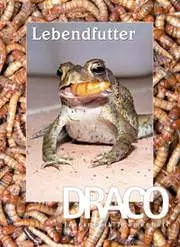
Draco 28 - Live food

Article no: draco28

CHF 18.40

Stock: 0

Ready for dispatch in 1-3 days, delivery time 7 working days

Delivery between Tuesday, 7 July and Wednesday, 8 July
Zahlungsarten
Product information "Draco 28 - Live food"

Draco 28 - Live food

Contents:

2 Editorial
4 Live food for amphibians and reptiles
– History and basics
Ursula Friedrich
22 The professional handling of food animals
– Basic requirement for a species- and animal-appropriate diet for reptiles and amphibians
Thomas Wilms
32 Some aspects of breeding your own food animals
Stefan Ziesmann
39 The pea aphid – an unusual food animal
Lars Österdahl
42 Breeding the common fruit fly (Drosophila melanogaster)
– Many paths lead to success
Marco Wagemann
50 Tropical cockroaches – lively insect lovers, valuable food animals or even both?
Andreas Bauer
58 Oven fish breeding – a way to provide a little variety in the diet of our vivarium animals with little effort!
Marco Wagemann
64 The breeding of aquatic snails
Cornelia Gabler
67 Agate snails
– not only an extraordinary food animal
Uwe Geissel
71 Tubifex breeding
Cornelia Gabler
74 Small mammals as food animals
– using the house mouse (Mus musculus) as an example
Thomas Wilms & Beate Löhr
86 Book box

Composition
Feeding recommendation
Technical details
Size information

0 of 0 reviews

Give us a rating!

Share your experience with the product with other customers.


Suggested products

Handbook of food plants for tortoises and other reptiles
Handbook of forage plants 2nd revised editionMarion Minch is not only a successful breeder of diverse tortoises for many years, but also an excellent connoisseur of native wild herbs. She founded and runs samenkiste.de, which is well known to many tortoise keepers and nature lovers. Her name is inextricably linked with reptile care and species-appropriate nutrition for tortoises. Her handbook of food plants summarises the most important native food plants for herbivorous and omnivorous reptiles. She not only considers tortoises, but also iguanas, spiny-tailed dragons and even chameleons. From the basics of plant biology to native wild herbs to suitable food plants for hardy tropical reptile species, this comprehensive work provides the basis for species-appropriate keeping. In the expanded and supplemented 2nd edition, the plant section is divided according to flower colour. This makes it even easier to identify wild herbs. The work has also been supplemented with a wealth of additional information and many pictures.

CHF 46.50

Geckos
Geckos in the terrarium by Astrid FalkThe book offers a comprehensive introduction to geckos and their species-appropriate keeping in terrariums. It explains what you need to think about before buying a gecko and what preparations should be made. The book describes in detail how the terrarium is technically equipped and set up. The care of the animals, their special features and behaviour, their diet, reproduction and rearing of young animals are described, as well as diseases and husbandry problems with tried and tested suggestions for prevention and treatment. Individual gecko species that are particularly suitable for keeping and breeding in terrariums are portrayed in detail in the second part of the book.

CHF 28.50

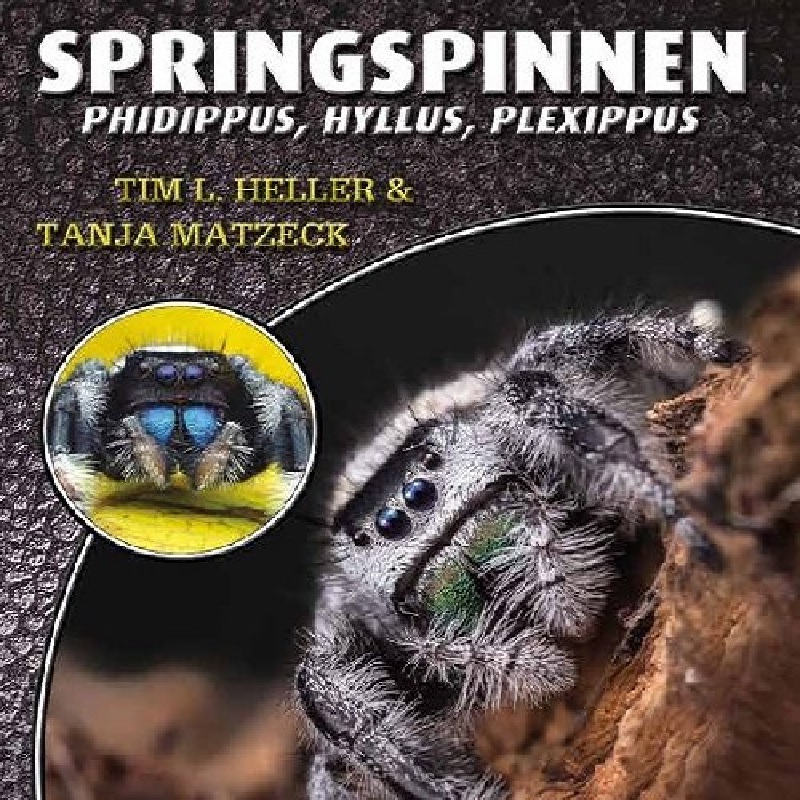
Jumping spiders Phidippus, Hyllus, Plexippus
Book Jumping Spiders - Phidippus, Hyllus & Plexippus A guide to keeping jumping spiders of the genera Phidippus, Hyllus & Plexippus. Who can resist the charm of jumping spiders? The childlike appearance of their expressive face simply leaves no one cold! In addition, their behavior is extremely exciting to observe, their colors are bright and their requirements for species-appropriate keeping are very easy to meet. No wonder these likeable jumpers are all the rage! This volume in the "Species by Species" series describes in detail what to look out for when buying and keeping them, introduces the most commonly kept species and color forms and provides plenty of tips on how to keep them successfully - so you can be sure they will breed well! Species by Species introduces you to the books in this series, which present the most popular terrarium animals. Each volume offers you detailed, practical care instructions and all the information you need to successfully breed your animals. All important questions from the required tank size to terrarium set-up, technical equipment, species-appropriate nutrition and disease prevention are answered with numerous tricks and tips. Experienced, long-standing breeders reveal how you can encourage the animals to reproduce and raise healthy young. All this in full color, generously illustrated and attractively designed - just about your terrarium animal - species by species

CHF 23.90

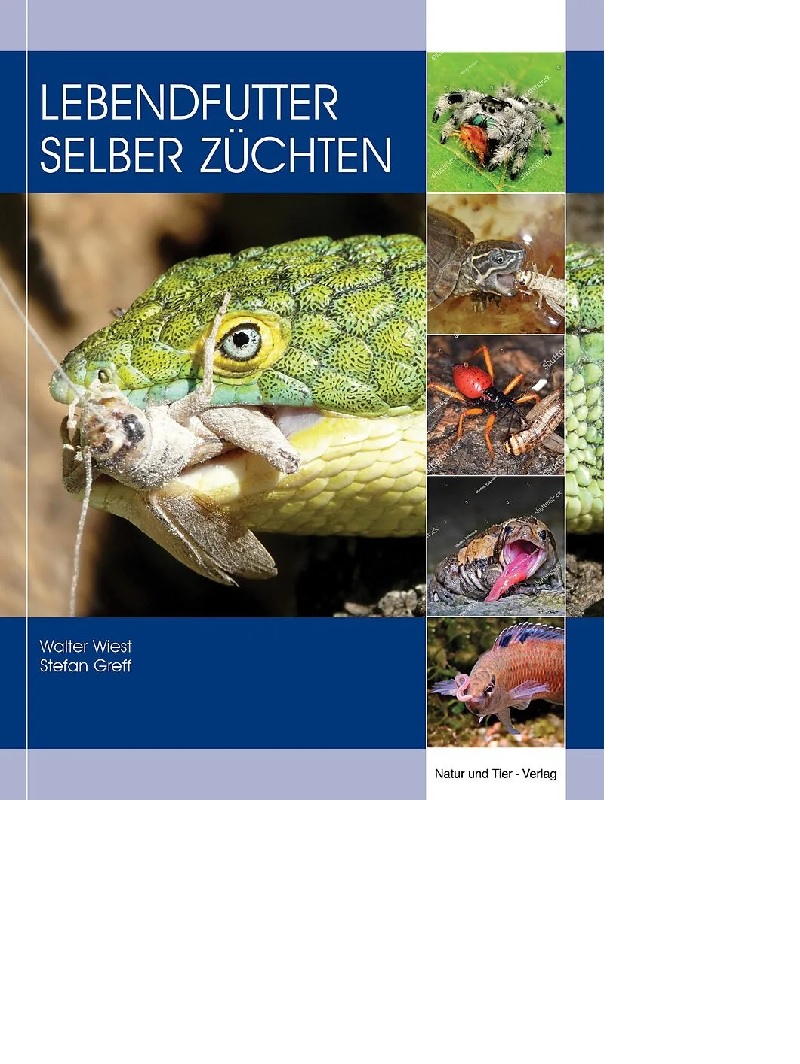
Book Breeding live food yourself
Book "Grow your own live food" - The perfect guide for pet owners Discover practical and detailed instructions on how you can easily breed food for your reptiles, birds, fish or other animals yourself in the book "Breeding live food yourself". With valuable tips on various food insects, their care and breeding, you can save money and ensure a species-appropriate diet for your pets. Contents of the book: Step-by-step instructions for breeding feeder insects Information on the best types of food for reptiles, birds and fish Care instructions and breeding conditions for various live food species Tips for sustainable and cost-effective food production Why breed your own live food? Get healthy, fresh food for your animals Save money and reduce dependence on pet shops Promote the health and well-being of your animals with species-appropriate food Whether you are a beginner or an experienced pet owner, this book provides you with everything you need to successfully breed live food yourself.

CHF 46.50

Marginata 69 - New Guinea tortoises
Marginata 69 - New Guinea tortoises – the genus ElseyaCover storyThe unrecognised beauties: New Guinea tortoises (Andreas S. Hennig)My experiences with Branderhorst's New Guinea tortoise, Elseya (Elseya) branderhorsti (Ouwens, 1914) (Andreas S. Hennig)Keeping and breeding of Rhodin's New Guinea tortoise, Elseya (Hanwarachelys) rhodini Thomson, Amepou, Anamiato & Georges, 2015 (Andreas S. Hennig)PortraitGeoemyda spengleri, Chinese serrated tortoise (Andreas S. Hennig)ReportageMacrochelys temminckii – Experiences and impressions with vulture tortoises part 2 (Reiner Praschag)KeepingAn alternative to year-round keeping of the Egyptian tortoise in the terrarium – my experiences with seasonal outdoor keeping of Testudo kleinmanni (Ricarda Schramm)EtymologySawbacks and living maps part 4: Graptemys gibbonsi, Pascagoula humpback tortoise (Holger Vetter)Classifieds & animal placement

CHF 16.50

Marginata 44 - European tortoises observe in nature
Marginata 44 Magazine Observing European tortoises in the wild Yellow-banded box turtleTortoise rescue centreMauremys hybrids Contents: Cover story: Observing European tortoises in the wild EditorialMagazine ReportageObserving European tortoises in the wildBenny Trapp ReportageOn a turtle tour at the foot of OlympusBenny Trapp BiologyIn search of tortoises in BulgariaThorsten Geier PhotographyPhotographing tortoises in the wildBenny Trapp PortraitGopherus agassizii (Cooper, 1863), Mojave Desert tortoiseHeiko Werning Keeping and breedingThe Yellow-banded Box Turtle (Cuora flavomarginata). Part 1: Biology and careUlrich Hennen Species protectionTortoise catastrophe in the PhilippinesEditorial team, with material from ZGAP and Katala Foundation Inc. ReportgeCan love be a sin? A side note on hybrids from Mauremys leprosa and Mauremys reevesiiSebastian Nickl Subscription & ServiceRegional guide

CHF 16.50

NTV Green snakes
NTV - Grass snakes Thorsten Schmidt 88 pages 17 x 0.9 x 22.3cm many colour photos The splendidly green-coloured, diurnal and completely harmless grass snakes are much sought-after terrarium animals. The fact that they can be easily fed with insects and other invertebrates is another plus point in favour of keeping these lively snakes.This guide tells you everything you need to know to keep and breed grass snakes successfully.Thorsten Schmidt explains here from his rich experience with the animals that properly cared for grass snakes are not at all problematic, but can be easily cared for and also bred. The author explains what to look out for and gives specific tips on setting up and equipping species-appropriate terrariums.

CHF 33.50

Draco 10 - Animals, Terrariums, Habitats
Draco 10 - Animals, Terrariums, Habitats Contents: 2 Editorial4 Deserts – cold land under a hot sunSurvival strategies of desert-dwelling amphibians and reptilesThomas Wilms & Heiko Werning26 Planning, building and setting up a desert terrariumThomas Ackermann41 Colourful jewels in the terrarium – experiences with the long-term care and breeding of Uromastyx ornata (Heyden, 1827) up to the second filial generationThomas Wilms, Hans Dietmar Müller & Beate Löhr 50 The bearded toadhead Phrynocephalus mystaceus (Pallas, 1776) in the terrariumHans Dietmar Müller58 The fringed-fingered lizards (Acanthodactylus) of North AfricaUwe Schlüter 66 The kings of the North American desert: ChuckwallasHeiko Werning74The horned vipers (Cerastes) of North AfricaUwe Schlüter79 Namibia – hot land on a cold currentFelix Hulbert & Mirko Barts 94 Magazine

CHF 16.80

Marginata 15 - Snake-necked turtles
Marginata 15 - Snake-necked turtles Genetic variability of western tortoisesTuscan tortoises part 2Food plants for aquatic turtles part 3 Contents: 2 EDITORIAL 3 READER LETTERS 4 MAGAZINE 8 DATES 10 REPORTAGEThe snake-necked turtles of Indo-AustraliaHans - Dieter Philippen 18 BREEDING IN HUMAN CAREKeeping and breeding the Australian long-necked turtle (Chelodina longicollis)Stefan Thierfeldt & Sabine Höfler-Thierfeldt 24 BREEDING IN HUMAN CAREKeeping and breeding the white-nosed snake-necked turtle (Chelodina spec.) Steffen Szymanski 31 PORTRAITSouth African tent-footed tortoise (Psammobates tentorius, BELL 1828)Irmtraud Jasser-Häger & Matts Blohm 35 REPORTAGEFood plants for aquatic turtles (Part III)Susanne Vogel 40 REPORTAGETuscany – In search of Eurotestudo hermanni (Part II)Michael Wirth & Walter Matzanke 48 REPORTAGEGenetic studies on western tortoisesGiorgio Berorelle, Vassili Goutner, Barbara Livoreill and Stefano Mazzotti 54 REPORTAGENotes on incubation and hatching of a wet clutch of red-bellied slider turtles Martin Leonard Voss 58 SHORT REPORTAGEComments on frequent carcass findings of leatherback turtlesAlfred Schleicher 60 BOOK TIP 61 CLASSIFIEDS 62 REGIONAL GUIDE

CHF 14.70

Turtles Volume 2 - The Turtles Gardener
The Turtle Gardener – A Natural Diet for European TortoisesGuide to keeping European tortoises Over 65 suitable food plants, plus instructions, tips and tricks for successful plant cultivation – 14–99 years When keeping tortoises, nutrition plays an essential role. Through a careful selection of safe food plants, we can significantly influence their health and thus ensure a balanced diet for our animals. As a recognised expert and successful author of numerous books on tortoises, Thorsten Geier aims to explain all horticultural aspects to you in an accessible way. This guide is aimed at both beginners in tortoise keeping and those who have been keeping them for many years. In this comprehensive guide, you will find detailed, clear and clearly presented information on species-appropriate nutrition and independent foraging within the enclosure. Numerous instructions, tips and tricks for successful plant cultivation, as well as over 65 highly suitable and varied food plants, are listed in this book. Furthermore, it contains information on feeding behaviour in the wild, on keeping tortoises in a natural environment in the garden, and on poisonous or unsuitable plants. Numerous photos and picture galleries document all the necessary steps for successful plant cultivation, so that every tortoise owner can grow valuable and nutritious food in their garden, even without a ‘green thumb’. A truly fabulous guide to a varied diet.

CHF 34.90

Draco 31 - Uromastyx
Draco 31 - Spiny-tailed Agamas Contents: 2  Editorial  4  Spiny-tailed agamas of the genus Uromastyx– Introduction to the taxonomy and ecology of a lizard group specialised in desertsThomas Wilms  20  An article on the species-appropriate setup and lighting of terrariums for keeping spiny-tailed agamasThomas Wilms, Bernd Strassen, Andreas Oppermann & Claudia Petri  30  The Mali spiny-tailed agama Uromastyx dispar maliensisManfred Rogner  42  A particular problem in terrarium husbandry of Uromastyx: cheilitis of the spiny-tailed agama (Cheilitis of Uromastyx)Jutta Wiechert   45  Project “Spiny-tailed Agama”: The Reptilium field research project in Saudi ArabiaThomas Wilms   54  Observations on the lifestyle of Uromastyx ornata in the Eilat Mountains, IsraelDanny Molco  61  Philby's spiny-tailed agama (Uromastyx ornata philbyi) – about an almost unknown beautyThomas Wilms   67  The spiny-tailed agamas of the Sultanate of OmanHermann Seufer, Thomas Kowalski & Hans Jürgen Zilger      75  Causes and extent of the threat to spiny-tailed agamas – attempt at an inventoryThomas Wilms  82  Book box  87  Magazine

CHF 18.40

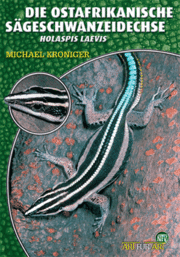
The East African saw-tailed lizard
NTV The East African saw-tailed lizard All about the East African saw-tailed lizard by Michael Kroninger 61 pages 14.8 x 21 cm numerous colour photos 1st edition Author Michael Kroninger Publisher NTV Contents: They are brightly coloured, the always agile and lively saw-tailed lizards. It's no wonder that they are currently becoming increasingly popular, as these endearing, attractive animals are not only highly interesting reptiles, but also very easy to care for. Michael Kroninger is an experienced terrarium keeper and has been successfully breeding saw-tailed lizards for many years. In this volume of the "Species by Species" series, you will therefore find all the information you need for the species-appropriate care of these beautiful lizards. The fact that you will also learn how to breed your animals, hatch the eggs and raise the little ones makes this book an indispensable guide. Systematics and body structure The fascinating biology: From the life of the saw-tailed lizard All information on species-appropriate keeping: from suitable terrariums to equipment and technology to feeding Successful breeding: Mating stimulation, incubation of the eggs and rearing the young Solutions to problems: How to avoid the most common mistakes in care and how to help sick animals Brilliant photos

CHF 21.90