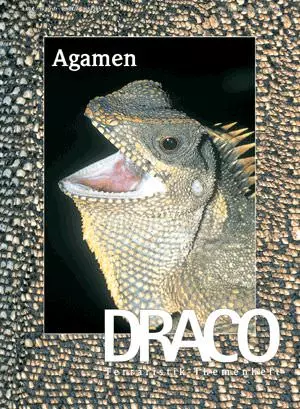

Draco 14 - Agamen

Article no: draco14

CHF 16.80

Stock: 0

Ready for dispatch in 1-3 days, delivery time 7 working days

Delivery between Tuesday, 27 October and Wednesday, 28 October
Zahlungsarten
Product information "Draco 14 - Agamen"

Draco 14 - Agamen

Contents:

  • 2 Editorial
  • 4 The agamas of the world
    Mirko Barts & Thomas Wilms
  • 24 On the keeping of Philippine sailfin lizards (Hydrosaurus pustulatus)
    Jiři Gábriš
  • 34 On observations of aggressive behaviour in wild butterfly agamas (genus Leiolepisy CUVIER), including a form of locomotion previously unknown in vertebrates/
    Wolfgang Böhme
  • 40 In profile: the Vietnamese butterfly agama (Leiolepis guttata CUVIER, 1829)
    Uwe Schlüter
  • 42 On the keeping and breeding of two taxa from the Uromastyx-acanthinura complex: Uromastyx geyri MÜLLER, 1922 and Uromastyx dispar flavifasciata MERTENS, 1962 (Reptilia: Agamidae: Leiolepidinae: Uromastyx
    Thomas Wilms, Dieter Ruf & Beate Löhr
  • 56 Agama impalearis (BOETTGER, 1874) – the Atlas agama, well-known and rarely kept in the terrarium
    Hans D. Müller
  • 64Notes on the keeping and breeding of the lyre-headed agama, Lyocephalus scutatus (LINNAEUS, 1758)
    Uwe Bartelt
  • 70The agamas of southern Africa
    Mirko Barts
  • 80 Experiences with the blue-throated angulate-headed agama (Gonocephalus bellii) in the terrarium
    Ingo Kober
  • 87 Book box
  • 94 Magazine
Composition
Feeding recommendation
Technical details
Size information

0 of 0 reviews

Give us a rating!

Share your experience with the product with other customers.


Suggested products

Handbook of food plants for tortoises and other reptiles
Handbook of forage plants 2nd revised editionMarion Minch is not only a successful breeder of diverse tortoises for many years, but also an excellent connoisseur of native wild herbs. She founded and runs samenkiste.de, which is well known to many tortoise keepers and nature lovers. Her name is inextricably linked with reptile care and species-appropriate nutrition for tortoises. Her handbook of food plants summarises the most important native food plants for herbivorous and omnivorous reptiles. She not only considers tortoises, but also iguanas, spiny-tailed dragons and even chameleons. From the basics of plant biology to native wild herbs to suitable food plants for hardy tropical reptile species, this comprehensive work provides the basis for species-appropriate keeping. In the expanded and supplemented 2nd edition, the plant section is divided according to flower colour. This makes it even easier to identify wild herbs. The work has also been supplemented with a wealth of additional information and many pictures.

CHF 46.50

Geckos
Geckos in the terrarium by Astrid FalkThe book offers a comprehensive introduction to geckos and their species-appropriate keeping in terrariums. It explains what you need to think about before buying a gecko and what preparations should be made. The book describes in detail how the terrarium is technically equipped and set up. The care of the animals, their special features and behaviour, their diet, reproduction and rearing of young animals are described, as well as diseases and husbandry problems with tried and tested suggestions for prevention and treatment. Individual gecko species that are particularly suitable for keeping and breeding in terrariums are portrayed in detail in the second part of the book.

CHF 28.50

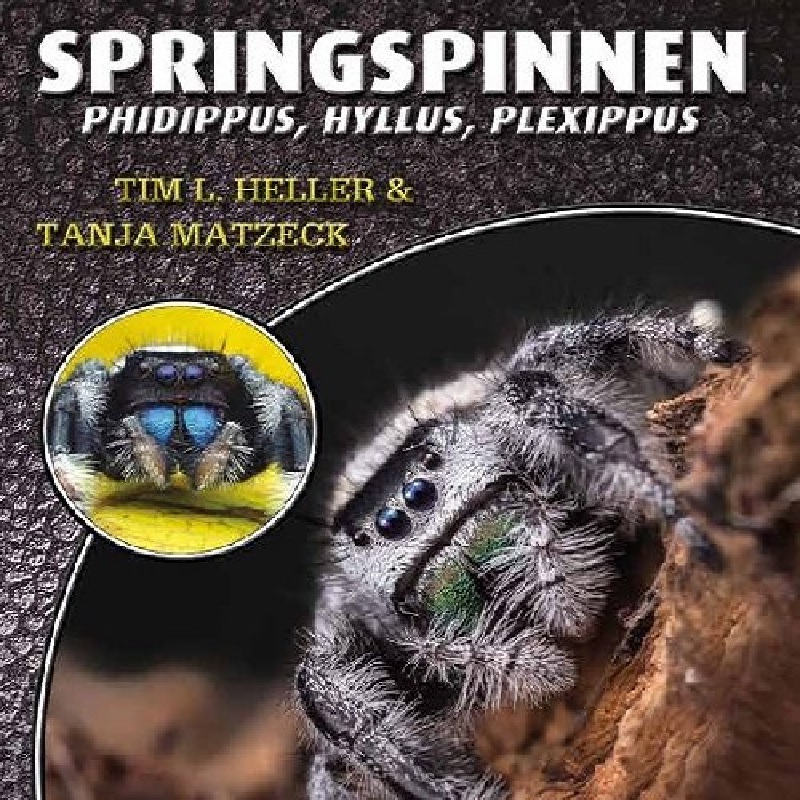
Jumping spiders Phidippus, Hyllus, Plexippus
Book Jumping Spiders - Phidippus, Hyllus & Plexippus A guide to keeping jumping spiders of the genera Phidippus, Hyllus & Plexippus. Who can resist the charm of jumping spiders? The childlike appearance of their expressive face simply leaves no one cold! In addition, their behavior is extremely exciting to observe, their colors are bright and their requirements for species-appropriate keeping are very easy to meet. No wonder these likeable jumpers are all the rage! This volume in the "Species by Species" series describes in detail what to look out for when buying and keeping them, introduces the most commonly kept species and color forms and provides plenty of tips on how to keep them successfully - so you can be sure they will breed well! Species by Species introduces you to the books in this series, which present the most popular terrarium animals. Each volume offers you detailed, practical care instructions and all the information you need to successfully breed your animals. All important questions from the required tank size to terrarium set-up, technical equipment, species-appropriate nutrition and disease prevention are answered with numerous tricks and tips. Experienced, long-standing breeders reveal how you can encourage the animals to reproduce and raise healthy young. All this in full color, generously illustrated and attractively designed - just about your terrarium animal - species by species

CHF 23.90

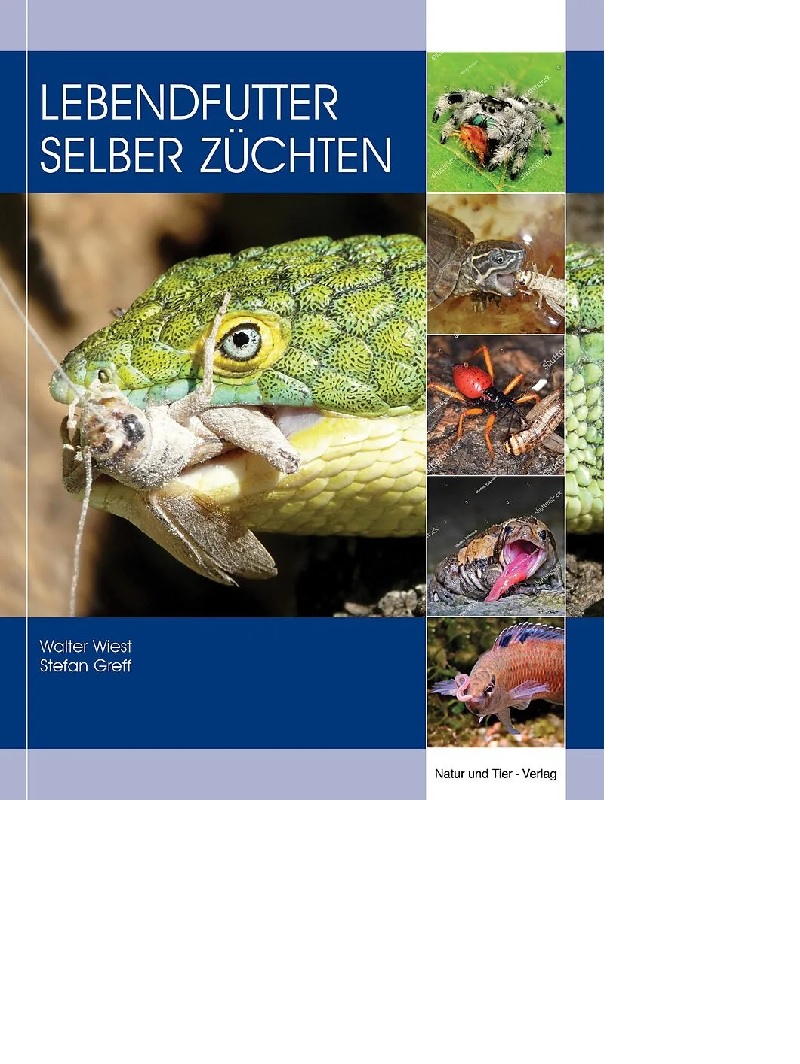
Book Breeding live food yourself
Book "Grow your own live food" - The perfect guide for pet owners Discover practical and detailed instructions on how you can easily breed food for your reptiles, birds, fish or other animals yourself in the book "Breeding live food yourself". With valuable tips on various food insects, their care and breeding, you can save money and ensure a species-appropriate diet for your pets. Contents of the book: Step-by-step instructions for breeding feeder insects Information on the best types of food for reptiles, birds and fish Care instructions and breeding conditions for various live food species Tips for sustainable and cost-effective food production Why breed your own live food? Get healthy, fresh food for your animals Save money and reduce dependence on pet shops Promote the health and well-being of your animals with species-appropriate food Whether you are a beginner or an experienced pet owner, this book provides you with everything you need to successfully breed live food yourself.

CHF 46.50

Marginata 69 - New Guinea tortoises
Marginata 69 - New Guinea tortoises – the genus ElseyaCover storyThe unrecognised beauties: New Guinea tortoises (Andreas S. Hennig)My experiences with Branderhorst's New Guinea tortoise, Elseya (Elseya) branderhorsti (Ouwens, 1914) (Andreas S. Hennig)Keeping and breeding of Rhodin's New Guinea tortoise, Elseya (Hanwarachelys) rhodini Thomson, Amepou, Anamiato & Georges, 2015 (Andreas S. Hennig)PortraitGeoemyda spengleri, Chinese serrated tortoise (Andreas S. Hennig)ReportageMacrochelys temminckii – Experiences and impressions with vulture tortoises part 2 (Reiner Praschag)KeepingAn alternative to year-round keeping of the Egyptian tortoise in the terrarium – my experiences with seasonal outdoor keeping of Testudo kleinmanni (Ricarda Schramm)EtymologySawbacks and living maps part 4: Graptemys gibbonsi, Pascagoula humpback tortoise (Holger Vetter)Classifieds & animal placement

CHF 16.50

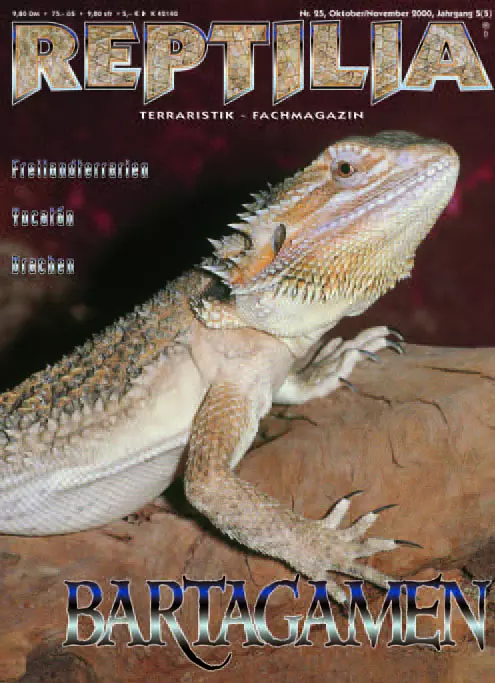
Reptilia 25 - Bearded dragons
Reptilia 25 - Bearded dragons Outdoor terrariumsYucatánDragons Contents: 2 Editorial 4 Letters to the Editor 8 Magazine 16 Dates 20 Western Herp Perspectives: Road Cruising - in search of reptiles and amphibians by car 22 Photo report: The bearded dragons, by A. Hauschild 28 Keeping and breeding: An evergreen: Bearded dragons in the terrarium, by A. Hauschild 33 Herpetofauna: Behaviour and interaction of my bearded dragons (Pogona vitticeps) in the terrarium, by R. Kohlmeyer 39 Report: Bearded dragon fever, by B. Love 43 Journey: Travelling in the realm of the Maya, by L. Barkam and H. Werning 51 Portrait and poster: Trapelus pallidus, by L. Rifai and D. Modry 56 Herpetofauna: Notes on Boiga nigriceps(GÜNTHER, 1863) 62 Report: To Madagascar - for the turtles?, by W. Schmidt and K. Liebel 68 Keeping and breeding: Dendrobates azureus, a blue jewel in the terrarium, U. Dost 73 Terraristics: Building a snake enclosure, Part 1: Basic considerations, by M. Hallmen 78 Herpetology and culture: 'In caves lives the dragon's old brood', a look at the ideas of dragons in East and West, Part 1, by K. Kunz 87 Advice and action 91 Library 104 Gloss: Dead texts don't talk, by L. Hogeback

CHF 9.80

Reptilia 73 - Photography of reptiles and amphibians
Reptilia 73 - Photographing reptiles and amphibians Slowinski's corn snakeBlack monitor lizardNamibia Contents: 2     EDITORIAL3     MAGAZINE13   DATES16   FOTOSTORY       Photographing reptiles and amphibians       by A. Kwet32   REPORTAGE       Tips and tricks from the professional       by B. Trapp44   REPORTAGE       Small animal really big       A few words about the use of        lens converters in macro photography       by K. Kunz48   WESTERN HERP PERSPECTIVES       Tips for terrarium photography       by B. Love51   PORTRAIT and poster       Bombina variegata       by M. Dobiey56   TRAVEL       Herpetological travel sketches from Namibia       by K. Hirschfeld64   KEEPING AND REPRODUCTION       Experience with care and breeding        of Varanus (Odatria) tristis orientalis       with notes on Varanus (Odatria)       tristis tristis       by T. Hörenberg74   KEEPING AND REPRODUCTION       Slowinski's corn snake in nature and terrarium       Observations of occurrences in Texas and        Louisiana       by K.J. & K. Lodrigue81   KEEPING AND REPRODUCTION       Amphibian ark       A dream or a realistic endeavour?       Part 1       by B. Akeret91   LIBRARY104 BRUTKASTEN        Wild living room       by L. Hogeback

CHF 12.00

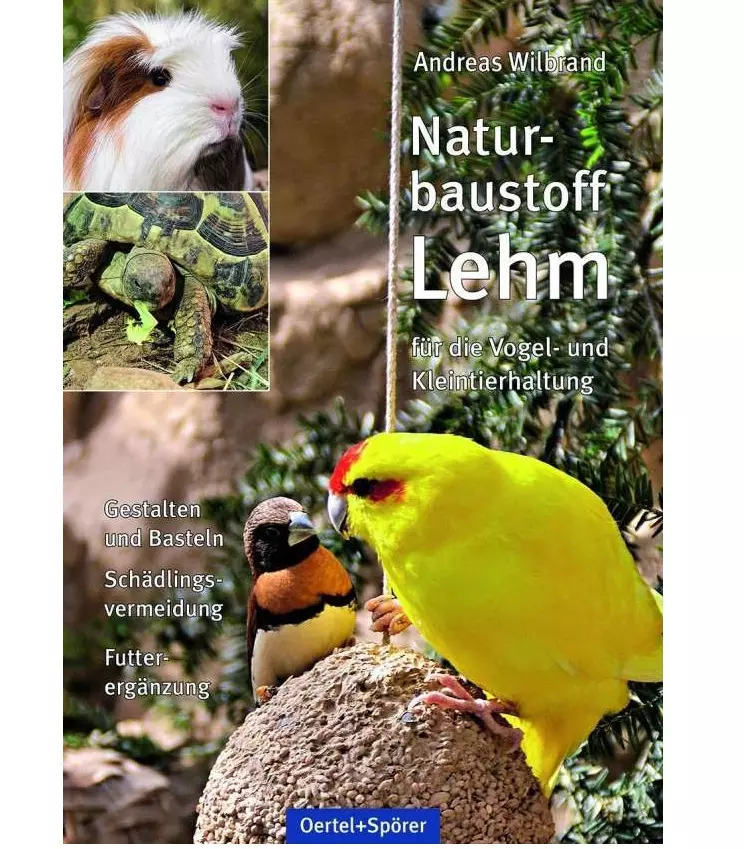
Natural building material clay for keeping birds and small animals
Natural building material clay for keeping birds and small animals The first clay DIY book for animal lovers - a practical guide with simple instructions, new ideas and health tips! Designing and crafting Pest prevention Feed supplement Clay is the oldest and most universal building material in the world. The animal world has been demonstrating for millions of years how it can be used to build safe dwellings. And humans also utilised this building material a long time ago and even created huge and artistic buildings from it. Clay can also be used perfectly for our pets. Building projects for animal housing of all kinds, landscaping in terrariums, soil construction for aquariums, pest control in aviaries, pigeon coops and stables - this book will show you how to do all this and what you need for it.Clay is not only a building material that can almost always be reused, but also contributes to the health of humans and animals. Clay binds toxins, displaces pests and is suitable as a fertiliser. For this reason, the health maintenance of our protégés through clay is also described in detail

CHF 27.90

Reptilia 47 - Sand boas
Reptilia 47 - Sandboas White alligatorsBeavertail dragonsThree-striped folding tortoise Contents: 2 EDITORIAL 3 MAGAZINE 16 DATES 18 WESTERN HERP PERSPECTIVESThe Mecca of a reptile photographerby B. Love 20 PHOTO REPORTAGE Sandboasby C. Jones 31 KEEPING AND BREEDINGOn keeping and caring for sandboas by C. Jones 35 KEEPING AND BREEDINGOn breeding Eurasian sandboas: Eryx jaculus, Eryx miliaris and Eryx tataricus by C. Jones 42 REPORTFascination record snakePart 3: Don't let them bite you… by Henry Bellosa 45 TRAVELThe white alligators of the MississippiOf ancient Indian trails, bald cypresses and crocodiles by W. Ise 51 PORTRAIT AND POSTERLialis burtonisby U. Schlüter 56 KEEPING AND BREEDINGThe Three-striped Box Turtle Kinosternon baurii) – A turtle for small aquariums?by A. M. Glaser 64 HERPETOFAUNAKeeping and breeding some Andean keel-tailed iguanas Stenocercus from the Peruvian highlandsPart 4: Observations on behaviour, sexual dimorphism and ecology of Stenocercus melanopygus BOULENGER, 1900by U. Schlüter 72 KEEPING AND BREEDINGExperiences in keeping and breeding Xenagama batillifera (VAILLANT, 1882), with observations on the behaviour of Xenagama taylori (PARKER, 1935)by M. Barts 78 REPORTAGEPlanning and building a reptile zoo: "Reptilium - Terrarien- und Wüstenzoo" in Landau is being built - Part 2: The construction phaseby T. Wilms 87 CLASSIFIED ADS 91 RAT & TAT 94 LIBRARY 104 GLOSSA family story. Part 1by H. Werning

CHF 11.20

Reptilia 51 - Tree agamas
Reptilia 51 - Tree dragons Drakensberg armadilloGreen night tree snakeChin spotted tortoise Contents: 2 EDITORIAL 6 READER LETTERS 8 MAGAZINE 16 DATES 18 PHOTO REPORTAGE With horns, crests and gliding membranesThe bizarre arboreal dragonsby J. Hallermann 26 KEEPING AND BREEDINGMantheyus phuwuanensis (MANTHEY & NABHITABHATA, 1991) – from capture to breeding in the terrarium by S. & U. Manthey 32 HERPETOFAUNAOn the variability and biology of the Philippine angular-headed dragon Gonocephalus sophiae) by M. Gaulke & A. Demegillo 41 REPORTAGEThe lyre-headed dragon Lyriocephalus scutatus by U. Bartelt, H. & M. de Bitter 51 PORTRAIT AND POSTERCaiman yacareby H. Werning 56 TRAVELPulau Tioman – Pearl in the South China Sea; Part 2 by W. Grossmann & F. Tillack 66 KEEPING AND BREEDINGKeeping and breeding the Drakensberg armadillo lizard (Cordylus melanotus subviridis) by B. Langerwerf 70 KEEPING AND BREEDING Boiga cynodon – The green night tree snakeA rarely kept rear-fanged snake and its breedingby J. Bulian 78 REPORTAGETrachemys callirostris callirostris – Biology, use and protection of the chin spotted tortoise in Colombiaby A. Martínez Silvestre & L. Arias Bernal 86 SMALL ADS 91 WESTERN HERP PERSPECTIVESAliens – not the filmby B. Love 93 RAT & TAT 95 LIBRARY 104 GLOSSELots of waves – disturbing turn of the yearby H. Werning

CHF 11.20

The steppe turtles
All about the fascinating steppe turtles 64 Seiten 14,8 x 21 cm zahlreiche Farbfotos Autor Thomas Wilms Inhalt: Schildkröten sind die Sympathieträger unter den Reptilien. Urtümliches Äusseres gepaart mit liebenswertem Wesen und sprichwörtlicher Gemütlichkeit machen sie bei allen Altersgruppen beliebt. Die Steppenschildkröte bildet da keine Ausnahme, ganz im Gegenteil: Ihr „handliches“ Format und die einfach zu erfüllenden Haltungsanforderungen machen sie zu einem äusserst geeigneten Terrarientier. Thomas Wilms, DRACO-Redakteur und Leiter des „Reptiliums“, schildert aus seiner langjährigen erfolgreichen Haltungspraxis sämtliche Aspekte rund um Haltung und Pflege dieser attraktiven Schildkröten. Ausserdem lesen Sie, wie Sie Ihre Tiere zur Paarung stimulieren, die Eier ausbrüten und die niedlichen Jungen aufziehen können. Systematik und Körperbau Die faszinierende Biologie: Aus dem Leben der Steppenschildkröte Alle Informationen zur artgerechten Haltung: Vom geeigneten Terrarium über Einrichtung und Technik bis hin zur Fütterung Erfolgreich nachzüchten: Paarungsstimulation, Inkubation der Eier und Aufzucht der Jungtiere Problemlösungen: Wie man die häufigsten Fehler bei der Pflege vermeidet, und wie man kranken Tieren helfen kann Brillante Fotos

CHF 24.90

Marginata 41 - Steppe tortoises
Marginata 41 - Steppe tortoisesKeeping and breeding big-headed tortoises part 3Wintering of Mediterranean tortoisesForest tortoise breeding at Dortmund ZooContents:EditorialMagazineDatesPHOTOSTORYNews about steppe tortoisesHans - Dieter PhilippenKEEPING AND BREEDINGKeeping and breeding of the steppe tortoise in the Alpine regionWilli HoferBREEDINGNature-identical carapace proportions and shapes in the breeding of steppe tortoisesPetr Velensky & Natasha VelenskaHOLDINGWintering of steppe tortoises and European tortoisesThorsten GeierPORTRAITChinese three-keeled turtle. Chinemys[Mauremys] reevesii (Grey, 1831)Hans - Dieter PhilippenBREEDINGBig-headed tortoises in nature and human care. Part 3Reiner PraschagBREEDINGKeeping and breeding the red-headed box turtle (Podocnemis erythrocephala) Part 2David DrajeskeKEEPING AND BREEDINGBreeding of forest tortoises at Dortmund ZooSimone Karlowski & Stephanie ZechREPORTAGEThe European Studbook Foundation: off to new shores!Henk ZwartepoorteREPORTAGESurprising observation of charcoal tortoisesSusanne VogelBook tipSubscription & ServiceRegional guide

CHF 16.50