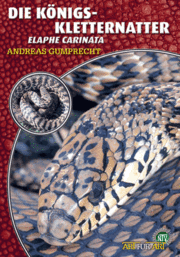
Terrarium keeper and snake expert Andreas Gumprecht has been keeping terrarium animals for 25 years now and would like to share his positive experiences with the care and breeding of the king climbing snake with the reader in this guide. br>Let yourself be impressed by perhaps the most imposing representative of the climbing snake complex.
Systematics and body structure
The fascinating biology: From the life of the king climbing snake
All information on species-appropriate keeping: from suitable terrariums to equipment and technology to feeding
Successful breeding: Mating stimulation, incubation of the eggs and rearing of the young
Problem solving: How to avoid the most common mistakes in care and how to help sick animals
Brilliant photos
Composition
Feeding recommendation
Technical details
Size information
0 of 0 reviews
Give us a rating!
Share your experience with the product with other customers.
Login
No reviews found. Go ahead and share your findings with others.
Handbook of forage plants 2nd revised editionMarion Minch is not only a successful breeder of diverse tortoises for many years, but also an excellent connoisseur of native wild herbs. She founded and runs samenkiste.de, which is well known to many tortoise keepers and nature lovers. Her name is inextricably linked with reptile care and species-appropriate nutrition for tortoises. Her handbook of food plants summarises the most important native food plants for herbivorous and omnivorous reptiles. She not only considers tortoises, but also iguanas, spiny-tailed dragons and even chameleons. From the basics of plant biology to native wild herbs to suitable food plants for hardy tropical reptile species, this comprehensive work provides the basis for species-appropriate keeping. In the expanded and supplemented 2nd edition, the plant section is divided according to flower colour. This makes it even easier to identify wild herbs. The work has also been supplemented with a wealth of additional information and many pictures.
Geckos in the terrarium by Astrid FalkThe book offers a comprehensive introduction to geckos and their species-appropriate keeping in terrariums. It explains what you need to think about before buying a gecko and what preparations should be made. The book describes in detail how the terrarium is technically equipped and set up. The care of the animals, their special features and behaviour, their diet, reproduction and rearing of young animals are described, as well as diseases and husbandry problems with tried and tested suggestions for prevention and treatment. Individual gecko species that are particularly suitable for keeping and breeding in terrariums are portrayed in detail in the second part of the book.
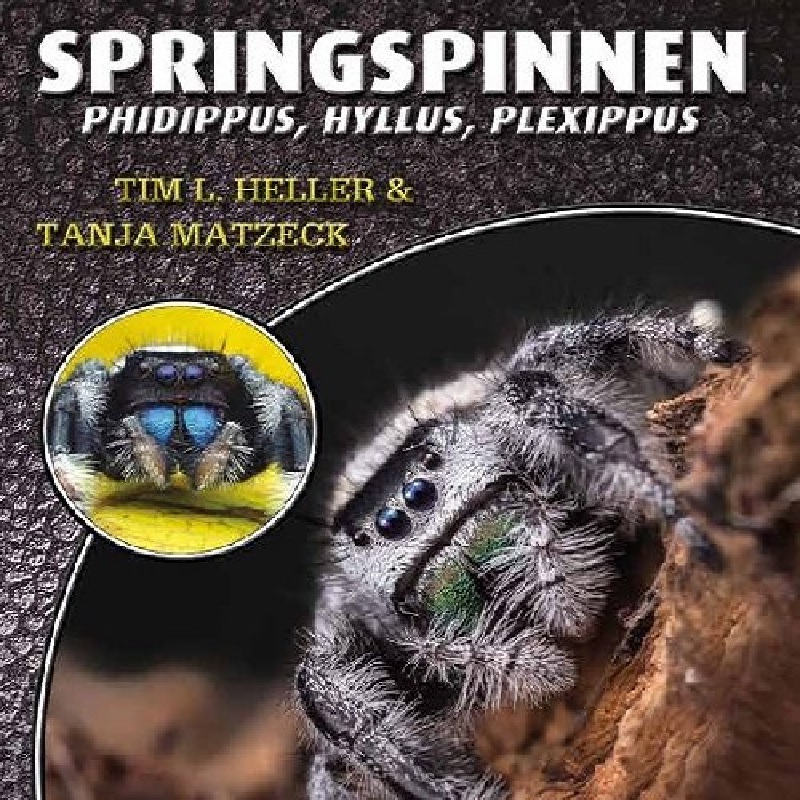
Book Jumping Spiders -
Phidippus, Hyllus & Plexippus
A guide to keeping jumping spiders of the genera Phidippus, Hyllus & Plexippus. Who can resist the charm of jumping spiders? The childlike appearance of their expressive face simply leaves no one cold! In addition, their behavior is extremely exciting to observe, their colors are bright and their requirements for species-appropriate keeping are very easy to meet. No wonder these likeable jumpers are all the rage!
This volume in the "Species by Species" series describes in detail what to look out for when buying and keeping them, introduces the most commonly kept species and color forms and provides plenty of tips on how to keep them successfully - so you can be sure they will breed well!
Species by Species introduces you to the books in this series, which present the most popular terrarium animals. Each volume offers you detailed, practical care instructions and all the information you need to successfully breed your animals.
All important questions from the required tank size to terrarium set-up, technical equipment, species-appropriate nutrition and disease prevention are answered with numerous tricks and tips.
Experienced, long-standing breeders reveal how you can encourage the animals to reproduce and raise healthy young.
All this in full color, generously illustrated and attractively designed - just about your terrarium animal - species by species
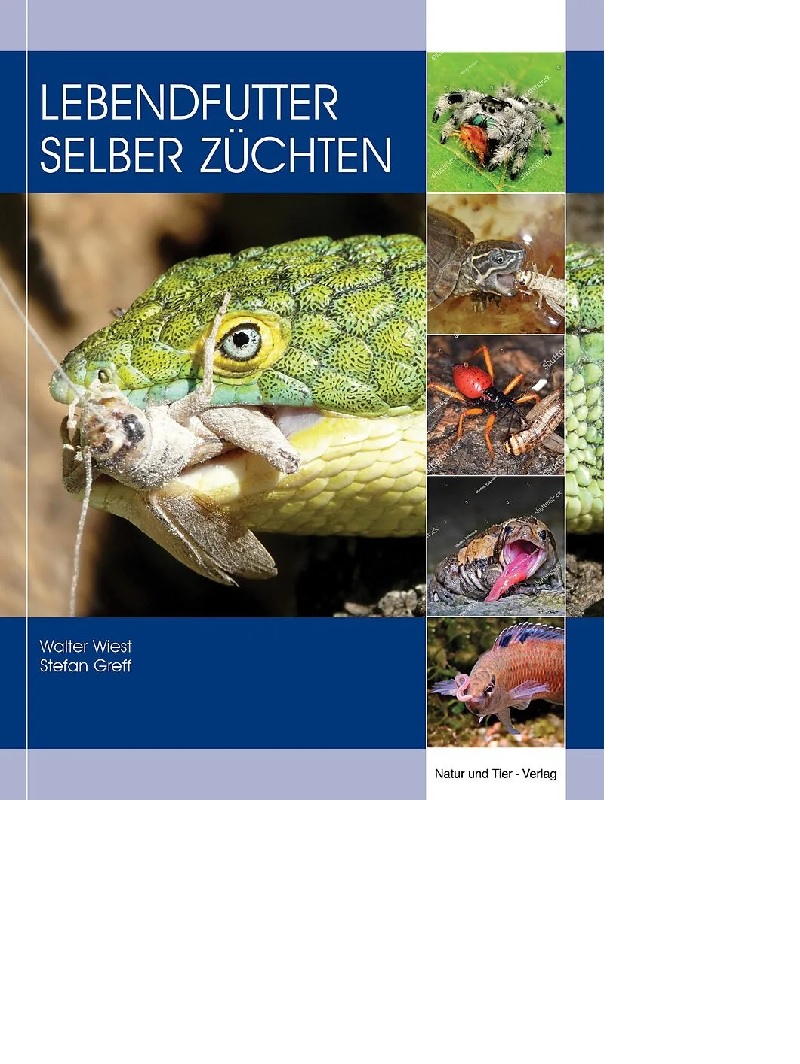
Book "Grow your own live food" - The perfect guide for pet owners
Discover practical and detailed instructions on how you can easily breed food for your reptiles, birds, fish or other animals yourself in the book "Breeding live food yourself". With valuable tips on various food insects, their care and breeding, you can save money and ensure a species-appropriate diet for your pets.
Contents of the book:
Step-by-step instructions for breeding feeder insects
Information on the best types of food for reptiles, birds and fish
Care instructions and breeding conditions for various live food species
Tips for sustainable and cost-effective food production
Why breed your own live food?
Get healthy, fresh food for your animals
Save money and reduce dependence on pet shops
Promote the health and well-being of your animals with species-appropriate food
Whether you are a beginner or an experienced pet owner, this book provides you with everything you need to successfully breed live food yourself.
Marginata 69 - New Guinea tortoises – the genus ElseyaCover storyThe unrecognised beauties: New Guinea tortoises (Andreas S. Hennig)My experiences with Branderhorst's New Guinea tortoise, Elseya (Elseya) branderhorsti (Ouwens, 1914) (Andreas S. Hennig)Keeping and breeding of Rhodin's New Guinea tortoise, Elseya (Hanwarachelys) rhodini Thomson, Amepou, Anamiato & Georges, 2015 (Andreas S. Hennig)PortraitGeoemyda spengleri, Chinese serrated tortoise (Andreas S. Hennig)ReportageMacrochelys temminckii – Experiences and impressions with vulture tortoises part 2 (Reiner Praschag)KeepingAn alternative to year-round keeping of the Egyptian tortoise in the terrarium – my experiences with seasonal outdoor keeping of Testudo kleinmanni (Ricarda Schramm)EtymologySawbacks and living maps part 4: Graptemys gibbonsi, Pascagoula humpback tortoise (Holger Vetter)Classifieds & animal placement
Draco 10 - Animals, Terrariums, Habitats
Contents:
2 Editorial4 Deserts – cold land under a hot sunSurvival strategies of desert-dwelling amphibians and reptilesThomas Wilms & Heiko Werning26 Planning, building and setting up a desert terrariumThomas Ackermann41 Colourful jewels in the terrarium – experiences with the long-term care and breeding of Uromastyx ornata (Heyden, 1827) up to the second filial generationThomas Wilms, Hans Dietmar Müller & Beate Löhr 50 The bearded toadhead Phrynocephalus mystaceus (Pallas, 1776) in the terrariumHans Dietmar Müller58 The fringed-fingered lizards (Acanthodactylus) of North AfricaUwe Schlüter 66 The kings of the North American desert: ChuckwallasHeiko Werning74The horned vipers (Cerastes) of North AfricaUwe Schlüter79 Namibia – hot land on a cold currentFelix Hulbert & Mirko Barts 94 Magazine
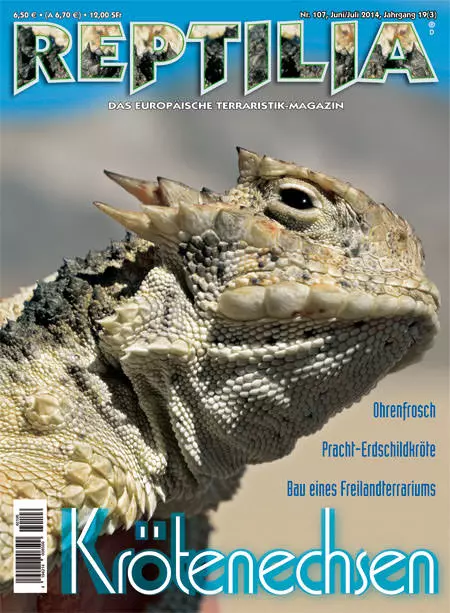
Reptilia 107 Toad lizards
Eared frogMagnificent tortoiseConstruction of an outdoor terrarium Contents:Cover story: Toad lizardsThe bizarre toad lizards of the genus Phrynosoma are among the almost legendary terrarium animals. Every reptile lover is probably enchanted by the appearance of these small North American iguanas, but they have a reputation for being impossible to keep. However, more and more dedicated terrarium keepers are succeeding not only in keeping these food specialists for many years, but also in breeding them successfully. We provide an overview of the genus, discuss the problem of feeding these animals and provide two examples of successful keeping and breeding.
EditorialMAGAZINEDATES
WESTERN HERP PERSPECTIVESThe invisible ark B. Love
PHOTOSTORYToad lizards – a (very good) freak of natureH. Werning
REPORTAGEConsiderations on the diet of toad lizardsB. Fabian
KEEPING AND BREEDINGKeeping and breeding the giant toad lizard (Phrynosoma asio) in the terrariumK. Haase
KEEPINGPhrynosoma orbiculare – a toad lizard from the highlands in captive careK. Haase
KEEPINGThe eared frog, a little-known guest in the terrariumP. Janzen
KEEPING AND BREEDINGSilent observers – on the lifestyle and keeping of the Central American magnificent tortoiseL. Spinner
PracticeConstruction of an outdoor enclosure for emerald lizardsM. Herz
TEST RUNSuccessful combination of terrarium and rackK. Kunz
ANIMALS OF OUR HOMEThe spadefoot toadR. Leptien
LIBRARYSERVICEALSO NEAR YOU
TRAVELTerra incognita in the middle of Madagascar's rice fields – the herpetofauna of BetaolanaS. Wolf
PREVIEW
BRUTKASTEN Tangimangi – or: Take what you need!M. Zawadzki
Marginata 15 - Snake-necked turtles
Genetic variability of western tortoisesTuscan tortoises part 2Food plants for aquatic turtles part 3
Contents:
2 EDITORIAL
3 READER LETTERS
4 MAGAZINE
8 DATES
10 REPORTAGEThe snake-necked turtles of Indo-AustraliaHans - Dieter Philippen
18 BREEDING IN HUMAN CAREKeeping and breeding the Australian long-necked turtle (Chelodina longicollis)Stefan Thierfeldt & Sabine Höfler-Thierfeldt
24 BREEDING IN HUMAN CAREKeeping and breeding the white-nosed snake-necked turtle (Chelodina spec.) Steffen Szymanski
31 PORTRAITSouth African tent-footed tortoise (Psammobates tentorius, BELL 1828)Irmtraud Jasser-Häger & Matts Blohm
35 REPORTAGEFood plants for aquatic turtles (Part III)Susanne Vogel
40 REPORTAGETuscany – In search of Eurotestudo hermanni (Part II)Michael Wirth & Walter Matzanke
48 REPORTAGEGenetic studies on western tortoisesGiorgio Berorelle, Vassili Goutner, Barbara Livoreill and Stefano Mazzotti
54 REPORTAGENotes on incubation and hatching of a wet clutch of red-bellied slider turtles Martin Leonard Voss
58 SHORT REPORTAGEComments on frequent carcass findings of leatherback turtlesAlfred Schleicher
60 BOOK TIP
61 CLASSIFIEDS
62 REGIONAL GUIDE
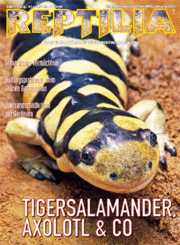
Reptilia 67 - Tiger Salamander, Axolotl & Co.Steve Irwin's legacyHusbandry problems with the green tree pythonBroad-shelled turtles in SardiniaContents:
2EDITORIAL
3MAGAZINE
11TERMINE
14WESTERN HERP PERSPECTIVESRevive the old passionFrom B. Love
6 PHOTO REPORTAGEAmbystomatidae Gray, 1850 ?transverse-toothed newtsBy T. Blanck
22HERPETOFAUNAThe cross-toothed newts, family Ambystomatidae Gray, 1850An overview of the speciesBy T. Blanck
36 KEEPING AND REPRODUCTIONKeeping and breeding the banded tiger salamander Ambystoma mavortiumBy T. Blanck & M. Braun
41HERPETOCULTUREThe axolotl in religion, magic and mythBy F. Cupul
45LETTERS11 years ReptiliaVisiting Bill LoveBy H. Werning
51PORTRAIT AND POSTERZamenis longissimusFrom A. Kwet
56 KEEPING AND REPRODUCTIONFringed-fingered lizards (Acanthodactylus) in the wild and in the terrariumPart 2: Basics of terrarium keeping and reproductive biologyBy U. Schlüter
67HERPETOFAUNATestudo marginata - A view of SardiniaBy E. Cimatti
77KEEPING AND REPRODUCTIONThe most common husbandry problems with the green tree python (Morelia viridis)By G. Maxwell
82TERRARIUM SHOW PLANTSCrickey! - A visit to Australia ZooBy K. Grießhammer
90FAQ - FREQUENTLY ASKED QUESTIONSGarter snakesBy M. Hallmen
94LIBRARY
104BROOD BOX The Silence of the Nose Frogs, Part 2 By H. Werning
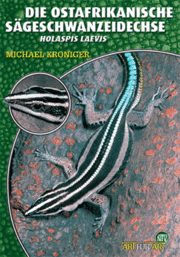
NTV The East African saw-tailed lizard
All about the East African saw-tailed lizard by Michael Kroninger
61 pages
14.8 x 21 cm
numerous colour photos
1st edition
Author Michael Kroninger
Publisher NTV
Contents:
They are brightly coloured, the always agile and lively saw-tailed lizards. It's no wonder that they are currently becoming increasingly popular, as these endearing, attractive animals are not only highly interesting reptiles, but also very easy to care for. Michael Kroninger is an experienced terrarium keeper and has been successfully breeding saw-tailed lizards for many years. In this volume of the "Species by Species" series, you will therefore find all the information you need for the species-appropriate care of these beautiful lizards. The fact that you will also learn how to breed your animals, hatch the eggs and raise the little ones makes this book an indispensable guide.
Systematics and body structure
The fascinating biology: From the life of the saw-tailed lizard
All information on species-appropriate keeping: from suitable terrariums to equipment and technology to feeding
Successful breeding: Mating stimulation, incubation of the eggs and rearing the young
Solutions to problems: How to avoid the most common mistakes in care and how to help sick animals
Brilliant photos
Reptilia 87 - Crocodiles - primeval animals in danger
Jewelled box turtleDesign of rainforest terrariumsLong-nosed snake, Rhynchophis boulengeriContents:Cover story: Crocodiles – primeval animals in dangerWhen the great dinosaurs ruled the world, crocodiles were already lurking for prey in the swamps of that era. These reptiles have not changed their design significantly for millions of years – a success story of evolution. It is only today that many species are on the brink of extinction because humans are killing them en masse and, above all, destroying their habitats. With the cover story of the next REPTILIA, a high-calibre team of experts opens a series of articles that shed light on the crucial role that zoos can play in saving these living fossils. Dieter Gramentz also presents the precarious situation of the swamp and saltwater crocodile in Sri Lanka, and Ralf Sommerlad reports on a hopeful project to preserve the extremely rare Siamese crocodile.Endangered crocodiles in Europe's zoological gardens? R. Sommerlad, F. Schmidt & T. Ziegler
Table of contents
Editorial MAGAZINE DATES WESTERN HERP PERSPECTIVES “Winter herping” in Florida B. Love
PHOTOSTORY Crocodiles – reptile giants in danger R. Sommerlad
REPORTAGE Endangered crocodiles in Europe's zoological gardens? R. Sommerlad, F. Schmidt & T. Ziegler
REPORTAGE A special conservation project, not only for crocodiles: Danau Mesangat R. Sommerlad
REPORTAGE Threats to and "conservation" of the swamp crocodile (Crocodylus palustris) and the saltwater crocodile (Crocodylus porosus) in Sri Lanka D. Gramentz
PORTRAIT AND POSTER Bufo bufo (Linnaeus, 1758). Common toadA. Kwet & J. Fieber
PRACTICE Near-natural design of rainforest terrariums D. Hluschi
KEEPING AND REPRODUCTION Information on the care, husbandry and breeding of the Vietnamese long-nosed snake, Rhynchophis boulengeri Mocquard, 1897 B. Schulz & K.-D. Schulz
KEEPING AND REPRODUCTION Care and breeding of the Eastern jewelled box turtle, Terrapene ornata ornata M. Wirth & H. P. Mattern
HERPETOFAUNA Black widows. Spiders of the genus Latrodectus C. Nagel & R. Hübers
SUBSCRIPTION & SERVICE ALSO NEAR YOU PREVIEW
INCUBATOR Borderlands. Part 2 H. Werning
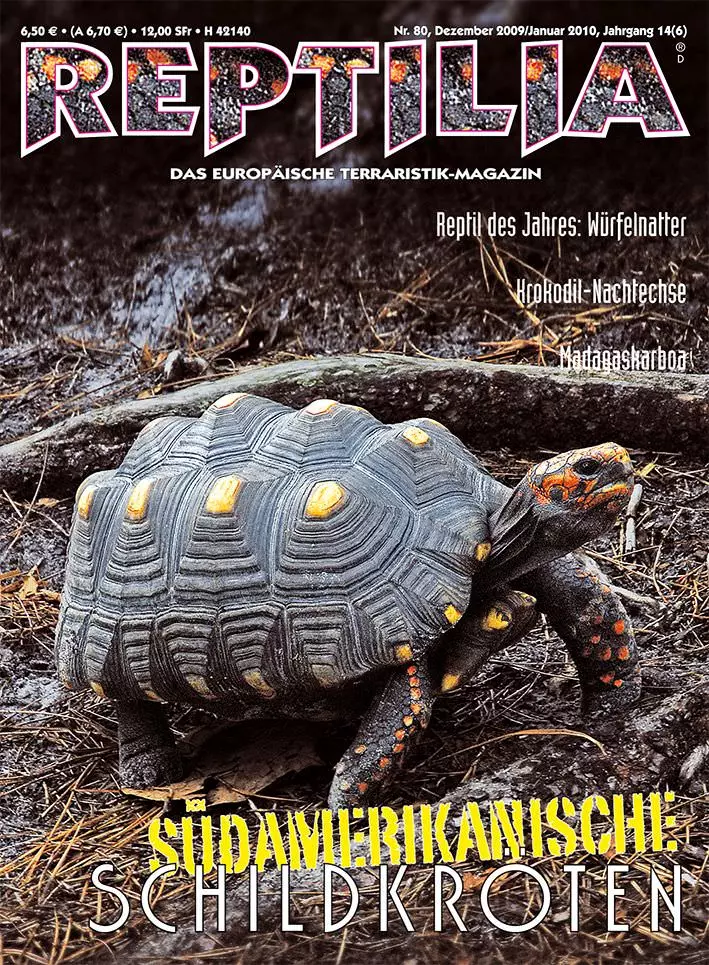
Reptilia 80 - South American turtles
Reptile of the Year: Dice snakeCrocodile night lizardMadagascar boa
Contents:
South America is home to a rich and diverse turtle fauna –especially as far as the aquatic species are concerned. Although some species from this continent are very popular in terraristics, such as the charcoal tortoise, little is known about others. Our lavishly illustrated photo story offers you an overview of the South American turtles, and experienced experts then present individual species in detail.
MAGAZINEDATES
WESTERN HERP PERSPECTIVESBad economic times – and theirconsequences for terraristicsBy B. Love
PHOTOSTORYSouth American turtlesby J. Valverde
HERPETOFAUNACharcoal tortoises in the Gran Chaco – adaptations to an extreme habitatby T. & S. Vinke
33 HERPETOFAUNAMesoclemmys zuliae – The mysterious toad-headed turtle from the south of Lake Maracaiboby F.J.M. Rojas-Runjaic
REPTILE OF THE YEARThe dice snake (Natrix tessellata), Reptile of the Year 2009by A. Kwet & K. Mebert
PORTRAIT AND POSTERNatrix tessellataby A. Kwet & K. Mebert
TRAVELIn the footsteps of Darwin through South AmericaPart 3: From the cold rainforest to the driest desertby H. Werning
KEEPING AND REPRODUCTIONAcrantophis dumerili – Keeping and breeding of the Southern Madagascar boaby M. Borer
KEEPING AND REPRODUCTIONThe yellow-spotted crocodile night lizard (Lepidophyma flavimaculatum) in the terrariumby U. Schlüter
FAQ – FREQUENTLY ASKED QUESTIONSHarduneby M. Dieckmann
LIBRARYSUBSCRIPTION & SERVICE ALSO NEAR YOU PREVIEW INCUBATORWhy we will be standing in front of unconscious civvies in old ageL. Hogeback
CHF 12.00
❅
❆
❅
❆
❅
❆
❅
❆
❅
❆
❅
❆
This website uses cookies to ensure the best experience possible. More information...