Handbook of forage plants 2nd revised editionMarion Minch is not only a successful breeder of diverse tortoises for many years, but also an excellent connoisseur of native wild herbs. She founded and runs samenkiste.de, which is well known to many tortoise keepers and nature lovers. Her name is inextricably linked with reptile care and species-appropriate nutrition for tortoises. Her handbook of food plants summarises the most important native food plants for herbivorous and omnivorous reptiles. She not only considers tortoises, but also iguanas, spiny-tailed dragons and even chameleons. From the basics of plant biology to native wild herbs to suitable food plants for hardy tropical reptile species, this comprehensive work provides the basis for species-appropriate keeping. In the expanded and supplemented 2nd edition, the plant section is divided according to flower colour. This makes it even easier to identify wild herbs. The work has also been supplemented with a wealth of additional information and many pictures.
Geckos in the terrarium by Astrid FalkThe book offers a comprehensive introduction to geckos and their species-appropriate keeping in terrariums. It explains what you need to think about before buying a gecko and what preparations should be made. The book describes in detail how the terrarium is technically equipped and set up. The care of the animals, their special features and behaviour, their diet, reproduction and rearing of young animals are described, as well as diseases and husbandry problems with tried and tested suggestions for prevention and treatment. Individual gecko species that are particularly suitable for keeping and breeding in terrariums are portrayed in detail in the second part of the book.
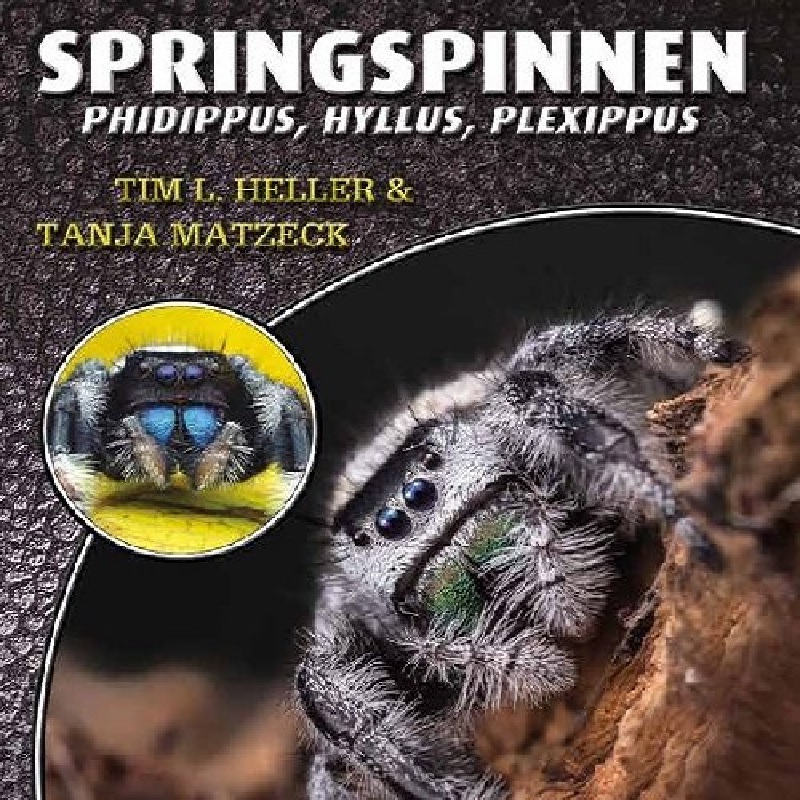
Book Jumping Spiders -
Phidippus, Hyllus & Plexippus
A guide to keeping jumping spiders of the genera Phidippus, Hyllus & Plexippus. Who can resist the charm of jumping spiders? The childlike appearance of their expressive face simply leaves no one cold! In addition, their behavior is extremely exciting to observe, their colors are bright and their requirements for species-appropriate keeping are very easy to meet. No wonder these likeable jumpers are all the rage!
This volume in the "Species by Species" series describes in detail what to look out for when buying and keeping them, introduces the most commonly kept species and color forms and provides plenty of tips on how to keep them successfully - so you can be sure they will breed well!
Species by Species introduces you to the books in this series, which present the most popular terrarium animals. Each volume offers you detailed, practical care instructions and all the information you need to successfully breed your animals.
All important questions from the required tank size to terrarium set-up, technical equipment, species-appropriate nutrition and disease prevention are answered with numerous tricks and tips.
Experienced, long-standing breeders reveal how you can encourage the animals to reproduce and raise healthy young.
All this in full color, generously illustrated and attractively designed - just about your terrarium animal - species by species
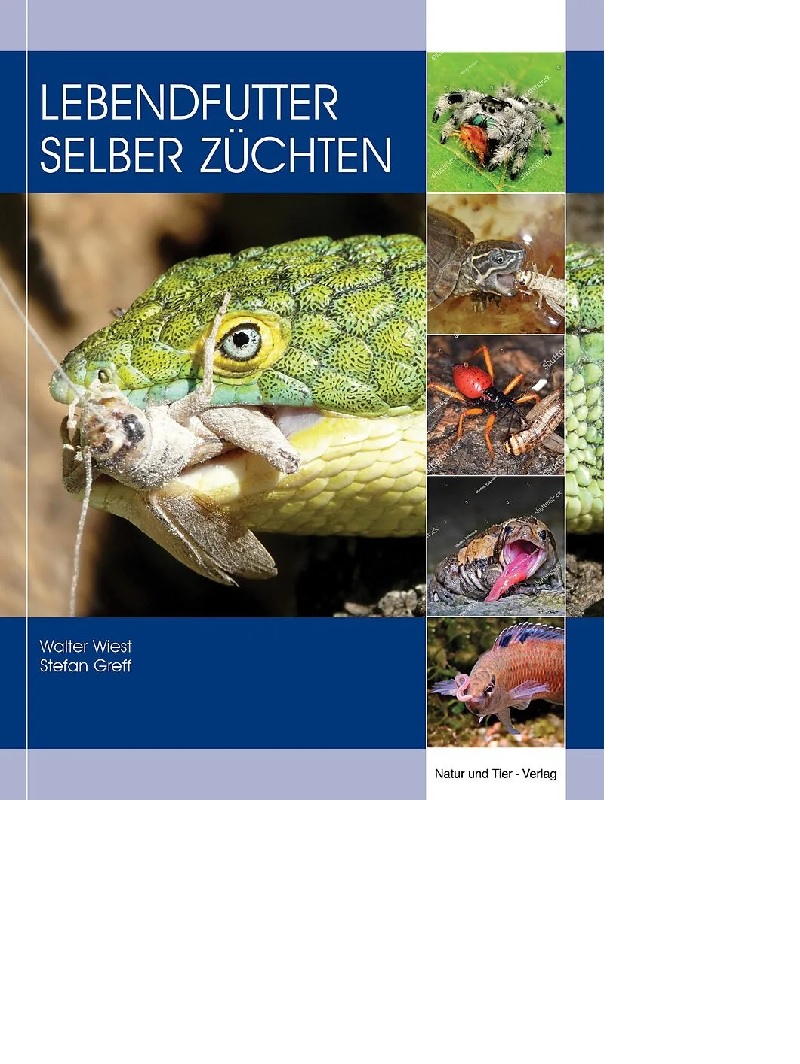
Book "Grow your own live food" - The perfect guide for pet owners
Discover practical and detailed instructions on how you can easily breed food for your reptiles, birds, fish or other animals yourself in the book "Breeding live food yourself". With valuable tips on various food insects, their care and breeding, you can save money and ensure a species-appropriate diet for your pets.
Contents of the book:
Step-by-step instructions for breeding feeder insects
Information on the best types of food for reptiles, birds and fish
Care instructions and breeding conditions for various live food species
Tips for sustainable and cost-effective food production
Why breed your own live food?
Get healthy, fresh food for your animals
Save money and reduce dependence on pet shops
Promote the health and well-being of your animals with species-appropriate food
Whether you are a beginner or an experienced pet owner, this book provides you with everything you need to successfully breed live food yourself.
Marginata 69 - New Guinea tortoises – the genus ElseyaCover storyThe unrecognised beauties: New Guinea tortoises (Andreas S. Hennig)My experiences with Branderhorst's New Guinea tortoise, Elseya (Elseya) branderhorsti (Ouwens, 1914) (Andreas S. Hennig)Keeping and breeding of Rhodin's New Guinea tortoise, Elseya (Hanwarachelys) rhodini Thomson, Amepou, Anamiato & Georges, 2015 (Andreas S. Hennig)PortraitGeoemyda spengleri, Chinese serrated tortoise (Andreas S. Hennig)ReportageMacrochelys temminckii – Experiences and impressions with vulture tortoises part 2 (Reiner Praschag)KeepingAn alternative to year-round keeping of the Egyptian tortoise in the terrarium – my experiences with seasonal outdoor keeping of Testudo kleinmanni (Ricarda Schramm)EtymologySawbacks and living maps part 4: Graptemys gibbonsi, Pascagoula humpback tortoise (Holger Vetter)Classifieds & animal placement
Reptilia 83 - ArgentinaAmphibian of the year: the pond newtUsambara bush viperPoison dart frog Ameerega trivittata - the orange variety Contents:Argentina is still an insider tip among travellers. The Pampa state is one of the most diverse countries in the world and is home to an extremely rich herpetofauna. In this huge South American country, you can marvel at sub-Antarctic glaciers, climb mountains almost reaching the 7,000 metre mark, hike through steaming rainforests, marvel at perhaps the most spectacular waterfalls in the world, traverse gigantic swamps or sweat in some of the hottest spots on the planet. And eat more fantastic beef than anywhere else. REPTILIA has asked leading Latin American experts on the country's reptiles and amphibians to introduce us to this "blank spot" on the map, which is not only home to some terraristic or well-known highlights such as the southern boa, black caiman, yellow anaconda or Argentine tortoise, but also to a large number of species that are largely unknown to us but are extremely interesting and fascinating - from the high-mountain iguana to the black toad.Table of contentsEDITORIALMAGAZINESeveral amphibian and reptile species newly included in the Washington Convention on International Trade in Endangered Species of Wild Fauna and Flora (CITIS)Alexander Gutsche Conservation status WA II for the entire genus AgalychnisTobias Eisenberg The earthquake in Chile in 2010Johara Bourke Information conference "Dangerous animals - keeping, trade and risks"Florian GieseDATESWESTERN HERP PERSPECTIVES"Florgia Herping"from B. LovePHOTOSTORYThe reptiles of Argentinaby S. WinchellHERPETOFAUNAThe Southern Boa or Argentine Boa, Boa constrictor occidentalisby T. & S. VinkeTERRARIUM PRACTICEThe Southern Boa (Boa constrictor occidentalis) and the mandatory marking requirementby H. & E. StöcklHERPETOFAUNAThe Red Teju, Tupinambis rufescensby T. & S. VinkeKEEPING AND REPRODUCTIONFringed-finger lizards (Acanthodactylus) in the wild and in the terrariumPart 5a: The Acanthodactylus scutellatus groupby U. SchlüterPORTRAIT and posterEpidalea calamita (Bufo calamita) (Laurenti, 1768). Natterjack toadvon J. M. Dehling & D. M. DehlingTRAVELThe orange variant of the poison dart frog Ameerega trivittata from the Nassau Mountains in Surinameby H. DivossenKEEPING AND REPRODUCTIONCare and breeding of the Usambara bush viper Atheris ceratophoraby Georg JachanKEEPING AND REPRODUCTIONThe Macrothele genus in the terrarium. Description, care and breedingvon R. HübersHERPETOFAUNAThe common newt (Lissotriton vulgaris) – Amphibian of the Year 2010by A. Kwet, A. Nöllert & J. HillLIBRARYBook review: Whistling frogs in Peru, Duellman & Lehr (2009): Terrestrial-breeding frogs (Strabomanidae) in PeruAndreas SchlüterBook review: Henkel & Schmidt (2009): Leopard GeckosMartin DieckmannSUBSCRIPTION & SERVICEALSO NEAR YOUPREVIEW
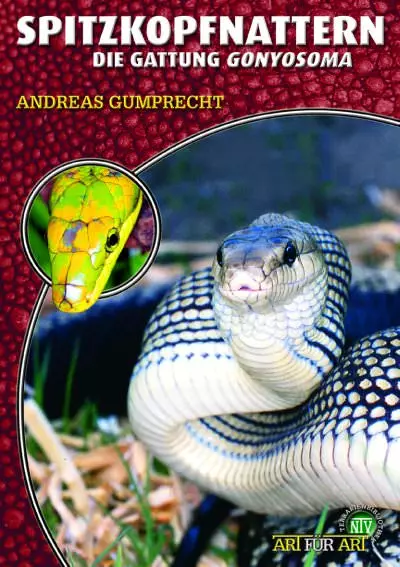
NTV - Pointed-headed snakes are one of the most popular snakes among snake lovers.
64 pages
Paperback
14.8 x 21 cm
numerous colour photos
Andreas Gumprecht
Contents:
Beautiful colouring, elegance and strength are combined in one of the most attractive snakes of all, the pointed-headed snake. No wonder it has long been one of the most sought-after snakes among snake lovers. The fact that it does not make any unrealistic demands in terms of keeping does the rest. Snake expert Andreas Gumprecht has been propagating this species for years and has also tracked it down in its natural habitats. In this volume of the "Species by Species" series, he therefore provides first-hand information on all the important aspects of the proper care of the pointed-headed snake. And as an additional delicacy, he also deals with the related Jansen's climbing snake. Tips and tricks on mating stimulation, incubating the eggs and rearing the young make this book an indispensable guidebook for anyone interested in the pointed-headed snake and/or Jansen's climbing snake.
Systematics and body structure
The fascinating biology: From the life of the pointed-headed snake and Jansen's climbing snake
All information on species-appropriate keeping: from suitable terrariums to equipment and technology to feeding
Successful breeding: Mating stimulation, incubation of the eggs and rearing the young
Solutions to problems: How to avoid the most common mistakes in care and how to help sick animals
Brilliant photos
Bugs No. 07 - Colourful tarantulas
Journey: Thailand and BorneoCockroaches: Deropeltis paulinoiRearing substrate: Flake SoilContents:Tarantulas are gloomy grey-brown? Not at all! Many species display fantastic, bright colours! We introduce you to the most beautiful representatives and show you how to keep and breed them using two species as examples.The colourful theme continues: Necroscia annulipes, one of the most colourful stick insects currently to be found in our terrariums, is presented. You can find out everything you need to know to keep them successfully in this issue of Bugs.Our travel report takes you to the forests of Thailand, where, for example, a lot of brightly coloured praying mantises live.For cockroach lovers we have an article about Deropeltis paulinoi – the authors report in detail about the breeding of this impressive species.In addition, of course, a number of other exciting topics are addressed, so that there will be something for fans of various invertebrate groups. Plus practical tips and news from the world of science and much more ...Table of contents
EditorialFacetsDatesFlown in
Cover storyColourful splendour on eight legs
Blue is beautiful!
FledgedA journey to the praying mantises and grasshoppers of Thailand and Borneo
Keeping & BreedingAbout the breeding of the privet hawk moth
PracticeFlake Soil – Quality offensive in beetle breeding
Keeping & BreedingTurquoise blue stick insect
CultureCockroaches in the mouth
Keeping & BreedingVelvet cockroaches – Noble terrarium inhabitants
Kids CornerA chirping and chirping
Book scorpionAlso in your neighbourhoodService & ImprintPreview
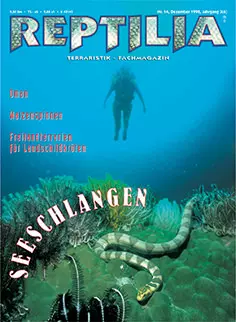
Reptilia 14 - Sea snakes
OmanSea spidersOutdoor terrariums for tortoises
Contents:
Page 2 - EditorialPage 3 - Letters to the editorPage 6 - MagazinePage 12 - Western Herp Perspective: Colour breeding of leopard geckos, by B. LovePage 14 - Report: Spectacular new discoveries within the Pacific monitor group, by T. Ziegler, W. Böhme and U. SchweersPage 17 - DatesPage 18 - Photo report: Sea snakes, by Dr M. GaulkePage 26 - Herpetofauna: Penlder between the tropical tides: The life of the sea cobra Laticauda colubrina, by H. K. Voris and H. H. VorisPage 34 - Report: Sea snakes as a commodity, by Dr M. GaulkePage 40 - Travelogue: A herpetological expedition through Oman, by F.-W. HenkelPage 47 - Portrait and poster: Uroplatus fimbriatus, by M. Aresté and J. L. FarriolsPage 51 - Report: Threatened with extinction - The iguana of Utila, by Dr G. KöhlerPage 58 - Keeping and breeding: Palms and other exotic plants for the tortoise outdoor terrarium, by J. BruekersPage 62 - Report: O ferreiro The blacksmith - Biology of a remarkable tree frog, by A. KwetPage 68 - Keeping and breeding: The camel spider Galeodes orientalis - Observations on behaviour and lifestyle, by H. EsterbauerPage 74 - Herpetology and culture: The snake in Celtic mythology, by L. Batista Carissimi-PrioriPage 81 - Reptilia on the road: Rotterdam Zoo, by H. WerningPage 88 - Advice and helpPage 91 - LibraryPage 96 - Hatchery: Depressive fauna, by L. Lewejohan
Reptilia 64 - Web spidersColour variations of the web pythonAmerican tree frogChamaeleo montiumContents:
2 EDITORIAL
3 MAGAZINE
12 DATES
16 WESTERN HERP PERSPECTIVESThe thing with the rubbishFrom B. Love
18 PHOTO REPORTAGEWeb spiders and their amazing survival strategiesBy F. Tomasinelli
26 REPORTAGEThe thousand uses of spider silk - from catching prey to brood careBy F. Tomasinelli
31 KEEPING AND REPRODUCTIONBiology and breeding of hunting spiders of the genus CupienniusBy F. Tomasinelli
35 ARACHNOFAUNAThe European Tarantulas - Introduction to the genus Lycosa in Western EuropeBy E. Biggi & F. Tomasinelli
40 TRAVELWestern emerald lizards(Lacerta bilineata) on the Atlantic coast in BrittanyBy W. & Y. Lantermann
44 TRAVELWith harpoon and machete - the hunt for moor caimans in the AmazonasBy P. Ulmer
51 PORTRAIT AND POSTERMacropisthodon flavicepsBy A. Gumprecht & D. Trautmann
56 KEEPING AND REPRODUCTIONThe breeding of the American tree frog, Hyla cinerea (SCHNEIDER 1799), in the aquarium of Cologne ZooBy K. van der Straeten, D. Karbe, S. Olbort & T. Ziegler
64 KEEPING AND REPRODUCTIONKeeping offspring of the mountain chameleon, Chamaeleo (Trioceros) montiumBy T. Paechl
70 REPORTAGEUnknown diversity: colour and pattern variations of the reticulated python(Python reticulatus)By K. Wöllner
75 HERPETOFAUNAHydromedusa maximiliani - The Brazilian snake-necked tortoiseBy F. L. Souza
80 HUSBANDRY AND REPRODUCTIONCare and breeding of the Peruvian leaf-fingered gecko Phyllodactylus reissi (PETERS 1862)By U. Schlüter
87 FAQ - FREQUENTLY ASKED QUESTIONSAnacondasBy L. Dirksen
94 LIBRARY
104 BRUTKASTENHigh mountain hallucinations, part 2By H. Werning
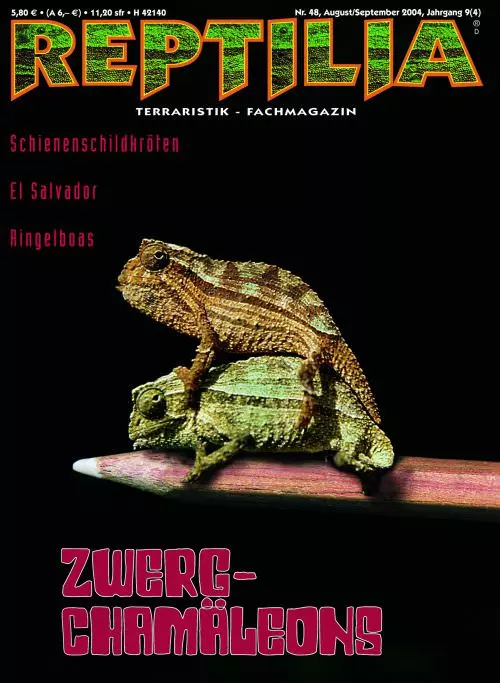
Reptilia 48 Dwarf Chameleons
Rail turtlesEl SalvadorRing-tailed boas
Contents:
2 EDITORIAL
4 MAGAZINE
12 DATES
16 WESTERN HERP PERSPECTIVESThe Cutsby B. Love
18 PHOTO REPORTAGE Mysterious mini-dragons – The ground and stub-tailed chameleons of the genera Brookesia and Rhampholeonby P. Necas and W. Schmidt
28 KEEPING AND BREEDINGKeeping and breeding of the short-tailed chameleon Rhampholeon brevicaudatus?
by N. Lutzmann, S. Esser, A. Flamme & H. Schneider
34 HERPETOFAUNAThe low-frequency vibration of chameleons – New findings about a peculiar behaviour
by N. Lutzmann
38 REPORTAGEPiggyback to the weddingWhy do some female chameleons carry the males on their backs?
by N. Lutzmann
41 REPORTAGEThe desert in your own house
by H. Zorn
45 TRAVELEl Imposible – The impossible is possibleThe national park "El Imposible" in El Salvador
by T. Leenders
51 PORTRAIT AND POSTERMantis religiosaby B. Trapp
56 HERPETOFAUNAComments on the current situation of the rail turtles Podocnemis expansa and Podocnemis unifilis in Boliviaby J. Knaak
65 KEEPING AND BREEDINGThe ring-tailed boa (Corallus annulatus annulatus)A little-known jewel in the terrarium by S. Wirz
72 REPORTAGEEndemic terrestrial salamanders of the Italian mainlandby F. Pasmans and S. Bogaerts
80 REPORTAGEPlanning and construction of a reptile zoo: "Reptilium - Terrarium and Desert Zoo" in Landau - Part 3: The Openingby H. Werning
90 LIBRARY
91 CLASSIFIEDS
96 RAT & TAT
104 GLOSSA family history. Part 2by H. Werning
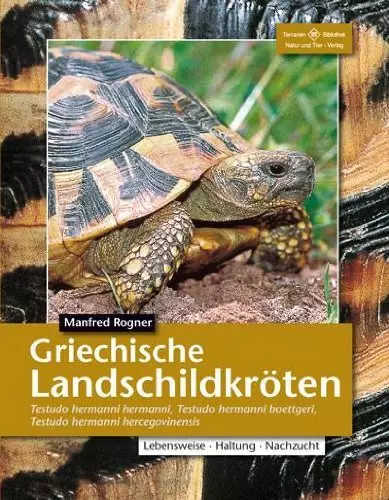
Book Greek tortoises
The Greek tortoise is a true classic of terraristics.
167 pages
with numerous mostly coloured illustrations and maps
Paperback
Author Manfred Rogner
Publisher NTV
Their attractive appearance and friendly character mean that they are rightly at the top of the list of favourites among tortoise lovers. For decades, the experienced terrarium keeper Manfred Rogner has been caring for and breeding this attractive species with great success, which he has also observed in their habitat.In this guide, he describes everything you need to know about the species-appropriate keeping and breeding of your armoured pets in a clear and practical way.
CHF 35.50
❅
❆
❅
❆
❅
❆
❅
❆
❅
❆
❅
❆
This website uses cookies to ensure the best experience possible. More information...