Reptilia 04 - Bird spiders

Article no: reptilia04

CHF 9.80

Stock: 0

This article is currently not available

Product information "Reptilia 04 - Bird spiders"

Reptilia 04 - Tarantulas

Skink
Thailand
Mysticism & superstition

Contents:

Page 2 - Editorial
Page 3 - Letters to the editor
Page 6 - Magazine
Page 17 - Photo reportage: Tarantulas, by P. Klaas
Page 23 - Keeping and reproduction: Keeping and breeding tarantulas, by P. Klaas
Page 26 - Terraristics and law: Legal issues in keeping spiders and scorpions, by D. Rössel
Page 27 - Report: A feast of tarantulas, by R. West
Page 30 - Psychology: Arachnophobia, by L. Hogeback
Page 33 - Travelogue: Thailand - Mecca of herpetological tourism, by J. Bergadá
Page 37 - Travelogue: The snake farm of Bangkok, by J. Viader
Page 39 - Portrait and poster: Chondropython viridis, by M. Aresté and J. L. Farriols
Page 43 - Herpetofauna: Skinks, by P. Gassner and A. Hauschild
Page 50 - Reptilia on the road: Terrarium displays, by H. Werning
Page 54 - Terraristics and law: Snake keeping in residential property and tenancy law, by D. Rössel
Page 57 - Herpetology and Culture: Magic and Superstition, Part 1: Turtles and Amphibians, by L. B. Carissimi-Prior
Page 62 - Terraristics: Egg-laying problems with tortoises, by E. Meier
Page 69 - Supplement: Venomous snakes
Page 74 - Advice and action
Page 76 - Library
Page 80 - Incubator: Glossary by H. Werning

Composition
Feeding recommendation
Technical details
Size information

0 of 0 reviews

Give us a rating!

Share your experience with the product with other customers.


Suggested products

Handbook of food plants for tortoises and other reptiles
Handbook of forage plants 2nd revised editionMarion Minch is not only a successful breeder of diverse tortoises for many years, but also an excellent connoisseur of native wild herbs. She founded and runs samenkiste.de, which is well known to many tortoise keepers and nature lovers. Her name is inextricably linked with reptile care and species-appropriate nutrition for tortoises. Her handbook of food plants summarises the most important native food plants for herbivorous and omnivorous reptiles. She not only considers tortoises, but also iguanas, spiny-tailed dragons and even chameleons. From the basics of plant biology to native wild herbs to suitable food plants for hardy tropical reptile species, this comprehensive work provides the basis for species-appropriate keeping. In the expanded and supplemented 2nd edition, the plant section is divided according to flower colour. This makes it even easier to identify wild herbs. The work has also been supplemented with a wealth of additional information and many pictures.

CHF 46.50

Geckos
Geckos in the terrarium by Astrid FalkThe book offers a comprehensive introduction to geckos and their species-appropriate keeping in terrariums. It explains what you need to think about before buying a gecko and what preparations should be made. The book describes in detail how the terrarium is technically equipped and set up. The care of the animals, their special features and behaviour, their diet, reproduction and rearing of young animals are described, as well as diseases and husbandry problems with tried and tested suggestions for prevention and treatment. Individual gecko species that are particularly suitable for keeping and breeding in terrariums are portrayed in detail in the second part of the book.

CHF 28.50

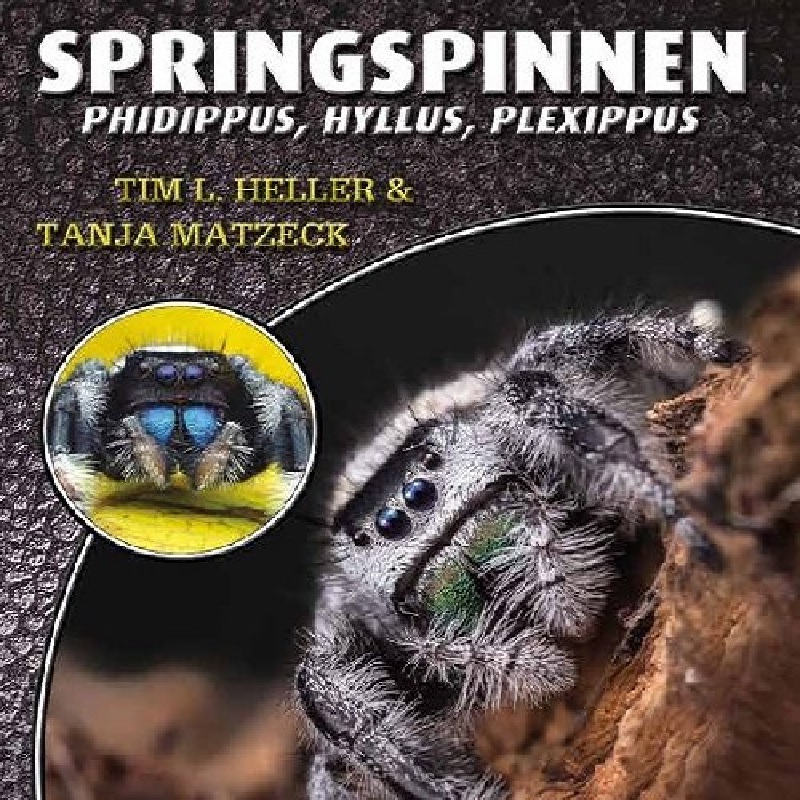
Jumping spiders Phidippus, Hyllus, Plexippus
Book Jumping Spiders - Phidippus, Hyllus & Plexippus A guide to keeping jumping spiders of the genera Phidippus, Hyllus & Plexippus. Who can resist the charm of jumping spiders? The childlike appearance of their expressive face simply leaves no one cold! In addition, their behavior is extremely exciting to observe, their colors are bright and their requirements for species-appropriate keeping are very easy to meet. No wonder these likeable jumpers are all the rage! This volume in the "Species by Species" series describes in detail what to look out for when buying and keeping them, introduces the most commonly kept species and color forms and provides plenty of tips on how to keep them successfully - so you can be sure they will breed well! Species by Species introduces you to the books in this series, which present the most popular terrarium animals. Each volume offers you detailed, practical care instructions and all the information you need to successfully breed your animals. All important questions from the required tank size to terrarium set-up, technical equipment, species-appropriate nutrition and disease prevention are answered with numerous tricks and tips. Experienced, long-standing breeders reveal how you can encourage the animals to reproduce and raise healthy young. All this in full color, generously illustrated and attractively designed - just about your terrarium animal - species by species

CHF 23.90

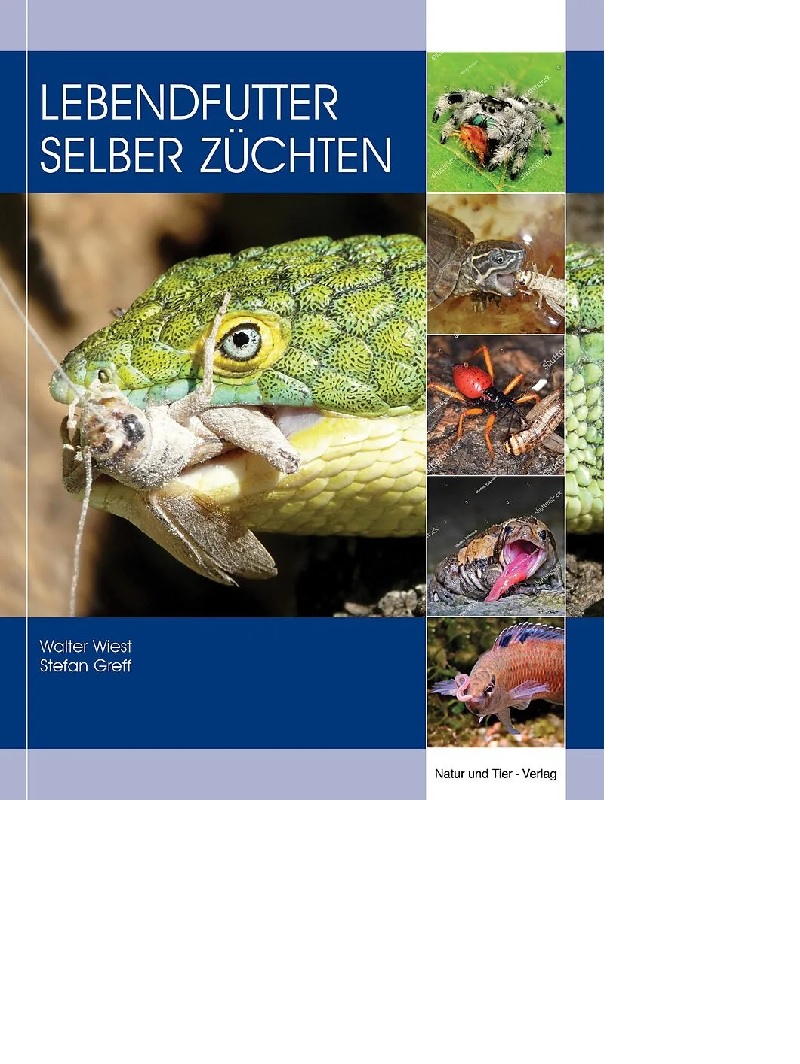
Book Breeding live food yourself
Book "Grow your own live food" - The perfect guide for pet owners Discover practical and detailed instructions on how you can easily breed food for your reptiles, birds, fish or other animals yourself in the book "Breeding live food yourself". With valuable tips on various food insects, their care and breeding, you can save money and ensure a species-appropriate diet for your pets. Contents of the book: Step-by-step instructions for breeding feeder insects Information on the best types of food for reptiles, birds and fish Care instructions and breeding conditions for various live food species Tips for sustainable and cost-effective food production Why breed your own live food? Get healthy, fresh food for your animals Save money and reduce dependence on pet shops Promote the health and well-being of your animals with species-appropriate food Whether you are a beginner or an experienced pet owner, this book provides you with everything you need to successfully breed live food yourself.

CHF 46.50

Marginata 69 - New Guinea tortoises
Marginata 69 - New Guinea tortoises – the genus ElseyaCover storyThe unrecognised beauties: New Guinea tortoises (Andreas S. Hennig)My experiences with Branderhorst's New Guinea tortoise, Elseya (Elseya) branderhorsti (Ouwens, 1914) (Andreas S. Hennig)Keeping and breeding of Rhodin's New Guinea tortoise, Elseya (Hanwarachelys) rhodini Thomson, Amepou, Anamiato & Georges, 2015 (Andreas S. Hennig)PortraitGeoemyda spengleri, Chinese serrated tortoise (Andreas S. Hennig)ReportageMacrochelys temminckii – Experiences and impressions with vulture tortoises part 2 (Reiner Praschag)KeepingAn alternative to year-round keeping of the Egyptian tortoise in the terrarium – my experiences with seasonal outdoor keeping of Testudo kleinmanni (Ricarda Schramm)EtymologySawbacks and living maps part 4: Graptemys gibbonsi, Pascagoula humpback tortoise (Holger Vetter)Classifieds & animal placement

CHF 16.50

NTV - Water dragons and sail lizards
The author of NTV - Wasseragamen und Segelechsen describes everything about keeping and caring for these interesting terrarium animals. 127 pages 118 colour photos and 6 map drawings Paperback About water dragons and sea lizards Author Heiko Werning The large water dragons of the genus Physignathus are undoubtedly among the most attractive and interesting terrarium animals. Their impressive shape, their primeval appearance reminiscent of mythical creatures and their lively behaviour have fascinated entire generations of terrarium keepers. Unfortunately, the popularity of water dragons has not been sufficiently recognised in the literature to date. This monograph by REPTILIA editor Heiko Werning completely fills this gap. It contains all the important information on the biology, origin and care of these animals. The breeding of the green water dragon Physigathus cocincinus, which the author has already successfully bred many times, is dealt with in particular detail. The author also describes the lesser-known genus Lophognathus in detail. In addition to the water dragons, the anatomy and behaviour of the Hydrosaurus lizards, which are similar in appearance, are also discussed. The book is characterised by Werning's practical approach and detailed knowledge: it is not only an absolute must for all terrarium keepers who are interested in these fascinating lizards, but also has scientific merit.

CHF 35.90

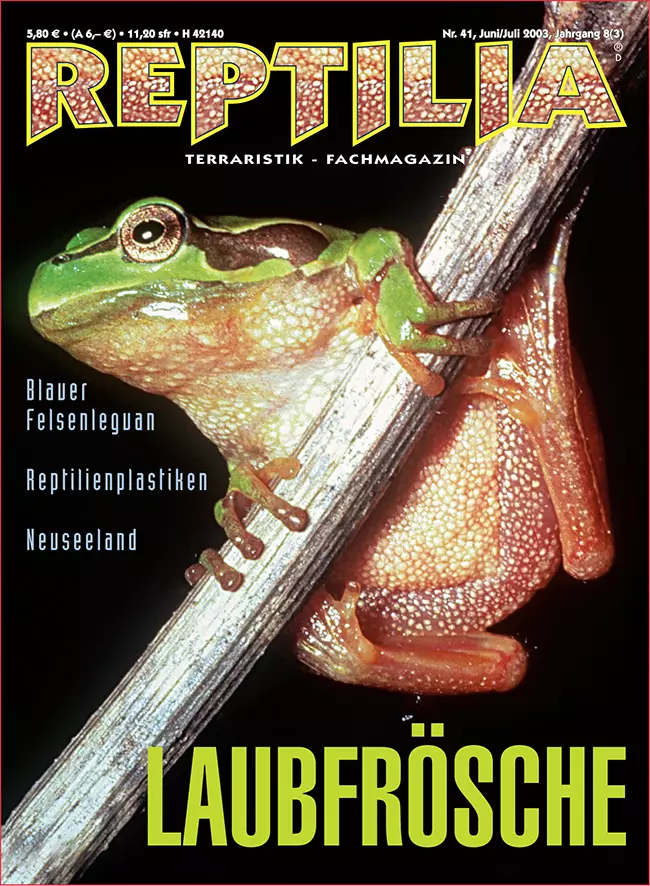
Reptilia 41 - Tree Frogs
Reptilia 41 - Tree frogs Blue rock iguanaReptile sculpturesNew Zealand Contents: 2 EDITORIAL 3 READER LETTERS 5 MAGAZINE 15 DATES 18 WESTERN HERP PERSPECTIVESAbout taming terrarium animalsby B. Love 22 PHOTO REPORTAGETree frogsby M. S. Staniszewski 28 REPORTAGEThe tree frogs of the genus Hyla in Venezuela by C. M. Barrio Amorós 33 REPORTAGETree frogs in northern Australia by B. Akeret 40 REPORTAGEThe toad tree frogs of the genus Phrynohyas in the Brazilian coastal rainforest by A. Kwet 45 HERPETOCULTUREOf bronze reptiles and colourful repro-sculpturesby U. Krabbe-Paulduro & E. Paulduro 51 PORTRAIT AND POSTERTestudo marginataby B. Trapp 56 TRAVEL100% Pure New Zealand?by M. Gaulke & A. Altenbach 65 KEEPING AND BREEDINGThe copperhead (Agkistrodon contortrix) – a “beginner’s” snake? Part 2by D. Schmidt 72 KEEPING AND BREEDINGPetrosaurus thalassinus (COPE, 1863) – the Blue rock iguana.Care, keeping and breedingby A. Dickhoff 84 SMALL ADS 88 ADVICE & SUPPORT 92 LIBRARY 104 ESSAYA REPTILIA romance (para Kriton)by H. Werning

CHF 11.20

Marginata 19 - Soft-shelled turtles
Marginata 19 - Soft-shelled Turtles The turtles of Nova ScotiaTurtle genetics Part IIISnapping turtles Contents: 2Editorial3 Letters to the Editor4Magazine8 Dates10Reportage The family of soft-shelled turtles – a more than fascinating group of turtles by Hans-Dieter Philippen16ReportageThe Red-backed Flap- Soft-shelled Turtle (Cycloderma aubryi) – a special beauty from the Congo by Gunther Köhler & Herbert Nigl22Breeding in Human CareKeeping and breeding of the Indian Flap-backed Soft-shelled Turtle (Lissemys punctata punctata)by Christina Schäfer31ProfileOrnate Box Turtle, Terrapene ornata ornataby Hans - Dieter Philippen35 ReportageFeeder Animals Part 2Hans - Dieter Philippen40ReportageFrom the pea experiment to decoding of the human genome – Genetics yesterday and today Part 3 by Jens R. Poschadel & Martin Platz46ReportageA journey to the turtles of Nova Scotia in Canada by Herbert Becker, Andreas Gräf & Urs Landweer55ReportageThe snapping turtle problem, a problem to be taken seriously by Markus Baur, Tobias Friz & Rudolf Hoffmann60Book Tip61Classifieds62Regional Guide

CHF 14.70

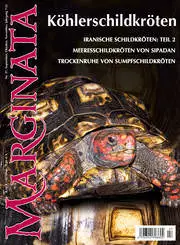
Marginata 27 - Red-footed tortoise
Marginata 27 - Charcoal-burning tortoise Iranian tortoises: Part 2Sea turtles from SipadanDry resting of pond turtles Contents: EditorialMagazineDates REPORTAGEThe Charcoal-burning tortoise (Chelonoidis carbonaria)Hans - Dieter Philippen REPORTAGECharcoal-burning tortoises (Chelonoidis carbonaria ssp.) observed in the wild in the Lesser AntillesPeter Fehringer BREEDINGAlmost 40 years of keeping and breeding tortoises using the charcoal-burning tortoise as an example Victor Mislin REPORTAGECharcoal-burning tortoises on the island of Barbuda – an unusual experience during a short stayPeter Fehringer REPORTAGEAlbino charcoal-burning tortoises – a common mutationHans – Dieter Philippen POSTERThe Western Malayan pond turtleHans - Dieter Philippen REPORTAGESipadan – the island of sea turtlesPetra Jungnickel & Jens Jungnickel REPORTAGEObservations of freshwater turtles in Iran Part 2: Mauremys caspicaMarkus Auer & Mario Herz REPORTAGEAestivation of European pond turtles in SpainJochen Meyer BREEDINGComments on the breeding of Pyxidea m. mouhotii and P. m. obsti as well as observations on plastron colouration of the juveniles Herbert Becker REPORTAGEAdder eats European pond turtle Michael Wirth Book tipClassifiedsSubscription & ServiceRegional guide

CHF 16.50

Terraria 18 - Building of large terrariums
Terraria 18 - Building Large Terrariums In the rainforests of MadagascarGiant salamander Contents: 2 Editorial Mike ZAWADZKI4 Magazine Remarkable import: Grave frogs of the genus Calluella/DGHT once again a member of the BNA – Opening of a new BNA- training centre in Hambrücken/ 24th Terraristikbörse Karlsruhe in new hall/Legal/Reference/Vegetarian cravings of a garter snake?/Marketplace12 TERRAglobal All beginnings are difficult Maik DOBIEY The forgotten "insufficient data" species Mirco SOLÉ Cover story: Building Large Terrariums16 17 square metres of rainforest Wolfgang DAHM26 When they grow larger – the relocation of the caimans Matthias SCHMIDT35 A terrarium wall for tropical tortoises (Testudinidae) Erica HAMERS & Hans – Dieter PHILIPPEN40 Construction of a large wooden terrarium for diamond pythons Sascha ESSER43 The Kárpathos water frog (Rana cerigensis or Pelophylax cerigensis): Taxonomic change and acute endangerment Hans-Jürgen LUEF50 Giant salamanders of the genus Andrias – a Japanese-Chinese relationship Lutz DIRKSEN58 To the knowledge of an unknown: Cricosaura typica, the Cuban night lizard Ansel FONG G. & Irelis BIGNOTTE-GIRÓ64 Journey Silky sifakas and flat-tailed geckos – the Marojejy National Park Peter KRAUSE & Sebastian WOLF77 New species The smallest frog of the South American Andes Axel KWET A “feather-tailed gecko” from the south-western Angola Mirko BARTS New tree frogs in Europe Axel KWET80 Among researchers The diversity of amphibian species in a lowland rainforest in Borneo Alexander KELLER83 A visit to the Museo da Historia Natural de Asunción, Paraguay Uwe SCHLÜTER88 Near you91 Subscription & Service94 Preview96 Incubator The lizard wall Mike ZAWADZKI 

CHF 12.00

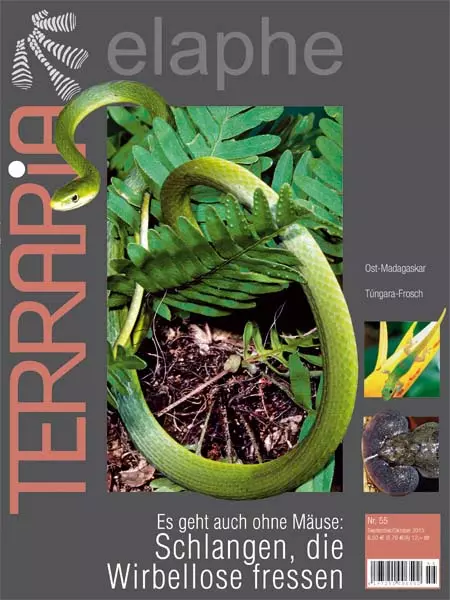
Terraria 55 - Snakes eating invertebrates
Terraria 55 - Snakes that eat invertebrates Túngara frogEast Madagascar Contents: Cover story: It works without mice: Snakes that eat invertebrates Most snakes in terraria have to be fed on rodents. However, there are a whole range of often lesser known but highly interesting species that exclusively eat invertebrates such as insects, snails and others. We present a selection of the most interesting representatives and discuss in detail the dwarf snakes of the genus Eirenis and the brown snakes of the genus Storeria. We also reveal how to breed slugs for feeding snail-eating snakes. Territorial HerpetoramaWorld's first reproduction of an endangered clawed frog species: Xenopus longipes Species diversity on the display Thorny devil: Kermit frog in Costa Rica Cultural followers: The reign of the terror lizards Pappochelys – a 240 million year old “turtle grandpa” Poison dart frog: Death of a turtle breeder Cover storySnakes that eat invertebratesKriton Kunz Terraristic remarks on the snakes of the genus StoreriaFrank Täufer Habitat and terrarium observations on dwarf snakes of the genus Eirenis from south-west SyriaHans Esterbauer Collect and breed slugsHerbert Stern PanoramaDiary of a trip to eastern Madagascar. Visiting the Marojejy National Park and the Betampona Nature ReservePeter Baert Research New speciesNew moccasin snakes in North AmericaAxel Kwet Among researchersHerpetology in theory and practice A journey to the Caribbean north of ColombiaClaudia Koch Salamandra TerraristicsFoam maker and top model. Exciting things surrounding the Túngara frog.Part 1: Behaviour and bioacousticsKriton Kunz Bibliography Ophiophagy in snakes in terrariaDieter Schmidt Nature and species protection Field notesGrass snakes hunting newtsRudolf Malkmus Common toad clings to common carpJörn Krütgen Children's page on the reptile of the year: The European pond turtle The snake plagueAxel Hilger & Axel Kwet Amphibian action plan for northwest BrazilMirco Solé Also in your areaSubscription & ServicePreview Incubator No gecko at allRolf Leptien

CHF 12.00

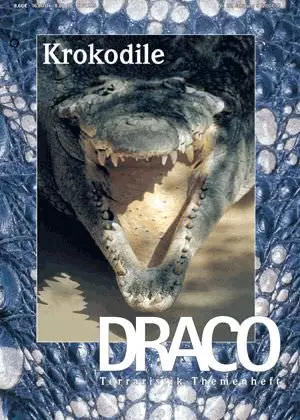
Draco 20 - Crocodiles
Draco 20 - Crocodiles Contents: 2 Editorial 4 The agamas of the worldMirko Barts & Thomas Wilms 24 On keeping Philippine sailfin lizards (Hydrosaurus pustulatus)Jiři Gábriš 34 On aggressive encounters among free-living butterfly agamas (genus Leiolepisy CUVIER), with a form of locomotion previously unknown in vertebrates/Wolfgang Böhme 40 In profile: the Vietnamese butterfly lizard (Leiolepis guttata CUVIER, 1829)Uwe Schlüter 42 On keeping and breeding two taxa from the Uromastyx-acanthinura complex: Uromastyx geyri MÜLLER, 1922 and Uromastyx dispar flavifasciata MERTENS, 1962 (Reptilia: Agamidae: Leiolepidinae: UromastyxThomas Wilms, Dieter Ruf & Beate Löhr 56 Agama impalearis (BOETTGER, 1874) – the Atlas agama, well-known and rare in the terrariumHans D. Müller 64Notes on keeping and breeding the lyre-headed lizard, Lyocephalus scutatus (LINNAEUS, 1758) Uwe Bartelt 70The agamas of southern AfricaMirko Barts 80 Experiences with the blue-throated angulate-headed lizard (Gonocephalus bellii) in the terrariumIngo Kober 87 Book box 94 Magazine

CHF 16.80