History of the Irish Terrier
The Irish Terrier is considered to be one of the oldest Irish terrier breeds. Before the 1880s, the coat color was not yet uniform; in addition to red dogs, there were also black and tan and brindle animals. Towards the end of the 19th century, the red coat color became established. Originally, the breed was a versatile farm dog that was used as a guard dog, companion dog and hunting dog.
Appearance
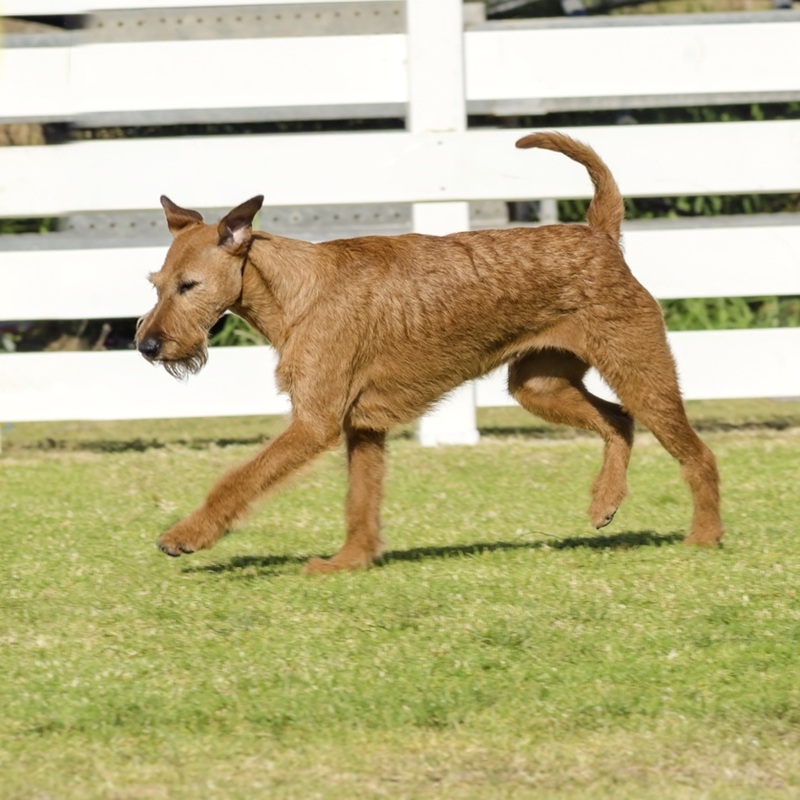
Body shape: The Irish Terrier is active, lively, tall and wiry. He should have a lot of substance, but not appear clumsy or heavy. Typical is his elegant, fast and enduring appearance with an athletic line.
Coat: The coat is hard, wiry and lies close to the body. It should offer protection and be weatherproof. There is usually a slightly longer beard on the muzzle, which gives the face the typical terrier-like expression. In terms of colour, the Irish Terrier is recognized in various shades of red.
Nature/character
The Irish Terrier is considered courageous, spirited, loyal and people-oriented. In the standard, it is described as good-natured and affectionate towards people, but at the same time very brave and defensive when challenged. His self-confident, alert and lively nature is typical.
Grooming
Grooming is generally straightforward, but the wiry coat needs regular attention. Brushing alone is often not enough, as dead hair often has to be removed from rough-haired breeds. Trimming is usually advisable to keep the coat in good condition. Ears, claws, teeth and paws should also be checked regularly.
Health
The Irish Terrier is generally regarded as a robust and hardy breed. Nevertheless, as with any breed, attention should be paid to responsible breeding, good weight management and regular veterinary check-ups. Depending on the line, occasional skin problems, eye problems or other hereditary diseases can play a role, but overall the breed is not considered to be heavily overbred.
Training
Training should be clear, fair and consistent. The Irish Terrier is intelligent and capable of learning, but has an independent character typical of terriers. It therefore needs early socialization, reliable rules and calm, confident leadership. Harsh methods are unsuitable because they often encourage resistance rather than trust.
What are the special features of this breed?
What is special about this breed is the mixture of elegance, courage and temperament. The Irish Terrier is not a quiet, comfortable dog, but a self-confident companion with a strong character. He has a lot of personality, is alert and often closely bonded to his people. His striking red, wiry coat and energetic appearance make him very distinctive.
Suitable for first-time dog owners?
Conditionally. A committed first-time dog owner can get on well with an Irish Terrier if they are prepared for consistent training, terrier character and sufficient activity. However, the breed is not completely uncomplicated because it can be independent, courageous and sometimes quite temperamental.
Family dog or not?
Yes, in principle the Irish Terrier can be a good family dog. They are people-oriented, loyal and often very affectionate. They are best suited to active families who enjoy a lively, self-confident dog and can provide clear rules. Because of its temperament and its typical terrier independence, good training is particularly important.