German Shepherd Dog
History of the Scottish Terrier
Scheduled breeding began in 1899 after the founding of the German Shepherd Dog Association. The breed was developed from Central German and Southern German herding dog breeds with the aim of creating a powerful working dog.
Appearance
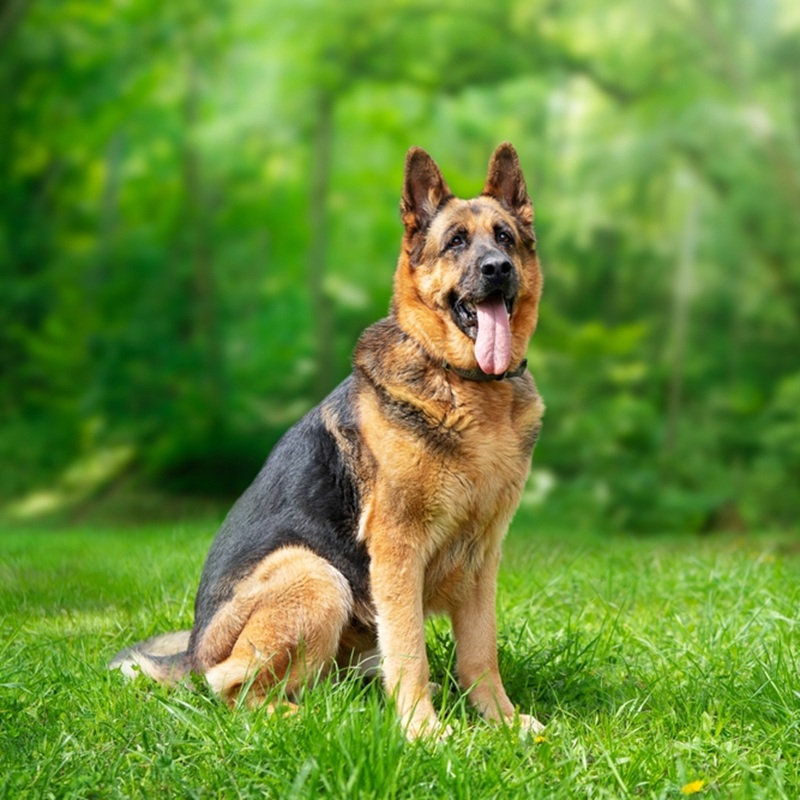
Build: medium-sized, slightly elongated, sturdy, well-muscled and generally solidly built. Typical features include the wedge-shaped head, erect ears and the ground-covering, springy gait when trotting.
Coat:
The coat is functional, weatherproof and has an undercoat. It provides good protection against cold and wet conditions, but sheds significantly, particularly during the moulting season. The long-haired variety usually requires slightly more grooming than the short-haired variety.
Nature/character
According to the standard, the German Shepherd Dog should be balanced, steady of nerve, self-confident, attentive and easy to handle. Properly bred and well socialised, it is loyal, willing to learn and very closely bonded to its owner. At the same time, it is not a dog that just runs "on the side" - it needs tasks, structure and mental exercise.
Grooming
The coat should be brushed regularly, much more frequently when shedding. Claw, ear and dental care are also important. Even more important than grooming, however, is daily mental and physical exercise for German Shepherds. Sport, nose work, obedience, tracking or other tasks are often very suitable.
Health
Like many larger breeds, the German Shepherd Dog can be susceptible to hip dysplasia (HD) and elbow dysplasia (ED); the breed is also tested for degenerative myelopathy (DM). When selecting a puppy, serious breeding, proof of the health of the parents and a moderate, non-stressful upbringing are particularly important.
Education
The German Shepherd Dog is very capable of learning, but is also sensitive to leadership errors. It needs calm, clear, fair and consistent training without harshness. Early socialisation, environmental training, impulse control and reliable everyday rules are crucial. With good guidance, he is often extremely trainable.
What are the special features of this breed?
The German Shepherd is a classic working and utility dog. Its great strength is its combination of intelligence, willingness to bond, eagerness to learn and willingness to work. This is exactly what makes him so versatile - but also demanding. He usually needs more than just walks: he wants to think, work and be kept busy in a meaningful way. Without suitable exercise, he can quickly develop undesirable behaviour.
Suitable for first-time dog owners?
Only conditionally. For committed beginners with a lot of time, willingness to learn, dog school and a clear everyday concept, it can work. For people who are looking for an uncomplicated "follower", the German Shepherd is usually not the best choice. They are less forgiving of training mistakes than many less complicated family breeds.
Family dog or not?
Yes, but not automatically. In the right family, he can be a very loyal, watchful and child-loving dog. The prerequisites are good breeding, early socialisation, clear leadership and sufficient activity. On the other hand, he often becomes difficult in a low-stimulus, underchallenged or inconsistent environment. It is best suited to active people who really enjoy training and working with the dog.


.jpg "Sitting Boston Terrier")