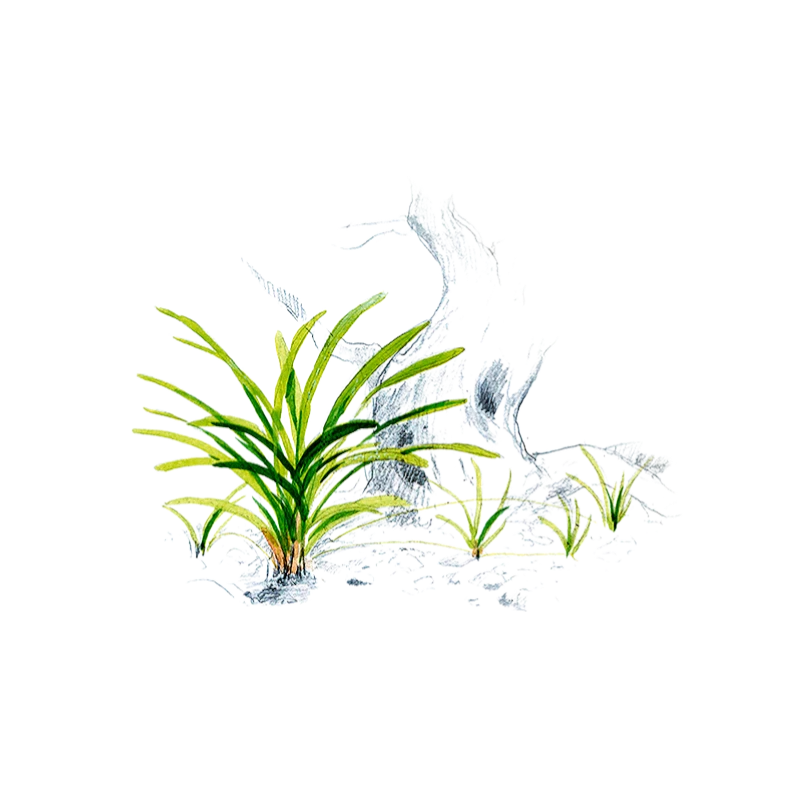
Echinodorus grisebachii Amazonicus - Narrow-leaved Amazon sword plant

Article no: DE-161

CHF 11.90

Stock: 0

Ready for dispatch in 1-3 days, delivery time 14 working days

Delivery between Tuesday, 5 May and Wednesday, 6 May
Zahlungsarten
Product information "Echinodorus grisebachii Amazonicus - Narrow-leaved Amazon sword plant"

Echinodorus grisebachii Amazonicus

Narrow-leaved Amazonian sword plant

max. growth height - 50 cm Country of origin Brazil
Suitability Perch aquarium
Community aquarium
Type Rosette plant
Family Alismataceae Genus Echinodorus
Propagation Adventive plants on the flower stalk Growth rate fast
pH 5 - 8 Water hardness 0 - 20 °dh
Notes  

This sword plant is native to the Amazon region in Brazil. It is also known as the "narrow-leaved Amazonas sword plant", is very vigorous and can be kept in aquaria from 200 litres. The submerged leaves are 2-3 cm wide and bottle green. This species is particularly suitable for South American plantings with angelfish or discus fish in combination with other Echinodorus species. An open, bright location promotes vigorous growth and the formation of inflorescences with adventitious plants.

Aquarium: Community aquarium, Perch aquarium
Genus: Echinodorus
Growth: fast
Origin: South and Central America
Properties: Rosette plants
Stand: In the background
Composition
Feeding recommendation
Technical details
Size information

3 of 3 reviews

4.83 out of 5 stars


100%

0%

0%

0%

0%


Give us a rating!

Share your experience with the product with other customers.


21 August 2025 14:05

Beautiful healthy plant.

Beautiful healthy plant.

25 March 2021 15:43

Well done and thank you for the care taken with the deliveryporté à l'expédition

Bravo et merci pour l'expédition

2 April 2020 19:57

Beautiful plant

beautiful plant

Customers also bought

Echinodorus grisebachii Bleherae - Large Amazon sword
Echinodorus grisebachii Bleherae Amazonas - Sword Plant max. growth height 60 - 80 cm Country of origin Brazil Suitability Perch aquarium, discus aquariumCommunity aquarium Type Rosette plant family Alismataceae Genus Echinodorus Propagation Adventive plants on the flower stalk Growth rate fast pH 5 - 9 Water hardness 10 - 20 °dh Notes   The large Amazonas sword plant is perhaps the most popular plant in the aquarium hobby. Its leaves are 3–6 cm wider than those of the ‘amazonicus’ variety, and the height of up to 60 cm makes this species appear even more dominant. Mature clumps, some with more than 50 leaves, are a striking feature. However, the substrate must be at least 10 cm deep for the root system to develop properly. Combined with Helanthium species (dwarf Echinodorus), beautiful South American underwater landscapes can be created.

CHF 8.90

Echinodorus argentinensis - Argentine frogspoon
Echinodorus argentinensis / Argentine frogspoon max. growth height - 60 cm Country of origin Argentina, Brazil, Uruguay Suitability Perch aquariumCommunity aquarium Type family Alismataceae Genus Echinodorus Propagation Adventitious plants on the flower stalk Growth rate medium pH 5 - 9 Water hardness 0 - 20 °dh Hints Beginner plant The distribution of sword plants extends from the USA to Argentina. E. argentinensis is one of the larger species and requires sufficient space in an underwater landscape. It is very suitable for open aquaria and its sturdy leaves look decorative above water. With a little patience, flowering shoots with white flowers will also form. A nutrient-rich substrate and medium to good lighting are required.

CHF 8.90

Easy Life Bio-Exit Green
Variant: 250ml | Variant (1): 250ml
Bio-Exit GreenA biological imbalance can cause plants to grow poorly and increasingly lose sugars. These sugars can serve as a food source for algae (such as beard algae, filamentous algae, brush algae and brown algae). Bio-Exit Green restores this biological balance and counteracts the loss of sugars in plants with a unique blend of specific organic acids and growth stimulators.When used as directed, the treatment is not harmful to fish, plants, crustaceans and other invertebrates.Application: Shake before use. Remove activated carbon. Do not overdose.Balance treatment for 2 weeks:Day 1: 10 ml per 40 litres of waterDay 7: 10 ml per 40 litres of waterDay 14: Change waterDo not change the water during the treatment.If the result is not satisfactory, this treatment can be repeated.

CHF 7.90

Rotala rotundifolia Invitro
Invitro aquarium plant Rotala rotundifoliaColorful stem plant for the background Rotala rotundifolia is one of the most popular stem plants in the aquarium hobby - versatile, easy to care for and particularly attractive thanks to its delicate, round leaves. Depending on the light intensity and nutrient supply, it develops a vibrant green to bright red, adding lively color accents to any aquarium layout. The in vitro version is grown under sterile conditions and is therefore free from algae, snails and pesticides - ideal for sensitive aquariums, especially shrimp tanks. Fast-growing and adaptable, Rotala rotundifolia is ideal for the mid to background and harmonizes wonderfully with other fine stem plants in the natural aquarium. Advantages at a glance: ✅ Changes color depending on the light - from green to red ✅ Fast-growing & ideal for dense groups of plants ✅ InVitro - guaranteed free from harmful substances & snails ✅ Safe for shrimps & sensitive tanks ✅ Perfect for aquascaping & classic plant aquariumsProduct details: Name: Rotala rotundifolia Type: Stem plant Position in aquarium: Middle to background Growth height: approx. 30-50 cm Light requirement: Medium to high CO₂ supply: Recommended for more intense colorationTemperature: 22 - 28°C Delivery form: In vitro cup (grown sterile) Color effect: Green to reddish, depending on light & nutrients

CHF 6.50

SuperFish Stainless Steel Window Scraper
SuperFish window scraper 46 - 65 cmWindow scraper for easy removal of algae and other dirt from aquarium glass. Stainless steel with a long service life.Caution! Blades are NOT included in the package. (Can be ordered separately)The sharp razor blade removes stubborn algae deposits from aquarium glassExtralong handle (46 - 65 cm)The razor blade is easy to replaceStainless steel with long life.

CHF 26.90

Hygrophila corymbosa Thailand - Narrow-leaved giant hygro
Hygrophila corymbosa Thailand Narrow-leaved giant hygrophila max. growth height - 50 cm Country of origin   Suitability   Type   Family Acanthaceae Genus Hygrophila Propagation Cuttings, side shoots Growth rate fast pH 5 - 8 Water hardness 0 - 30 °dh Notes   The "Thailand" variety has the narrowest leaves of the three different H. corymbosa varieties. Under good lighting, the leaves turn a reddish brown colour, under normal lighting medium to light green. The small, purple-coloured flowers can also be observed in open aquaria. Typical of their emersed shoots is the hairiness of the stems and the generally firmer and stiffer growth. Hygrophila species are also well suited to paludariums and humid terrariums.

CHF 8.90

Suggested products

New
Ludwigia ovalis Invitro aquarium plant
Ludwigia ovalis invitro cup This plant, with a characteristic oval leaf oval leaf shape in orange-pink color, is easy to grow and an interesting addition to the aquarium. interesting addition to the aquarium. The leaves are slightly smaller than those of the popular Repens variety. Due to their rapid growth the clumps must be trimmed and thinned out regularly to prevent excessive growth. prevent excessive growth. The original shape of the leaf blade makes it an attractive addition to the plant composition in the aquarium. aquarium.To use this plant, remove it from the cup and rinse the gel. cup and rinse the gel thoroughly under running water. Then divide it into small clumps of 1-2 cm and plant them at short intervals. them at short intervals. As it grows, it will form a form a uniform group of adult plants.This plant comes from in vitro cultivation and is free from snails, parasites and algae. and algae. High-quality gel was used as a medium, so it will establish itself quickly establish itself in the aquarium. Light requirement: medium to intensive Optimum temperature: 10 to 28 °C Water values: soft to hard pH value: 4 to 7 CO2 and nutrients: recommended Propagation: cuttings

CHF 16.90

Anubias barteri var. glabra
Anubias barteri var. glabraAnubias barteri var. glabra' or Anubias minima. This is a recommended species for aquaria with little light. Ideal for medium-sized tanks. The plant is easy to grow, does not require intensive fertilization and reproduces by dividing the rhizome. In vitro plant.Difficulty of cultivation: easyLight requirement: lowCO₂ requirement: lowHeight of the adult plant: 15-25 cmGrowth: slowTemperature: 20 - 22°CPlacement in the aquarium: Middle groundOrigin: AfricaCup diameter 6 cmAnubias Barteri Var. Glabra is a green plant from the Asteraceae family that is native to the swamps of Africa. It can grow both under water and in water. It can be found in the trade under the name Anubias minima. Unlike other Anubias, it is easy to plant in the substrate and has characteristic lanceolate leaves that grow up to 15 cm long. It can reach a height of 25 cm, but grows slowly so that it can also be cultivated in small aquariums. The plant has a rhizome from which roots grow that wrap tightly around the spot where it is planted , making it ideal for planting on roots or lava rock. It is suitable for a second or third planting Anubias thrives at different temperatures. It is suitable for cooler tanks as well as warm, tropical aquariums, e.g. with discus fish.It tolerates hard, soft, acidic and alkaline water. It prefers weak, diffuse lighting. It can become overgrown with algae under prolonged and intensive lighting. It is therefore advisable to plant it in darker or even shady areas of the aquarium.This plant does not like neglected aquaria and prefers the water to be changed regularly and no dirt to accumulate on its leavesIt grows slowly but forms a very attractive shape, especially in a group that forms a green, decorative clump. It feels very comfortable in tanks with a low water level and looks great in 'dachshund' type aquariums, where it creates the effect of an aesthetically pleasing tank. Thanks to it, we can create very interesting compositions. It is also well suited for aquariums with cichlids and other herbivorous fish It does not require special care, it is enough to remove older leaves, which stimulates the rhizome to form cuttings. If you want to obtain new cuttings, you can regularly divide the rhizome into 2-3 cm long sections. To attach the Anubias to roots or stones, a very thin string, thread or a special adhesive for attaching aquarium plants is sufficient. The in vitro culture of plants is carried out in tissue culture laboratoriesThanks to the sterile production conditions, the cuttings are free from snails, algae or pathogens.Planting:The plant must be removed from the cup and thoroughly rinsed of the gel under running waterThis is best done by placing the plant in a container of lukewarm water. Most of the gel will then fall off by itself.

CHF 16.90

Anubias barteri nana 'Petite
Anubias Barteri Nana 'Petite' Anubias Barteri Nana 'Petite' is a very small, uniformly filigree Anubias variety. Selection has resulted in a miniature form that is ideal for nano aquariums.Difficulty of cultivation: easy Light requirement: low CO₂ requirement: low Height of the adult plant: up to 5 cm Growth slow Temperature: 20-30 °C Placement in aquarium: In the foreground Origin: cultivation 6 cm cup diameter Anubias barteri is a succulent green plant of the rhizome family, naturally native to the swamps of Cameroon and Nigeria, growing in fast-flowing waters. It can grow both under and above water. "Petite" is a selected cultivar of Anubias barteri. This species does not occur in nature in such a miniature form. Consistent selection by Singapore botanists has resulted in a delicate, compact version of Anubias barteri for nano-aquariums. The variety is rarely seen in the trade and represents a kind of rarity. The plant has a rhizome that forms roots that strongly entwine the area in which it is planted. It is therefore ideal for planting on roots or rocks, such as volcanic lava.The very decorative, tiny, heart-shaped leaves are stiff and fleshy, shiny on the surface and have a velvety texture on the underside. At the same time, they are very hard and stiff, so herbivorous fish are not interested in them. The height of this miniature plant is less than 5 cm. Therefore, it is well suited for the foreground. However, it can also be used for eye-catching trees in the background. Under good conditions, it can produce a delicate white flower. Anubias Barteri Nana 'Petite' can handle a variety of temperatures. It can thrive in cooler tanks as well as in warm, tropical aquariums with discus fish, for example. It likes water with a pH of 5.5-8.0, up to 15 ° dH. it prefers weak, diffuse lighting, reaching more like 0.3 W/l. In case of prolonged and intense lighting, it may become overgrown with algae. Therefore, it is advisable to plant it in darker or even shaded areas of the tank. The plant does not like neglected aquariums, it prefers water that is changed regularly and does not leave dirt on its leaves. It grows slowly, but forms a very attractive shape, especially when it grows in a group to form a green, decorative clump. It is very comfortable in tanks with low water levels and looks great in nano aquariums. Therefore, it is a popular plant for many aquascapers. With it can create very interesting miniature compositions. It also does well in aquariums with cichlids and other herbivorous fish. It is often used in shrimp tanks and nano aquariums for fighting fish. It does not require special care, it is enough to remove older leaves, which stimulates the rhizome to form offshoots. If you want to get new cuttings, you can divide the rhizome into 2-3 cm long sections from time to time. To attach the Anubias to roots or stones, it is enough to use very thin string, thread or special glue for fixing aquarium plants. Planting: The plant must be removed from the cup and thoroughly rinsed from the gel under running water. This is best done by placing the plant in a container of lukewarm water. Most of the gel will then fall off by itself.

CHF 16.90

Vallisneria spiralis Torta - Large corkscrew vallis
Vallisneria spiralis Torta Large screw - swamp screw max. growth height 30 - 50 cm Country of origin Africa, Asia Suitability Perch aquarium, community aquarium Type  Rosette Family Hydrocharitaceae Genus Vallisneria Propagation Stolons Growth rate medium pH 6 - 9 Water hardness 10 - 30 °dh Notes   A very decorative variety of Vallisneria spiralis with a twisted growth habit. It is also known commercially as ‘screw vallisneria’. With a height of 30-50 cm, the leaves remain significantly shorter than those of the stem form. It is also undemanding in cultivation, only the light intensity should be slightly higher than for the normal V. spiralis. The ‘Torta’ variety is suitable for the middle ground of small aquaria or the background of larger aquaria.

From CHF 7.90

Vallisneria australis Curly - Curly-leaved giant vallis
Vallisneria australis Curly Wavy-leaved giant vallisneria max. growth height - 200 cm Country of origin Cultivated form Suitability Perch aquarium, discus aquarium, community aquarium Type  Rosette plant Family Hydrocharitaceae Genus Vallisneria Propagation Runners Growth rate fast pH 6 - 9 Water hardness 25 - 30 °dh Notes   Alongside Vallisneria spiralis, Vallisneria australis is the most widely cultivated plant in this genus. The growth habit of the ‘Curly’ variety has attractive, bullous leaves and looks very decorative in the background. Larger aquaria are essential for keeping it, as the leaves can reach a length of 100 - 200 cm. It propagates via runners, which should be removed regularly to prevent uncontrolled growth. The plants thrive best in medium-hard to hard water.

From CHF 10.50

Microsorium pteropus on stone with suction cup
Microsorium pteropus (on root with suction cup) max. growth height up to 40cm Country of origin  Southeast Asia Suitability Community aquariumPerch aquarium Type  Perennial plant Family  Scrophulariaceae Genus  Microsorium Propagation  Daughter plants from leaves and roots Growth rate  slowly pH 5-8 Water hardness very soft to hard Notes  

CHF 23.90

Anubias barteri nana
Anubias barteri nana - Dwarf spear leaf, multi-stemmed Dennerle A21 max. growth height 5 - 10 cm Country of origin West Africa Suitability Aquascaping, perch aquarium, community aquarium, NanoCube Type Perennial plant family Araceae Genus Anubias Propagation Division of the rhizome Growth rate slow pH 5 - 9 Water hardness 0 - 30 °dh Notes  Tie onto a stone or root. The dwarf spear leaf, as it is known commercially, is one of the most popular aquarium plants of all. It is an excellent foreground plant that requires very little care. When planting, attention must be paid to the rhizome. This thickened shoot must not be covered with substrate. The small Anubias grows best when tied up on stones and roots (see Mbuna trees on page 78). The dwarf spear leaves are very often used for cichlids from Lake Malawi and Lake Tanganyika. Here they look particularly decorative between the stone structures.

From CHF 7.90

Vallisneria spiralis - Straight vallis
Vallisneria spiralis (smooth-leaved marsh screw) max. growth height - 100 cm Country of origin Tropical cosmopolitan Suitability Perch aquarium, discus aquarium, community aquarium Type  Rosette plant family Hydrocharitaceae Genus Vallisneria Propagation Stolons Growth rate fast pH 6 - 9 Water hardness 10 - 30 °dh Notes   Vallisneria spiralis is also one of the classics in aquaristics. This undemanding aquatic plant forms ribbon-shaped leaves between 0.8 and 1.5 cm wide. Sometimes leaf lengths of up to 1 metre are achieved. It is easy to care for and cultivate and is ideal for creating a green, living back wall. Runner shoots that grow into the front area should be removed in good time. The species name "spiralis" does not refer to the leaves, but to the spirally twisted flower stems. It is also an ideal plant for perch aquaria.

From CHF 7.90

Echinodorus argentinensis - Argentine frogspoon
Echinodorus argentinensis / Argentine frogspoon max. growth height - 60 cm Country of origin Argentina, Brazil, Uruguay Suitability Perch aquariumCommunity aquarium Type family Alismataceae Genus Echinodorus Propagation Adventitious plants on the flower stalk Growth rate medium pH 5 - 9 Water hardness 0 - 20 °dh Hints Beginner plant The distribution of sword plants extends from the USA to Argentina. E. argentinensis is one of the larger species and requires sufficient space in an underwater landscape. It is very suitable for open aquaria and its sturdy leaves look decorative above water. With a little patience, flowering shoots with white flowers will also form. A nutrient-rich substrate and medium to good lighting are required.

CHF 8.90

Anubias nana on root
Anubias nana on root (dwarf spear leaf on root) The dwarf spear leaf is one of the most popular aquarium plants. This is an excellent foreground plant with very low requirements. The rhizome, a thickened shoot, must not be covered with substrate. It is best to tie the Anubias barteri nana to a stone or a root. This is the best way for the plant to grow. It is not only suitable for community aquaria or nano cubes, but is also ideal for cichlids from Lake Malawi or Lake Tanganyika. The small Anubias barteri nana look beautiful and very decorative between these stone structures. max. growth height 5-10 cm Country of origin  West Africa Suitability Community aquarium, NanoCube and cichlid aquarium (cichlids) Type  Epiphyte Family  Araceae Genus  Anubias Propagation  Division of the rhizome Growth rate  slow pH 5-9 Water hardness very soft to very hard Notes  Tie onto a stone or a root.

CHF 28.90

Vallisneria nana - Narrow leaf vallis
Vallisneria nana / Grassy marsh screw max. growth height - 70 cm Country of origin Australia Suitability Perch aquarium, community aquarium, NanoCube, aquascaping Type  Rosette plant Family Hydrocharitaceae Genus Vallisneria Propagation Stolons Growth rate medium pH 6 - 9 Water hardness 10 - 30 °dh Notes   Vallisneria nana is a new vallisneria in the aquarium hobby. The species name “nana” means: dwarf. However, the plant only exhibits this growth behaviour in its natural habitat in Australia. In our aquaria, the plants can reach lengths of 30-70 cm. This very narrow-leaved species is therefore more suitable for the background. Cultivation and care are very simple, but here too it is important to control the growth of the runners. CO2-applications additionally promote the growth of all Vallisnerias.

From CHF 9.90

Anubias barteri var. nana Bonsai
Anubias barteri var. nana 'Bonsai' - Smallest dwarf spear leafDennerle A21.3 max. growth height - 5 cm Country of origin Cultivated form Suitability Aquascaping, perch aquarium, community aquarium, NanoCube Type  Epiphytic plant Family Araceae Genus Anubias Propagation Lateral shoots on the rhizome Growth rate slow pH 5 - 9 Water hardness 0 - 30 °dh Notes  Tie onto a stone or a root. It really couldn't get any smaller! It is probably the smallest Anubias in the world and a real enrichment for any underwater landscape. In cultivation and care it is just as robust as the parent form, but needs a little more light to form beautiful, compact cushions. The dwarf form can already be used in a 10 L Nano Cube. The plants look very natural when tied onto delicate roots. The red bogwood is best suited for this. But the Bonsai Anubias also cuts a fine figure on decorative stones.

From CHF 14.90

Customers also saw

Echinodorus argentinensis - Argentine frogspoon
Echinodorus argentinensis / Argentine frogspoon max. growth height - 60 cm Country of origin Argentina, Brazil, Uruguay Suitability Perch aquariumCommunity aquarium Type family Alismataceae Genus Echinodorus Propagation Adventitious plants on the flower stalk Growth rate medium pH 5 - 9 Water hardness 0 - 20 °dh Hints Beginner plant The distribution of sword plants extends from the USA to Argentina. E. argentinensis is one of the larger species and requires sufficient space in an underwater landscape. It is very suitable for open aquaria and its sturdy leaves look decorative above water. With a little patience, flowering shoots with white flowers will also form. A nutrient-rich substrate and medium to good lighting are required.

CHF 8.90

Duckweed portion
Duckweed portion for aquariums floating plant suitable for the aquarium also for the garden pond and the biotope

CHF 5.00

Pogostemon Yatabeanus (Yatbe's star plant)
Pogostemon yatabeanusPogostemon Yatabeanus is a beautiful tertiary plant. It grows vertically upwards and impresses with its pale green appearance and fine texture. Difficulty of cultivation: demandingLight requirements: highCO₂ requirements: highHeight of mature plant: up to 40 cmGrowth rate: fastTemperature: 20-28°CPlacement in aquarium: third levelOrigin: Asia6 cm cup diameterPogostemon Yatabeanus (Bearded) is a pale green stem plant. It grows on the banks of rivers, ponds, swamps and rice fields in eastern and southern China, the Korean peninsula and Japan. The size and shape of the leaves are somewhat reminiscent of Pogostemon stellatus. The leaves and stem are green in color. The leaves are 4-6 cm long and narrow. In the aquarium the plant is very conspicuous and forms forest-like compositions with evenly planted trees. It grows vertically upwards and does not interfere with other plants. It does well in a group. It is a very decorative plant that is perfect for the background. It has a stiff red stem that is densely covered with bright green, pointed leaves that grow in threes in a whorl. It makes an ideal shelter for smaller fish species and shrimp. It looks most beautiful in a group of about a dozen seedlings.Plant Pogostemon Yatabeanus in the substrate. The best growth results can be achieved by using an active substrate. Under good conditions, it spreads very quickly. The administration of liquid fertilizer with micro and macro elements has a positive effect on its development. It can reach a height of up to 40 cm. It thrives best in an acidic to neutral pH. It requires good filtration and weekly water changes in the aquarium. Requires an additional addition of carbon dioxide. Pogostemon yatabeanus has high light requirements. Under good conditions it grows quickly and compacts well. The intense growth of the plant is greatly enhanced by the dosage of carbon dioxide and the addition of micro and macro elemental fertilizers.It is easy to shape and prune. It requires little maintenance. It reproduces by lateral regrowth. As with most stems, cut stems can be replanted in the ground. Divide the purchased plant into individual stems and plant them at close 2-3 cm intervals. Pogostemon yatabeanus spreads very quickly, so you should give it enough space to grow. Planting: The plant must be removed from the cup and thoroughly rinsed from the gel under running water. This is best done by placing the plant in a container of lukewarm water. Most of the gel will then fall off by itself. Divide the contents of the cup into 1-2 cm lumps and then place them at a small distance on the selected items..

CHF 6.50

Hygrophila corymbosa Compact
Hygrophila corymbosa Kompakt / Short-stemmed Water Friend max. growth height - 15 cm Country of origin  Cultivated form Suitability NanoCube, aquascaping and community aquarium Type  Stem plant family Acanthaceae Genus Hygrophila Propagation Cuttings, side shoots Growth rate slow pH 5 - 8 Water hardness 0 - 30 °dh Notes   This growth form is probably the result of a mutation and is rather atypical for the Hygrophila genus due to its height. The stems are strongly compressed and the leaves sit close together in a compact form. Plants cultivated above water have deep dark green leaves, in the aquarium they are bright light green. It grows slowly, which is why it requires significantly less care than other Hygrophila species. It is well suited to the foreground. Its leaf shape makes it a nice change from other foreground plants.

CHF 11.90

Vallisneria spiralis - Straight vallis
Vallisneria spiralis (smooth-leaved marsh screw) max. growth height - 100 cm Country of origin Tropical cosmopolitan Suitability Perch aquarium, discus aquarium, community aquarium Type  Rosette plant family Hydrocharitaceae Genus Vallisneria Propagation Stolons Growth rate fast pH 6 - 9 Water hardness 10 - 30 °dh Notes   Vallisneria spiralis is also one of the classics in aquaristics. This undemanding aquatic plant forms ribbon-shaped leaves between 0.8 and 1.5 cm wide. Sometimes leaf lengths of up to 1 metre are achieved. It is easy to care for and cultivate and is ideal for creating a green, living back wall. Runner shoots that grow into the front area should be removed in good time. The species name "spiralis" does not refer to the leaves, but to the spirally twisted flower stems. It is also an ideal plant for perch aquaria.

From CHF 7.90

Nesea sp. Gold
Nesea sp. GoldNesea sp. "Gold" is a stem plant, with intense yellow to orange colors that is rare in aquarium plants. Growing difficulty: : medium, demandingLight requirement: mediumCO₂ requirement: mediumAdult plant height: 40-50 cmGrowth: mediumTemperature: 22-28°CPlacement in aquarium: third levelOrigin: AfricaCup diameter 6 cmNesea Crassicaulis Gold (Nesea sp. Gold) from Africa, a quite rare and very decorative plant with medium requirements and moderate growth rate.With sufficient light, it takes on colors ranging from bright yellow to intense orange. Nesea sp. Gold is not very demanding in terms of growing conditions. The yellow coloration of the leaves can be achieved even with moderately intense light. The stronger the lighting, the more the color shifts towards an orange tone. The plant can reach a height of up to 50 cm and is thus intended for the third level. However, it has a fairly moderate growth, so it does not require frequent pruning and with good care can be used as a foreground plant. Nesea sp. Gold needs CO₂ in gaseous form, but the carbon dioxide requirement is not too high and medium due to the growth rate is not too fast. It requires nutrient-rich water for optimal appearance. However, attention should be paid to potassium levels, as excess can cause deformation of the growth cones.It grows best at temperatures between 22 and 28 degrees Celsius. Since it prefers high temperatures, it is suitable for tanks with a population of extremely heat-loving fish. The undoubted advantage of this plant is the combination of a very unusual leaf color and low requirements. Nesea sp. Gold provides a good contrast with both green and red foliage plants, and the effect is relatively easy to achieve. It does not require a large amount of CO2. It likes soft and slightly acidic water, but can grow in other parameters as well. It needs good light, a nutrient-rich substrate, CO2 and adequate fertilization to achieve intense coloration. If you want to keep Nesea sp. Gold as a background plant, you should prune it regularly. This will not only keep it at the right height, but will also make it thicker and give it a striking appearance. After pruning, the plant will rejuvenate and the cut tops can be planted in the ground.Planting: Before planting, simply rinse the plants from the gel. Unlike plants kept in rockwool, partial drainage is not required..

CHF 8.90

Vallisneria australis Gigantea - Giant vallis
Vallisneria australis Gigantea (Giant swamp spurge) max. growth height - 200 cm Country of origin Australia Suitability Perch aquarium, discus aquarium, community aquarium Type  Rosette plant family Hydrocharitaceae Genus Vallisneria Propagation Stolons Growth rate medium pH 6 - 9 Water hardness 25 - 30 °dh Notes   The giant vallisneria is a very variable aquatic plant that is native to Australia. Its long, narrow leaves can take on gigantic proportions in good conditions, and leaf lengths of up to 3 metres are not uncommon. The giant vallisneria is very popular in discus aquariums and aquariums for East African cichlids from Lake Malawi and Lake Tanganyika. These fish require harder water, which is problematic for many plants. Vallisneria australis 'Giganta', however, prefers these water values.

From CHF 10.50