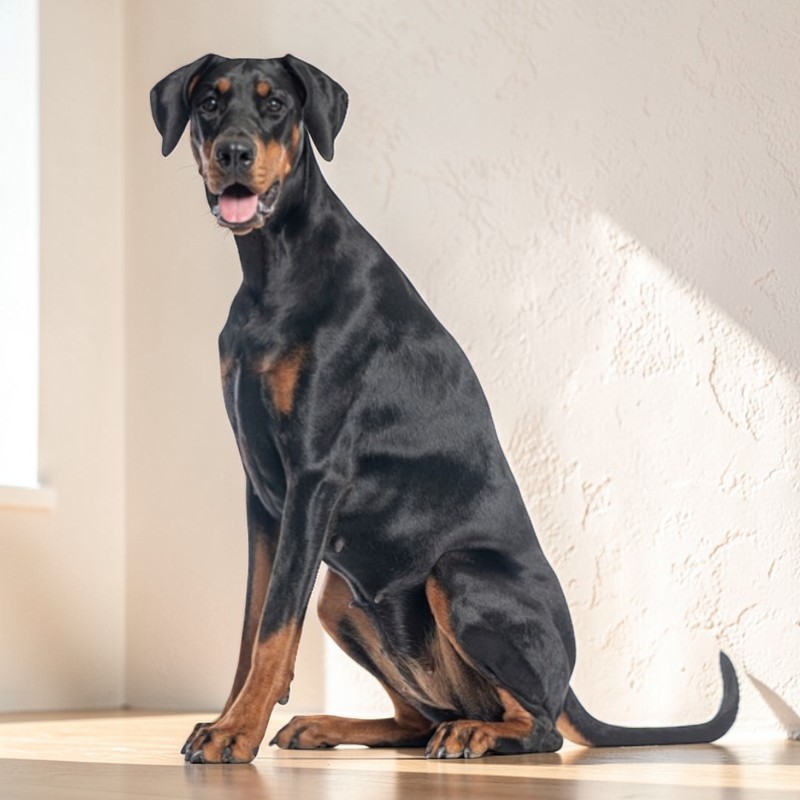

Doberman
FCI standard number: 143
Country of origin: Germany
Classification: FCI Group 2 - Pinscher and Schnauzer, Molosser and Schweizer Mountain and Cattle Dogs
Height at withers bitch: 63-68 cm
Height at withers male: 68-72 cm
Weight female: approx. 32-35 kg
Weight male: approx. 40-45 kg
Coat colour: Black or brown with rust-red, sharply defined markings.
Coat texture: Short, hard, dense, smooth lying; without undercoat.
Neck circumference: In practice, it is often around 45-55 cm for adult Dobermans; however, it should always be measured individually for collars or harnesses.
The Doberman
History of the Scottish Terrier
The Dobermann is the only German dog breed to be named after its first known breeder: Friedrich Louis Dobermann. In the 19th century, the breed was developed as a vigilant, sharp and resilient guard and working dog and was later also used as a police and service dog.
Appearance
Build: medium to large, strong, muscular and at the same time very elegant. Typical are the proud posture, the clear lines and the athletic, almost square build. He appears powerful, determined and very present.
Coat: The coat is very easy to care for because it is short and smooth. It provides less protection against the cold than densely coated breeds with an undercoat, which is why many Dobermans are more sensitive in winter or when wet.
Nature/character
According to the FCI, the Doberman should have a friendly and peaceful disposition, be very affectionate in the family, with a medium temperament, medium keenness, good manageability, willingness to work, self-confidence and fearlessness. The VDH also describes him as intelligent, attentive, robust and loyal; he is often initially reserved towards strangers.
Grooming
Grooming is uncomplicated; regular brushing and the usual claw, ear and dental care are usually sufficient. Exercise, activity and close social contact are more important for the Doberman than grooming. They are athletic and want to be challenged both physically and mentally.
Health
Heart health and responsible breeding are particularly important for this breed. Frequently mentioned issues are dilated cardiomyopathy (DCM), von Willebrand's disease (vWD) and hip dysplasia (HD); VDH breeder websites mention heart examinations, genetic tests and HD examinations, among other things. Thyroid problems are also mentioned as a typical breed issue.
Education
The Doberman is very capable of learning and eager to work, but needs expert, calm and consistent leadership. His strength, alertness and sensitivity need to be channelled in the right direction. With fair training, early socialisation and clear rules, he is usually a very reliable partner.
What are the special features of this breed?
The Dobermann combines elegance, speed, alertness and a high willingness to work like hardly any other breed. He usually bonds very closely to his humans, is alert and quick to react, but also sensitive and not made for a side-by-side attitude. He needs closeness, structure and meaningful tasks.
Suitable for first-time dog owners?
Rather no. The VDH expressly describes it as not a four-legged friend for beginners because it is demanding and needs expert training. Dedicated beginners with very good guidance could keep him, but overall he is better suited to experienced dog owners.
Family dog or not?
Yes, in principle - but only if kept appropriately. The FCI standard expressly states that it should also be particularly suitable as a family dog. The VDH describes it as a loyal family dog with a close bond, high adaptability and good tolerance towards children. However, this requires good socialisation, sufficient exercise and competent training.
Login
Suggested products


Customers also saw