Bugs No. 08 - Centipede

Article no: bugs08

CHF 12.00

Stock: 0

This article is currently not available

Product information "Bugs No. 08 - Centipede"

Bugs No. 08 - Centipede

Centipedes are on the rise in terraristics! Christian Kronmüller, a specialist in these fascinating animals and author of a book on the subject, presents these many-legged predators in detail in the next issue of Bugs and reveals tips and tricks on how to keep and breed them.
Insights into the way of life of invertebrates in nature provide valuable information on species-appropriate husbandry. Our Colombian author Jorge Cañas-Orozco has compiled exciting details and impressive photos of scorpions of the genus Opisthacanthus.
During the hot season, wasps and hornets become a nuisance in some places in this country. In Bugs No. 8, we show you what these insects are used for in the Far East - surprises are guaranteed!
Cuba is home to an absolutely spectacular arachnid fauna. Michael Seiter takes you on an expedition in search of flagellate spiders, scorpions and more.
In addition, of course, a number of other exciting topics are addressed, so that there will be something for fans of various invertebrate groups. Plus practical tips and news from the world of science and much more ...

Table of contents

Editorial
Facets
Dates

Cover story
Armoured hunters and gentle parents - centipedes in the terrarium

The top 10 centipedes for beginners

Flown out
In search of arachnids in Cuba

reportage
Opisthacanthus elatus: Observations from Colombia

Kids Corner
Colourful hummers

reportage
Beetle breeding made easy: white rotten wood from sustainable mushroom production

Culture
Harvest festival in Japanese - Wasps as a delicacy in the Japanese countryside

Book scorpion
Also in your neighbourhood
Service & Imprint

Composition
Feeding recommendation
Technical details
Size information

0 of 0 reviews

Give us a rating!

Share your experience with the product with other customers.


Suggested products

Handbook of food plants for tortoises and other reptiles
Handbook of forage plants 2nd revised editionMarion Minch is not only a successful breeder of diverse tortoises for many years, but also an excellent connoisseur of native wild herbs. She founded and runs samenkiste.de, which is well known to many tortoise keepers and nature lovers. Her name is inextricably linked with reptile care and species-appropriate nutrition for tortoises. Her handbook of food plants summarises the most important native food plants for herbivorous and omnivorous reptiles. She not only considers tortoises, but also iguanas, spiny-tailed dragons and even chameleons. From the basics of plant biology to native wild herbs to suitable food plants for hardy tropical reptile species, this comprehensive work provides the basis for species-appropriate keeping. In the expanded and supplemented 2nd edition, the plant section is divided according to flower colour. This makes it even easier to identify wild herbs. The work has also been supplemented with a wealth of additional information and many pictures.

CHF 46.50

Geckos
Geckos in the terrarium by Astrid FalkThe book offers a comprehensive introduction to geckos and their species-appropriate keeping in terrariums. It explains what you need to think about before buying a gecko and what preparations should be made. The book describes in detail how the terrarium is technically equipped and set up. The care of the animals, their special features and behaviour, their diet, reproduction and rearing of young animals are described, as well as diseases and husbandry problems with tried and tested suggestions for prevention and treatment. Individual gecko species that are particularly suitable for keeping and breeding in terrariums are portrayed in detail in the second part of the book.

CHF 28.50

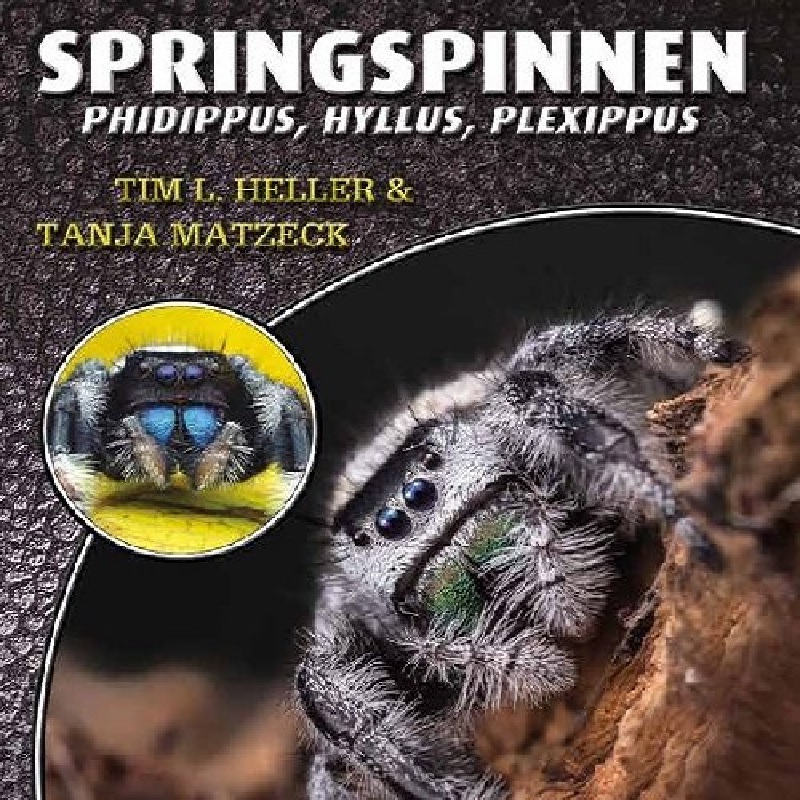
Jumping spiders Phidippus, Hyllus, Plexippus
Book Jumping Spiders - Phidippus, Hyllus & Plexippus A guide to keeping jumping spiders of the genera Phidippus, Hyllus & Plexippus. Who can resist the charm of jumping spiders? The childlike appearance of their expressive face simply leaves no one cold! In addition, their behavior is extremely exciting to observe, their colors are bright and their requirements for species-appropriate keeping are very easy to meet. No wonder these likeable jumpers are all the rage! This volume in the "Species by Species" series describes in detail what to look out for when buying and keeping them, introduces the most commonly kept species and color forms and provides plenty of tips on how to keep them successfully - so you can be sure they will breed well! Species by Species introduces you to the books in this series, which present the most popular terrarium animals. Each volume offers you detailed, practical care instructions and all the information you need to successfully breed your animals. All important questions from the required tank size to terrarium set-up, technical equipment, species-appropriate nutrition and disease prevention are answered with numerous tricks and tips. Experienced, long-standing breeders reveal how you can encourage the animals to reproduce and raise healthy young. All this in full color, generously illustrated and attractively designed - just about your terrarium animal - species by species

CHF 23.90

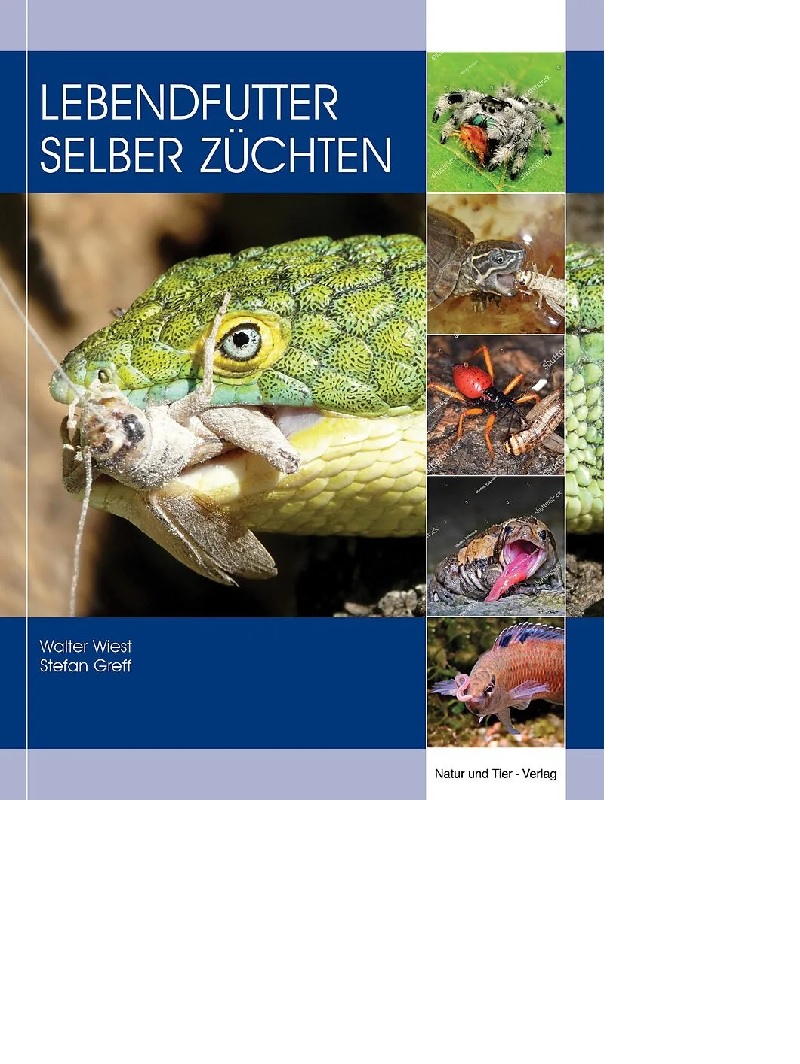
Book Breeding live food yourself
Book "Grow your own live food" - The perfect guide for pet owners Discover practical and detailed instructions on how you can easily breed food for your reptiles, birds, fish or other animals yourself in the book "Breeding live food yourself". With valuable tips on various food insects, their care and breeding, you can save money and ensure a species-appropriate diet for your pets. Contents of the book: Step-by-step instructions for breeding feeder insects Information on the best types of food for reptiles, birds and fish Care instructions and breeding conditions for various live food species Tips for sustainable and cost-effective food production Why breed your own live food? Get healthy, fresh food for your animals Save money and reduce dependence on pet shops Promote the health and well-being of your animals with species-appropriate food Whether you are a beginner or an experienced pet owner, this book provides you with everything you need to successfully breed live food yourself.

CHF 46.50

Marginata 69 - New Guinea tortoises
Marginata 69 - New Guinea tortoises – the genus ElseyaCover storyThe unrecognised beauties: New Guinea tortoises (Andreas S. Hennig)My experiences with Branderhorst's New Guinea tortoise, Elseya (Elseya) branderhorsti (Ouwens, 1914) (Andreas S. Hennig)Keeping and breeding of Rhodin's New Guinea tortoise, Elseya (Hanwarachelys) rhodini Thomson, Amepou, Anamiato & Georges, 2015 (Andreas S. Hennig)PortraitGeoemyda spengleri, Chinese serrated tortoise (Andreas S. Hennig)ReportageMacrochelys temminckii – Experiences and impressions with vulture tortoises part 2 (Reiner Praschag)KeepingAn alternative to year-round keeping of the Egyptian tortoise in the terrarium – my experiences with seasonal outdoor keeping of Testudo kleinmanni (Ricarda Schramm)EtymologySawbacks and living maps part 4: Graptemys gibbonsi, Pascagoula humpback tortoise (Holger Vetter)Classifieds & animal placement

CHF 16.50

Draco 57 - Snakes: Colour and drawing breeding
Draco 57 - Snakes: Colour and markings breedingsContents:Editorial Variety is the trump cardHans - Dieter Philippen Colour forms in garter snakes. A look into the past, the present and the trends of tomorrowDaniel GrübnerHurricane Season Hans-Jörg WinnerSturdy beauties. Colour and pattern variations in PituophisBernd SkubowiusThe latest trends in breeding the green tree python Marcel HoffmannChoose the diamond! Colour and pattern types of diamond pythonsMarc Mense A look at colour breeding in Pantherophis guttatusStephan Drees Colour and pattern forms in the western hook-nosed snakeFilip LonghitanoReal rarities: Colour varieties of the grey-banded king snake Malte Hornig

CHF 32.00

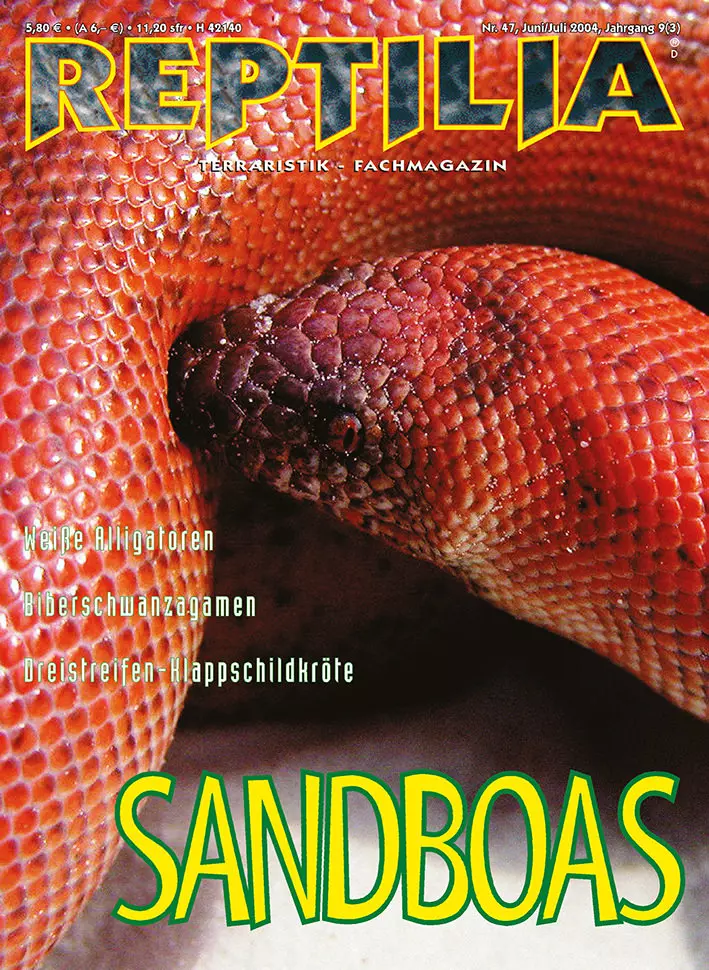
Reptilia 116 - Aquatic turtles - Perfect pets
Reptilia 116 - Aquatic turtles - Perfect pets Tarantula Oligoxystre diamantinensisChristmas in the African bushIntroduction to keeping venomous snakesContents: Cover story: Aquatic turtles – perfect petsAquatic turtles have enjoyed great popularity for decades. For a long time, however, small baby turtles were offered in pet shops for little money and ended up mainly with keepers who were not terrarium keepers and simply had no idea about these animals. The consequences are well known: overgrown red-eared sliders and other aquatic turtles that were abandoned or ended up in rescue centres. As a result, aquatic turtle keeping has fallen into disrepute. However, aquatic turtles are wonderful pets if you look after them properly and acquire the necessary expertise. We offer an overview of the species currently being kept and provide you with the tools you need to enjoy these charming turtles for a long time. EditorialMAGAZINEDATES WESTERN HERP PERSPECTIVESHerp photography goes crazyB. Love Photo storyFrequently kept aquatic turtle species – an overviewA. S. Hennig PracticeYellow stripes again and again …Information on the identification of commonly kept aquatic turtle speciesA. S. Hennig Keeping and breedingLarge salad with insect garnish. Nutritional advice for commonly kept ornamental, decorative and humpback turtlesA. S. Hennig Keeping and breedingFrom a five-mark piece to a soup plate. The successful rearing of aquatic turtlesA. S. Hennig Keeping and breedingNow also poisonous creatures! My introduction to keeping venomous snakesM. Hallmen Keeping and breedingOligoxystre diamantinensis. A gem in the middle of nowhere among the IschnocolinaeB. Rast & I. Wendt ServicesLIBRARYALSO NEAR YOU JourneyChristmas in the bush. Reptiles and more on Makutsi (South Africa)I. Kober PREVIEW BRUTKASTENLike a fish in waterH. Werning

CHF 12.00

NTV - Haplopelma lividum
Haplopelma lividum - All about the blue Thai tarantula 64 pages numerous colour photos Series species by species A5 Paperback Author Karin Manns Publisher NTV The booklet explains everything about the systematics, anatomy, distribution, appearance, life expectancy and natural enemies. It also explains how poisonous the Haplopelma lividum is, which legal regulations apply to it and acquiring this tarantula. From the contents: Foreword Systematics and anatomy Distribution Appearance and behaviour Natural enemies Life expectancy How poisonous is Haplopelma lividum Legal regulations Acquisition and transport Keeping and care The terrarium Technology and climate Socialisation Nutrition How to handle the tarantula Moulting Diseases and injuries Reproduction - Mating - Cocoon construction and rearing Conclusion

CHF 19.90

NTV, Discover the amphibians
NTV, Discover the amphibians and learn all about these animals. 56 pages colour photos throughout Large format: 20.7 x 28 cm Hardcover Author Kriton Kunz Contents: Every child knows a frog that swims around in its pond and croaks cheerfully, or the black and yellow fire salamander. But how do these friendly animals live? What do they eat, how do they survive the winter? How does a tadpole become a small frog? And what other amazing amphibians are there? "Entdecke die Amphibien" explains what amphibians are, their special features and their incredible abilities in an entertaining and child-friendly way. Fantastic records from the world of frogs, salamanders and the like are included, as well as an exciting quiz about these colourful survival artists. Including 20 great stickers 

CHF 17.90

NTV, turtles in the garden pond
NTV, Schildkröten im Gartenteich - Hier werden Wasserschildkröten vorgestellt welche im Gartenteich gehalten werden können. 112 Seiten 88 Abbildungen Format: 16,8 x 21,8 cm Autor Veronika Müller und Wolfgang Schmidt Verlag NTV Inhalt: Schildkröten im Gartenteich? Sicher haben auch Sie sich schon gefragt, ob es nicht möglich ist, eine Schildkröte im Gartenteich zu pflegen. Es ist möglich!In diesem Buch werden u. a. alle Wasserschildkrötenarten vorgestellt, die auch ganzjährig im Garten leben können. Sie finden wertvolle Tips zur Gestaltung des Schildkröten-Biotops, zur Fütterung, zur Vergesellschaftung der Tiere sowie zum Thema Überwinterung. Was tun, wenn Ihre Schildkröte Eier legt? Was geschieht, wenn einmal ein Tier krank wird? Auch auf diese Fragen gehen die Autoren in eigenen Kapiteln ausführlich ein.Es gibt viele Bücher über Schildkröten. Das Buch 'Schildkröten im Gartenteich' befasst sich erstmals ausschliesslich mit den Arten, die auch im Freien gepflegt werden können. Geschrieben für den Natur- und Tierfreund, ist es ein wertvoller Leitfaden für die richtige Pflege von Wasserschildkröten.  

CHF 28.90

Draco 16 - Tarantulas
Draco 16 - Tarantulas Contents: 2 Editorial 4 Tarantulas – Biology & systematicsBoris F. Striffler 20 “Ecdysis”– when tarantulas fly off the handleBoris F. Striffler & Thomas Ziegler 26 Earth Tigers – the Asian tarantulas of the subfamily OrnithoctoninaeVolker von Wirth & Martin Huber 37 South American tree dwellers: Avicularia, Tapinauchenius & PsalmopoeusBoris F. Striffler, Armin Bochtler & Hans-Werner Auer 52 Brachypelma – the colourful tarantulas of MexicoBoris F. Striffler & Achim Graminske 62 Temperature preferences and activity patterns in tarantulasBoris F. Striffler 70 Tarantulas in Venezuela – from the Caribbean to the Tepuis Boris F. Striffler & Dirk Weinmann 79 Book box 86 Magazine 90 Species list

CHF 16.80

Reptilia 59 - Rose chafer
Reptilia 59 - Rose chafer South American tortoisesBuilding a desert terrariumReptile of the year: Forest lizard Contents: 4 EDITORIAL 6 MAGAZINE 17 DATES 20 PHOTO REPORTAGERose chaferBy M. Tomás Rafáles 28 KEEPING AND REPRODUCTIONCare and breeding of the rose chaferAmaurodes passeriniiBy M. Tomás Rafáles 33 REPORTAGEEuropean rose beetles (family Cetoniidae)By M. Yliana 39 TRAVELThin air – An excursion into the highlands ofIran and TurkeyBy B. Trapp 51 PORTRAIT AND POSTERPsammodynastes pulverulentusBy M. Gaulke 55 HERPETOFAUNAOn the "Reptile of the Year 2006" – The Eurasianforest or mountain lizard (Zootoca vivipara),the world's most successful terrestrial reptileBy W. Böhme & D. Rödder 62 PRACTICEUse of a conservatory as a terrariumlocation for a desert terrariumPart 1: Planning and building the terrariumBy T. Ackermann 71 HERPETOFAUNA The North African-Arab cat snakeTelescopus dhara (Forsskål, 1775)By U. Schlüter 77 REPORTAGEObservations on the occurrence ofGeochelone (Chelonoides) in southern BoliviaBy J. Knaack 87 CLASSIFIED ADS 92 RAT & TAT 96 WESTERN HERP PERSPECTIVESThe new "Good Guys"By B. Love 104 INCUBATORMaggot dispenserBy H. Werning

CHF 11.20

Customers also saw

Shroomroom MossMix 10g
Shroomroom MossMix 10g Dry mixture of Asian mosses and fern sporesShroomroom MossMix (10 g) is a dry mixture of Asian mosses and fern spores for the decorative design of terrariums and paludariums. Ideal for terrarium builders who want to create nature-like scenes with mossy structures. In combination with a suitable base, the spores can be placed in a targeted manner to add greenery to back walls, roots or stones.Properties and advantages Dry mixture of Asian mosses and fern spores Ideal for terrarium and paludarium design Suitable for moss-covered backgrounds, scene construction and detailed accents Can be used with pinpoint accuracy to visually enliven structures such as roots, cork or stones Particularly practical in combination with Shroomroom MossBase as an adhesive base 10 g pack for targeted applications and small to medium-sized projectsA harmonious terrarium or paludarium thrives on transitions, textures and details that look like nature. This is exactly what Shroomroom MossMix is designed for: a dry mixture of Asian mosses and fern spores with which you can decoratively create mossy structures and greenery effects. The mix is particularly suitable for scene construction - for example for mossy areas on back walls, branches, roots, cork or stones. Used correctly, MossMix brings more depth and naturalness to the layout and creates an authentic look without overloading the terrarium. For controlled work and better adhesion, we recommend using it on a suitable base, for example with Shroomroom MossBase, to fix the material to the desired substrate.Zoo Roco tip For particularly natural results, work in zones: Use MossMix specifically where your hardscape offers suitable conditions. First model the substrate (e.g. with TropicalClay and MossBase) and then apply MossMix selectively instead of scattering it over a large area. This makes mossy transitions look more realistic and the overall look remains harmonious. Customers searched for: MossMix, Shroomroom MossMix, moss mix terrarium, fern spore terrarium, moss back wall paludarium, terrascaping moss, moss for terrarium, moss-covered background, MossBase

CHF 17.90