
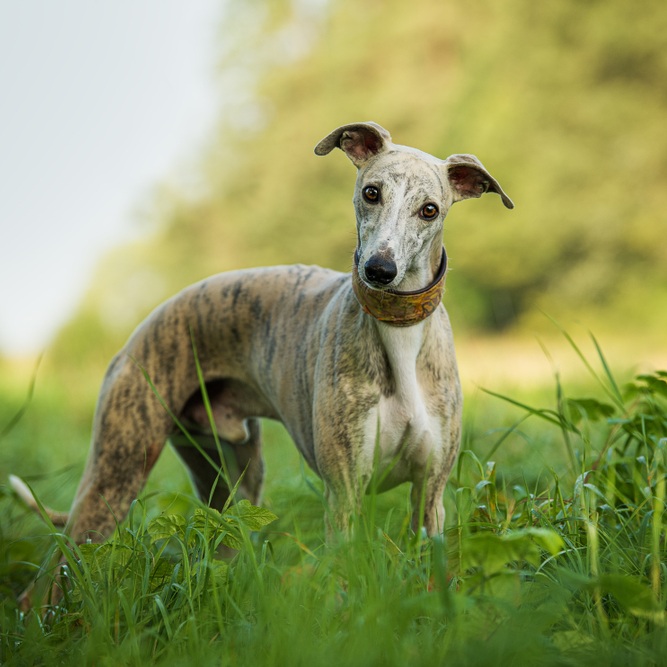
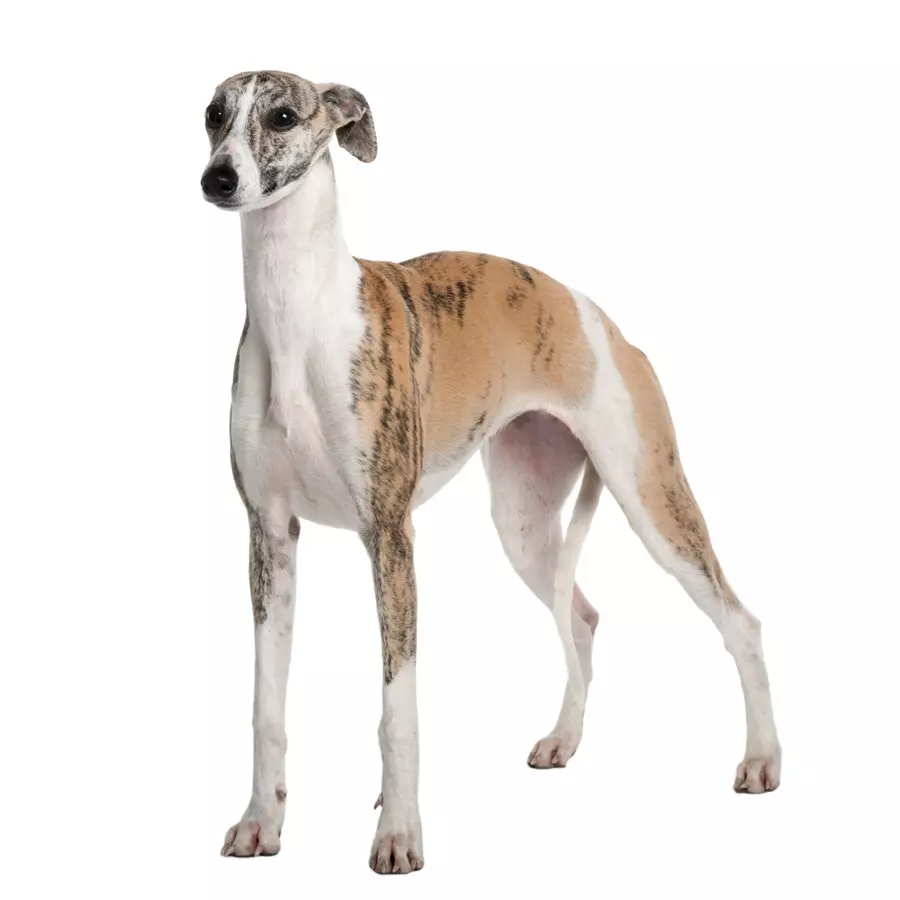
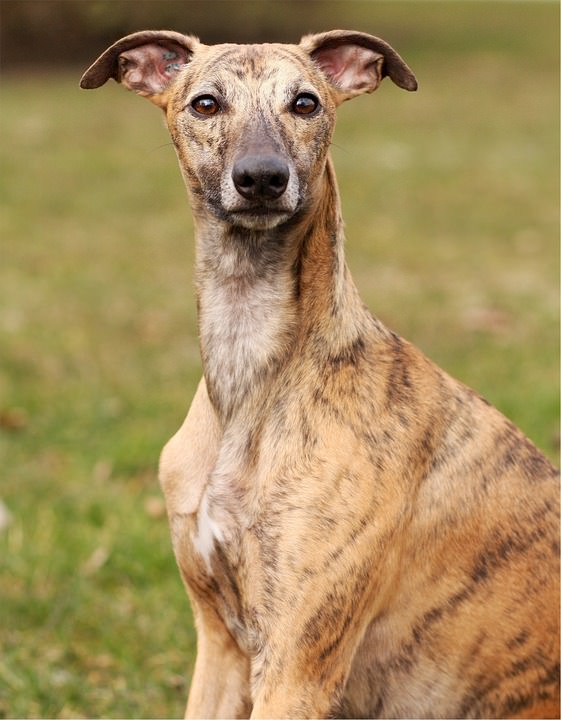
Whippet
FCI standard number: 162
Country of origin: Great Britain
Classification: FCI Group 10 "Sighthounds", Section 3 "Short-haired Sighthounds"
Height at withers bitch: 44–47 cm
Height at withers male: 47–51 cm
Weight bitch: often around 8–14 kg
Weight male: often around 10–16 kg
Coat colour: All colours and colour combinations are permitted
Coat texture: Fine, short and dense
Neck circumference: For collars, please always measure on the dog
Product information "Whippet"
The Whippet
History
The Whippet is a British sighthound breed. It was bred as a fast, smaller sight hunter and has been established as an independent breed since the 19th century; a first standard was established in 1891.
Appearance
The Whippet is a medium-sized, elegant, very athletic dog. The standard describes it as a balanced combination of muscular power and strength with elegance and grace, built for speed and performance.
Body shape: Slender, deep-chested, with tucked-up belly line, long-appearing back and characteristic arch over the loin; overall sprinter-like and very agile.
Coat: Short, fine, smooth lying and easy to care for.
Nature/Character
The FCI standard describes the Whippet as the ideal companion, very adaptable in both home and sporting environments, friendly, affectionate and even-tempered. At the same time, it remains a sight hunter with a pronounced responsiveness to moving stimuli.
Grooming
The grooming effort is low: regular brushing, checking claws, teeth, and ears is usually sufficient. Due to its very short coat, the Whippet is more sensitive to cold than many other breeds. This is a practical consequence of the coat structure and the very limited hair.
Health
The FCI generally emphasises that only functionally and clinically healthy dogs should be used for breeding. With the Whippet, it is also important to pay attention to responsible breeding, good weight management and appropriate protection in cold or rough conditions. The standard itself does not contain a detailed list of diseases.
Training
Whippets are usually sensitive and learn well, but often respond sensitively to pressure. Calm consistency, early socialisation and reliable recall training work best. Due to their prey and sighting drive, free running is not always possible everywhere without problems.
What special features does this breed have?
Particularly noteworthy are the enormous sprinting speed, the typical sighthound body, the very fine coat and the contrast between fast and alert outdoors and often calm and cuddly indoors. The VDH describes the Whippet as a "sprinter with a sense of cuddling", which describes the breed quite well.
Suitable for first-time dog owners?
Yes, often suitable with some reservations. A Whippet can be a good fit for beginners if they want a sensitive, rather gentle dog and are prepared to take recall, safety off-lead and sighthound specifics seriously. It is usually easier to handle in everyday life than many very driven working breeds, but it is not a dog that should be underestimated because of its calm nature.
Family dog or not?
Yes, in many cases a good family dog. The standard calls it friendly, affectionate and even-tempered; at the same time, it is considered adaptable in the home environment. In calm to normally active families it often fits very well as long as care is taken to ensure sensitive handling, safe exercise and opportunities to withdraw.
Composition
Feeding recommendation
Technical details
Size information
Login
Suggested products
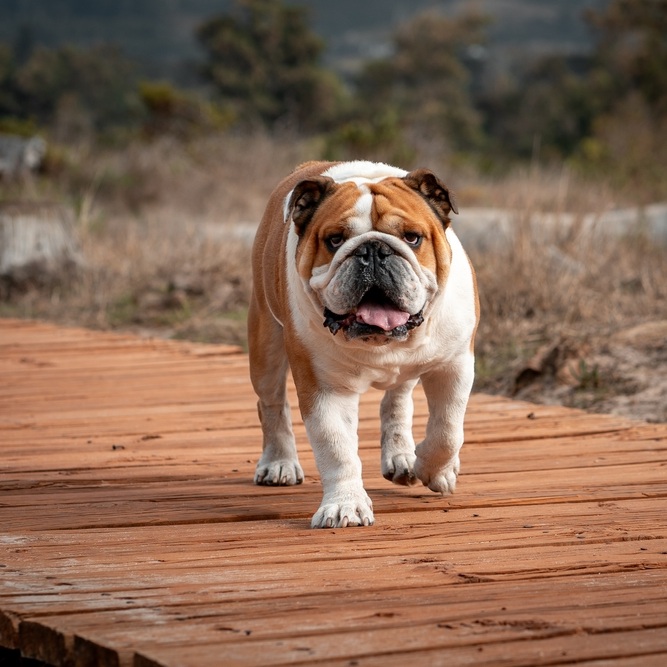
English Bulldog
The English BulldogHistory of the Scottish TerrierAccording to the FCI, the Bulldog was first explicitly mentioned as such around 1630. It was originally used to herd bulls. After 1835, the current, lower-set type with a shorter foreface developed; from 1860, it was also shown at dog shows. Today it is considered one of the oldest native breeds in Great Britain.AppearanceBody shape: The English Bulldog has a short coat, is rather low-set, broad-shouldered, powerful and compact. Typical features include a large head, a broad chest and a short, blunt muzzle. At the same time, the FCI and VDH expressly emphasise that no exaggeration should be allowed to go so far as to impair mobility, breathing or general function.Coat:
The coat is low-maintenance and lies close to the body. It usually only requires occasional brushing. More important than the amount of coat in this breed is the regular checking of the skin and skin folds.Nature/characterThe Bulldog is considered to be attentive, courageous, loyal, reliable and, despite its fierce expression, very affectionate. In everyday life, it is often described as friendly, calm and people-orientated. It is usually not a nervous endurance runner, but rather a cosy companion with a strong character.GroomingThe short coat is uncomplicated. More important are wrinkle care, skin control, weight management and adaptation to weather and stress. You have to be very attentive, especially in hot weather, when excited or under heavy physical strain, because Bulldogs can react sensitively to respiratory stress.HealthThe English Bulldog is one of the more demanding breeds in terms of health. Free breathing, open nostrils, healthy eyes, unproblematic skin folds and a functional tail are particularly important. The British Kennel Club lists breathing problems, turned-in or turned-out eyelids, skin inflammation in folds, too narrow nostrils and problematic tails as particular warning points for the Bulldog. A larger VetCompass evaluation found increased risks in English Bulldogs for skin-fold dermatitis, cherry eye, BOAS and dry eye, among others.EducationThe Bulldog is capable of learning, but often a little stubborn. It needs calm, friendly and consistent training with clear rules and lots of positive reinforcement. Pressure and harshness do not suit them well. With patience, it usually becomes suitable for everyday use, but it is often not a dog for exaggerated obedience drills.What are the special features of this breed?Their most distinctive feature is the mixture of a striking, almost fierce appearance and a mostly very affectionate, gentle nature. At the same time, however, the breed carries an increased health risk due to its body shape. For this very reason, particular care should be taken to ensure that the English Bulldog is bred properly, breathes well, has a moderate build and is normally agile.Suitable for first-time dog owners?Yes, conditionally. In terms of temperament, the English Bulldog can be a good choice for beginners because it is often friendly, people-orientated and not over-excited. Less suitable for beginners, however, are the possible health problems and the necessary management of heat, weight, exercise and skin care. It can be suitable for beginners with realistic expectations and well-chosen breeding.Family dog or not?Yes, basically yes. The breed is now considered a companion dog and is generally considered to be affectionate and family orientated. In a suitable, calm family, it can be a loving companion. It is important that children learn respectful behaviour and that the family shows consideration for the dog's temperature, stress levels and health.
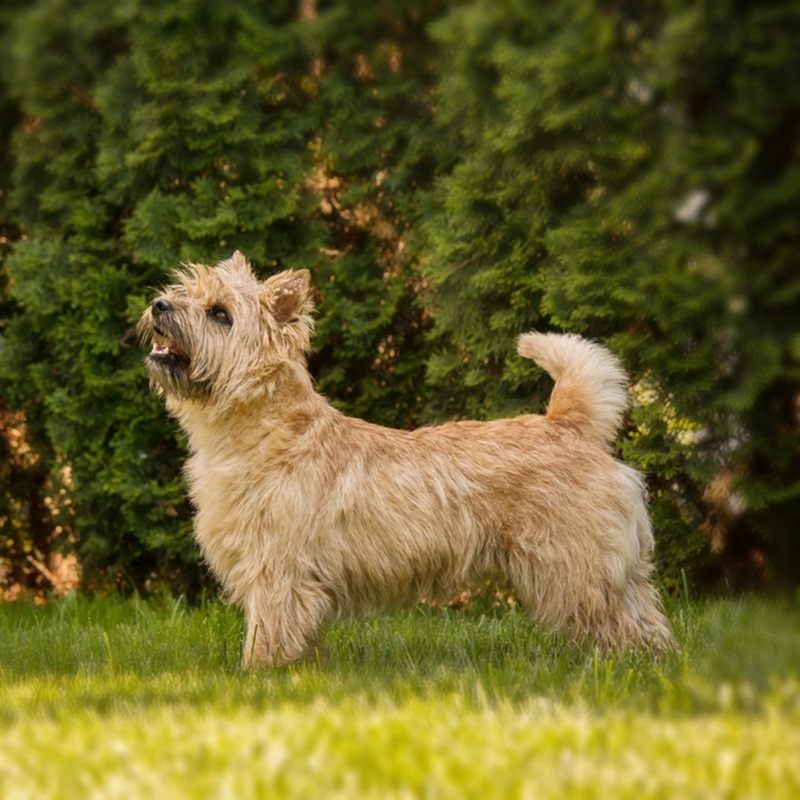
Cairn Terrier
Profile Cairn TerrierHistory of the Cairn TerrierYou are getting a traditional working terrier from the UK, which was originally used for hunting small game in rocky terrain and on cairns. The standard emphasizes the robust, natural working dog character.AppearanceBody shape:
The Cairn Terrier is small but robust and very agile. It should appear agile, alert and "natural", with strong hindquarters and a free, persistent gait.
Coat:
The coat is a typical double coat: hard, weatherproof outer coat and dense undercoat. This keeps the dog well protected even in windy and wet conditions.Nature and characterYou will usually see a cheerful, courageous and active terrier. According to the standard, he should be fearless and "in a good mood", confident but not aggressive.GroomingYou should brush the coat regularly and, depending on the quality of the coat, have it trimmed (hand-trimming is common for many rough-haired terriers) to maintain structure and function. Routine checks of ears, claws and teeth are also worthwhile.HealthTypically mentioned issues are patellar luxation (kneecap problem) as well as special issues occurring in the breed such as craniomandibular osteopathy (CMO, primarily described in young dogs). Serious breeders pay attention to appropriate examinations and transparent lines.
Education
The best way to train your dog is with clear rules, friendly consistency and reward training. As a terrier, the Cairn Terrier is independent and interested in hunting, which is why impulse control and a well-established recall are particularly helpful in everyday life.What special features does this breed haveThe Cairn Terrier is small, but very "big" in appearance: curious, weatherproof, persistent and often with a clear terrier character. Many dogs love digging and exploring, which is why you should plan to keep them busy with nose work, search games and clear everyday tasks.Suitable for first-time dog owners?Often yes, if you remain consistent, manage the terrier's will in a humorous but clear way and train regularly. If you are looking for a dog that automatically "runs along nicely" without training, the breed is usually less suitable.Family dog or not?In many cases, yes: you often get a friendly, playful companion that can fit well into active families. It is important that children learn to treat them respectfully and that you manage their hunting instinct and energy sensibly.
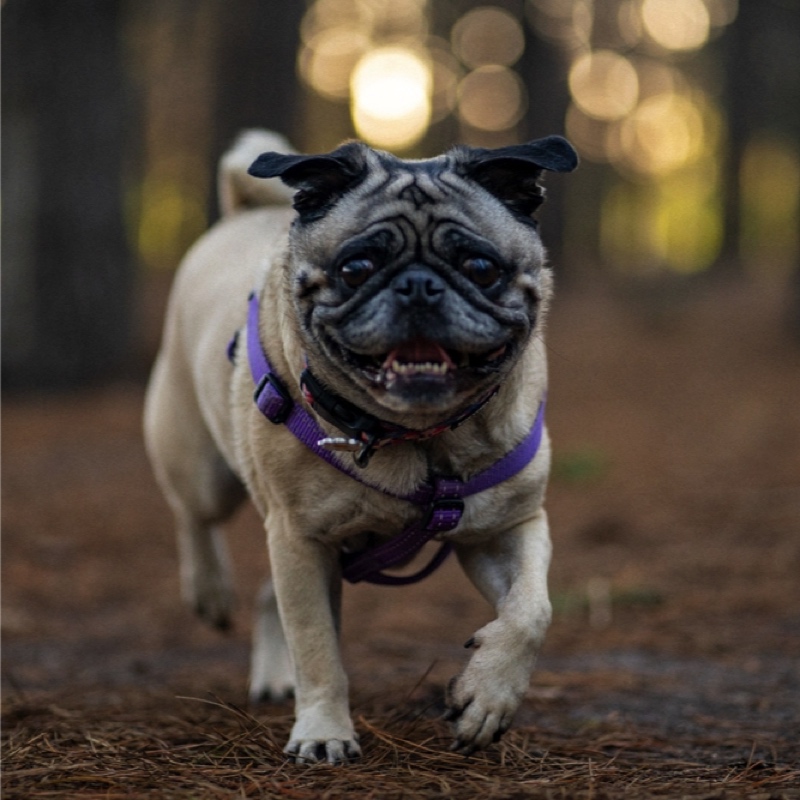
Pug
The PugHistory of the Scottish TerrierAccording to the FCI, the Pug originated in China. Blunt-nosed small dogs were popular there very early on. The breed probably came to Europe with traders and became particularly well-known and popular in the Netherlands and later in Great Britain. The further development of the breed was strongly influenced there, which is why Great Britain is also listed as a developing and patron country in the FCI.AppearanceBody shape: The Pug is square, compact and stocky in build. It is typically substantial for its size, combined with firm musculature and a round, distinctive head. Despite its small size, it should appear sturdy rather than dainty.
Coat: The coat is short, smooth, soft and glossy. The colours should be clear and pure so that the mask, dorsal stripe and other dark markings stand out clearly. Typical features include the dark mask, dark ears and the overall very distinctive facial markings.Nature/characterThe Pug is considered charming, dignified, intelligent, balanced, cheerful and lively. It is usually very people-orientated and seeks to be close to its caregivers. Many Pugs are friendly, playful and suitable for everyday life, but at the same time have a certain self-confidence.GroomingGrooming is generally uncomplicated as the coat is short. Regular brushing helps to remove loose hair. Skin folds, eyes, ears, claws and teeth often need more attention. The facial area in particular should be kept clean and dry. HealthHealth is particularly important for the Pug. The brachycephalic, i.e. short-headed, head shape can be associated with breathing problems, sensitivity to heat and other stresses relevant to everyday life. Eyes, skin folds, spine and weight also deserve special attention. This is why very responsible breeding and a critical look at breathing, resilience and general functionality are particularly important. EducationThe Pug is usually easy to train because it lives closely with its humans and generally likes attention. It needs friendly, clear and consistent leadership. Despite its small size, it should not be coddled or allowed to get away with everything. With early socialisation and loving consistency, the Pug usually develops into a pleasant companion dog. What are the special features of this breed?What is special about this breed is the mixture of unmistakable appearance, great closeness to people and a lot of personality in a small space. The Pug is often very present, charming and humorous in everyday life. At the same time, its conspicuous head shape brings with it special features that must be taken very seriously in terms of husbandry and health care.Suitable for first-time dog owners?Yes, in principle the Pug can be suitable for first-time dog owners because they are usually friendly, affectionate and easy to integrate into everyday life. However, it is important not to underestimate the breed's health characteristics and to be very aware of its responsible origins. This assessment is a professional categorisation based on the breed characteristics described.Family dog or not?Yes, the Pug can be a good family dog. They are generally friendly, people-orientated and like to be close to their caregivers. It fits particularly well into households that are looking for a rather small, sociable companion dog and respect its health limits. However, great care should be taken with heat, heavy physical exercise and unsuitable breeding.

Alaskan Malmute
The Alaskan MalmuteHistory of the MalmuteOriginally an Arctic draught dog for heavy loads; the FCI standard describes it as one of the oldest Arctic sled dog breeds.AppearanceBody shape: strong, heavy-boned, very muscular - designed for pulling power and endurance.Coat: weatherproof, very dense double coat (lots of undercoat).Temperament/characterPeople-oriented and friendly, not a "one-man dog" according to the standard, loyal and dignified.
At the same time often independent/ wilful and can be dominant towards other dogs.GroomingLots of coat, lots of hair: regular brushing, much more frequently in shedding phases (undercoat!).
Do not shear/shave (double coat fulfills protective functions; instead brush out/loosen undercoat).HealthFrequently monitored (depending on the line/individual):
Hip and elbow dysplasia
Hereditary polyneuropathy (AMPN) - there is a genetic test (UC Davis).
Other frequently mentioned topics: e.g. eye problems (cataract), thyroid gland (hypothyroidism).EducationNeeds early, consistent and calm training, preferably reward-based - and very good socialization.
Safe management is important: Malamutes love pulling, running, digging, "roaming" → escape-proof garden/leash/drag line.What special features does this breed haveUrge to pull and work (pulling sports, hiking with weight, canicross/skijoring-like activities - adapted to training).
Strong body + independence: a dog that "can do something" physically - and this is noticeable in everyday life.
High coat expenditure incl. heavy shedding.Suitable for first-time dog owners?Rather not ideal. Reason: a lot of strength, independence, sometimes dog dominance and high management/training requirements.
(It works - but usually better with the support of a dog school/trainer and breed-appropriate exercise).Family dog or not?Can fit into a family because it is often friendly and loyal to people.
But: because of its size/strength and sometimes difficult behavior towards other dogs, it is more of a family dog for active, structured households (children should be dog-experienced/respectful, supervision of small children).

English Pointer
The English PointerHistory of the English PointerThe pointer is a classic British pointing dog. According to the FCI, it originated in Great Britain; the Royal Kennel Club describes it as a traditional hunting dog, which was particularly prized in the 18th and 19th centuries for its stylish field work.AppearanceThe English Pointer is an athletic, elegant and at the same time powerful dog. The standard describes it as symmetrical, well-built and full of flowing lines - strong but not heavy. Typical features are the dry head, the slightly concave muzzle ("dish-face") and the athletic overall appearance.Body shape:
Athletic, deep-chested, dry-muscled and built for endurance. He is bred for long-distance searches in the field and accordingly shows a lot of gallop, resilience and reach.Coat:
The coat is easy to care for, short and functional. It protects well in everyday life, but does not require extensive grooming. Due to the short coat, the skin, ears and paws must nevertheless be checked regularly after long tours through the terrain.Nature/characterThe Pointer is considered friendly, balanced and dignified. In everyday life he is often gentle and people-oriented, but outdoors he is very passionate, fast and highly motivated to hunt. The PDSA describes him as mild in temperament, but with a high energy requirement; the VDH calls him a muscular athlete with strength and elegance.GroomingGrooming is simple; brushing once a week is usually sufficient. More important are exercise, nose work and sufficient free running opportunities in a safe environment. The Royal Kennel Club recommends more than 2 hours of exercise per day for the breed.HealthThe English Pointer is generally considered to be a fairly robust breed, but some issues are mentioned: Hip dysplasia, gastric torsion/GDV, progressive retinal atrophy, hypothyroidism, entropion, cataracts and in some cases Wobbler syndrome. The Pointer Club also refers to health surveys and breeding health plans for the breed.TrainingHe needs calm, fair and very consistent training. Recall, impulse control and good management of hunting behavior are particularly important. The Pointer is sensitive and learns well, but usually responds better to clear positive guidance than to harshness.What are the special features of this breed?Its most distinctive feature is its classic pointing work: the pointer searches over a wide area, picks up scent and "points", i.e. freezes in a typical posture in the direction of game. The Royal Kennel Club therefore calls it a prime example of a dog that is perfectly suited to its original task. In addition, he has an enormous willingness to run, a fine nose and a lot of style when moving.Suitable for first-time dog owners?Rather only to a limited extent. His nature is often friendly and not unnecessarily sharp, but his need for exercise and his hunting instinct are demanding. For beginners without experience with hunting-motivated, very active dogs, it is usually not an easy choice. For sporty, willing to learn people with good training and suitable exercise, it can work.Family dog or not?Yes, basically yes - in the right family. PDSA describes Pointers as mild and suitable for families with good socialization; the Royal Kennel Club classifies them as good companions. However, it is crucial that the family is really active and does not underchallenge the dog. They are usually less suitable for a quiet, less active everyday life.
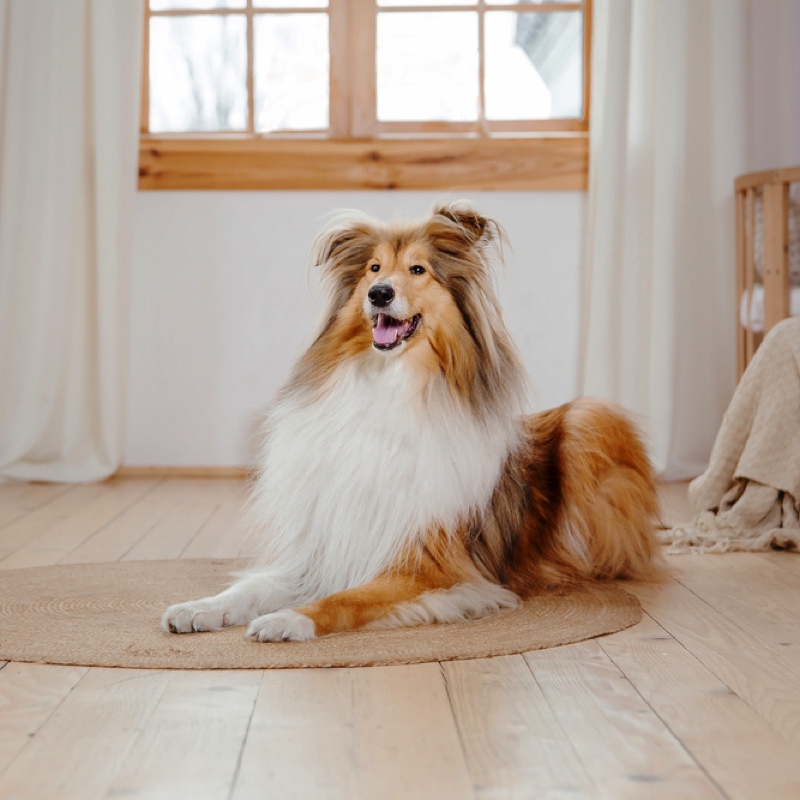
Collie
The Collie
HistoryThe Long-haired Collie, also known as the Long-haired Scottish Sheepdog, originates from Great Britain and was used as a shepherd and farm dog for a long time. According to the FCI, the Long-haired and Short-haired Collie developed from the same origin, presumably also under the influence of dogs brought to Scotland by the Romans. The Long-haired Collie is considered a refined form of the original working dog of the Scottish shepherds and later became very popular as a companion and family dog.AppearanceBody shape: The Long-haired Collie is harmonious, elegant and powerfully built without appearing clumsy or coarse. His expression is of particular importance and is created by the balanced head shape, the eyes, the ears and the overall dignified appearance. The body should appear capable of working and show flowing, effortless movements.Coat: The coat is one of the most striking characteristics of the breed. It is very dense and consists of a hard, straight outer coat and a soft undercoat. Typical are the lush mane, the ruff and the well-coated tail. The recognised colours are sable and white, tricolour and blue merle, each with the typical Collie markings.Nature/CharacterThe Long-haired Collie is considered friendly, cheerful, sensitive and people-orientated. According to the standard, it should never be nervous or aggressive. Many representatives of the breed are attentive, eager to learn and very closely bonded to their family. This mixture of gentleness, intelligence and alertness makes the Long-haired Collie a very pleasant companion and family dog.GroomingGrooming is necessary on a regular basis, but is usually easy to do. The dense coat should be brushed thoroughly to remove loose hair and prevent matting. The VDH points out that brushing too often is not advisable as too much undercoat is lost. However, daily brushing is advisable during the shedding period. In addition, ears, claws, teeth and paws should be checked regularly.HealthThe Long-haired Collie is generally considered a robust breed, but care should be taken to ensure responsible breeding. Among other things, eye issues and genetic characteristics play a role in the breed, and attention should also be paid to general health care, good weight management and a reputable breeding base. EducationTraining is often successful because the Long-haired Collie is intelligent, sensitive and people-orientated. As a rule, they respond particularly well to friendly, clear and consistent leadership. Harsh methods do not suit this sensitive breed. Early socialisation, loving consistency and mental activity help to make a confident dog that is suitable for everyday life. What are the special features of this breed?What is special about this breed is the combination of elegance, gentleness and a working past. The Long-haired Collie often appears very noble and refined, but at the same time has the roots of a true shepherd dog. Its friendly expression, splendid coat and close bond with people are typical. Many dogs of this breed are sensitive and react strongly to the mood of their environment.Suitable for first-time dog owners?Yes, the Long-haired Collie is often well suited to first-time dog owners. They are usually friendly, eager to learn and co-operative. However, it is important that you take his sensitivity seriously, train him lovingly and consistently and do not underestimate the amount of grooming required for his coat. He usually gets on very well in a calm, reliable home. Family dog or not?Yes, the Long-haired Collie is generally a very good family dog. He likes to live closely with his people, is considered friendly and adaptable and usually feels very comfortable in a harmonious family environment. They are particularly well suited to households that offer them closeness, exercise and friendly, clear leadership.
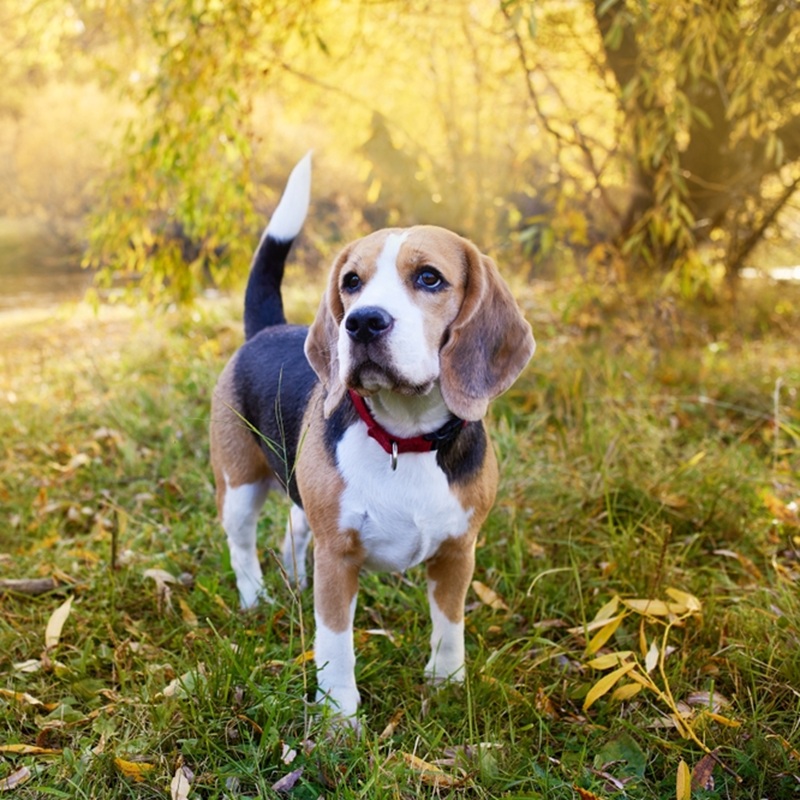
Beagle
Beagle profileHistory of the BeagleThe FCI standard describes the Beagle as a running dog from Great Britain, which traditionally hunts in packs and mainly follows the hare hunt over its nose.AppearanceBody shape:
You get a strong, compact running dog that looks athletic without appearing coarse.
Coat:
Short-haired, dense and practical in everyday life, as it sheds dirt and weather well.
Temperament and characterThe Beagle is considered cheerful, attentive, intelligent and friendly, with no signs of aggression or fearfulness, although the nose often leads the way in everyday life.GroomingThey usually require little grooming (regular brushing is sufficient), but their ears, claws and teeth should be checked consistently, as the drooping ears can require care.
Health
Frequently mentioned conditions include hypothyroidism, allergies, epilepsy and back problems such as IVDD; ear problems are also an issue that you should keep an eye on.TrainingThe best way to achieve your goal with Beagles is through calm consistency, clear rules and reward training. Realistically, management often helps with recall (drag line, secured free-running zones) because smells can be a strong motivator.What special features does this breed haveThe Beagle is a pronounced "nose dog" and likes to work persistently on tracks. At the same time, it can have a clear "voice", which is important in noisy living situations.Suitable for first-time dog owners?Yes, often yes, if you have patience, consistency and a desire for nose work and do not expect the recall to be a matter of course.Family dog or not?In many cases, yes: Beagles are usually friendly and social, fit in well with active families, but need clear rules and enough activity to keep them relaxed in everyday life.
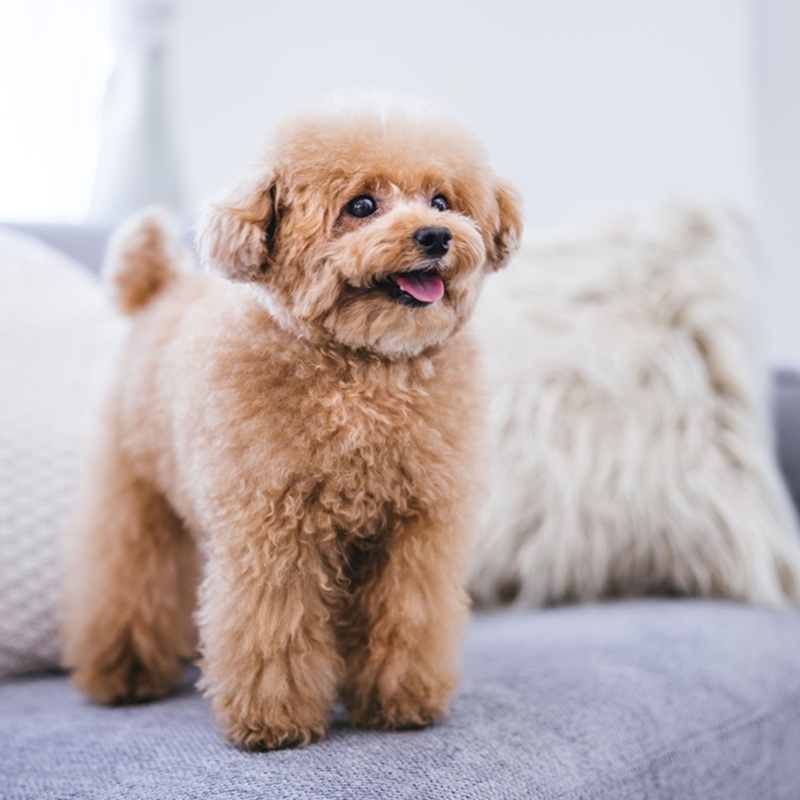
Small poodle
Small Poodle
History of the Scottish Terrier
The poodle is one of the old European dog breeds and was originally used as a water dog. It was strongly characterised and further developed in France in particular, which is why France is now considered the country of origin. Over time, the larger working dog developed into different size variants, including the small poodle. Later, the poodle became known primarily as an intelligent companion, show and family dog.
Appearance
Body shape: The Toy Poodle is harmoniously, elegantly and well-proportioned. It appears neither clumsy nor fragile, but lively, proud and agile. Typical features include a rather square overall appearance, a fine but not weak bone structure, and a springy, light gait.
Coat: The coat is one of the breed’s most striking features. It is dense, fine and tightly curled or formed into cords. The Toy Poodle usually sheds very little, but requires regular and careful grooming.
Nature/character
The small poodle is considered to be very intelligent, attentive, playful and people-orientated. It learns quickly, enjoys working with its people and is often extremely adaptable. Many small poodles are friendly, alert and sensitive without being overly nervous. Thanks to their intelligence and keen powers of observation, they often react very clearly to the mood and everyday life of their owners.
Grooming
Grooming is more time-consuming than many initially think. The coat must be regularly brushed, combed and cut or clipped at sensible intervals so that it does not become matted. Ears, claws, teeth and eyes should also be checked regularly. Because the coat sheds so little, loose wool often gets caught in the coat and needs to be actively removed.
Health
The small poodle is generally regarded as a fairly robust and long-lived variety. Nevertheless, attention should be paid to responsible breeding. Depending on the line, patella problems, eye diseases, dental problems or hereditary diseases can play a role. Regular veterinary checks, good weight management and a reputable breeding base are important.
Education
The small poodle is generally very easy to train. It learns quickly, is attentive and often wants to work closely with its human. It responds best to friendly, clear and consistent training. Harsh methods are unsuitable because many Poodles react sensitively. With early socialisation, variety and meaningful mental activity, the small poodle usually develops into a very pleasant companion.
What are the special features of this breed?
What is special about this breed is the combination of intelligence, elegance and a great love of learning. The small poodle is usually much more than just a pretty companion dog. They are often very attentive, athletic and versatile, for example in everyday life, dog sports or mental tasks. They also have a special coat that sheds very little but requires a lot of grooming.
Suitable for first-time dog owners?
Yes, the small poodle is often very suitable for first-time dog owners. They are usually smart, co-operative and easy to train. The important thing is not to underestimate them. Even a small to medium-sized poodle needs training, activity and regular grooming. If you are prepared to do this, you will often find him to be a very pleasant beginner's dog.
Family dog or not?
Yes, the small poodle is generally a very good family dog. It is usually friendly, playful and closely bonded to its humans. They generally feel very comfortable in a family with loving consistency, sufficient activity and respectful behaviour. Due to its adaptability, it often suits both active families and quieter households.
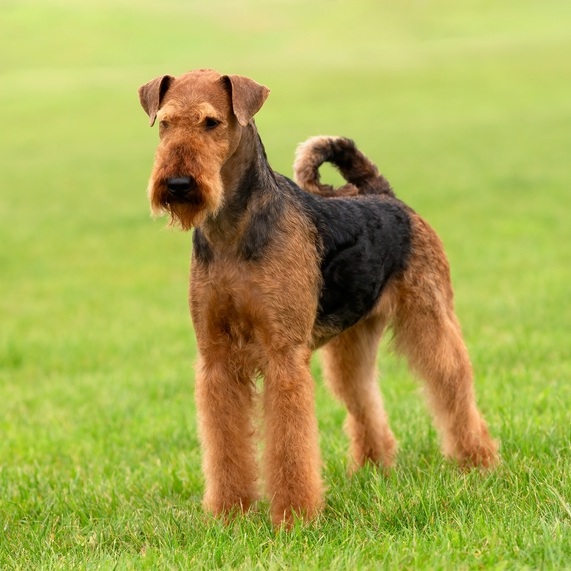
Airedale Terrier
The Airedale TerrierHistory of the Scottish TerrierThe Airedale Terrier comes from Yorkshire (Great Britain) and got its name, among other things, from shows/the "Airedale" reference. It was used in a variety of ways (including as a hunting/utility dog, later also for tracking, in war, in the police/army).AppearanceBody shape: sturdy, muscular, active, appearing ‘compact’ (without being high-legged or elongated).Coat: typical wiry terrier coat with a distinctive beard and ‘leg fringes’, with a dark saddle-coloured patch across the back.Nature/characterSelf-confident, friendly, courageous, intelligent and very alert - not aggressive according to the standard, but fearless.GroomingRelatively high (typical of a terrier):
Brushing/combing: approx. 2-3× per week (otherwise felt/tangles, especially beard/legs).
Trimming/hand-stripping or clipping: for the "classic" Airedale look usually every 6-8 weeks; hand-stripping often maintains structure/colour better.
Everyday life: Ears, claws, teeth should be groomed regularly (as with all breeds).HealthFrequently mentioned topics (not every dog gets this - but it is "typical to keep an eye on"):
Hip dysplasia
Gastric torsion/GDV (severe form of "bloat") - risk present in larger dogs; favoured by hasty eating or romping immediately after eating, among other things.
Underactive thyroid (hypothyroidism) is also described.EducationAn Airedale is clever, but also independent (terrier!). Works best:
clear rules + consistent routine
plenty of mental exercise (nose work, tricks, retrieving games)
fair, positive training methods (and good socialisation at an early age).Special features of the breed"King of Terriers": largest terrier, very versatile, robust.
Combination of alertness + athleticism + brains → needs a task, otherwise he looks for one (digging, "rubbish", hunting).Suitable for first-time dog owners?Conditional. It can work if you are really keen on training, leadership and regular grooming. Without activity/consequence, he quickly becomes "boss in the ring" and does terrier things.Family dog or not?Can be a good family dog if it is kept busy and children treat the dog with respect (no roughhousing). Due to his size/power, he is more suitable for families who like to be outside and like rules/structure.
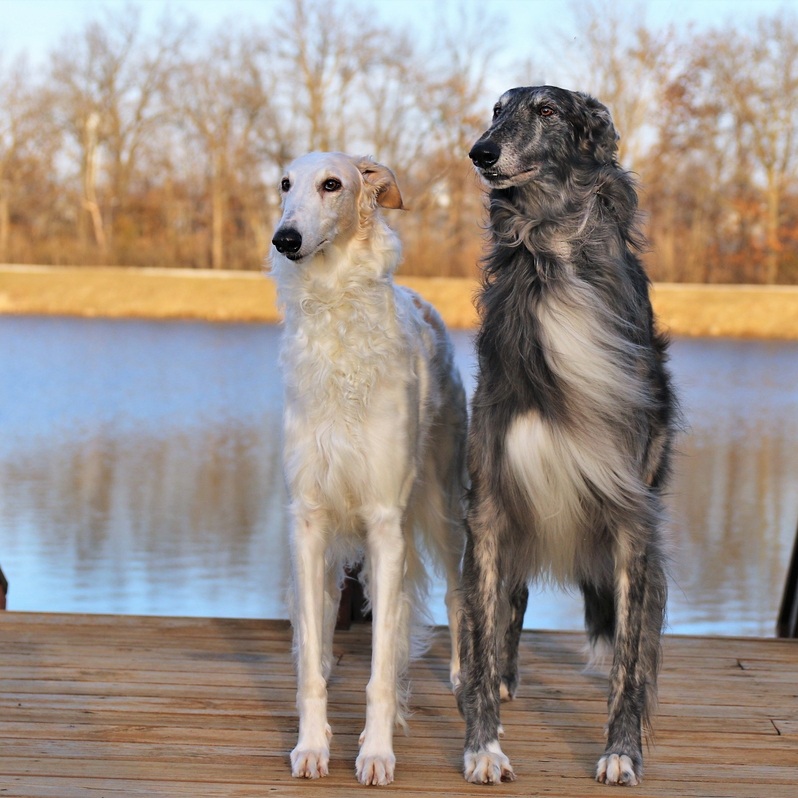
Borzoi
Profile BorzoiHistory of the BorzoiThe Borzoi is a Russian hunting sighthound that was historically bred for sight hunting (including wolves) and is closely associated with the Russian hunting tradition and nobility.AppearanceBody shape: very tall, slender and elegant, with a deep chest and long, narrow silhouette (typical sighthound build).
Coat : long, fine coat, which can be smooth or wavy depending on the dog; typical "fringing" on legs, tail and ruff.Nature and characterIn everyday life, many borzoi appear calm, gentle and rather reserved with strangers, but are very quick to react outdoors. Typical of sighthounds, they are often very independent and have a strong instinct to chase. GroomingThe long coat needs regular brushing to prevent matting (especially on the ears, ruff, "pants" and tail). Many borzoi are pleasantly quiet indoors, but need safe opportunities to sprint outside.Health Stomach torsion (GDV) is an important issue in large, deep-chested breeds, so food and rest management after eating is advisable. In addition, sensitivity to medication or anesthesia is often indicated in greyhounds (low body fat percentage).TrainingCalm, fair training with positive reinforcement works best. Recall is often challenging when game or fast-moving objects come into play, which is why a drag lead and fenced-in outdoor runs are realistic in many everyday situations. What special features does this breed haveThe Borzoi is often a "couch potato" indoors, but a high-performance sprinter outdoors. The combination of elegance, sensitivity and hunting instinct makes it special, but requires good management and safe environments. Suitable for first-time dog owners?Only to a limited extent: If you take sighthound needs (safety, hunting instinct, running free only in a controlled manner) seriously and build up training patiently, it can work. It is usually not ideal for people who are looking for an "always-listening" dog without management.Family dog or not?May be suitable if the family is calmly structured and everyone can handle the hunting instinct and size with confidence. In households with very small pets (rabbits, ferrets, free-roaming cats), caution is advised unless you socialize very early and manage consistently.

Affenpinscher
Profile AffenpinscherHistory of the AffenpinscherOriginally a domestic and companion dog from southern Germany; ancestors were already depicted by Albrecht Dürer. First records date back to 1879.AppearanceBody shape: small, strong, compact and rather "square" in appearanceCoat: rough and shaggy-looking, particularly emphasized on the head/shoulders (eyebrows/beard = "monkey face")Nature/characterIntrepid, alert, stubborn and very affectionate; according to the FCI a "pleasant family dog", but can also be temperamental/temperamental at times.
He needs a lot of social contact and variety (keeping his head and nose busy helps).GroomingBrushing/de-matting: regularly (otherwise the wiry coat quickly becomes matted, especially on the beard/legs).
Trimming/cutting: useful depending on the desired look; many owners have the coat professionally shaped (typical "monkey" head).Everyday life: often wipe the beard briefly after eating/walking - dirt likes to get stuck there (very practical, not a "breed fault").HealthAs with small breeds, these include (depending on the line/individual) Patellar luxation, tracheal collapse, sometimes hip problems and eye problems.
Due to the short muzzle, respiratory problems can also be favored in heat/exertion (keyword brachycephalic).EducationSmart, self-confident small dogs: positive reinforcement, clear rules and short, playful sessions are best (otherwise he switches to "no desire").
Early socialization is important so that alertness does not turn into "permanent alarm".What special features does this breed haveUnmistakable "monkey" face (beard/eyebrows)
Big character in a small body: courageous, alert, sometimes stubbornly charming
Original rat catcher: can show hunting instinct for small animals (training/management is worthwhile).Suitable for first-time dog owners?Often yes - with the right expectations. Some vet/breed information says it is generally suitable for first-time owners because it can be moderately active and very people-oriented.
But: stubbornness + alertness + grooming mean that "just walking alongside" rarely works well.Family dog or not?Basically suitable for families if the family has time and the dog is well socialized. (FCI: "pleasant family dog"; VDH: seeks people with lots of time/social contact).
It works best with children if they are respectful (no pulling/pushing) - because of their small size, very small children should always be supervised.

English Setter
The English Setter
History of the English SetterThe English Setter is a classic British hunting dog for bird hunting. The term "Belton" was popularized by Edward Lavarack, among others, who strongly influenced the breed.AppearanceElegant, athletic pointing dog with clear lines, deep chest and long, dry head. His gait is expansive and persistent - made for long searches in the field.Body shape:
Athletic, symmetrical, light rather than bulky; working lines often somewhat "sportier" and lighter than show lines.Coat: Beautiful, but "high maintenance": Feathering tends to knot (especially ears, armpits, breeches, tail). Regular checks after walks (burrs/grits) are important.Nature/character Usually friendly, gentle, people-oriented and social - yet lively and motivated to hunt. He is often considered pleasant in the house if he gets enough exercise and nose work outside.Grooming Brush/comb out 2-4× per week (more often if coat is thick or changing)
Keep a close eye on feathering and ears (felt, burrs)
Check paws, ears and belly for burrs after hunting/meadow rounds Health As with many medium to large sporting dogs, hip dysplasia and sometimes eye issues play a role - in the UK, for example, hip and eye examinations are recommended as part of breeding/health programs.
Breed clubs also mention issues such as hypothyroidism and atopy/allergies as areas where breeding work is being carried out.EducationThe key is recall + hunt control (impulse control, orientation, tug line, alternative tasks such as retrieving/tracking). Setters are sensitive - clear rules, lots of rewards and consistent training without harshness work best.What are the special features of this breed?"Belton" spotting is typical of the breed and very variable.
Very strong nosed and bred for persistent field work - therefore needs real activity (nose work/reporting/mantrailing light etc.).
Many are very family-oriented, but do not like to be left alone all the time.Suitable for first-time dog owners?Conditionally yes - if you are keen on training (recall/hunting behavior) and regular exercise. Rather unsuitable for beginners who are looking for a "just goes with the flow" dog.Family dog or not? Yes, often a very good family dog: friendly, social and usually loves children - provided he gets enough exercise, activity and hunting management.