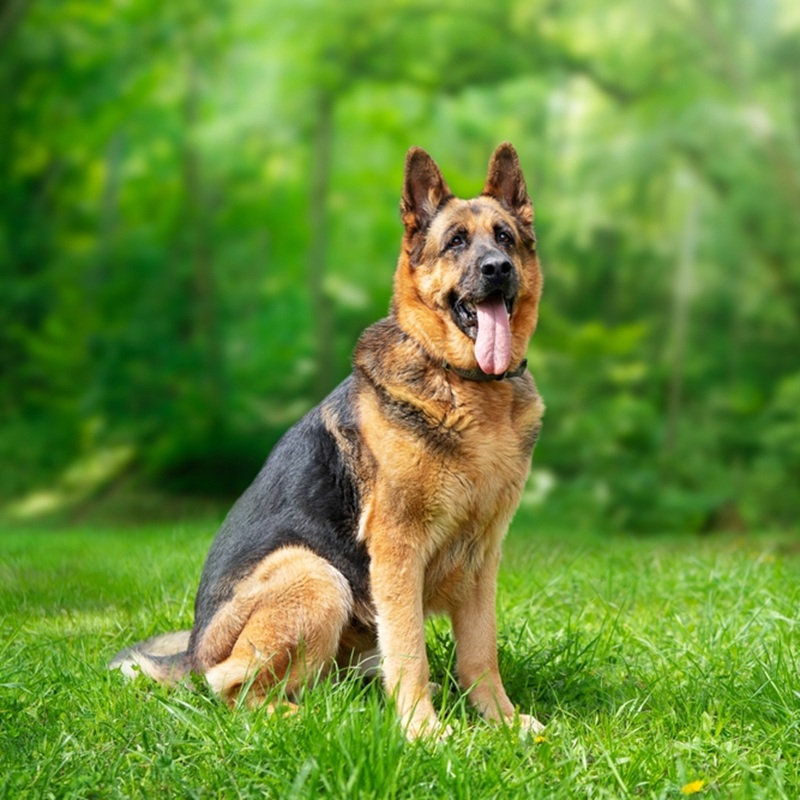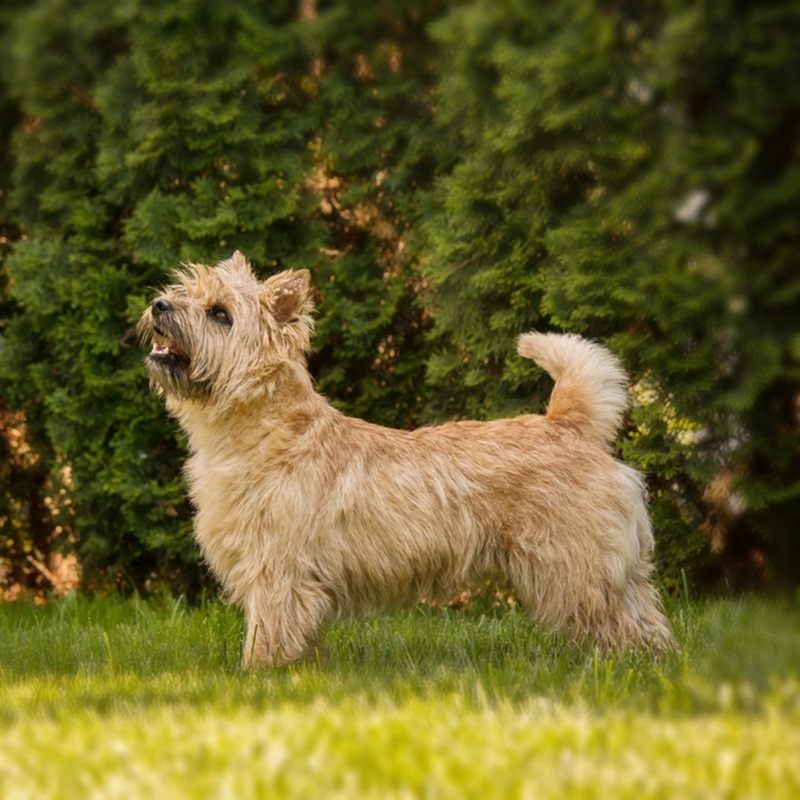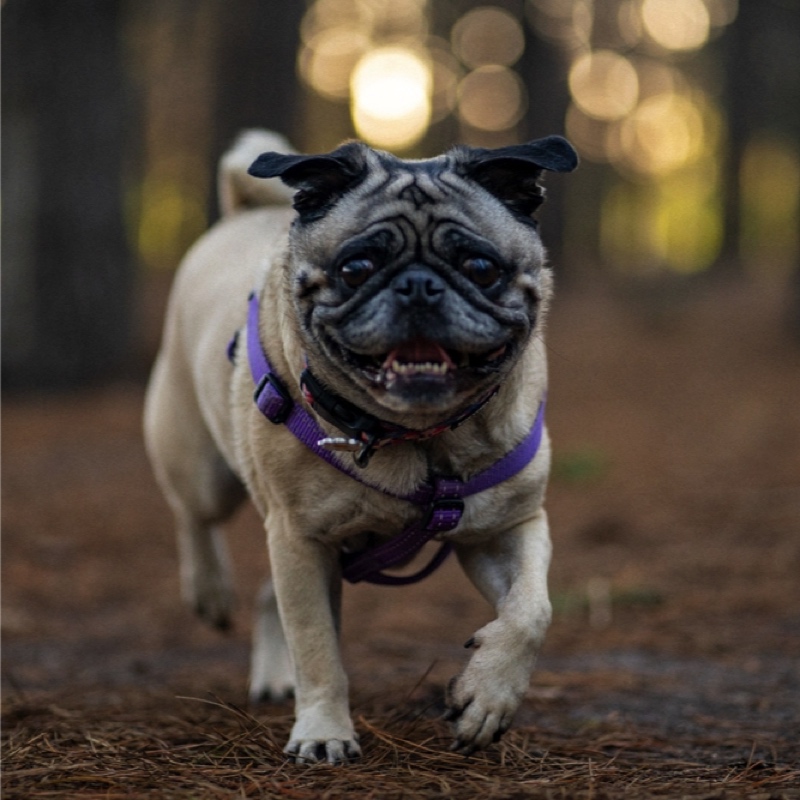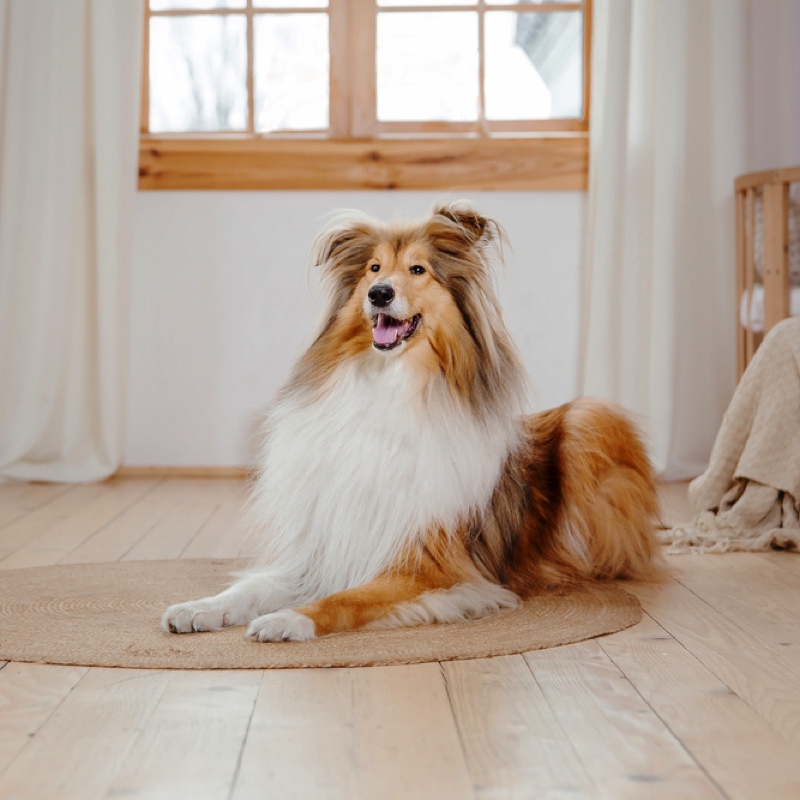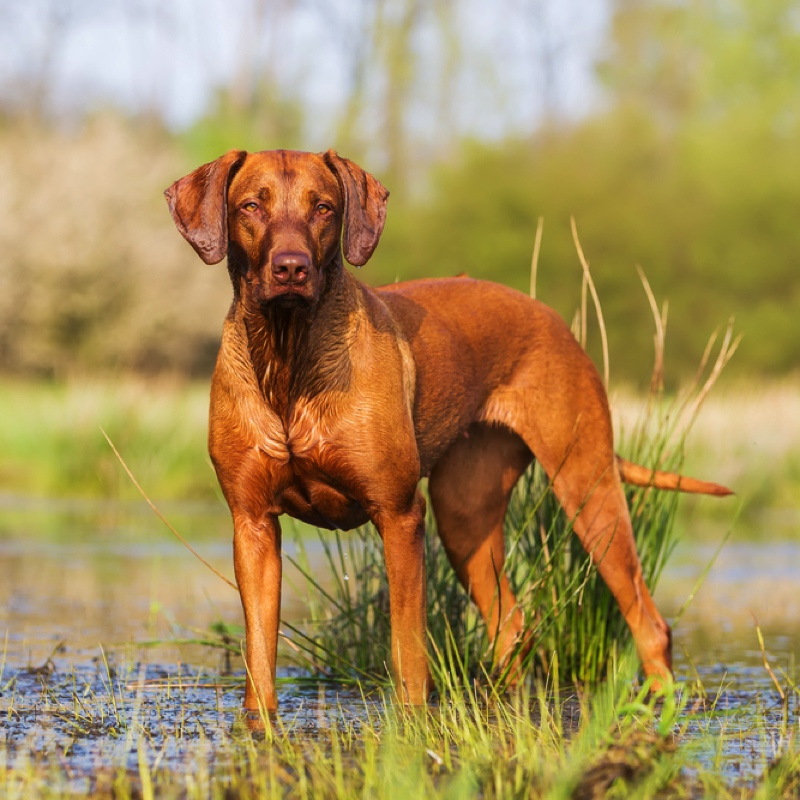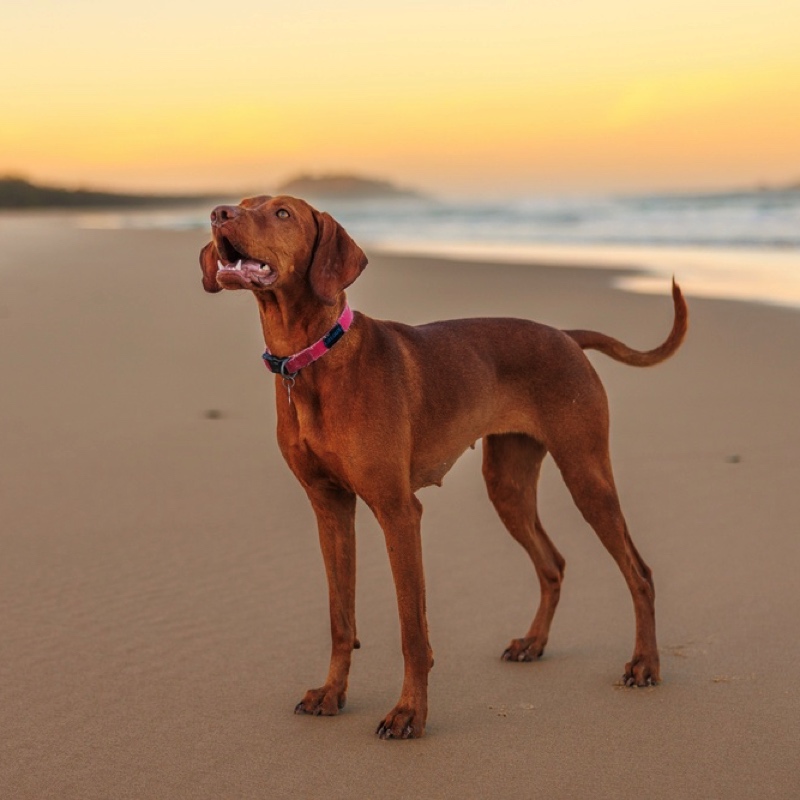
Vizsla

FCI standard number: 57Country of origin
: HungaryClassification
: FCI Group 7, Section 1, Continental Pointing Dogs, Type BraqueHeight at withers
female: 54-60 cmHeight at withers
male: 58-64 cmWeight
female: approx. 20-27
kgMale
weight
: approx. 22-30 kgFur color
: Semmel yellow in various shadesFur texture
: Short, dense, coarse and hard to the touch, thinner, silkier and shorter on the head and coat
Neck circumference: approx. 35-45 cm - always measure the neck circumference directly on your dog
Product information "Vizsla"

Magyar Vizsla


History of the Magyar Vizsla

The Magyar Vizsla is an old Hungarian hunting dog whose roots go back a long way. It was bred as a versatile pointing dog for field, forest and water and was intended to work closely with humans. Its development was systematically continued in Hungary until today's elegant, powerful shorthaired Vizsla was established as an independent type.

Appearance

Body shape: The Magyar Vizsla is a medium-sized, elegant hunting dog with a noble expression. Its build is rather light, dry and lean, yet powerful and capable. The body is slightly longer than tall, and overall it appears harmonious, athletic and enduring.

Coat: The coat is short, dense and close to the body. It should be robust and functional, without feathering or longer sections as in long-haired hunting dogs. Typical is the uniform semmel yellow color, which makes the dog very distinctive.

Nature/character

The Magyar Vizsla is considered to be lively, friendly, balanced and very people-oriented. One of its most important characteristics is its pronounced willingness to make contact with people. They are usually sensitive, easy to train and eager to work. It does not tolerate harsh treatment well and should not be aggressive or shy.

Grooming

Grooming is generally uncomplicated. The short coat only needs regular brushing to remove loose hair and dirt. Ears, claws, teeth and paws should also be checked. Due to its activity and use in the field, it makes sense to check the dog for minor injuries, ticks or dirt after walks or hunting.

Health

The Magyar Vizsla is generally considered to be a robust and efficient breed. Nevertheless, attention should be paid to responsible breeding. As with many medium-sized to large hunting dogs, hip problems, eye problems or other hereditary diseases can play a role, depending on the line. Good weight management, appropriate exercise and careful rearing during growth are also important.

Training

Training is often successful because the Magyar Vizsla works very closely with its owner and usually wants to please. He needs friendly, clear and consistent leadership without harshness. Early socialization, recall training and a sensible combination of exercise, nose work and mental activity are particularly important. An underchallenged Vizsla can quickly become restless or unbalanced.

What are the special features of this breed?

A special feature of this breed is its close bond with humans. The Magyar Vizsla is usually not a dog that just runs alongside, but actively seeks contact and cooperation. Added to this are its versatility as a hunting dog, its love of water and its eye-catching, uniform, semi-melange color. He combines elegance, sensitivity and a love of work in a very typical way.

Suitable for first-time dog owners?

Conditionally. A committed and well-informed first-time dog owner can get on well with a Magyar Vizsla if there is enough time, exercise and activity. However, the breed is not always easy because it is very sensitive, needs a lot of closeness and wants to be kept busy both physically and mentally. If you are looking for an uncomplicated dog with little activity, this breed is usually not the ideal choice.

Family dog or not?

Yes, in principle the Magyar Vizsla can be a very good family dog. They are usually friendly, affectionate and very attached to their humans. However, it is best suited to active families or households that have plenty of time for exercise, occupation and joint activities. Without sufficient exercise, this sensitive and hard-working dog often becomes unbalanced in everyday life.

Composition
Feeding recommendation
Technical details
Size information

0 of 0 reviews

Give us a rating!

Share your experience with the product with other customers.


Suggested products

Whippet
The WhippetHistoryThe Whippet is a British sighthound breed. It was bred as a fast, smaller sight hunter and has been established as an independent breed since the 19th century; a first standard was established in 1891.AppearanceThe Whippet is a medium-sized, elegant, very athletic dog. The standard describes it as a balanced combination of muscular power and strength with elegance and grace, built for speed and performance. Body shape: Slender, deep-chested, with tucked-up belly line, long-appearing back and characteristic arch over the loin; overall sprinter-like and very agile. Coat: Short, fine, smooth lying and easy to care for.Nature/CharacterThe FCI standard describes the Whippet as the ideal companion, very adaptable in both home and sporting environments, friendly, affectionate and even-tempered. At the same time, it remains a sight hunter with a pronounced responsiveness to moving stimuli.GroomingThe grooming effort is low: regular brushing, checking claws, teeth, and ears is usually sufficient. Due to its very short coat, the Whippet is more sensitive to cold than many other breeds. This is a practical consequence of the coat structure and the very limited hair.HealthThe FCI generally emphasises that only functionally and clinically healthy dogs should be used for breeding. With the Whippet, it is also important to pay attention to responsible breeding, good weight management and appropriate protection in cold or rough conditions. The standard itself does not contain a detailed list of diseases.TrainingWhippets are usually sensitive and learn well, but often respond sensitively to pressure. Calm consistency, early socialisation and reliable recall training work best. Due to their prey and sighting drive, free running is not always possible everywhere without problems.What special features does this breed have?Particularly noteworthy are the enormous sprinting speed, the typical sighthound body, the very fine coat and the contrast between fast and alert outdoors and often calm and cuddly indoors. The VDH describes the Whippet as a "sprinter with a sense of cuddling", which describes the breed quite well.Suitable for first-time dog owners?Yes, often suitable with some reservations. A Whippet can be a good fit for beginners if they want a sensitive, rather gentle dog and are prepared to take recall, safety off-lead and sighthound specifics seriously. It is usually easier to handle in everyday life than many very driven working breeds, but it is not a dog that should be underestimated because of its calm nature.Family dog or not?Yes, in many cases a good family dog. The standard calls it friendly, affectionate and even-tempered; at the same time, it is considered adaptable in the home environment. In calm to normally active families it often fits very well as long as care is taken to ensure sensitive handling, safe exercise and opportunities to withdraw.
 
Sheltie - Shetland Sheepdog
The Sheltie - Shetland SheepdogHistory of the Scottish TerrierThe Shetland Sheepdog is descended from the rough and small herding dogs of the Shetland Islands. There it was used as a versatile farm dog and helped to herd small farm animals. The breed was later refined with collie-like dogs, resulting in its current elegant appearance. Despite the outward resemblance, the Sheltie is not a simple miniature form of the Collie, but an independent breed with its own development.AppearanceBody shape: The Sheltie is a small, long-haired, harmoniously built dog with a slightly elongated body. It appears elegant, agile and expressive. The head is wedge-shaped, the eyes are almond-shaped and very alert, the ears are small and laid back when at rest, and half-erect when alert. Coat: The coat is double, with a long, hard outer coat and a dense, soft undercoat. Particularly striking are the pronounced ruff, the feathering on the legs and tail, and the overall very full appearance.Nature/characterThe Sheltie is considered to be intelligent, sensitive, attentive and very keen to learn. It usually forms a close bond with its humans and is often reserved towards strangers without being aggressive. Many representatives of the breed are lively, sensitive and strongly orientated towards their owner. Due to their herding dog background, they often react very attentively to movements and stimuli in their environment.GroomingThe coat needs regular grooming to prevent matting. Thorough brushing several times a week is advisable, often even more frequently during the shedding season. Knots can easily form, especially behind the ears, on the legs and in the ruff. Grooming is more time-consuming than with short-haired breeds, but can be done well with routine.HealthThe Sheltie is a fairly robust breed overall, but there are some risks typical of the breed. These include eye diseases, MDR1 defects, patellar luxation, thyroid problems and, in some lines, skin or autoimmune diseases. Responsible breeding with health checks is therefore very important.EducationThe Sheltie is generally easy to train because it is smart and learns quickly. However, it often reacts very sensitively to harshness or unclear signals. Calm, consistent and friendly training with positive reinforcement works best. Early socialisation is important so that shyness or excessive reporting does not become too strong.What are the special features of this breed?The Sheltie is particularly well known for its high learning ability, sensitivity and strong human-orientation. Many animals are extremely alert and alert quickly, which makes them good watchdogs. At the same time, they are often very sensitive in their perception and react strongly to mood, tone of voice and changes in everyday life. Their striking ruff and elegant long-haired coat are also typical characteristics.Suitable for first-time dog owners?Yes, basically yes. The Sheltie can be a good dog for committed first-time dog owners if they are prepared to deal with training, exercise and grooming. Its intelligence and willingness to co-operate make many things easier. However, because of its sensitivity, it needs calm, fair and understandable leadership.Family dog or not?Yes, the Sheltie can be a very good family dog. They are usually affectionate, friendly and like to be close to their humans. They often feel particularly at home in a loving, not too noisy environment. It is important that he is not only physically but also mentally occupied and has opportunities to retreat.
 
Elo
The EloNature/characterThe breeding goal describes the Elo as friendly, balanced, suitable for children, docile, robust and resilient. It should have a high stimulus threshold, good social behavior, little tendency to bark and as little hunting behavior as possible. Many Elos are people-oriented, adaptable and initially reserved rather than pushy towards strangers. At the same time, the EZFG emphasizes that many Elos are strong-willed and intelligent and therefore need consistent training.GroomingRegular brushing is important, especially when changing their coat. In addition, the ears, teeth, claws and eyes should be checked as usual. The Elo is not a high-performance athlete, but needs daily walks, activity and close family contact.HealthThe EZFG attaches great importance to health checks. Extensive examinations are carried out before breeding approval, including HD x-rays, patellar luxation checks, some ED x-rays and eye examinations. This speaks for a health-oriented breeding approach, but is of course no substitute for careful selection of a reputable breeder and good breeding.EducationThe Elo learns well, but is often not simply "comfortable". The EZFG describes him as intelligent and sometimes strong-willed; especially at a young age he demands consistency. Calm, friendly and clear training with early socialization, firm rules and positive reinforcement works best.What are the special features of this breed?The most special feature is that the Elo was developed specifically as a family dog and the focus in breeding was on temperament and health rather than a strictly uniform conformation. In addition, "Elo®" is protected by trademark law and linked to EZFG breeding. In a way, the Elo is therefore less a classic FCI breed and more a controlled breeding project with its own standard.Suitable for first-time dog owners?Yes, often - but not automatically. The Elo is considered friendly and adaptable and is often described as suitable for beginners. At the same time, the EZFG points out that many Elos are strong-willed and intelligent and need consistent guidance, especially when they are young. They are often well suited to motivated beginners with a willingness to learn.Family dog or not?Yes, very clearly intended as a family dog. This is exactly what the Elo was originally bred for: as a child-friendly, friendly, strong-nerved and socially compatible companion. In a loving and consistent attitude suitable for everyday life, it can be a very good family dog.
 
Small poodle
Small Poodle History of the Poodle The poodle is one of the old European dog breeds and was originally used as a water dog. It was strongly influenced and further developed in France in particular, which is why France is now considered the country of origin. Over time, the larger working dog developed into different size variants, including the small poodle. Later, the poodle became known primarily as an intelligent companion, show and family dog. Appearance Body shape: The Small Poodle has a harmonious, elegant and well-proportioned build. It appears neither clumsy nor fragile, but lively, proud and agile. Typical are the rather square overall impression, the fine but not weak bone structure and a springy, light movement. Coat: The coat is one of the most striking characteristics of the breed. It is dense, fine and strongly curled or formed in cords. The Small Poodle usually sheds very little, but needs regular and careful grooming. Nature/character The Small Poodle is considered to be very intelligent, attentive, playful and people-oriented. They learn quickly, enjoy working with their people and are often extremely adaptable. Many small poodles are friendly, alert and sensitive without being overly nervous. Thanks to their intelligence and keen powers of observation, they often react very clearly to the mood and everyday life of their caregivers. Grooming Grooming is more complex than many people initially think. The coat must be regularly brushed, combed and cut or clipped at sensible intervals so that it does not become matted. Ears, claws, teeth and eyes should also be checked regularly. Because the coat sheds so little, loose wool often gets caught in the coat and must be actively removed. Health The small poodle is generally considered to be a fairly robust and long-lived variety. Nevertheless, attention should be paid to responsible breeding. Depending on the line, patella problems, eye diseases, dental problems or hereditary diseases can play a role. Regular veterinary checks, good weight management and a reputable breeding base are important. Training The small poodle is generally very easy to train. It learns quickly, is attentive and often wants to work closely with its owner. It responds best to friendly, clear and consistent training. Harsh methods are unsuitable because many Poodles react sensitively. With early socialization, variety and meaningful mental activity, the small poodle usually develops into a very pleasant companion. What are the special features of this breed? What is special about this breed is the combination of intelligence, elegance and a great love of learning. The small poodle is usually much more than just a pretty companion dog. They are often very attentive, athletic and versatile, for example in everyday life, dog sports or mental tasks. They also have a special coat that sheds very little but requires a lot of grooming. Suitable for first-time dog owners? Yes, the small poodle is often very suitable for first-time dog owners. They are usually smart, cooperative and easy to train. The important thing is not to underestimate them. Even a small to medium-sized poodle needs training, activity and regular grooming. If you are prepared to do this, you will often find a very pleasant beginner's dog. Family dog or not? Yes, the small poodle is generally a very good family dog. They are usually friendly, playful and closely bonded to their humans. They generally feel very comfortable in a family with loving consistency, sufficient activity and respectful treatment. Due to its adaptability, it often suits both active families and quieter households.
 
Samoyede
The RottweilerHistory of the Scottish TerrierThe Rottweiler is one of the oldest dog breeds. Its ancestors were already used as herding dogs in Ancient Rome and travelled across the Alps with the Roman legions. In the area around Rottweil, these dogs were mated with local dogs and developed into the type that later became known as the Rottweiler butcher's dog. It herded cattle, guarded property and was officially recognised as a police dog in 1910.AppearanceBody shape: The Rottweiler is medium to large in size, strong, compact and strikingly stocky in build. Despite its size, it should not appear clumsy, but rather like an athletic, enduring and agile athlete. Typical features include a broad head, deep chest, strong musculature and an overall very powerful appearance. Coat: The coat is double-coated, dense and weather-resistant. It consists of medium-length, coarse outer hair with an undercoat, which should not, however, be visible. The typical colour is black with clearly defined reddish-brown markings.Nature/characterThe Rottweiler is considered to be even-tempered, calm, strong-nerved and self-confident. At the same time, he is alert, resilient and usually closely attached to his family. With good socialisation and training, they are often friendly, docile and suitable for everyday use. Typical characteristics are his high stimulus threshold, his seriousness and his natural protective and guarding instinct.GroomingGrooming is generally uncomplicated. Occasional brushing is usually sufficient to remove loose hair and dirt. Brushing should be more thorough during the shedding period. In addition, ears, claws, teeth and paws should be checked regularly. HealthThe Rottweiler is generally regarded as a resilient and capable breed. Nevertheless, attention should be paid to responsible breeding. As with other large and strong dogs, hip and elbow problems or other hereditary diseases can play a role, depending on the line. Controlled growth, good weight management and sensible physical exercise are also important. EducationTraining should begin early, clearly, calmly and consistently. The Rottweiler is strong, intelligent and usually easy to handle, but needs reliable leadership and very good socialisation. Loving consistency is particularly important. Harsh or unfair methods are unsuitable. Good leash control, impulse control and safe everyday behaviour are very important for this breed.What are the special features of this breed?What makes this breed special is its combination of strength, nerve and versatility. The Rottweiler is not only a guard and family dog, but also a service, rescue, therapy and sporting dog. He has a lot of substance, seriousness and protective instinct, which is why his keeping and training must be particularly responsible. It is precisely this mixture of leadership and strength that makes him special.Suitable for first-time dog owners?Rather only to a limited extent. A very well-informed and consistent first-time dog owner can cope with a Rottweiler if they are intensively involved with socialisation, training and responsibility. Overall, however, the breed is rather demanding because it is powerful, alert and has a strong character. Family dog or not?Yes, in principle the Rottweiler can be a good family dog. With good socialisation and appropriate training, it is often described as friendly, loyal and family-oriented. However, it is best suited to people who can offer it clear leadership, close family ties and a responsible attitude. It is not intended to be an uncomplicated dog for every household.
 
Small poodle
Small Poodle History of the Scottish Terrier The poodle is one of the old European dog breeds and was originally used as a water dog. It was strongly characterised and further developed in France in particular, which is why France is now considered the country of origin. Over time, the larger working dog developed into different size variants, including the small poodle. Later, the poodle became known primarily as an intelligent companion, show and family dog. Appearance Body shape: The Toy Poodle is harmoniously, elegantly and well-proportioned. It appears neither clumsy nor fragile, but lively, proud and agile. Typical features include a rather square overall appearance, a fine but not weak bone structure, and a springy, light gait. Coat: The coat is one of the breed’s most striking features. It is dense, fine and tightly curled or formed into cords. The Toy Poodle usually sheds very little, but requires regular and careful grooming. Nature/character The small poodle is considered to be very intelligent, attentive, playful and people-orientated. It learns quickly, enjoys working with its people and is often extremely adaptable. Many small poodles are friendly, alert and sensitive without being overly nervous. Thanks to their intelligence and keen powers of observation, they often react very clearly to the mood and everyday life of their owners. Grooming Grooming is more time-consuming than many initially think. The coat must be regularly brushed, combed and cut or clipped at sensible intervals so that it does not become matted. Ears, claws, teeth and eyes should also be checked regularly. Because the coat sheds so little, loose wool often gets caught in the coat and needs to be actively removed. Health The small poodle is generally regarded as a fairly robust and long-lived variety. Nevertheless, attention should be paid to responsible breeding. Depending on the line, patella problems, eye diseases, dental problems or hereditary diseases can play a role. Regular veterinary checks, good weight management and a reputable breeding base are important. Education The small poodle is generally very easy to train. It learns quickly, is attentive and often wants to work closely with its human. It responds best to friendly, clear and consistent training. Harsh methods are unsuitable because many Poodles react sensitively. With early socialisation, variety and meaningful mental activity, the small poodle usually develops into a very pleasant companion. What are the special features of this breed? What is special about this breed is the combination of intelligence, elegance and a great love of learning. The small poodle is usually much more than just a pretty companion dog. They are often very attentive, athletic and versatile, for example in everyday life, dog sports or mental tasks. They also have a special coat that sheds very little but requires a lot of grooming. Suitable for first-time dog owners? Yes, the small poodle is often very suitable for first-time dog owners. They are usually smart, co-operative and easy to train. The important thing is not to underestimate them. Even a small to medium-sized poodle needs training, activity and regular grooming. If you are prepared to do this, you will often find him to be a very pleasant beginner's dog. Family dog or not? Yes, the small poodle is generally a very good family dog. It is usually friendly, playful and closely bonded to its humans. They generally feel very comfortable in a family with loving consistency, sufficient activity and respectful behaviour. Due to its adaptability, it often suits both active families and quieter households.
 
Yorkshire Terrier
The Yorkshire TerrierHistory of the Scottish TerrierThe Yorkshire Terrier originates from the same area as the Airedale Terrier and was first seen around 1850. According to the FCI, it originates from various small terrier types that were common at the time, including the now extinct Clydesdale Terrier or Paisley Terrier, as well as Waterside Terriers and old Black-and-Tan Terriers.AppearanceThe Yorkshire Terrier is a small, compact, elegant-looking long-haired terrier with a proud bearing. The standard emphasises an upright posture and an overall strong, well-proportioned appearance despite very small size.Body shape: Compact and well proportioned, with a straight back and upright posture.Coat: Long, silky, straight and so abundant at the crown that it is often parted and tied; the coat should fall freely and smoothly.Nature/characterDespite its small size, the Yorkshire Terrier is a true terrier: lively, courageous, alert and self-confident. The FCI standard describes it as vital, intelligent and with a character that shows the important independence typical of terriers.GroomingThe grooming effort is high. The long, silky coat must be brushed regularly and kept clean so that it does not become matted. Grooming is much more intensive than for many other small breeds, especially with long show coats. HealthThe FCI standard does not contain a detailed list of breed-typical diseases, but requires functionally and clinically healthy breeding animals. The VDH also points out that a minimum weight of 2.4 kg is stipulated for breeding; extremely small "miniature" breeds are therefore not a good guide.EducationThe Yorkshire Terrier is clever and capable of learning, but often also independent and alert. It therefore needs friendly, clear and consistent training. Small dogs in particular are easily underestimated; with the Yorkie you should work on socialisation, everyday rules and controlled reporting behaviour from an early age. What are the special features of this breed?Its combination of very small size and great self-confidence, its long silky coat and its amazingly spirited terrier temperament are special. The Yorkshire Terrier often appears delicate and decorative, but its character is much more robust, courageous and alert than its appearance would suggest.Suitable for first-time dog owners?Conditionally yes. It can be a good choice for committed beginners if they want a small, lively dog and train it consistently. If they are underestimated because of their size, barking, stubbornness and bad everyday habits can quickly become a problem. Family dog or not?Yes, but with restrictions. In calm, dog-loving families, the Yorkshire Terrier can be an affectionate and cheerful companion dog. For households with very small, boisterous children, special care is required due to its small size and vulnerability. However, as a close-knit companion dog, it is generally suitable for families. 
 
American Staffordshire Terrier
Profile American Staffordshire TerrierHistory of the breedOriginated in the USA from bull-and-terrier-type dogs; later consolidated as an independent breed and further developed in the show and companion dog sector. AppearanceBody shape: compact, very muscular, "powerful for its size", at the same time agile/athletic Head/teeth: broad skull, pronounced chewing muscles, strong lower jaw; black nose Coat: short, shiny, little undercoat (depending on the individual)Temperament / characterTypically people-oriented, affectionate, courageous, attentive and often playful. Many AmStaffs are very suitable for everyday use with good leadership - but: powerful, sometimes with high excitability and (individual) conflict readiness towards other dogs, which is why early, clean socialization is particularly important.GroomingCoat: 1-2×/week brushing is usually sufficient Claws/teeth/ears: check regularly Exercise: daily consistent - rather fitness + mental work than endless ball throwingHealthCan - like many medium-sized, muscular breeds - be susceptible to hip/elbow problems, skin/allergies, sometimes heart disease; serious breeding (health tests), appropriate weight and muscle-building, joint-friendly exercise are important.TrainingMust: clear rules, frustration tolerance, impulse control, leash trainingBest: reward-based, structured, with rest trainingImportant: reliable management (e.g. encounters), because strength + speed can make mistakes "expensive" What are the special features of this breed?A special characteristic is the combination of great physical strength and often high motivation. In a positive sense, this can mean that the dog is athletic, willing to learn and very cooperative. However, it can also mean that mistakes in training or management can lead to problems more quickly because the dog can physically assert itself. In addition, the breed is often confronted with prejudices. This makes good socialization, polite manners in everyday life and a responsible owner who acts with foresight all the more important.Who this breed is suitable forThe American Staffordshire Terrier is particularly well suited to people who are prepared to actively train the dog, give it meaningful exercise and provide clear everyday structures. Experience with dogs is helpful, because with a strong, spirited dog you are more likely to find yourself in situations where timing, calmness and management are crucial. A dog that runs "on the side" is usually not ideal. For people keeping a dog for the first time, this breed can still be possible if they get professional support from the start, remain consistent and are honest about the requirements. Without guidance, training and management, however, it can quickly become unnecessarily difficult.Family dog or not?The American Staffordshire Terrier can work well as a family dog if the dog is well socialized and reliably trained and if the family deals responsibly with rules, calm and supervision. Because of its physical strength and sometimes tempestuous nature, contact between the dog and small children should always be supervised, even if the dog is generally friendly.Important information on keeping dogs in SwitzerlandIn Switzerland, there are different rules depending on the canton, which can range from licensing requirements to bans. In some cantons, the American Staffordshire Terrier is expressly listed as a prohibited breed, while other cantons have different regulations. It is therefore important to check the regulations of your own canton and commune before deciding on a dog of this breed.
 
Great Dane
The Great DaneHistoryThe FCI standard names the old Bullenbeisser as well as Hatz and Saur males as the forerunners of the Great Dane, i.e. strong and agile dogs that were used for hunting game. These types later developed into today's uniformly standardized Great Dane.AppearanceBody shape: The Great Dane is a very large, powerful, yet elegant dog with a proud bearing. It should appear harmoniously proportioned and well muscled - not plump.Coat: The coat is short and easy to care for, close lying and shiny.Nature and characterThe "gentle giant" is typical: friendly, people-oriented and usually quiet in the house, but at the same time alert. Due to their size, good behavior is particularly important, because even "naughty friendliness" quickly becomes impractical in everyday life.GroomingThe short coat only needs regular brushing/rubbing. More effort is often required for the surrounding area: ears, claws and teeth, but above all everyday management (car, stairs, space requirements, suitable leash/harness size). Many Great Danes also drool more than other breeds.HealthImportant issues for the Great Dane are above all Gastric torsion (GDV/Bloat): large, deep-chested dogs like the Great Dane are particularly at risk; it is an emergency. Heart disease, especially dilated cardiomyopathy (DCM) is described more frequently in Great Danes. Hip dysplasia (and joint stress in general in giant breeds) is also a relevant issue.TrainingTrain calmly, friendly and consistently. Practice early on: walking on a lead, greeting without jumping up, impulse control and staying alone in a relaxed manner. Because of their size, it is better to train good manners immediately than to "train them off" later.What are the special features of this breed?Extreme space and strength factor: everyday life must be suitable for dogs (living space, car, transportation, stairs). "Gentle giant", but not automatically uncomplicated: Needs clear rules and good socialization. Health management (especially GDV/heart/joints) plays a major role for many owners.Suitable for first-time dog owners?Conditionally. If you get help (dog school), train consistently and really want to take on the responsibility of a giant breed (costs, handling, health), it can work. Without structure, it quickly becomes difficult.Family dog or not?Yes, often - with conditions. In a calm, well-organized family, the Great Dane can be very affectionate and child-friendly. Important are places to retreat, respectful children and a daily routine that takes size and health into account.
 
Small poodle
Small Poodle History of the Poodle The poodle is one of the old European dog breeds and was originally used as a water dog. It was strongly influenced and further developed in France in particular, which is why France is now considered the country of origin. Over time, the larger working dog developed into different size variants, including the small poodle. Later, the poodle became known primarily as an intelligent companion, show and family dog. Appearance Body shape: The Small Poodle has a harmonious, elegant and well-proportioned build. It appears neither clumsy nor fragile, but lively, proud and agile. Typical are the rather square overall impression, the fine but not weak bone structure and a springy, light movement. Coat: The coat is one of the most striking characteristics of the breed. It is dense, fine and strongly curled or formed in cords. The Small Poodle usually sheds very little, but needs regular and careful grooming. Nature/character The Small Poodle is considered to be very intelligent, attentive, playful and people-oriented. They learn quickly, enjoy working with their people and are often extremely adaptable. Many small poodles are friendly, alert and sensitive without being overly nervous. Thanks to their intelligence and keen powers of observation, they often react very clearly to the mood and everyday life of their caregivers. Grooming Grooming is more complex than many people initially think. The coat must be regularly brushed, combed and cut or clipped at sensible intervals so that it does not become matted. Ears, claws, teeth and eyes should also be checked regularly. Because the coat sheds so little, loose wool often gets caught in the coat and must be actively removed. Health The small poodle is generally considered to be a fairly robust and long-lived variety. Nevertheless, attention should be paid to responsible breeding. Depending on the line, patella problems, eye diseases, dental problems or hereditary diseases can play a role. Regular veterinary checks, good weight management and a reputable breeding base are important. Training The small poodle is generally very easy to train. It learns quickly, is attentive and often wants to work closely with its owner. It responds best to friendly, clear and consistent training. Harsh methods are unsuitable because many Poodles react sensitively. With early socialization, variety and meaningful mental activity, the small poodle usually develops into a very pleasant companion. What are the special features of this breed? What is special about this breed is the combination of intelligence, elegance and a great love of learning. The small poodle is usually much more than just a pretty companion dog. They are often very attentive, athletic and versatile, for example in everyday life, dog sports or mental tasks. They also have a special coat that sheds very little but requires a lot of grooming. Suitable for first-time dog owners? Yes, the small poodle is often very suitable for first-time dog owners. They are usually smart, cooperative and easy to train. The important thing is not to underestimate them. Even a small to medium-sized poodle needs training, activity and regular grooming. If you are prepared to do this, you will often find a very pleasant beginner's dog. Family dog or not? Yes, the small poodle is generally a very good family dog. They are usually friendly, playful and closely bonded to their humans. They generally feel very comfortable in a family with loving consistency, sufficient activity and respectful treatment. Due to its adaptability, it often suits both active families and quieter households.
 
Pekingese
The PekingeseHistory of the Scottish TerrierThe Pekingese originates from China and is one of the old Asian social dogs. Long before our era, there were depictions of small dogs that resembled today's Pekingese. In China, the breed was closely associated with the imperial court and later became popular in Europe. Great Britain strongly influenced its further development and is listed as a patron country by the FCIAppearanceBody shape: The Pekingese is small, compact and surprisingly heavy for its size. Typical features include a broad, rather flat head, a short muzzle, large dark eyes and an overall lion-like expression. Despite its small size, it should appear dignified, robust and not dainty. Coat: The coat is of medium length, straight and very abundant, without completely covering the body. Particularly striking are the mane around the neck and shoulders, as well as the feathering on the ears, legs, tail and toes. The wide range of acceptable colours makes the breed visually quite versatile. Nature/characterThe Pekingese is considered courageous, self-confident, dignified and often quite independent. It is usually closely bonded to its carers, but is often more reserved than impetuous towards strangers. Its large presence in a small space is typical. It often appears more serious and independent than many other small companion dogs. This character assessment is a technical derivation from the breed type, standard and breed description.GroomingGrooming is time-consuming and requires regularity. The long coat should be brushed and combed thoroughly to prevent matting. Eyes, skin folds, ears, claws and teeth should also be checked regularly. Careful grooming is particularly important in the facial area. This practical grooming assessment is a professional deduction from the coat type and body structure. HealthHealth is particularly important for the Pekingese. The short head shape can be associated with breathing problems, sensitivity to heat and other everyday stresses. The eyes, skin folds and spine also deserve attention. This is why very responsible breeding with a view to functionality and resilience is particularly important. EducationThe Pekingese needs friendly, clear and consistent leadership. It is intelligent, but often also wilful and not simply pleasing. Therefore, despite its small size, it should be taken seriously and given reliable rules. With early socialisation and calm consistency, he usually develops into a pleasant companion dog. What are the special features of this breed?What is special about this breed is the combination of its lion-like appearance, old imperial court history and very self-confident demeanour. The Pekinese is not a typical submissive small dog, but often a dignified, courageous and independent companion. It is precisely this mixture of small size and big personality that makes him so special. Suitable for first-time dog owners?Conditional. A calm and well-informed first-time dog owner can get on well with a Pekingese. However, the breed is not completely uncomplicated because it can be independent, high-maintenance and more demanding in terms of health than many other small dogs.Family dog or not?Conditionally yes. The Pekingese can be a good family dog if its independence is respected and it is treated with consideration. It is often particularly well suited to quiet households. It is usually less comfortable in very turbulent families or with boisterous behaviour. 
 
Bull Terrier
Bull Terrier and Mini Bull Terrier (Bull Terrier) Features Body shape: Stature strong, muscular Skull oval and flat Ears small and close together Coat Short and close top coat, hardly any undercoat Solid white, coloured with white markings or brindle Character of the Bull Terrier and Mini Bull TerrierThe bull terrier is an ideal family dog. The bull terrier is a cuddly dog that enjoys physical contact with its family. However, he also has a very lively temperament when it comes to playing. He can be very boisterous and therefore care should be taken with small children.The bull terrier has a unique character, he is even-tempered and fearless.The mini bull terrier hardly differs from the big bull terrier. It has the same character traits, but the mini bull terrier is more inclined to bark and its urge to move is not as high as that of the big bull terrier. TrainingWhen training, the human must be more stubborn than the bull terrier, as this gives the human the chance to train the bull terrier well. But you should never be rough with the bull terrier, because then he will react with ignorance towards the human, so empathy should be present. Wilfulness is encouraged by boredom. The best way to train your bull terrier is through play. Special featuresThe coat of the bull terrier does not require much grooming. The big bull terrier is more susceptible to joint problems and the mini bull terrier suffers more from kidney diseases and eye diseases. The skin of white dogs is more sensitive than that of the others.Is the Bull Terrier permitted in Switzerland? The big bull terrier is considered a listed dog in some cantons. This means that this breed (including crossbreeds) either requires a permit in these cantons or is completely banned. Please inform yourself before purchasing such a dog. Care should also be taken when on holiday and you should inform yourself well in advance.