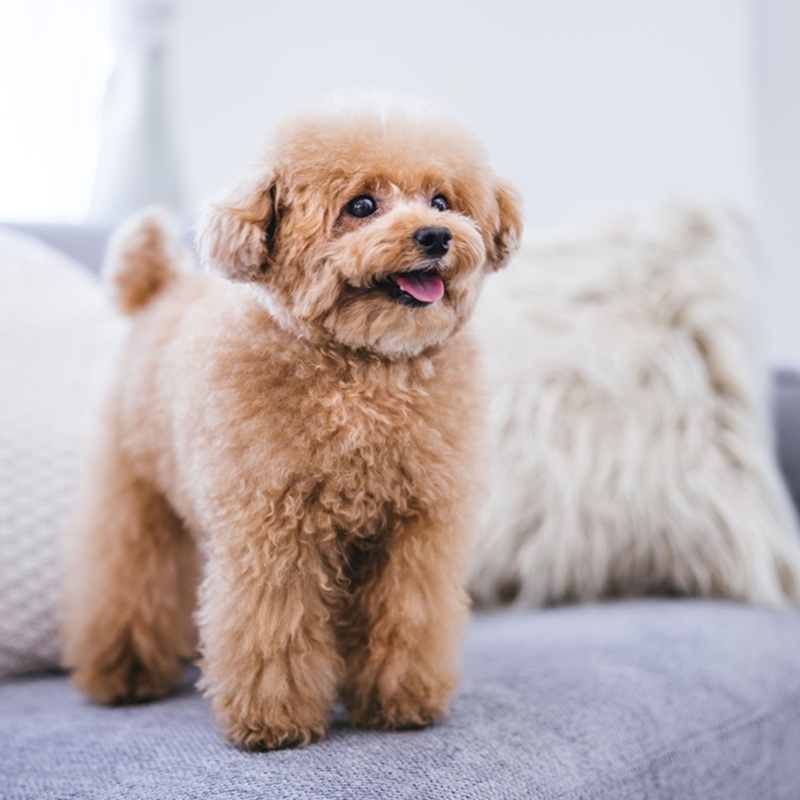
Small poodle
FCI standard number: 172
Country of origin: France
Classification: FCI Group 9, Section 2, Poodle
Height at withers female: over 35 cm to 45 cm
Height at withers male: over 35 cm to 45 cm
Weight female: approx. 8–12 kg
Weight male: approx. 8–12 kg
Coat colour: black, white, brown, grey, fawn and other colours and multi-colours covered by the standard, depending on the FCI standard version
Coat texture: Abundant, fine, woolly and curly or corded, dense and without natural shedding like many other breeds
Neck circumference: approx. 28–38 cm - please always measure the collar on the dog
Small Poodle
History of the Scottish Terrier
The poodle is one of the old European dog breeds and was originally used as a water dog. It was strongly characterised and further developed in France in particular, which is why France is now considered the country of origin. Over time, the larger working dog developed into different size variants, including the small poodle. Later, the poodle became known primarily as an intelligent companion, show and family dog.
Appearance
Body shape: The Toy Poodle is harmoniously, elegantly and well-proportioned. It appears neither clumsy nor fragile, but lively, proud and agile. Typical features include a rather square overall appearance, a fine but not weak bone structure, and a springy, light gait.
Coat: The coat is one of the breed’s most striking features. It is dense, fine and tightly curled or formed into cords. The Toy Poodle usually sheds very little, but requires regular and careful grooming.
Nature/character
The small poodle is considered to be very intelligent, attentive, playful and people-orientated. It learns quickly, enjoys working with its people and is often extremely adaptable. Many small poodles are friendly, alert and sensitive without being overly nervous. Thanks to their intelligence and keen powers of observation, they often react very clearly to the mood and everyday life of their owners.
Grooming
Grooming is more time-consuming than many initially think. The coat must be regularly brushed, combed and cut or clipped at sensible intervals so that it does not become matted. Ears, claws, teeth and eyes should also be checked regularly. Because the coat sheds so little, loose wool often gets caught in the coat and needs to be actively removed.
Health
The small poodle is generally regarded as a fairly robust and long-lived variety. Nevertheless, attention should be paid to responsible breeding. Depending on the line, patella problems, eye diseases, dental problems or hereditary diseases can play a role. Regular veterinary checks, good weight management and a reputable breeding base are important.
Education
The small poodle is generally very easy to train. It learns quickly, is attentive and often wants to work closely with its human. It responds best to friendly, clear and consistent training. Harsh methods are unsuitable because many Poodles react sensitively. With early socialisation, variety and meaningful mental activity, the small poodle usually develops into a very pleasant companion.
What are the special features of this breed?
What is special about this breed is the combination of intelligence, elegance and a great love of learning. The small poodle is usually much more than just a pretty companion dog. They are often very attentive, athletic and versatile, for example in everyday life, dog sports or mental tasks. They also have a special coat that sheds very little but requires a lot of grooming.
Suitable for first-time dog owners?
Yes, the small poodle is often very suitable for first-time dog owners. They are usually smart, co-operative and easy to train. The important thing is not to underestimate them. Even a small to medium-sized poodle needs training, activity and regular grooming. If you are prepared to do this, you will often find him to be a very pleasant beginner's dog.
Family dog or not?
Yes, the small poodle is generally a very good family dog. It is usually friendly, playful and closely bonded to its humans. They generally feel very comfortable in a family with loving consistency, sufficient activity and respectful behaviour. Due to its adaptability, it often suits both active families and quieter households.
Login
Suggested products


.jpg "Sitting Boston Terrier")



Customers also saw