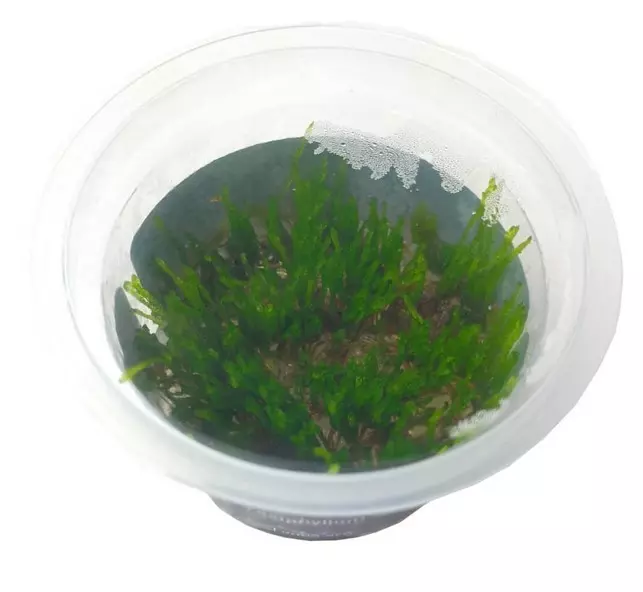
Riccia fluitans - Floating liverwort

Article no: DE-374

CHF 11.90

Stock: 0

Ready for dispatch in 1-3 days, delivery time 14 working days

Delivery between Tuesday, 14 July and Wednesday, 15 July
Zahlungsarten
Product information "Riccia fluitans - Floating liverwort"

Riccia fluitans - pond liverwort portion

max. growth height - 5 cm Country of origin Tropical cosmopolitan
Suitability NanoCube, community aquarium, aquascaping Type free floating underwater plant / floating plant
family Ricciaceae Genus Riccia
Propagation Division Growth rate fast
pH 5 - 8 Water hardness 0 - 20 °dh
Notes  

The pond liverwort Riccia is found worldwide and colonises floating water surfaces or damp soils. It was Takashi Amano who first introduced this floating moss to the aquarium hobby. In many of his designs, Riccia can be admired as a foreground plant. Cultivation and care are very simple: the moss clumps are tied onto stones or roots, where they can grow beautifully. The compact growth habit is maintained if the light green clumps are trimmed with scissors from time to time. CO₂ 2 -supplementation significantly promotes growth.

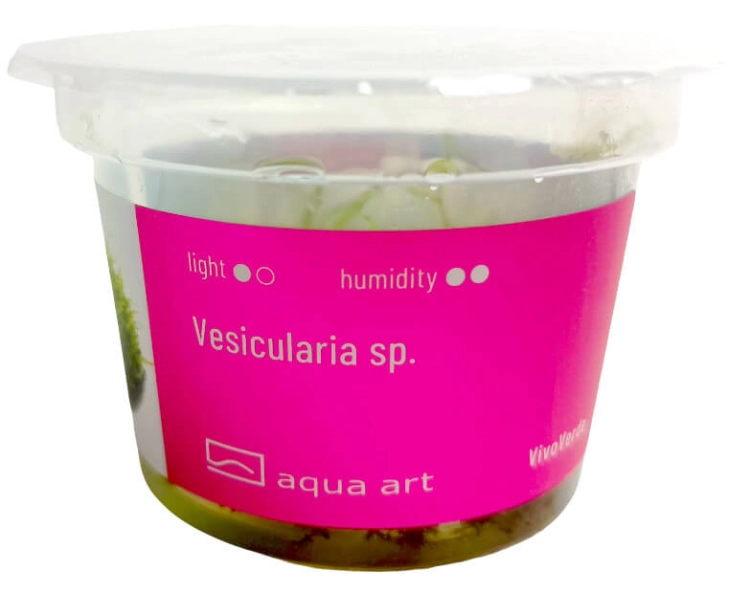
Aquatic plants in vitro

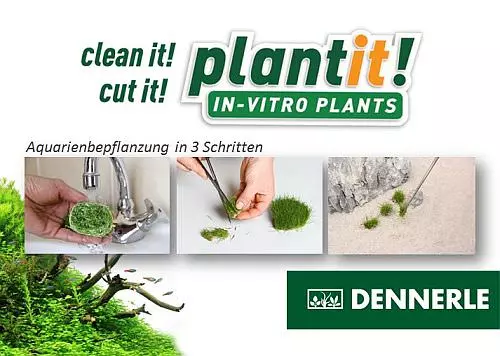
In vitro plants are cultivated in the laboratory under sterile conditions. They are supplied in a 7cm closed container. The small plants are completely free of algae and snails and can be planted directly. This product group is ideal for smaller aquariums and nano cubes as well as for modern aquascaping. You can easily see how demanding each plant is by looking at the top right-hand corner of the packaging. Before planting, simply rinse off the culture medium and portion out the plant

Aquarium: Community aquarium, Landscape/Aquascaping, Nano aquarium
Feature: Floating plants, In-Vitro
Genus: Mosses diverse
Growth: fast
Origin: Worldwide
Properties: Floating plants, In-Vitro
Stand: In the foreground
Composition
Feeding recommendation
Technical details
Size information

1 of 1 reviews

5 out of 5 stars


100%

0%

0%

0%

0%


Give us a rating!

Share your experience with the product with other customers.


30 November 2018 14:36

Top

Top

Customers also bought

Duckweed portion
Duckweed portion for aquariums floating plant suitable for the aquarium also for the garden pond and the biotope

CHF 5.00

Salvinia auriculata (Salvinia auriculata)
Salvinia auriculataSalvinia Auriculata (Brazilian salvinia) is a floating plant native to South America. It grows moderately quickly so that its population can be controlled. Easy to grow. Absorbs nitrogen to combat algae. Propagates by spreading.Difficulty of cultivation: easy to mediumLight requirement: medium to highCO₂ requirement: lowHeight of the adult plant: 0.5 cmGrowth: moderate to fastTemperature: 22 - 24°CPlacement in the aquarium: SurfaceOrigin: South and Central AmericaCup diameter 6 cmSalvinia Auriculata (Brazilian Salvinia) is a floating ornamental plant. It is native to the calm, still waters of South and Central America. It can be found from Paraguay to Cuba. It owes its popularity above all to its original appearance. Its small oval leaves with a diameter of 10 mm cm are arranged opposite each other on an elongated leaf stalk. These leaves are covered with fine hairs that trap air bubbles, allowing them to float. Depending on the light intensity, they are wavy or flat. Salvinia forms a third type of underwater leaves on which the spores are deposited.Like all floating plants, Salvinia is recommended for shady waters . Its great appetite for nitrogen and phosphorus compounds makes this plant a good ally in the fight against algae. Salvinia has low light and nutrient requirements. It grows well in both moderate and strong light. As a floating plant, it does not require a substrate but draws all the necessary nutrients directly from the water. During the vegetation period, it reproduces by spreading, whereby the growth rate is moderate. This makes it easy to control its growth and remove excess plants. It grows to a length of 3-6 cm and likes warm, humid air, so it is advisable to use a glass or cover when growing it.It should be placed in such a way that no condensation falls on the plants. It adapts very quickly to the new parameters. However, it should be borne in mind that it will die if there is too little light. It thrives best in soft to medium-hard water at 22-24°C. The in vitro culture of plants is carried out in tissue culture laboratories. Thanks to the sterile production conditions, the cuttings are free from snails, algae or pathogens.Planting:The plant must be removed from the cup and thoroughly rinsed of the gel under running water. This is best done by placing the plant in a container of lukewarm water. Most of the gel will then fall off by itself. Place the plant on the surface of the water.

CHF 6.90

Ceratophyllum demersum - hornwort / hornwort
Ceratophyllum demersum max. growth height - 120 cm Country of origin Cosmopolitan Suitability Discus aquarium, community aquarium, NanoCubes, perch aquarium Type Floating plant family Ceratophyllaceae Genus Ceratophyllum Propagation Head cuttings, side shoots Growth rate fast pH 6 - 8 Water hardness 5 - 25 °dh Advice Recommended as an algae stopper for all new installations. Care instructions The hornwort is a cosmopolitan plant that can be found in many bodies of water around the world. We found the free-floating stem plant in huge populations in a tributary of the Rio Miranda on the edge of the Pantanal in South America. The growth rate of the stems is enormous, so they have to be constantly pruned. Ceratophyllum is considered a "miracle weapon" against algae growth. The explanation is quite simple: the plant is a strong nutrient consumer and removes the algae's food source. The use of hornwort is recommended for every new aquarium.Wir sind sehr bemüht, dass unsere Pflanzen gesund und unbeschädigt bei Ihnen ankommen. Trotz grösster Sorgfalt, kann es vorkommen, dass Pflanzen durch den Postversand oder andere unvorgesehene Ereignisse, leicht beschädigt sind. Dazu zählen braune Blätter gleichermassen, wie abgeknickte Zweige. Dafür übernehmen wir keine Haftung.

From CHF 7.50

SuperFish Medaka Filter Kit
Medaka Filter KitThe SuperFish Medaka Filter Kit is the ideal solution for clean and clear water quality in small aquariums and for the species-appropriate care of medaka fish or other small aquarium inhabitants. This compact filter system ensures optimal water circulation and mechanical and biological filtration, which improves living conditions for your fish whilst keeping the water free of pollutants. With a simple installation and effective filtration performance , the SuperFish Medaka Filter Kit is an excellent Wahl for both beginner and experienced aquarists.The Medaka Filter Kit is suitable for indoor aquariums. Not suitable for garden ponds, mini ponds or outdoor aquariums. The practical filter unit operates quietly and efficiently, whilst the built-in foam filter enables thorough mechanical filtration. Thanks to the biological filter media breaks down harmful substances such as ammonia and nitrite, keeping the water healthy and stable. The filter kit includes all necessary components, so you can get started straight away without worrying about additional accessories. Efficient filtration: The system offers both mechanical and biological filtrationto keep the water clear and healthy. For small aquariums: Perfectly suited for small aquariums and for keeping medaka fish and other small species. Easy installation: The complete set contains everything you need to start using the filter kit straight away – no additional components required. Quiet operation: The filter operates at low noise levels, so it does not disturb the peace of the aquarium. Durable and reliable: Robust design for long-lasting performance. Regular maintenance: Clean the filter every 2–4 weeks to maintain maintain filter performance and prevent blockages. Water changes: Perform regular water changes to further optimise water quality. Even when using a filter, some water replacement is necessary. Optimal positioning: Position the filter kit so that it ensures even water circulation in the aquarium without disturbing the fish. For small aquariums: The SuperFish Medaka Filter Kit is ideal for aquariums with up to 40 litres, particularly for medaka or small fish species. Contents: The kit includes the filter, foam filter, and biological filter media – everything needed for installation. Compatibility: Perfect for small aquariums (up to 40 litres) and keeping medaka fish or other small species. Performance: Provides both mechanical and biological filtration for balanced water quality. Maintenance: The filter requires regular maintenance to ensure high filtration performance in the long term.

CHF 21.90

Hydrocotyle verticillata - Whorled pennywort, American. Water pennywort
Hydrocotyle verticillata (mushroom plant, American pennywort) max. growth height - 20 cm Country of origin  North and South America Suitability Aquascaping, community aquarium Type   family Apiaceae Genus Hydrocotyle Propagation Side shoots Growth rate medium pH 5 - 8 Water hardness 0 - 15 °dh Notes   This water pennywort is very decorative due to its umbrella-like leaves and is suitable for the foreground to midground. Unlike H. leucocephala and H. tripartita, it grows rather slowly; the water temperature should not be too high. We found magnificent stands in shallow water in the Rio Sucuri, Brazil. The water temperature was 23 °C; the water was crystal clear with a high CO2 concentration. Hydrocotyle verticillata looks very natural in the middle of a Hemianthus carpet, with small ‘umbrellas’ protruding from it.

From CHF 6.90

Hydrocotyle sp. Japan
🌿 Hydrocotyle sp. 'Japan' InVitroPlayful ground cover with a unique leaf shape Hydrocotyle sp. 'Japan' from Aqua Art is an unusual, fast-growing aquarium plant with characteristic small, round leaves on thin shoots. It is ideal for the foreground or middle ground and can grow both creeping and ascending, depending on how it is cared for. InVitro cultivation guarantees a snail and pesticide-free plant, perfect for shrimp tanks, nano aquariums and detailed aquascapes. Its unusual appearance brings playful lightness and fresh greenery to any underwater landscape.✅ Advantages at a glance: Characteristic rounded leaves on fine tendrils InVitro - sterile, shrimp-safe & pesticide-free Ideal for the foreground or middle area Flexible growth - creeping, hanging or ascending Easy to care for & fast-growing Perfect for creative aquascapes and nano tanks📋 Product details: Name: Hydrocotyle sp. 'Japan' Type: Ground cover / foreground plant Growth height: 3-10 cm Light requirement: medium to high CO₂ supply: recommended Growth: fast Propagation: via side shoots Delivery form: InVitro cup (sterile cultivated) Manufacturer: Aqua ArtHydrocotyle sp. 'Japan' brings an unusually shaped, fresh green plant into the aquarium that is suitable for beginners and experienced aquascapers alike.

CHF 6.50

Suggested products

Salvinia auriculata (Salvinia auriculata)
Salvinia auriculataSalvinia Auriculata (Brazilian salvinia) is a floating plant native to South America. It grows moderately quickly so that its population can be controlled. Easy to grow. Absorbs nitrogen to combat algae. Propagates by spreading.Difficulty of cultivation: easy to mediumLight requirement: medium to highCO₂ requirement: lowHeight of the adult plant: 0.5 cmGrowth: moderate to fastTemperature: 22 - 24°CPlacement in the aquarium: SurfaceOrigin: South and Central AmericaCup diameter 6 cmSalvinia Auriculata (Brazilian Salvinia) is a floating ornamental plant. It is native to the calm, still waters of South and Central America. It can be found from Paraguay to Cuba. It owes its popularity above all to its original appearance. Its small oval leaves with a diameter of 10 mm cm are arranged opposite each other on an elongated leaf stalk. These leaves are covered with fine hairs that trap air bubbles, allowing them to float. Depending on the light intensity, they are wavy or flat. Salvinia forms a third type of underwater leaves on which the spores are deposited.Like all floating plants, Salvinia is recommended for shady waters . Its great appetite for nitrogen and phosphorus compounds makes this plant a good ally in the fight against algae. Salvinia has low light and nutrient requirements. It grows well in both moderate and strong light. As a floating plant, it does not require a substrate but draws all the necessary nutrients directly from the water. During the vegetation period, it reproduces by spreading, whereby the growth rate is moderate. This makes it easy to control its growth and remove excess plants. It grows to a length of 3-6 cm and likes warm, humid air, so it is advisable to use a glass or cover when growing it.It should be placed in such a way that no condensation falls on the plants. It adapts very quickly to the new parameters. However, it should be borne in mind that it will die if there is too little light. It thrives best in soft to medium-hard water at 22-24°C. The in vitro culture of plants is carried out in tissue culture laboratories. Thanks to the sterile production conditions, the cuttings are free from snails, algae or pathogens.Planting:The plant must be removed from the cup and thoroughly rinsed of the gel under running water. This is best done by placing the plant in a container of lukewarm water. Most of the gel will then fall off by itself. Place the plant on the surface of the water.

CHF 6.90

Duckweed portion
Duckweed portion for aquariums floating plant suitable for the aquarium also for the garden pond and the biotope

CHF 5.00

Limnobium laevigatum In-Vitro
Limnobium laevigatum In-Vitro - a dainty floating plant Limnobium laevigatum is a dainty floating plant for open aquariums and for the garden pond or water trough. However, this South American plant is not hardy and therefore, needs to be overwintered in a warm place. In the right conditions, the plants spread quickly and, bit by bit, develop into a dense carpet of plants. Very long root beards can form in places, providing good protection for young fish in the aquarium

CHF 10.20

Ceratopteris thalictroides - Fine-leaved Sumatra fern
Ceratopteris thalictroides Fine-leaved horn fern - Sumatran fern max. growth height - 50 cm Country of origin North Australia, South America, Southeast Asia Suitability Discus aquarium, community aquarium Type Fern family Pteridaceae Genus Ceratopteris Propagation Adventive plants on the leaves Growth rate fast pH 5 - 9 Water hardness 10 - 30 °dh    Easy to care for. Beginner plant The Sumatran fern has much finer leaves than Ceratopteris cornuta. This species is found in many tropical countries. Here it usually grows in muddy shallow water, but can also be found in rice fields. This graceful fern requires sufficient space in the aquarium as it grows very quickly. It is easy to care for and problem-free under medium light levels. A proven beginner's plant for every newcomer to the aquarium hobby.

From CHF 7.90

Customers also saw

Limnobium laevigatum In-Vitro
Limnobium laevigatum In-Vitro - a dainty floating plant Limnobium laevigatum is a dainty floating plant for open aquariums and for the garden pond or water trough. However, this South American plant is not hardy and therefore, needs to be overwintered in a warm place. In the right conditions, the plants spread quickly and, bit by bit, develop into a dense carpet of plants. Very long root beards can form in places, providing good protection for young fish in the aquarium

CHF 10.20

Duckweed portion
Duckweed portion for aquariums floating plant suitable for the aquarium also for the garden pond and the biotope

CHF 5.00

Ceratophyllum demersum - hornwort / hornwort
Ceratophyllum demersum max. growth height - 120 cm Country of origin Cosmopolitan Suitability Discus aquarium, community aquarium, NanoCubes, perch aquarium Type Floating plant family Ceratophyllaceae Genus Ceratophyllum Propagation Head cuttings, side shoots Growth rate fast pH 6 - 8 Water hardness 5 - 25 °dh Advice Recommended as an algae stopper for all new installations. Care instructions The hornwort is a cosmopolitan plant that can be found in many bodies of water around the world. We found the free-floating stem plant in huge populations in a tributary of the Rio Miranda on the edge of the Pantanal in South America. The growth rate of the stems is enormous, so they have to be constantly pruned. Ceratophyllum is considered a "miracle weapon" against algae growth. The explanation is quite simple: the plant is a strong nutrient consumer and removes the algae's food source. The use of hornwort is recommended for every new aquarium.Wir sind sehr bemüht, dass unsere Pflanzen gesund und unbeschädigt bei Ihnen ankommen. Trotz grösster Sorgfalt, kann es vorkommen, dass Pflanzen durch den Postversand oder andere unvorgesehene Ereignisse, leicht beschädigt sind. Dazu zählen braune Blätter gleichermassen, wie abgeknickte Zweige. Dafür übernehmen wir keine Haftung.

From CHF 7.50

Aquascaping Bonsai tree
Size (1): S | Size (6): S
Aquascaping bonsai for aquariums Bonsai trees for your aquarium! For a large and creative scope in aquascape layout design. Original decoration Natural and gnarled look ideal for aquascaping tanks As with any wood, there may initially be a bacterial film on the wood. This is not mould and is completely harmless. The bacterial film can simply be vacuumed off and is also gladly eaten by many aquarium inhabitants. The fine branches can be well planted with moss or smaller Bucephalandra species and the implied roots in the lower area allow perfect integration into the layout. As this is a natural product, each one is slightly different in growth and may vary in size. Size: S - 15cm - 20cm M - 23cm - 30cm

CHF 49.00

Pinguicula Florian - carnivorous plant
Carnivorous plant - Pinguicula Floriansupplied in an in vitro cupeasy to keepThe diameter of the rosette is approx. 1 cmSunlight, 16-hour dayHumidity: 50-80%Temperature: 22-29 °CPale pink flowerPinguicula 'Florian' is a hybrid of Pinguicula 'Debbertiana' and Pinguicula. 'Esseriana'. Pinguicula 'Florian' was registered as a cultivar in 2004 and is named after the breeder's eldest son. The plant Pinguicula 'Florian' has leaves that turn an intense red color in strong light.This is an easy-to-grow species of carnivorous plant and therefore also suitable for beginners.Size: The rosette reaches a diameter of only 1-2 cm. Excellent for cultivation in the small WabiKusa jars. Flowers: The flower emerges from the winter rosette and is pale pink.Light: The plant prefers partial to full sun, 16 hours of light per day Substrate: An airy and well-drained mixture, usually consisting of peat moss and perlite or coarse sand. Feeding/ fertilizing: The plant does not require special fertilization as it absorbs nutrients through insects. The plant can be fed Drosophila from time to time. Springtails that stray onto the plant are also eaten.Humidity: The ideal humidity is between 50 % and 80 % with sufficient air circulation. During the insectivorous phase, provide sufficient distilled water to keep the medium moist. The plant can also tolerate dry periods. Temperature: The plant grows well at temperatures between 22°C and 29°C.Propagation: Propagation takes place via leaf cuttings. The leaf is broken off at the base and placed on the moist substrate. New plants will form after a few weeks. The combination of carnivorous plants with reptiles reptiles in a terrarium can create an aesthetically pleasing and ecologically interesting environment. Carnivorous plants such as Drosera, Nepenthes, Pinguicula and Sarracenia are not only exotic and beautiful, but they also contribute to a balanced ecosystem by controlling the population of small insects. small insects.

CHF 12.90

Bachbunge (9 cm) – Veronica beccabunga
Veronica beccabunga – Brooklime for pond edge & banksVeronica beccabunga (Brooklime) is a low-growing pond-edge plant for damp banks and the shallow water zone. It is suitable for a planting depth of 0 to –15 cm and remains pleasantly compact at a height of 10–20 cm. The flowering period runs from May to September (V–IX).Flowering period: V–IX (May to September)Hardiness/Zone: Zone 1–2Height: approx. 10–20 cmPot size: approx. 9cmSpecifications for the plant:They visually green pond edges and stream courses softly and naturally, without obstructing the view of the water. Thanks to the long flowering period V–IX, the border zone remains lively for many weeks.With zone 1–2, brooklime is suitable for perennial, low-maintenance pond plantings.Technical data:Botanical name: Veronica beccabungaGerman name: BrooklimeFlowering period: V–IXWinter hardiness zones: Zone 1 / 2Height: approx. 10–20 cmPlanting depth: 0 to –15 cmWith Veronica beccabunga (Brooklime) you are choosing a compact, natural-looking plant for garden ponds, streams and damp banks. Especially at pond edges there are often transitions that can quickly appear ‘harsh’ – for example at stones, liner edges or between plant baskets. Brooklime helps to visually connect these areas: it grows low, has a calm appearance, and provides a natural finish without overloading the pond edge.A major advantage is the long flowering period from May to September (V–IX). This keeps the edge zone attractive for much of the season and gives a well-maintained appearance. Thanks to the low growth height of approx. 10 to 20 cm, Veronica beccabunga is particularly suitable for the foreground of bank plantings or as a ‘filler plant’ in the shallow water zone. It can be excellently combined with taller structural plants that may stand behind, while the brooklime in the foreground softly outlines the edge visually.The recommended planting depth of 0 to –15 cm makes the plant very flexible: place it directly in moist bank soil or in a very shallow water area, depending on the pond layout. For a neat pond edge and easy care, a planting basket is often helpful, especially if you want to reposition the plant later. For growth, a consistently moist location is crucial. Thanks to zone 1–2, Veronica beccabunga is suitable for perennial pond installations and is a good choice if you are looking for a low-growing, uncomplicated plant for damp areas that integrates harmoniously into a natural pond design.Note on shipping: We do our utmost to ensure that our plants arrive healthy and undamaged. Despite the greatest care, plants may be slightly damaged by postal delivery or other unforeseen events. This includes brown leaves as well as broken twigs. We do not accept liability for this. Do not plant in open waters such as lakes or biotopes.Zoo-Roco tip: Place brooklime along the shore where you want to fill gaps – it looks especially natural when it ‘grows into’ stones. In very shallow areas (up to –15 cm), a planting basket is practical so that the plant stands stably and you can keep design control easily.

CHF 7.90

Guppy
The guppy fish (guppies / guppies) Area of origin: Central America to Brazil, today mostly captive bred from Asia (Singapore). Social behaviour: Livebearers. Some parents chase their young immediately after birth. No brood care, otherwise very peaceful Keeping conditions: The persistent guppy can be kept in almost any aquarium. High-breeding guppies are sensitive. pH 5.5 - 8.5 (7.0); hardness 5 - 25 (15) dGH. Well-planted tank of any size if possible. Breeding: Surface plants such as floating ferns for random breeding. Targeted breeding only possible with spawning box. 20 - 40 young, males sexually mature at three months, females earlier. Stock insemination possible. Raise fry with Artemia, powdered food and powdered flake food. Standard forms: European guppy breeders currently recognise 12 different standards, which can be divided into three classes. The classes are the large-finned breeding forms (fantail, triangle-tail, veiltail and flag-tail), the swordtype class (double-sword, top-sword, bottom-sword and lyre-tail) and the short-tail class (spade-tail, spear-tail, round-tail and needle-tail). In addition, there is an almost infinite number of colours in the animals in each class and in each standard, which are usually judged separately at shows. Here are the individual standards: Fantail The tail fin has an elongated triangular shape with an angle of 45 degrees close to the body. Its ideal length is equal to the body length. The edges are straight, the transitions can be slightly rounded. The dorsal fin is pointed, rises steeply at the base and extends to the end of the first third of the caudal fin Triangle tail The tail fin has the shape of a triangle with an angle of 70 degrees close to the body. Its length is 80% of the body length. The edges are straight, the transitions can be slightly rounded. The dorsal fin rises steeply, is broad and extends bluntly to the end of the first third of the caudal fin. Veiltail The upper and lower edges of the caudal fin form curves which run in such a way that the greatest width of the fin is reached at 75% of its length. The rear edge is concave, the length is 80% of the body length and should not be less than 50%. The fin width is 3/4 of the length. The dorsal fin has a rounded end and extends to the end of the first third of the caudal fin. Bannertail The tail fin has the shape of a rectangle, the length of which is 8/10 of the body length. The fin width is 4/10 of the body length. The base of the fins is rounded. Minimum tail length 6/10 of the body length. Minimum width the largest body width. The dorsal fin extends to the end of the first third of the caudal fin and is pointed. Double sword The caudal fin has an oval basic shape with sword-shaped extension of the upper and lower fin rays. The length of the fins corresponds to the length of the body. The outer edges form an angle of 30 degrees. The part of the fins between the blades must not exceed 4/10 of the body length and can be colourless. Here too, the dorsal fin extends to the end of the first third of the caudal fin. The dorsal fin is slender, rises steeply at the base and is pointed at the end. Topsword The caudal fin has an oval basic shape with a sword-shaped extension of the upper fin rays. The length of the sword corresponds to the length of the body and runs at the upper edge at a 15 degree angle or parallel to the body axis. The basic oval shape must not exceed 4/10 of the body length and can be colourless. The dorsal fin is slender and extends, as usual, tapering to the end of the first third of the caudal fin. Bottom sword The caudal fin has an oval basic shape with a sword-shaped extension of the lower fin rays. The length of the sword corresponds to the body length and forms an angle of 15 degrees to the body axis at its lower edge. The basic oval shape must not exceed 4/10 of the body length and can be colourless. The dorsal fin is slender, rises steeply at the base and reaches out to where? To the end of the first third of the caudal fin, of course. Lyretail The caudal fin has approximately the shape of a lyre. The basic shape is round and must not exceed 4/10 of the body length. The outer fin rays reach 8/10 of the body length with the tips clearly bent outwards. The dorsal fin rises steeply and reaches the end of the first third of the caudal fin with an upwardly curved tip. Spade tail The shape of the tail fin resembles a miner's spade. The upper and lower fin borders, which stand out from the body with a clear projection, are parallel. Their length corresponds to half the body length, the height reaches 8/10 of the fin length. The dorsal fin extends pointedly from the base of the caudal fin to the end of the first third of the caudal fin. Speartail The shape of the tail fin resembles the tip of a spear. Its length is 8/10 of the body length, the height 6/10 of the fin length. The dorsal fin rises steeply and reaches the end of the first third of the caudal fin with an upward curved tip. Roundtail The caudal fin has a circular shape, the diameter is 5/10 of the body length The dorsal fin extends roundly to the base of the caudal fin. Needletail The tail fin has a circular shape, the length of which is 4/10 of the body length. The centre fin rays are elongated like needles. The total length of the fin corresponds to the body length. The dorsal fin is slender, rises steeply at the base and tapers to the end of the first third of the caudal fin. Special features: The guppy's ability to breed quickly, its variability in shape and colour and its endurance make it one of the most popular fish for beginners. Recently, the guppy has been reclassified as a member of the genus Lebistes. It is therefore correctly called Lebistes reticulatus again. Do not socialise guppies with fighting fish. The fins of the males are eaten by the fighting fish of both sexes.Source reference: Mergus Atlas Volume 1If you have any questions or problems, our trained team is at your disposal at Zoo Roco. They can provide you with expert advice on all questions.