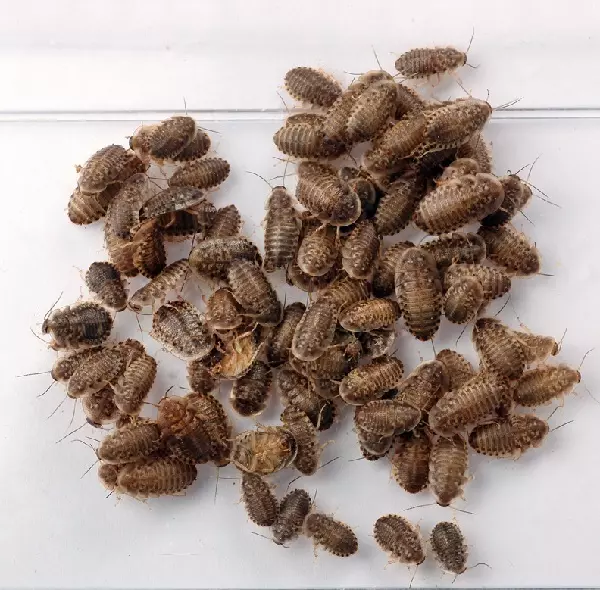

Mealworms (Tenebrio molitor) mini

CHF 4.50
Stock: 0
Ready for dispatch in 1-3 days, delivery time 14 working days

Mealworms mini (Tenebrio molitor)
The mealworm (Tenebrio molitor) is actually the beetle larva of the meal beetle. It hatches from an egg and, after moulting several times, grows to a size of approx. 25 mm.
- For birds
- in small quantities also for reptiles
The mealworm is actually the beetle larva of the meal beetle. It hatches from an egg and, after moulting several times, grows to a size of approx. 25 mm. Finally, the beetle larva pupates, from which another beetle emerges. Mealworms are among the oldest commercially bred feeder animals. They are relatively easy to breed and are produced in large quantities. Mealworms are actually pests, mainly known from grain mills, as the larvae prefer to feed on flour or its by-products. As it is not possible to use insecticides in mills, it is difficult to control them if infested.
Mealworms are classic food for soft-feeding birds. For this purpose, hundreds of tonnes of the beetle larvae are produced in Europe every year. A bird's stomach is well prepared for this type of food. A mealworm consists mainly of a hard, chitinous shell and, due to its rather simple diet, contains only a few nutrients. However, the stomach of a reptile is not well prepared for these conditions. If too many or only mealworms are fed to reptiles, deficiency symptoms or obesity may occur. It can also be seen from the faecal residues of the animals that mealworms are only insufficiently digested. Feeding the mealworms with vegetables or fruit before feeding them only results in a certain vitaminisation, which could also be achieved by dusting the beetle larvae with a vitamin preparation. The high fat content of the mealworms is another reason why the larvae should only be given to reptiles as supplementary food.
For many bird enthusiasts, however, they are the basic food for their pets and are mainly bred for this purpose.
At temperatures below 10 degrees C. the animals become motionless but are not dead. This can be used to advantage for storage. At temperatures of 6-8 degrees C. the animals can be stored for several weeks without food.
Order by Sunday evening - delivery on Thursday
Orders received by Sunday evening will be sent by A-Post on Wednesday or Thursday.
Please provide a recipient address where the parcel can be delivered.
We accept no responsibility for parcels that are delivered late or collected late.
The live feeder animals in the shop are only available at this price on Wednesdays - otherwise the price per tin is Fr. 1.00 higher per tin, as we also feed and care for the feeder animals.
Even with the greatest care, it may happen that feeder animals die due to temperature fluctuations or unpredictable events. We accept no liability for this.
| Weight: | approx. 50g tin |
|---|
Login
5 June 2023 12:13
Super quality.
Hardly any failures after delivery.
Customers also bought


Suggested products


.jpg "Reptile tweezers set stainless steel")


Customers also saw