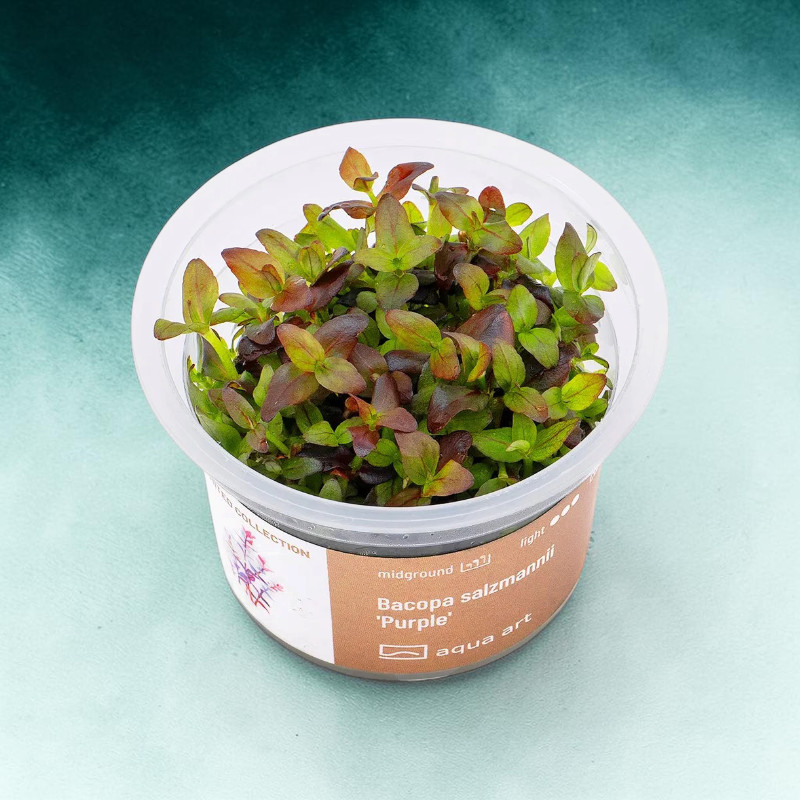
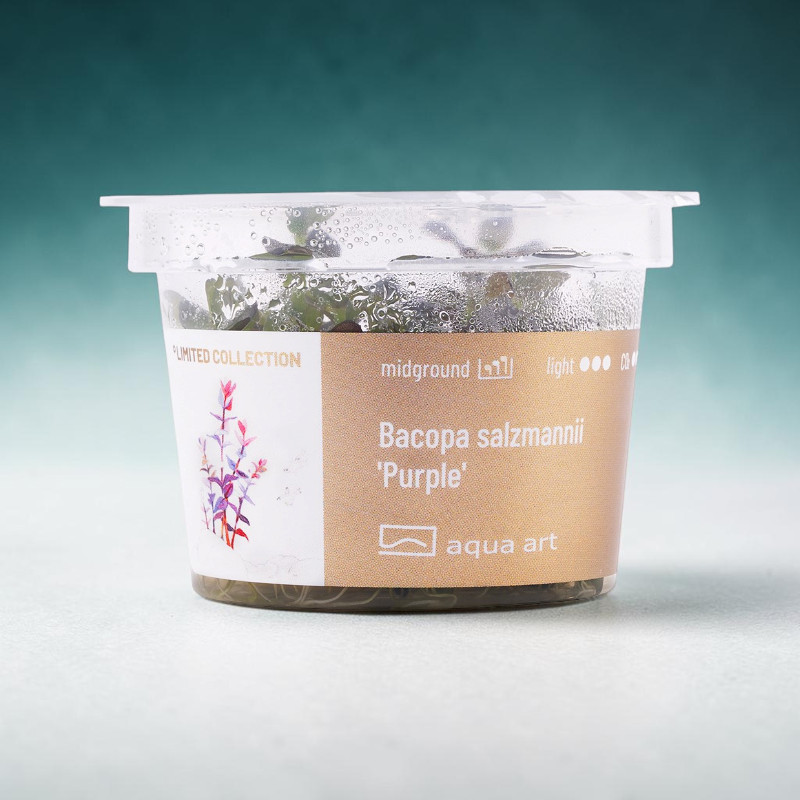
Bacopa salzmannii 'Purple'

  • Red-purple aquarium plant
  • For the midground
  • Slow growth
  • In-vitro culture dish
Article no: ZJ-2150

CHF 16.90

Stock: 5

Available, delivery time: 1-3 days

Delivery between Friday, 6 November and Monday, 9 November
Zahlungsarten
Product information "Bacopa salzmannii 'Purple'"

Bacopa salzmannii 'Purple' – purple aquarium plant

Aqua Art Bacopa salzmannii 'Purple' – an attractive in-vitro aquarium plant with dark purple leaves. Ideal for the midground and colourful aquascapes.
Aqua Art’s Bacopa salzmannii ‘Purple’ is an exceptionally attractive stem plant which adds striking colour accents to the aquarium with its intense reddish-purple to dark purple leaf colouring. Native to South America, this plant is ideal for aquascaping and natural-looking underwater landscapes.
Particularly striking are the oval leaves, which, under suitable conditions, develop a rich purplish-red to dark violet colour. Unlike many other red aquarium plants, Bacopa salzmannii ‘Purple’ displays a characteristic dark colouration that provides a beautiful contrast to light green aquatic plants.
The plant grows relatively slowly and produces upright, sturdy shoots. These usually reach a height of 10–30 cm, but can grow to around 40 cm under favourable conditions. The individual shoots are approximately 3–4 cm wide and may branch out even at the base.
Due to its compact and rather slow growth, Bacopa salzmannii ‘Purple’ is particularly well suited to the midground of the aquarium. In smaller tanks, it can also be used as a decorative background plant.
The plant looks its best when several shoots are planted in small groups. Over time, this creates a dense, colour-rich stand of plants that adds a varied structure to the aquarium design.
Strong lighting is crucial for the intense purple leaf colouration. The more suitable light the plant receives, the darker and more pronounced the reddish-purple hues can become. With weaker lighting, the colouration may be less intense.
Additional CO₂ fertilisation is beneficial for healthy growth. Together with a balanced supply of macro- and micronutrients, it supports the development of vigorous shoots and attractive leaf colour.
Bacopa salzmannii ‘Purple’ is considered relatively easy to care for. Thanks to its slow growth rate, it requires pruning less frequently than many fast-growing stem plants.
Propagation is easily achieved using cuttings. Cut shoot tips can be placed directly back into the substrate, where they will form new roots.
Aqua Art offers this plant as an in vitro culture. The plants are propagated under controlled laboratory conditions and are free from snails, algae and parasites.
With its distinctive leaf colouring and elegant growth habit, Bacopa salzmannii ‘Purple’ is an excellent Wahl for aquarists who wish to add an extraordinary purple colour accent to their aquarium.

Your benefits at a glance

  • 1 in-vitro culture cup of Bacopa salzmannii 'Purple'
  • Intense reddish-purple to dark purple leaf colouration
  • A particularly decorative stem plant for the midground
  • Slow growth, reaching a height of approx. 10–30 cm
  • More vibrant leaf colours under intense lighting
  • Ideal for aquascaping and high-contrast plant groups
  • Easy propagation using head cuttings
  • Laboratory-propagated culture free from snails, algae and parasites

Instructions for use

Preparing the in vitro plant
  • Open the culture cup and carefully remove the plants. Rinse off any remaining nutrient gel thoroughly with clean, lukewarm water
  • Then divide the seedlings into small groups of about 1–2 cm and place them in the substrate using aquascaping tweezers

Planting
  • Plant the individual clumps in the midground of the aquarium, leaving a little space between them. This gives the shoots enough room to grow and allows them to develop into a dense stand of plants over time

Lighting
  • Bacopa salzmannii 'Purple' prefers strong aquarium lighting. High light intensity promotes the intense reddish-purple colouration of the leaves
  • In lower light conditions, the plant may remain lighter in colour or take on a greenish hue

CO₂ supply
  • A moderate supply of CO₂ is recommended. A steady supply of CO₂ can support growth and colour development

Nutrient supply
  • Ensure an adequate supply of macro- and micronutrients. A balanced supply of nitrogen, phosphate, potassium and trace elements is particularly important for healthy plant growth
  • A nutrient-rich substrate or regular liquid fertilisation can further promote plant growth

Pruning and propagation
  • If the shoots become too long, they can be trimmed with plant shears
  • The cut shoot tips can be replanted directly into the substrate. This results in additional plants, and the stand can become denser over time
  • Regular pruning encourages the formation of new side shoots and helps to maintain a compact plant cluster.

Zoo Roco Tip

Bacopa salzmannii ‘Purple’ is ideal as a colourful focal point in an aquascape. Its dark purple leaf colour looks particularly beautiful when combined with light green aquarium plants.
We recommend, for example, a layout featuring Micranthemum tweediei ‘Monte Carlo’, light-green Rotala species or delicate aquarium mosses. The strong colour contrast really brings out the purple leaves to their best advantage.
Plant several shoots in small groups, leaving a little space between them. Once the plants have established themselves, the shoot tips can be pruned back regularly and replanted. This will gradually result in a dense, intensely coloured plant population.
To achieve the deepest possible purple colour, we recommend good LED lighting, balanced CO₂ fertilisation and a regular supply of plant nutrients.
Please note that newly introduced in vitro plants initially require an acclimatisation period. The new leaves formed underwater may differ in shape and colour from the original leaves.
Composition
Feeding recommendation
Technical details
Size information

0 of 0 reviews

Give us a rating!

Share your experience with the product with other customers.


Suggested products

New
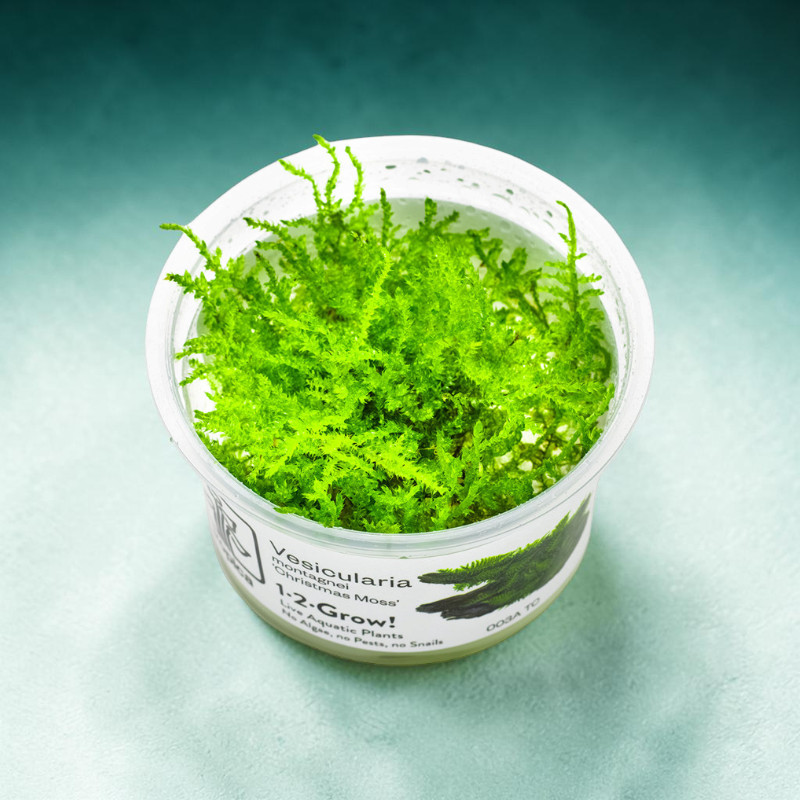
Vesicularia montagnei 'Christmas Moss'
Vesicularia montagnei 'Christmas Moss' – Christmas mossAqua Art Vesicularia montagnei ‘Christmas Moss’ – decorative Christmas moss with fir-tree-like shoots. Ideal for aquascaping, roots, rocks and shrimp aquariums.Vesicularia montagnei ‘Christmas Moss’ from Aqua Art is a particularly attractive aquarium moss that captivates with its unique, fir-tree-like growth habit. The finely branched, rich green shoots are reminiscent of small Christmas trees and lend aquariums and aquascapes a natural, detailed structure.Also known as Christmas moss or Christmas tree moss, this moss originates from Brazil and is one of the most decorative moss species in the aquarium hobby. Its characteristic, horizontally growing side shoots form regularly branched, triangular structures reminiscent of the branches of a fir tree.Unlike ordinary Java moss, Christmas moss usually grows more compactly and, under suitable conditions, forms dense, even mats of moss. The shoots spread mainly horizontally and can develop into beautiful green patches over time.With a growth height of up to 5 cm, Vesicularia montagnei is ideal for the foreground and midground of the aquarium. The moss looks particularly attractive on natural stones, roots and other decorative elements.The delicate moss shoots can be attached to roots or stones and, over time, become firmly anchored to the surface. This allows you to create natural tree canopies, verdant rock formations or densely overgrown root structures.Christmas Moss requires only low to medium light levels and can be cultivated without additional CO₂ fertilisation. However, a consistent supply of nutrients and a moderate addition of CO₂ are beneficial for particularly dense and vigorous growth.Growth is moderate, although under favourable conditions the moss can develop into dense, branched mats. Occasional trimming helps to maintain the characteristic Christmas tree structure and prevents the lower layers of moss from receiving too little light.Christmas moss is also particularly interesting for shrimp aquariums. The fine branches offer dwarf shrimp and juvenile shrimp numerous hiding places. At the same time, biofilms and microorganisms can colonise the moss surfaces, which the shrimp enjoy grazing on.Aqua Art offers Vesicularia montagnei ‘Christmas Moss’ as an in vitro culture. The moss is propagated under controlled laboratory conditions and, according to the manufacturer, is free from snails, parasites and algae.With its distinctive growth habit and versatile uses, Christmas moss is an excellent Wahl for aquarists who wish to design their underwater landscape with natural, lush green moss structures.Your benefits at a glance1 in vitro culture dish of Vesicularia montagnei 'Christmas Moss'Characteristic, fir-tree-like branched moss shootsLush green and densely branched growthIdeal for the foreground and midground of the aquariumGrows to a height of approx. 5 cmLow to medium light requirementsCO₂ addition is not strictly necessaryLaboratory-propagated culture free from snails, parasites and algaeInstructions for usePreparing the in vitro plantOpen the culture cup and carefully remove the Christmas mossRinse off any remaining nutrient gel thoroughly under clean, lukewarm waterTake care to damage the delicate moss shoots as little as possible.Then divide the moss into small portions of about 1–2 cmAttaching it in the aquariumChristmas Moss is particularly well suited for covering roots, stones and other aquascaping elementsSecure the small pieces of moss to the desired surface using suitable plant glue or fine threadSpace the clumps out slightly so that the moss has enough room to spread and form a dense carpet over timeLightingVesicularia montagnei ‘Christmas Moss’ grows even under low to medium light levelsBalanced lighting promotes compact growth and the characteristic branched structureAvoid excessively strong lighting without an appropriate nutrient supply, as this can encourage algae growth on the moss surfacesCO₂ supplyAdditional CO₂ fertilisation is not strictly necessary for keeping this plantHowever, a moderate supply of CO₂ can support the growth and development of dense moss cushionsNutrient supplyAs Christmas moss absorbs nutrients across its entire surface, a balanced supply of macro- and micronutrients is importantIf necessary, a suitable liquid fertiliser for aquarium plants can be usedPruning and propagationIf the moss grows too densely or irregularly, the tips of the shoots can be trimmed with fine garden shearsRegular trimming encourages a compact growth habit and ensures that even the lower layers of moss receive sufficient lightTrimmed pieces of moss can be reattached to roots or stones and will continue to grow under suitable conditionsZoo Roco TipVesicularia montagnei ‘Christmas Moss’ is one of the most beautiful moss species for natural aquascapes. Its fir-tree-like, branched shoots are particularly well suited to creating small trees, overgrown rocks and natural woodland landscapes underwater.Attach small portions of Christmas moss to the upper branches of a slender aquarium root. Once the moss has taken root and spread out, it creates the impression of a small green tree crown.Christmas Moss looks particularly decorative when combined with light green ground cover plants, Bucephalandra, Anubias or compact ferns.The moss is also a lovely addition to shrimp aquariums. The densely branched shoots provide young shrimp with sheltered areas and additional surfaces on which they can search for food.It is better to trim the moss regularly and carefully rather than letting it grow too much. This preserves its characteristic Christmas tree structure and ensures the moss forms beautiful, dense clumps that last.

CHF 6.50

New
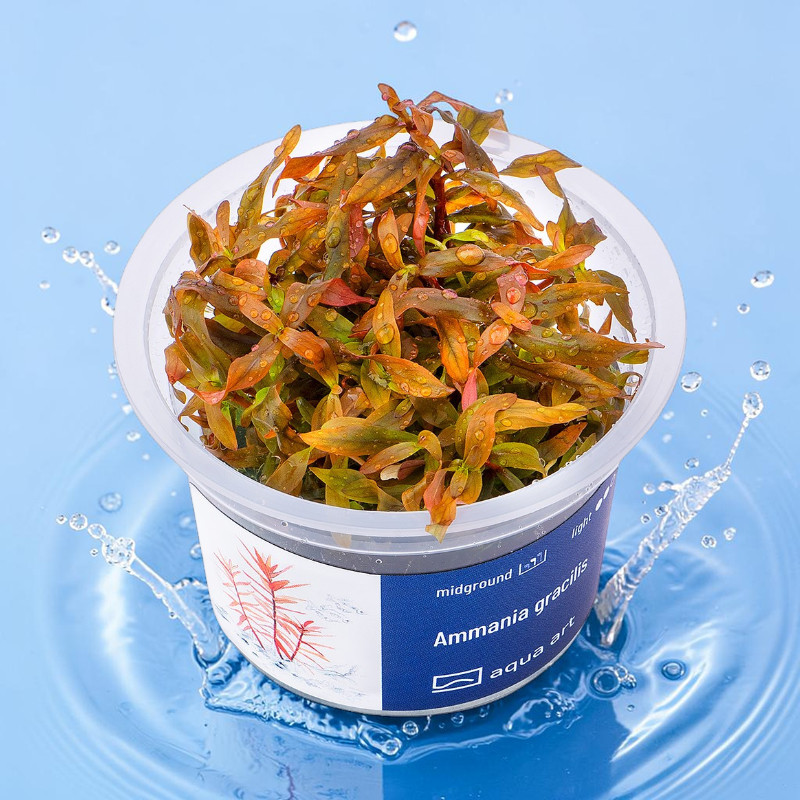
Ammania gracilis – red stem plant
Ammania gracilis – red stem plant for aquascapingAmmania gracilis – a decorative red stem plant for the midground and background. Ideal for aquascaping, with beautiful colouration when provided with light, CO₂ and a good supply of nutrients.Ammania gracilis is an attractive stem plant for freshwater aquariums and is particularly popular in aquascaping. The plant produces elongated, slightly wavy leaves which, depending on light and nutrient levels, can range in colour from greenish to coppery to a rich reddish hue. This allows it to add beautiful splashes of colour to the aquarium and makes it ideal as an eye-catching feature in the midground or background.Under good conditions, Ammania gracilis grows upright and can reach a height of around 20 to 50 cm. To develop an intense red colour, the plant requires medium to strong lighting, a good supply of nutrients and, ideally, CO₂ supplementation. It develops its full colour particularly well under strong light and with sufficient micronutrients.Ammania gracilis is suitable for planted aquariums, aquascapes and ‘ Holland ’ aquariums. Regular trimming keeps the plant compact and encourages bushier branching. The cut shoot tips can be replanted directly into the substrate.Your benefits at a glanceAttractive red stem plant for aquariumsIdeal for the midground and backgroundAdds lovely splashes of colour to the aquascapeGrowth height approx. 20–50 cmParticularly beautiful colouration under good lightingBenefits from CO₂ injection and nutrient fertilisationEasy to propagate by pruningHeight: approx. 20–50 cmInstructions for useBefore planting, carefully remove the pot, rockwool or transport material from the roots. If necessary, divide the plant into smaller sections and plant the individual stems in the substrate, leaving a little space between them. This ensures the shoots receive enough light and can develop well.Ammania gracilis prefers a bright spot in the aquarium. Moderate to strong lighting, as well as a regular supply of macro- and micronutrients, promote healthy growth and vibrant colouration. Adding CO₂ is recommended, as the plant grows significantly more vigorously and with more intense colour when supplied with sufficient CO₂.Regular pruning encourages bushier growth. The cut shoot tips can be replanted as cuttings.Zoo Roco TipTo develop a beautiful red to copper-coloured hue, Ammania gracilis requires plenty of light and a steady supply of nutrients. Do not plant the stems too densely, so that the lower leaves also receive sufficient light. When combined with light-green plants, this creates a particularly beautiful colour contrast in the aquarium.

CHF 6.50

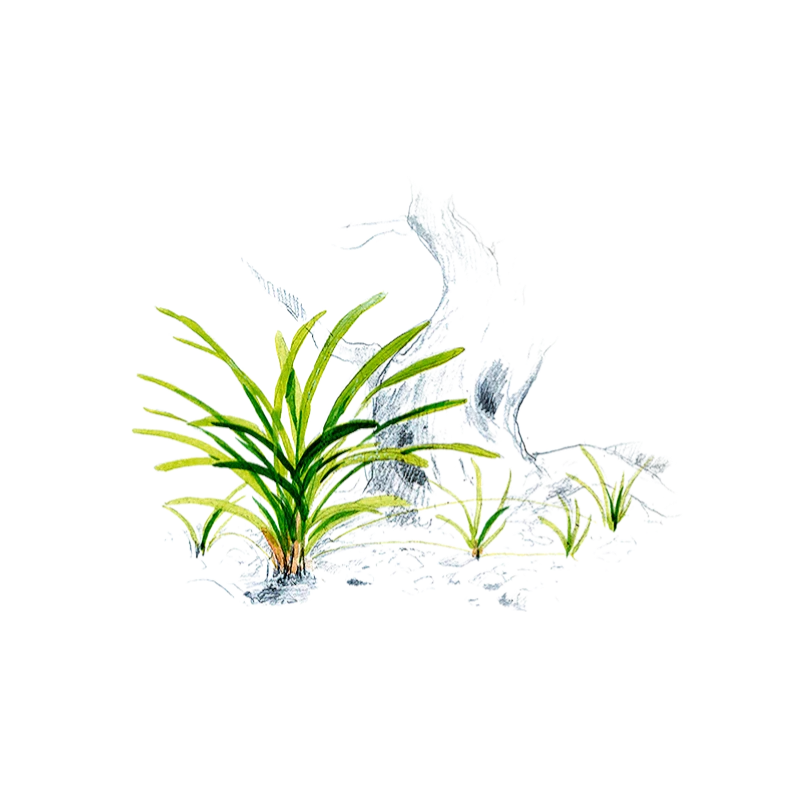
Sagittaria subulata
Saggitaria subulata - InVitro Sagittaria subulata is a versatile and easy-care aquarium plant that creates a harmonious overall picture both in the foreground and in the middle ground. With its narrow, grass-like leaves, it forms dense, natural carpets and brings lively structure to any aquarium. Under optimal conditions, the plant spreads via runners and quickly creates a dense growth. Depending on the placement and light conditions, it can vary its growth height - from low ground cover to taller, decorative accents in the background. The occasional flowering is particularly attractive in optimal conditions: Delicate, small flowers can appear above the surface of the water, adding an unusual touch to the aquarium. Advantages at a glance: Undemanding aquatic plant for beginners and professionals Forms dense lawns through natural runners Flexible growth height depending on location and care Can develop decorative flowers above the water surface Supplied free from snails, algae and parasites Product details: Name: Sagittaria subulataPlanting location: Foreground - middle groundOrigin: South America Growth: FastHeight: Up to 30 cm, depending on conditionsLight requirement: Medium to high CO₂ supply: not essential, but beneficial Propagation: by stolons, divisionDelivery form: InVitro (sterile packaging) Manufacturer: Aqua art

CHF 6.50

Eleocharis parvula Mini
🌱 Eleocharis parvula 'Mini' - Fine grass carpet for the foreground Ultra-compact ground cover for detailed aquascapes Eleocharis parvula 'Mini' from Aqua Art is a particularly low-growing variant of the well-known turf grass plant. It is ideal for nano aquariums and natural aquariums where a fine, even grass lawn is desired in the foreground. Due to its low height, the view of other design elements such as stones or wood is retained - ideal for modern Iwagumi layouts. As an in vitro plant, it is free from algae, pesticides and snails, making it ideal for sensitive aquarium inhabitants such as shrimps. ✅ Advantages at a glance Particularly compact & low growth Ideal for nano aquariums and foreground layouts Forms a dense, light green carpet of grass InVitro - sterile & shrimp-safe Easy to care for with CO₂ and light supply Perfect for Iwagumi and natural aquariums 📋 Product details Name: Eleocharis parvula 'Mini' Type: Ground cover / foreground plant Growth height: approx. 2-5 cm Light requirement: medium to high CO₂ supply: recommended Growth: medium Propagation: via runners Delivery form: In vitro cup (sterile) Manufacturer: Aqua Art 💡 Zoo Roco tip Divide the in-vitro cup into small portions and place them in nutrient-rich soil at regular intervals - this way Eleocharis 'Mini' grows together to form a dense, natural-looking carpet. Ideal in combination with light-colored substrates or high-contrast hardscapes. With Eleocharis parvula 'Mini' from Aqua Art, you can design the foreground of your aquarium precisely, naturally and richly detailed - perfect for creative aquascaping concepts.Customers also searched for: ground cover aquarium, foreground plant, InVitro plant, Aqua Art, grass carpet aquarium, aquascaping foreground, nano aquarium plants, CO₂ plants aquarium, fine aquarium plant

CHF 6.50

Eleocharis parvula
🌱 Eleocharis parvula - Fine ground cover for the natural aquarium Natural lawn effect in the foreground The dwarf needle sedge / Eleocharis parvula from Aqua Art is a popular foreground plant for natural aquariums and aquascapes. The fine, grass-like stems grow dense and low and form a dense, light green carpet of grass under optimal conditions. The plant is ideal for detailed layouts and looks particularly harmonious in open tanks with clear lines. Thanks to its undemanding nature, it is also suitable for beginners. With a supply of CO₂ and good lighting, it grows quickly and ensures a neat appearance in the tank. ✅ Advantages at a glance Forms a dense carpet of grass in the foreground Fine stems for a natural look Grows compact and low Ideal for nano aquariums & aquascapes Very easy to care for with CO₂ and light Shrimp-safe & pesticide-free (in vitro) 📋 Product details Name: Eleocharis parvula Type: Ground cover / foreground plant Origin: Europe/North America Growth height: approx. 3-10 cm Light requirement: medium to high CO₂ supply: recommended Growth: medium Propagation: via runners Delivery form: In vitro cup (sterile cultivation) Manufacturer: Aqua Art 💡 Zoo Roco tip Eleocharis parvula can be perfectly combined with stones or root wood to create natural-looking bank zones. Cut the plant into smaller clumps when planting so that the carpet can close evenly. Eleocharis parvula from Aqua Art is a finely structured, low-maintenance ground cover plant that transforms the aquarium into a near-natural underwater landscape.

CHF 6.50

Hygrophila sp. Araguaia
🌿 Hygrophila sp. 'Araguaia' InVitro Reddish-brown accent plant with unique growth habit Hygrophila sp. 'Araguaia' from Aqua Art is a particularly attractive, compact stem plant with a reddish-bronze color and finely branched growth. It is ideal for the foreground to midground and provides structured contrasts and warm color accents in aquascapes. This plant is one of the slow-growing Hygrophila species and can be easily shaped and thickened by regular pruning. Supplied as an in-vitro plant, it is free from algae, snails and pesticides - ideal for shrimp tanks and sensitive aquariums.✅ Advantages at a glance: Compact Hygrophila with reddish-bronze leaves InVitro - sterile, snail-free & pesticide-free Ideal for the foreground or middle ground Slow-growing - easy to shape and grow bushy Good effect with strong lighting & CO₂ supply Very decorative in natural aquariums and layouts with contrasting colors📋 Product details: Name: Hygrophila sp. 'Araguaia' Type: Stem plant Placement: Foreground to midground Growth height: approx. 5-15 cm Light requirement: medium to high CO₂ supply: recommended Growth: slow Delivery form: In vitro cup (sterile cultivated) Manufacturer: Aqua Art💡 Zoo Roco tip: Combine Hygrophila 'Araguaia' with light green plants such as Micranthemum or Hydrocotyle sp. 'Japan' - to show off the darker coloring particularly well. For a dense carpet, regular pruning is recommended.Hygrophila 'Araguaia' provides subtle color accents and fine structure in the lower section of the aquarium - ideal for sophisticated layouts and harmonious plant design.

CHF 6.50

Hydrocotyle verticillata
🌿 Hydrocotyle verticillata InVitro Whorled pennywort for the foreground Hydrocotyle verticillata from Aqua Art is a unique foreground plant with umbrella-shaped leaves that are reminiscent of small water lilies or parasols. This special leaf shape makes it a real eye-catcher in natural aquariums and aquascapes - especially in shallow tanks or detailed layouts. The plant remains compact, grows creeping across the bottom and is ideal for creative foreground or midground designs. Supplied as an in vitro plant, it is free from pesticides, algae and snails, making it ideal for shrimp tanks and sensitive aquarium inhabitants.✅ Advantages at a glance: Eye-catching umbrella-shaped leaves - natural look with design character InVitro - shrimp-safe, pesticide-free & algae-free Compact growth - perfect for the foreground Grows creeping & forms small groups Ideal for shallow tanks & creative aquascapes Undemanding & easy to care for📋 Product details: Name: Hydrocotyle verticillata Type: Ground cover / foreground plant Growth height: approx. 2-7 cm Light requirement: low to medium CO₂ supply: not essential, but beneficialpH value: 5 to 7 Growth: slow to medium Propagation: by runners, cuttings, division Delivery form: In vitro cup (sterile cultivation) Manufacturer: Aqua Art💡 Zoo Roco tip: Hydrocotyle verticillata looks particularly harmonious in combination with fine mosses or light-colored substrates. It is also very suitable for aquascaping and shallow-planted nano aquariums andcan also be kept emersed in Wabi-Kusa.

CHF 6.50

Eleocharis pusilla
Eleocharis pusilla InVitroDelicate ground cover for nano and natural aquariums Eleocharis pusilla from Aqua Art is a delicate, grass-like ground cover that looks particularly elegant in nano aquariums and delicate aquascapes. It grows significantly lower and finer than Eleocharis acicularis and forms dense, short grassy areas with a natural appearance. Thanks to in vitro cultivation, Eleocharis pusilla is free from pesticides, algae and snails, making it ideal for shrimp tanks and sensitive aquariums. The plant grows compactly, requires little care and spreads evenly through runners.✅ Advantages at a glance: Very fine ground cover with short, dense growth InVitro - sterile, shrimp-safe & pesticide-free Ideal for nano aquariums & detailed layouts Spreads through runners to form a carpet of grass Easy to care for - requires only medium light conditions Perfect for the foreground in aquascaping📋 Product details: Name: Eleocharis pusilla Type: Ground cover / foreground plant Growth height: approx. 3-5 cm Growth habit: grass-like, creeping Light requirement: medium to high CO₂ supply: recommended, but not essential Growth: slow to medium Propagation: by stolons Delivery form: In vitro cup (sterile cultivation) Manufacturer: Aqua Art💡 Zoo Roco tip: Divide the InVitro cup into small portions and place them in nutrient-rich soil with some space between them. This will create a dense, natural carpet of grass in just a few weeks. Ideal in combination with stones or root wood!Eleocharis pusilla is the perfect choice for detail-loving aquarium designers who value naturalness, delicacy and structure - even in small tanks.

CHF 6.50

Echinodorus quadricostatus tenellus
🌱 Echinodorus quadricostatus 'Tenellus' InVitro Grassy ground cover for your aquarium Echinodorus quadricostatus 'Tenellus ' - often referred to simply as Tenellus - is a popular ground cover for aquariums with a grassy appearance. The narrow, fresh green leaves quickly form dense plant carpets and are ideal for the foreground or midground. The plant is visually similar to Lilaeopsis or Eleocharis, but grows faster and is more robust. Aqua Art's in-vitro cultivation guarantees a snail and pesticide-free plant - perfect for shrimp tanks, aquascapes and sensitive animals. Tenellus also grows in medium light, spreads via runners and creates a natural "lawn effect" in the aquarium.✅ Advantages at a glance: Robust & fast-growing ground cover Fresh green for near-natural underwater landscapes InVitro - free from harmful substances, safe for shrimps Forms dense carpets quickly due to runners Easy to care for & adaptable - ideal for beginners Suitable for the foreground or middle ground📋 Product details: Name: Echinodorus quadricostatus 'Tenellus' Type: Ground cover / foreground plant Placement: Foreground to midground Growth height: approx. 5-10 cm Light requirement: medium CO₂ supply: recommended, but not essential Growth: medium to fast Propagation: via stolons Delivery form: In vitro cup (sterile cultivation) Manufacturer: Aqua Art💡 Zoo Roco tip: Place the plant in small portions with some space between them so that the runners can spread undisturbed. Regular trimming will keep the carpet compact and neat.

CHF 6.50

Bacopa myriophylloides Invitro
Invitro aquarium plant Bacopa myriophylloidesDelicate aquarium plant for the background Bacopa myriophylloides is an elegant stem plant with delicate, finely pinnate leaves - a real eye-catcher for the background of your aquarium. Its special structure brings lightness and movement to the layout and is ideal for aquascaping and natural aquariums. As a high-quality in vitro plant, it is free from algae, snails and pesticides, making it particularly safe for shrimps and sensitive tanks. With good lighting and CO₂ supply, Bacopa myriophylloides grows compactly and healthily - with a beautiful, delicate appearance. Advantages at a glance: ✅ Delicate stem plant with feathery leaves ✅ Ideal for the background & textured layouts ✅ InVitro - sterile, pesticide-free & shrimp-safe ✅ Healthy growth with light & CO₂ addition ✅ Perfect for aquascaping & natural aquariumsProduct details: Name: Bacopa myriophylloides Type: Stem plant Location in the aquarium: Background Growth height: approx. 30-50 cm Light requirement: Medium to high CO₂ supply: Recommended Delivery form: In vitro cup (grown sterile) Special feature: Very fine, decorative leaf structure

CHF 6.50

Salvinia auriculata (Salvinia auriculata)
Salvinia auriculataSalvinia Auriculata (Brazilian salvinia) is a floating plant native to South America. It grows moderately quickly so that its population can be controlled. Easy to grow. Absorbs nitrogen to combat algae. Propagates by spreading.Difficulty of cultivation: easy to mediumLight requirement: medium to highCO₂ requirement: lowHeight of the adult plant: 0.5 cmGrowth: moderate to fastTemperature: 22 - 24°CPlacement in the aquarium: SurfaceOrigin: South and Central AmericaCup diameter 6 cmSalvinia Auriculata (Brazilian Salvinia) is a floating ornamental plant. It is native to the calm, still waters of South and Central America. It can be found from Paraguay to Cuba. It owes its popularity above all to its original appearance. Its small oval leaves with a diameter of 10 mm cm are arranged opposite each other on an elongated leaf stalk. These leaves are covered with fine hairs that trap air bubbles, allowing them to float. Depending on the light intensity, they are wavy or flat. Salvinia forms a third type of underwater leaves on which the spores are deposited.Like all floating plants, Salvinia is recommended for shady waters . Its great appetite for nitrogen and phosphorus compounds makes this plant a good ally in the fight against algae. Salvinia has low light and nutrient requirements. It grows well in both moderate and strong light. As a floating plant, it does not require a substrate but draws all the necessary nutrients directly from the water. During the vegetation period, it reproduces by spreading, whereby the growth rate is moderate. This makes it easy to control its growth and remove excess plants. It grows to a length of 3-6 cm and likes warm, humid air, so it is advisable to use a glass or cover when growing it.It should be placed in such a way that no condensation falls on the plants. It adapts very quickly to the new parameters. However, it should be borne in mind that it will die if there is too little light. It thrives best in soft to medium-hard water at 22-24°C. The in vitro culture of plants is carried out in tissue culture laboratories. Thanks to the sterile production conditions, the cuttings are free from snails, algae or pathogens.Planting:The plant must be removed from the cup and thoroughly rinsed of the gel under running water. This is best done by placing the plant in a container of lukewarm water. Most of the gel will then fall off by itself. Place the plant on the surface of the water.

CHF 6.90

Micranthemum sp. 'Monte Carlo'
Micranthemum sp. 'Monte Carlo'Micranthemum sp. 'Monte Carlo' is a green plant that gets along with little light. It forms a green lawn in the aquarium. It can also be planted as an epiphyte on roots, ornaments or stones.Difficulty of cultivation: moderately demanding Light requirement: high CO₂ requirement: medium Height of mature plant: 2-10 cm Growth: medium Temperature: 23-28°C Placement in aquarium: in the foreground Origin: South America 6 cm cup diameter Micranthemum sp. 'Monte Carlo' (Micranthemum tweediei) is native to Argentina. It is a lawn plant with small, compact, round, light green leaves. In most cases, the leaves are 0.5-1 cm long. It is ideal fornano aquariums, but also for larger tanks. It forms a fast-growing carpet in the foreground of the aquarium. Under good conditions it spreads very quickly.Plant in small clumps close together or on roots or rocks. It floats well on substrate. When grown on decorative elements, it forms stems that hang down impressively. Pruning promotes density and growth of the plant. The care of Monte Carlo is not demanding. It consists of regular pruning with sharp scissors with curved blades.The cut longest branches can be planted in the ground as stems. Such a seedling will form roots and continue to grow.It also grows without additional carbon dioxide supply or macro- and micronutrient fertilizers. However, it should be remembered that it is a slow to moderate growth. To ensure optimal growth, the plant should receive good light conditions and additional CO₂.Fertile substrate and liquid fertilizer have a positive effect on the condition of the plant.Planting: The plant must be removed from the cup and thoroughly rinsed from the gel under running water. This is best done by placing the plant in a container of lukewarm water. Most of the gel will then fall off by itself. Divide the contents of the cup into 1-2 cm lumps and then place them at a small distance in the substrate or on the selected objects.

CHF 6.50

Customers also saw

Alternanthera reineckii 'Purple' (Purple parrot leaf)
Alternanthera reineckii 'Purple'Purple' is the largest variety of Alternanthera Reineckii. The red colored leaves make it a great plant for accenting.Difficulty of cultivation: difficultLight requirements: highCO₂ requirements: highHeight of mature plants: 20-50 cmGrowth: mediumTemperature: 20-28°CPlacement in aquarium: middle ground or backgroundOrigin: South America6 cm cup diameterAlternanthera Reineckii 'Purple' is a demanding plant for advanced aquarists. It should receive a fertile substrate, strong lighting, an additional supply of carbon dioxide and a full feeding in the form of liquid fertilizer. However, even under favorable conditions, its growth is very slow. Alternanthera Reineckii 'Purple' is a secondary or tertiary plant. The top of the leaf blades are reddish brown, while the undersides range from purple to violet to dark red. The mature plant can grow up to 50 cm tall, but usually reaches no more than 20-30 cm in height. It spreads laterally by lateral stolons. To obtain cuttings, 7 cm long cut stems are inserted into the ground It presents best in the second or third level. In nature, it is a swamp plant that occurs in South America. The best growth results are obtained when it is planted in an active substrate. The growth rate depends on the carbon dioxide concentration in the aquarium water. It prefers soft to hard water with a pH of 6 to 8. It depends on the availability of macronutrients in the water column and is sensitive to macronutrient deficiencies resulting in the loss of leaves in the lower part of the stem. Plant it in closely spaced clumps. As it grows, it will form a compact group of adult plants. Prune the plant regularly with sharp scissors. Frequent pruning helps the plant compact and grow. To maintain the dark red color of the foliage, the plant must be well exposed to light. In optimal light, it grows densely and the internodes are short, making it look much more attractive. It makes an interesting contrast to the many green plants in the aquarium. In open aquariums it grows easily to the water surface.Planting: The plant must be removed from the cup and thoroughly rinsed from the gel under running water. This is best done by placing the plant in a container of lukewarm water. Most of the gel will then fall off by itself. Divide the contents of the cup into 3-4 cm lumps and then place them in the substrate..

CHF 6.50