Striped grass mouse
Profile
| Home: | Northern Africa South of the Sahara |
| Size: | 9 - 11.8 cm (+ 9.5 - 13 cm tail) |
| Weight: | 33 - 41 g |
| Sexual maturity: | 2 months |
| Gestation period: | 21-25 days |
| Number of young / litter: | 4 - 5 young, sometimes more |
| social behaviour: | Group animal |
| Life expectancy: | 2-3 years |
| Nutrition: | Insects, grains, meadow herbs, seeds, fruit |
Grass striped mouse
Even self-confessed mouse haters can hardly resist the charm of this fascinating little rodent: striped mice are a real rodent gem Juwel.
However, they are not suitable for petting. However, they are interesting to watch and their daytime activity appeals to the observer.
Native to:
The zebra mouse originally comes from North Africa: Senegal, Tanzania, Morocco, Algeria, Tunisia and Sudan.
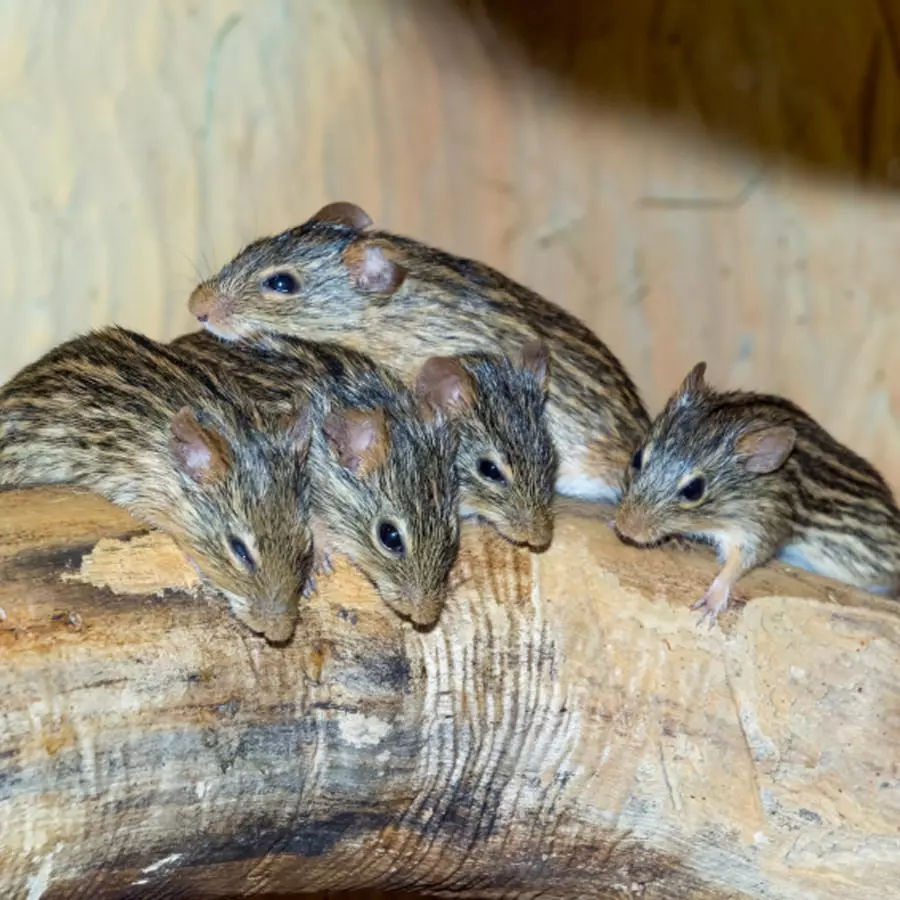
The striped mouse (Lemniscomys barbarus) lives in the open grasslands of Africa and belongs to the group of grass mice. The names "zebra mouse" or "zebra grass mouse" are also commonly used. However, its fur pattern is more similar to that of a wild boar than the vertical black and white pattern of zebras. It is more likely to be regarded as the "gazelle" among mice, as it is adapted to running fast. When running fast, only two toes of the front feet and three of the hind feet touch the ground. The long graceful legs and the laterally flattened body also no longer correspond to the original mouse type.
The colouring of the zebra mouse is a delightful blend of mass tone brown mixed under the black stripes, The stripes go from the head to the rump over the back and sides of the striped mouse. Their tail is as long as the body (sometimes longer). Be careful, the tail is very delicate and fragile!
Striped mouse care:
Striped mice are best kept in a terrarium that cannot be big enough. In a large terrarium (100 x 50 x 45 cm), the animals are also much more active and can be seen more often, although they can generally be provided with more hiding places. Breeding is also not easy and is only possible in a large container. Sand is recommended as a substrate. Striped mice always deposit their practically odourless urine in the same corner, and their droppings are also dry and odourless. Striped mouse terrariums can therefore even be integrated into the "parlour" as decorative showpieces. The animals love elevated points (stones, roots), but do not climb properly. They build up a firm alternation at the bottom, which they keep scrupulously clean. Disturbing stalks, stones and seed pods are swept away with sideways sweeping movements of the front feet. After creating a new change, the mice sometimes run back and forth on it for several minutes to trample the ground and test the "race track". Striped mice are sensitive to the cold, which is why they love the radiant heat of terrarium lighting, but will ignore heating lamps. Caves are only visited when they are very disturbed, otherwise the animals build hay nests above ground, but preferably under a root. Even the finest stalks of hay are torn apart during nest building, so that the finished nest resembles a ball of loose hair.
The best way to pick up a zebra mouse is to "scoop it up" with your hands. Do not try to pick up a striped mouse by the tail, otherwise the tail will break off and not grow back.
Cage equipment includes:
- Sand as a substrate
- Hay, straw,
- Various shelters made of wood or cork, branches for climbing
- Stones
- Nest material - hay (do not use hamster wool!)
- Food bowl and drinking bottle
Furnishings should not be made of plastic, as the mice will chew everything up.
Food:
Conventional food mixtures for small rodents are not suitable for striped mice. Budgerigar and canary food is readily accepted. Oat flakes and sunflower seeds can be added, but only with caution: overfeeding can easily lead to obesity. A good nutrient-rich meadow hay is part of the diet, even if it is used more for nest building. Millet and mealworms are tasty treats.
Striped mice are picky when it comes to green food, but they all like cucumber and chicory. If cucumber is fed, fresh water, which should otherwise always be available, can be omitted.
The striped mouse food should be supplemented with a mineral stone and vitamin pot or MuckiVit.
Breeding:

Breeding the striped mouse is not easy. One explanation sometimes given is that striped mice are extremely sensitive to inbreeding, as all the animals available in Europe are descended from a few imported specimens. Despite regular mating, litters are rather rare. The mating prelude begins with the rutting female constantly running around. The female regularly stops at the same spot and allows a male to ride up. During the chase, the animals emit loud, choppy cries - a clear indication of broodiness, as the animals are otherwise completely silent. Striped mice react very sensitively to nest checks. This may be one reason why the gestation period has not yet been precisely determined. The literature gives a gestation period of between 20 and 28 days.
In striped mice, the females are more aggressive than the males. Adult sexually mature females are sometimes so incompatible with each other that they can engage in prolonged chases and bites. Only their own offspring are an exception. It is therefore advisable to keep a pair plus any offspring.
For your information - we do not have any striped mice for sale. However, we can provide you with some on request.
Before you decide on striped mice, you should definitely have read a relevant specialist book.
The following applies to all animal husbandry: Children (including adolescents) must be guided, supervised and controlled by their parents. Children should know that animals are not toys!
Our trained team is available to assist you with any questions or issues at Zoo Roco. They can provide you with expert advice on all matters.
Login
Suggested products






Customers also saw