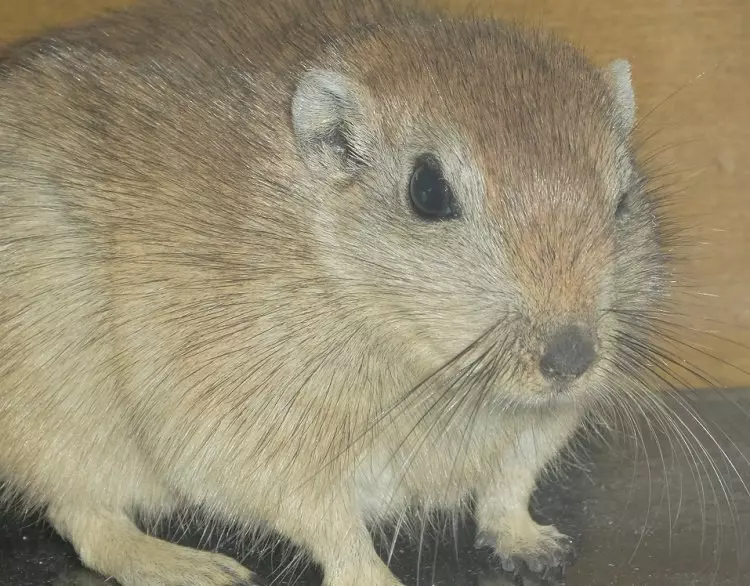
Acacia rat
Profile
| Home: | Eastern Africa from Ethiopia via Angola to South Africa |
| Age expectation: | 5-6 years |
| Sexual maturity: | 8-14 weeks |
| Gestation period: | 24 days Number of young/litter: 2-4 young, nestling |
| social behaviour: |
Group animal, crepuscular and nocturnal |
| Nutrition: | Seeds, insects, sweet fruits, vegetables |
Acacia rat
Acacia rats originate from Africa. They inhabit the savannahs and live in acacia trees.
Acacia rats owe their name to the fact that they are found almost exclusively in the upper regions of acacias. Studies have shown that they are probably specialised in this tree species and a few others. This is where most of their lives take place. Only in exceptional cases do the animals leave the trees to flee across the ground.
Biology:
The genus Thallomys comprises a total of four species. In addition to the true acacia rat (Thallomys paedulcus), the black-tailed acacia rat (Thallomys nigricauda), the Shortridge’s acacia rat (Thallomys shortridgei) and the Loring’s acacia rat (Thallomys loringi) also belong to the genus of these African tree dwellers. However, Thallomys paedulcus and Thallomys nigricauda were categorised as one species until 1988.
Keeping:
Acacia rats are very social and must be kept in groups. Both female and male groups can be kept together.
A mixed group leads to offspring - and you should consider in advance where you can give the young animals.
A large terrarium or an aviary is best suited as a cage. The dimensions of 100x50cm and a height of at least 80cm should not be undercut - however, the animals love to climb, so an aviary of 160-180cm is recommended.
The animals spend little time on the ground, so there is no need for a digging layer, just a bedding of sand or soil covering the ground.
With lots of branches and hideaways, the cage can be furnished very diversely. Our acacia rats love the coconuts and snuggle up together in them as a group.
Ideas for furnishing:
- Branches (also very attractive with the branches of the corkscrew hazel)
- Coconuts on ropes
- Nesting boxes (e.g. budgerigar nesting box)
- Ropes
- Suspension bridges
- Grass nests
- Nesting material - hay, leaves

Food:
To stay healthy, acacia rats – like other living beings – depend on a varied diet.
As basic feed, a mixture for dwarf hamsters or an exotic food can be offered. In addition, various herbs and flower mixtures are very important, as is the requirement for protein, which can be covered by dried or live food insects.
Fresh fruit and also vegetables can be offered to acacia rats. Try out what the animals like, as this can vary greatly.
Fruit: bananas, melons, grapes and sultanas, various berries
Vegetables: carrots, cucumbers, but also fresh herbs or dandelion can be fed.
Breeding:
Breeding acacia rats is relatively easy. In the wild, acacia rats breed only in the rainy season – in captivity, all year round.
After a gestation period of 24 days, the mother gives birth to two to four young, although most litters consist of two young. For the first three weeks, the young attach themselves to the mother’s teats for suckling and are also transported in this way.
The young are suckled for about 30 days. The parent animals defend their young very strongly and warn with a chattering of their teeth. The animals should stay with the parents for ten weeks, as the young learn essential social behaviours during this time.
Acacia rats can become tame, but they are not cuddly animals and are above all suitable for observation.
Regular monthly costs:
- Food depending on size of group: approx. CHF 30.--
- Bedding: approx. CHF 20.--
- Vet: The more species-appropriate and cleaner the keeping, the less likely a visit to the vet will be necessary. However, you must always expect that an animal may become ill and incur additional costs.
Before you decide on acacia rats, you should definitely have read an appropriate specialist book.
For all animal keeping: children must be guided, supervised and controlled by their parents. Children must learn that an animal has its own needs and way of life and to respect this. Parents should be aware that it is they who are responsible for the animal.
If you have any questions or problems, our trained team at Zoo Roco is at your disposal. They can provide you with expert advice on all matters.
Login
Suggested products







Customers also saw