
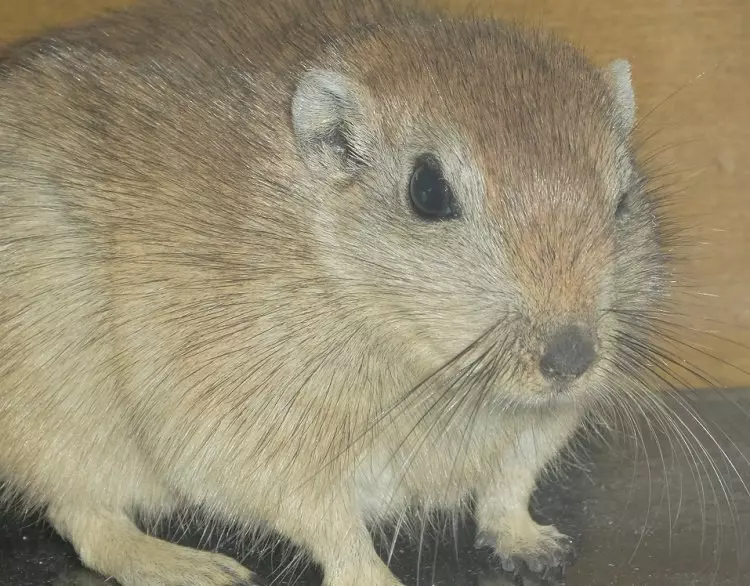
Fat sand rat
Psammomys obesus
Profile
| Home: | Sand deserts in Algeria to Saudi Arabia |
| Age expectation: | approx. 5 years |
| Sexual maturity: | approx. with 3 months |
| Gestation period: | approx. four weeks - 3-5 young animals |
| Social behaviour: | Group animals, sociable |
| Nutrition: | Degu food, hay, herbs and vegetables |
Fat sand rat - Psammomys obesus
The fat sand rat is, despite its name, neither a rat nor fat. It belongs to the gerbil family and lives in the sandy deserts from Algeria to Saudi Arabia. It is active both during the day and night.
Note:
Fat sand rats can become very tame towards their owner, but due to the special diet and the somewhat more demanding husbandry, these animals are not suitable for beginners.
Description:
The body length of a fat sand rat is approx. 14-20cm plus a tail of approx. 10-15cm. The weight is about 100-200g. A fat sand rat can reach an age of 5 years if kept well and appropriately for its species.
Husbandry:
Fat sand rats are very sociable rodents and should never be kept alone. At least two animals should be kept together.
The enclosure should provide a lot of space, therefore it should not be less than 120x60x120cm. The fat sand rats require warmth, or sunlight lamps.
The animals are very susceptible to stress and if there is too little peace and continuous stress, the animals can, in the worst case, die.
Legal requirements:
- Enclosure at least 120x60x120cm for 2 animals
- Hiding places for all animals (therefore at least 1 hiding place per animal)
- coarse structured food: hay or straw
- fresh branches
Furnishings:
The furnishings should be well designed and there should be plenty of climbing opportunities. Fat sand rats do not dig tunnels as strongly as gerbils, but they still need a bedding height of 30cm so they can dig their sleeping chambers. Levels and many hiding places are essential. Even though fat sand rats gnaw rather less, opportunities for gnawing should still be offered.
At a glance:
- suitable and burrowable bedding - 30cm high
- sand bath
- hay and straw - also serves as nesting material
- climbing and activity opportunities
- retreat options for all animals
- levels (if not already in the terrarium)
- food and water bowl
- warmth, or sunlight lamps
Diet and food:
The diet of fat sand rats is more demanding than that of gerbils, as the animals are absolute dietary specialists. They feed mainly on leaves, succulents, salt-containing stems and goosefoot plants. Sugar is taboo for fat sand rats, because like the degu, they are prone to diabetes and can die from it.
The most suitable food for fat sand rats is degu food. It contains no sugar and consists of many herbs and some grains.
Certain types of vegetables may be offered and are also very well accepted.
Suitable vegetables are...
- Chinese cabbage
- iceberg lettuce
- chicory
- broccoli, courgette and cucumber
Not suitable are...
- carrots
- cabbage varieties
- all fruit
Considerations before acquisition:
As already mentioned above, fat sand rats are not animals for beginners due to the special diet and more demanding husbandry. There should be enough space to offer the rodents a species-appropriate home. The terrarium must not be placed in direct sunlight and should be in a quiet place so that the animals can have their rest periods.
The life expectancy is approx. 5 years. During this time you have full responsibility for the animals.
Before you decide on these interesting animals, seek advice and allow yourself enough time for the decision.
Fat sand rats are not suitable for children.
For every kind of animal husbandry: Children (including adolescents) must be instructed, supervised and monitored by their parents. Children should know that animals are not toys!
For questions and problems, our trained team at Zoo Roco is at your disposal. They can advise you professionally on all matters.
Login
Suggested products







Customers also saw

