
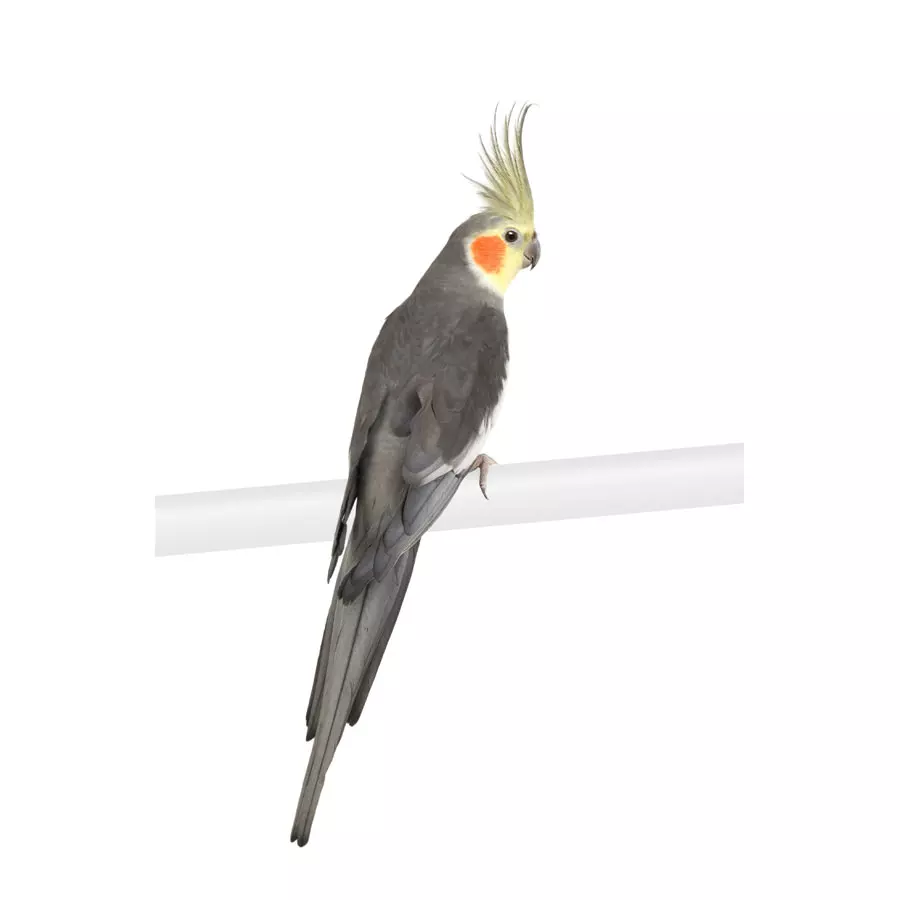
Cockatiel
Profile
| Home: | Australia |
| Age expectation: | 15-20 years |
| Sexual maturity: | approx. 9 months |
| Breeding: | 4-6 eggs Breeding period: 21 days Nestling period: 30 days |
| Diet: | Grain mix, egg food, sprouted food, fruit, vegetables, fresh twigs |
Area of origin:
In their homeland, cockatiels live in large flocks and, like budgerigars, colonise the whole of Central Australia.

Sexual differences:
The difference between the sexes can only be recognised from about 9 months of age. Until they moult as juveniles, young birds look like female cockatiels. Afterwards, the male's feather colour becomes more intense. The head becomes yellower and the cheek patch an intense orange. The undersides of the tail feathers are plain grey. The female remains paler and the tail feathers become striped yellow-grey.
| female cockatiel | male cockatiel |
|
|
|


Keeping:
Cockatiels live in large colonies in the wild. Therefore, they should also be kept at least in pairs in indoor aviaries. Outdoor keeping is possible all year round with an aviary with a shelter. A single bird would wither away if left alone. With a single bird, even with intensive human interaction, a conspecific can never be replaced!
The aviary should be placed in a draught-free location.
For cockatiels to feel comfortable, you need:
- Aviary
- Perches of various thicknesses or natural branches (willow, poplar or fruit trees)
- Toys, bells, ladder, swing etc.
- Bathing or showering facility
- Food and water bowl
Food:
The food consists of a special grain mixture for large parakeets.
In addition, the birds should have access to:
- Mineral stone - serves to meet the calcium requirements
- Bird sand - contains important components for digestion
- unsprayed vegetables (e.g. chicory / spinach / cress / carrots, cucumber slices)
- unsprayed fruit (e.g. pieces of apple / pears)
- unsprayed wild herbs (e.g. chickweed / knotweed / shepherd's purse / young dandelion)
- Millet on the cob (once a week, as the fat content is high, cockatiels otherwise suffer from obesity).
- Egg food and sprouted food
- Crackers and nibble sticks are healthy treats that also ensure the bird has to work for its food.
Food, water and fresh food must be renewed daily.
Breeding:
The parent birds should be at least 12 months old before breeding begins. In special nest boxes, cockatiels lay about 4-6 eggs every 2 days. Nest material is not necessary, as they lay the eggs directly on the wooden floor of the nest box. Cockatiels breed all year round and almost always raise the offspring successfully. However, it is better to schedule the breeding period for spring or summer.
The chicks are blind, naked and completely helpless when they hatch after 21 days of incubation. After about 10 days, the eyes open and the first feathers begin to sprout on the back. At 30 days, the cockatiels are fledged. The young birds should not be separated from their parent birds until they are at least 8 weeks old.
Swiss animal welfare legislation contains legal regulations governing the animal-friendly keeping and handling of birds.
The following regulations apply to all bird species:
- social species are to be kept socially (no individual housing)
- the enclosures must meet minimum dimensions = minimum requirements
- all birds must be offered a bathing opportunity
- the enclosures are to be structured with various, springy perches of different thickness and alignment, whereby one third of the volume must be free of structures
- all birds must be provided with appropriate sand for intake
- the private keeping of certain bird species is subject to authorisation (wild animal keeping permit)
- the tethering of parrots and the keeping of song canaries in Harzer cages is prohibited
- the use of sand sleeves as a cover for perches is prohibited
for parrots:
minimum enclosure area for 6 medium-sized parakeets up to cockatiel size
0.5 m2 (e.g. 100 cm x 50 cm), minimum height 60 cm
Parrots need plenty of natural branches for gnawing and climbing
Before you decide on cockatiels, you should definitely have read a suitable specialist book.
For all animal keeping: Children must be instructed, supervised and monitored by parents. Children must learn that an animal has its own needs and habits and respect this. Parents should be aware that they are the ones responsible for the animal.
If you have any questions or problems, our trained team at Zoo Roco is at your disposal. They can advise you professionally on all matters.
Login
Suggested products




Customers also saw


.jpg "Parrot with cone toy")
.jpg "Zoo Med Paludarium with plants")