
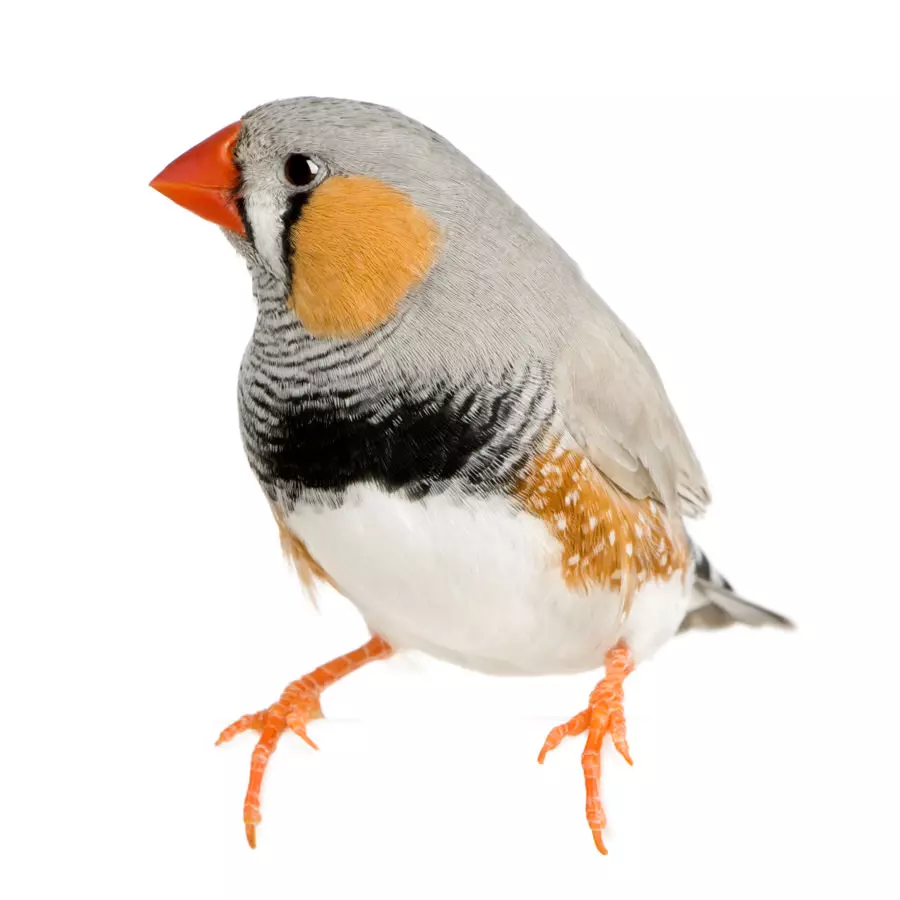
Zebra Finch
Profile
| Home: | Australia |
| Age expectation: | approx. 8 years |
| Sexual maturity: | 3-4 months |
| Sex different: |
M: coloured with orange cheek patch (except white form) |
| Breeding: | 4-6 eggs Breeding period: 12-14 days Nestling period: 20 days |
| Diet: | Grain mixture, egg food, insect food |
Area of origin:
Zebra finches live and breed in the grass and bush steppes of Australia.

Sexual differences:
The males are generally more colourful and have an orange cheek patch. Exceptions are the white varieties. There the male can be recognised by the redder beak.
The cheek patch is not yet present in young birds, this only appears after the juvenile moult.
| female zebra finch | male zebra finch |
|
|
|


Keeping:
In their homeland, wild zebra finches live in large flocks as they are very sociable. Therefore, they should be kept at least in pairs in cages measuring 70x40x40 cm per pair. The optimum is an aviary with several pairs. The cage should be placed in a draught-free location.
For zebra finches to feel comfortable you need:
- Cage or aviary
- Perches of various thicknesses or natural branches
- Sleeping, nesting basket = nest sleeper
- Bathing opportunity
- Food and drinking bowl
Food:
The food consists of a special seed mix for exotic birds.
As supplementary food you can give:
- unsprayed vegetables (e.g. chicory / lettuce / cress / cucumber slices)
- unsprayed fruit (e.g. pieces of apple / banana slices)
- unsprayed wild herbs (e.g. chickweed / knotweed / shepherd’s purse / young dandelion)
- Millet on the cob (once a week, as the fat content is high, otherwise zebra finches suffer from obesity.
- Egg food during breeding
- Insect food as a treat
Food, water and fresh food must be renewed daily.
Breeding:
The parent birds should be at least 9 months old before you start breeding. In special nesting baskets, the zebra finches build a nest with sarpie and coconut fibres.
Zebra finches breed all year round and almost always raise their young successfully. A clutch consists of 4 to 6 eggs, which are laid at intervals of one day. The young are blind, naked and completely helpless when they hatch. After about 8 days the eyes open and the first feathers begin to sprout on the back. At 20 days the zebra finches fledge.
The Swiss Animal Welfare Act contains legal provisions governing the species-appropriate keeping of and handling with birds.
The following rules apply to all bird species:
- social species must be kept socially (no single keeping)
- the enclosures must meet the minimum dimensions = minimum requirements
- all birds must be offered a bathing opportunity
- the enclosures must be structured with various, springy perches of different thicknesses and orientations, whereby one third of the volume must be free of structures
- all birds must be provided with suitable sand for consumption
- the private keeping of certain bird species is subject to authorisation (wild animal keeping permit)
- the keeping of parrots on perches and the keeping of song canaries in Harzer cages is prohibited
- the use of sand tubes as covers for perches is prohibited
for Estrildid finches:
minimum enclosure area for 4 birds:
0.24 m2 (e.g. 60 cm x 40 cm) minimum height 50 cm
Before you decide on zebra finches, you should definitely read an appropriate specialist book.
The following applies to all animal keeping: Children must be instructed, supervised and monitored by parents. Children must learn that an animal has its own needs and habits and respect these. Parents should be aware that they are responsible for the animal.
For questions and problems our trained team at Zoo Roco is at your disposal. They can advise you professionally on all aspects.
Login
Suggested products




Customers also saw