
Lovebirds
Profile
| Home: | Africa |
| Age expectancy: | approx. 10 years |
| Sexual maturity: | 6 months |
| Breeding: | approx. 5 eggs Breeding period: 21-25 days Nestling period: 40 days |
| Diet: | Grain mixture, egg food, sprouted food, fruit, fresh twigs |
Area of origin:
Africa is the home of all agapornids.
Subspecies:
Agapornids with white eye ring:
| Black- headed |
Peach- faced |
Masked- lovebird |
Strawberry- headed |
 |
 |
 |
 |
Agapornids without white eye ring:
| Rosy-faced | Mountain parrot | Grey-headed |
 |
 |
 |
Care:
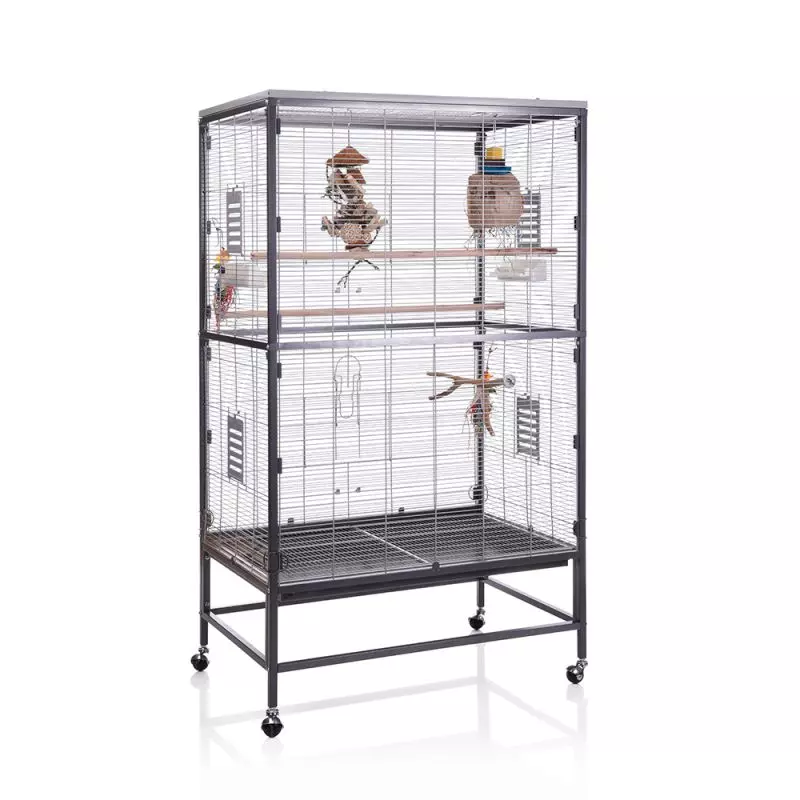
Agapornids live in pairs in closely limited areas. Therefore, they should also be kept with us always in pairs in large cages or indoor aviaries.
Agapornids are curious and, if given sufficient attention, become tame even as a pair.
The aviary should be placed in a draught-free location.
For agapornids to feel comfortable, you need:
- Aviary
- Perches of various thicknesses or natural branches (willows, poplars or fruit trees)
- Sleeping box - must be removed if breeding urge is too much
- Bathing or shower option
- Food and drinking bowl
Diet:
The diet consists of a special grain mix for large parakeets.
Additionally, the birds should have access to:
- Mineral stone - serves to meet calcium needs
- Bird sand - contains important elements for digestion
- unsprayed vegetables (e.g. chicory / spinach / cress / carrots, cucumber slices)
- unsprayed fruit (e.g. apple pieces / pears)
- unsprayed wild herbs (e.g. chickweed / knotweed / shepherd's purse / young dandelion)
- Millet on the cob (once a week, as the fat content is high, otherwise agapornids suffer from obesity).
- Egg food and germ food - indispensable during breeding season
- Crackers and nibble sticks are healthy treats that also give the bird a task to work for its food.
Food, water and fresh food must be renewed daily.
Breeding:
The parent birds should be at least 12 months old before breeding begins. In special nest boxes, the agapornids lay about 3-5 eggs at intervals of 2 days. As nesting material they use chopped branches, hay, leaves, bark. The chicks are blind, naked and completely helpless when they hatch after 21-25 days of incubation. After about 10 days the eyes open and the first feathers begin to sprout on the back. After 40 days, the agapornids are fledged. The young should be separated from the parent birds at the earliest from 8 weeks of age.
Agapornids breed throughout the year and almost always successfully rear their young. However, after 2 to 3 broods, parent birds should be given a break, otherwise the birds could die of exhaustion.
Swiss animal protection legislation contains statutory requirements regulating the animal-friendly keeping and handling of birds.
The following regulations apply to all bird species:
- social species must be kept socially (no single animals)
- enclosures must comply with the minimum sizes = minimum requirements
- all birds must be offered a bathing opportunity
- the enclosures must be structured with different, springy perches of varying thickness and orientation, with one third of the volume free of structures
- all birds must be provided with suitable sand for intake
- the private keeping of certain bird species is subject to authorisation (wild animal keeping permit)
- the keeping of parrot birds in stands and the keeping of song canaries in Harz cages is prohibited
- the use of sand tubes as coverings for perches is prohibited
for parrot birds applies:
minimum enclosure area for 4 small parakeets and agapornids
0.24 m2 (e.g. 60 cm x 40 cm), minimum height 50 cm
Parrot birds require plenty of natural branches for gnawing and climbing
Regular costs (per month/for 2 pets):
- Food: ca. Fr. 15.--
- Sand: ca. Fr. 20.--
- Vet: The more species-appropriate and cleaner the keeping, the less often a trip to the vet is necessary. Nevertheless, you must always expect that an animal could get ill and incur additional costs.
Before you decide in favour of agapornids, you should definitely have read a specialist book.
For each animal keeping applies: Children must be instructed, supervised and controlled by the parents. Children must learn that an animal has its own needs and habits which must be respected. Parents should be aware that it is they who are responsible for the animal.
For questions and problems, our trained team at Zoo Roco is at your disposal. They can advise you professionally on all questions.
Login
Suggested products




Customers also saw