Lysimachia nummularia aurea - Golden creeping Jenny

Article no: DE-226
Quantity Unit price
To 2
CHF 8.90
From 3
CHF 7.90

Stock: 0

Ready for dispatch in 1-3 days, delivery time 14 working days

Delivery between Tuesday, 19 May and Wednesday, 20 May
Zahlungsarten
Product information "Lysimachia nummularia aurea - Golden creeping Jenny"

Lysimachia nummularia aurea / Yellow Moneywort

max. growth height - 40 cm Country of origin Europe, Japan, North America
Suitability Community aquarium Type Stem plant
Family Primulaceae Genus Lysimachia
Propagation Cuttings Growth rate medium
pH 6 - 8 Water hardness 10 - 20 °dh
Notes  

A beautiful and attractive colour variant of the pennywort is the variety 'Aurea'. The care requirements are identical to the green stem form, but the lighting should be somewhat stronger here. The yellow pennywort is one of the typical indicator plants that very quickly indicate a lack of nutrients with stagnation and stunted growth. In the aquarium, its yellow stems can be used to create beautiful harmonious colour accents and colour transitions.

Aquarium: Community aquarium
Feature: In the background, Stem plants
Genus: Several
Growth: medium
Origin: Asia, Europe, North America
Properties: Stem plants
Stand: In the background
Composition
Feeding recommendation
Technical details
Size information

0 of 0 reviews

Give us a rating!

Share your experience with the product with other customers.


Customers also bought

Ludwigia sp. 'Super Mini Red
Ludwigia sp. 'Super Mini Red'Ludwigia sp. Super Mini Red' is a fast growing red plant for the second or third level in the aquarium. It is easy to propagate and does not require strong lighting. This plant grows in the soil and on decoration.Difficulty of cultivation: mediumLight requirement: mediumCO₂ requirement: mediumHeight of adult plant: 10-25 cmGrowth rate: mediumTemperature: 20-28°C Placement in aquarium: second or third level. Origin: Cultivar (cultivated variety) Cup diameter: 6 cm Ludwigia sp. 'Super Mini Red' is the smallest of the red-leaved Ludwigia varieties. It has fine and delicate dark red leaves. A particularly decorative aquarium plant. Depending on tank size, it is suitable for the middle or third level of the aquarium. It is popular for arrangements in Dutch and natural style aquariums. The leaf blade is about 2 cm long and 1.5 cm wide. The plant does not have excessive requirements. It grows even in moderate light, although the red color then becomes less intense. The plant can be planted in the ground or on decorations. When attached to the roots, it forms fanciful compositions, reminiscent of treetops. In this form of cultivation should not forget about the additional application of liquid fertilizer. The best growth results are obtained when planted in a fertile substrate. Under good conditions it spreads quickly.Ludwigia sp. Super Mini Red' has many lovers thanks to its extremely intense red color. It discolors easily and quickly under strong light conditions. In this way, it becomes an incredibly eye-catching design element in their aquarium. Due to its rapid growth, it must be regularly cut back and trimmed. It does well in the strong spots of an arrangement, in the second or third row. The Super Mini Red variety does not require CO₂ and grows in the water column even with low light intensity and low fertilizer levels. Therefore, it is a suitable plant for beginners in plant aquaristics. However, it is important to remember that the best growing results can be achieved with appropriate lighting and additional carbon dioxide addition. It grows in both hard and soft water with pH between 5.5 and 7.5. It does not require complicated care. Frequent pruning and good growing conditions will ensure beautiful, dense plants. It can grow up to 25 cm tall. As with most stems, the cut tips of the plants can be replanted in the ground. The plant will form side shoots at the cut.Planting:The plant must be removed from the cup and thoroughly rinsed from the gel under running water. This is best done by placing the plant in a container of lukewarm water. Most of the gel will then fall off by itself. Divide the contents of the cup into 1-2 cm lumps and then set them at intervals of 1 to 2 cm.

CHF 6.50

Duckweed portion
Duckweed portion for aquariums floating plant suitable for the aquarium also for the garden pond and the biotope

CHF 5.00

JBL GH Test
Variant: Test set | Variant (2): Test set
JBL GH Test - GH quick test to determine the total hardness in freshwater aquariums and ponds Simple and reliable control of water values in ponds/aquariums. Determines the ideal total hardness for freshwater aquariums and ponds Colour change test: fill plastic cuvette with sample water, add reagent drop by drop until colour changes from red to green. Number of drops = level of GH (total hardness) When to use: for setting up a new aquarium: once a week Online Laboratory: regular control for a healthy aquarium/pond with conditions close to nature. JBL has water tests in the form of quick tests or colour change tests for every water analysis. Testing aquarium water for healthy, clear water Package contents: 1 quick test, GH Test. Incl. reagent and plastic vial. Refill reagent avaiable separately Healthy aquarium/healthy pond with conditions close to natureThe right water values are dependent on the fish stock and the plants in the aquarium/pond. Even if the water looks clear it can be contaminated. With bad values diseases or algae can appear in the aquarium/pond. To maintain a healthy aquarium/pond with conditions close to nature it is important to check and adapt the water values regularly.For each water analysis JBL provides water tests in the form of quick tests or colour change tests. These determine a certain value or several values in one go. With these water tests you can recognise algae problems and negative nitrate, nitrite, potassium, magnesium values etc.Why test?Depending on origin and consistency of the subsoil, water may contain varying quantities of alkaline earth salts, usually in the form of calcium and magnesium salts. General hardness, by definition, is the sum of calcium and magnesium ions suspended in the water. Most fish and plants thrive well at a general hardness of between roughly 8 and 20°dH. Excessive total hardness values, should, however, be counteracted by the appropriate measures.JBL Online LaboratoryRegular control for a healthy aquarium/pond with conditions close to nature. Enter your water values into the JBL Online Laboratory and get an in-depth analysis of your values within seconds.Recommended general hardness values:Freshwater aquarium (community aquarium): 8-25 °dGHLake Malawi/Lake Tanganyika aquarium: 5-20 °dGHPlant aquarium with few fish (aquascaping): 3-10 °dGHMarine aquarium: not measurable with GH test because GH too high. Please test calcium and magnesium separatelyPond: 6-20 °dGH

Variants from CHF 7.20
CHF 13.90

Gioia Shrimp Bactoshrimp H₂O⁺ 100 ml
GioiaShrimps Bactoshrimps liquid 100mlGioiaShrimps Bactoshrimps liquid is the ideal solution to sustainably promote the health and well-being of your shrimps in the aquarium. With a specially developed formula, this preparation contains valuable probiotic cultures that support the natural balance in the water and have a positive effect on shrimp growth. Thanks to its liquid consistency, Bactoshrimps can be dosed easily and precisely, ensuring optimum distribution in the aquarium. Visible improvements in the behavior and vitality of your shrimps can be seen after just a short period of use. The product is free from harmful additives and has been carefully tailored to the needs of freshwater shrimps. It helps to keep the aquarium water stable, strengthen the animals' immune system and improve the water quality in the long term. Use Bactoshrimps regularly to ensure the long-term health of your shrimps and create a lively, colorful aquarium. For best results, we recommend using it in combination with a balanced diet and proper aquarium care

CHF 9.20

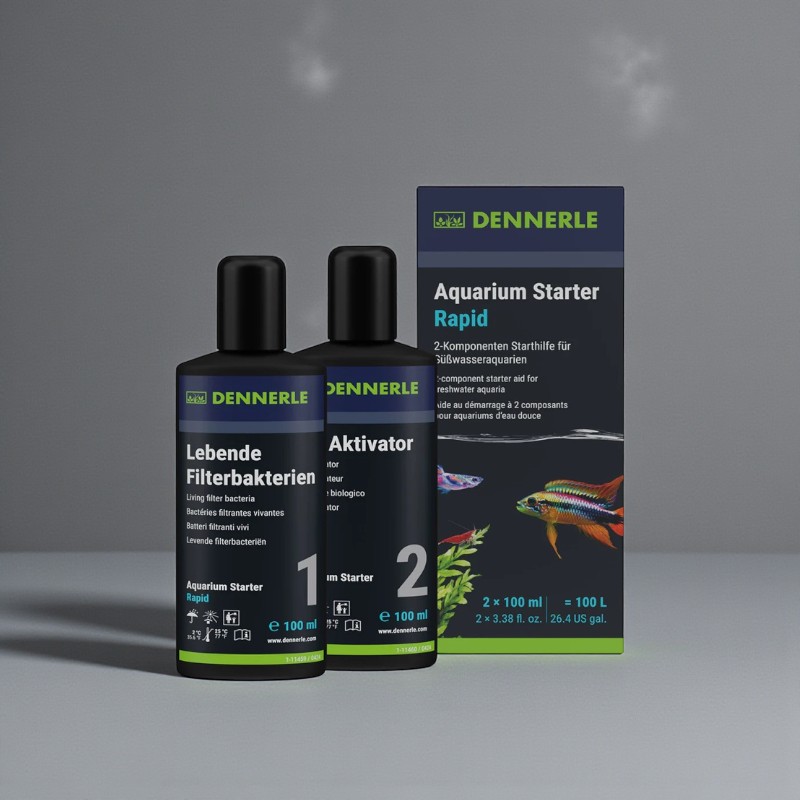
Aquarium Starter Rapid
Dennerle Aquarium Starter RapidMixed culture of live cleaning and filter bacteria.Concentrate for rapid, biological activation of filter material and substrate in the aquariumFor a quick and safe aquarium startWith a guaranteed 500 million bacteria per milliliter when filledRemoves toxins (e.g. ammonia, nitrite) quickly and efficientlyFirst fish stocking possible after just 24 hoursMixed culture from living cleaning and filter bacteriaDennerle Aquarium Starter Rapid is a highly effective product for the fast, safe start of newly set up aquariums.It consists of two components:1. live filter bacteria - they settle on filter material and gravel and immediately start breaking down pollutants. The bacteria solution is highly concentrated, with a guaranteed 500 million bacteria per milliliter (when bottled).2. bacteria booster nutrient solution - the specially developed "bacteria food" ensures rapid growth and reproduction. Mode of action: Powerful nitrifying bacteria (Nitrosomonas, Nitrobacter) convert dangerous ammonia via nitrite into nitrate and thus detoxify the water Denitrifying bacteria (Paracoccus) convert nitrate into gaseous nitrogen in the anaerobic areas of the aquarium - especially in the substrate and filter - and thus reduce the nitrate content. At the same time, the filter bacteria break down plant and food residues, fish excrement, organic turbidity, proteins, fats, carbohydrates, organic pollutants and organic sludge.Dosage and application1. filter starter bacteria: Dosage: 100 ml for 50 - 100 L of aquarium water. Add half of the starter bacteria to the filter material and the other half to the aquarium water (25 °C).2. bacteria booster nutrient solution 1st day: 50 ml per 100 L aquarium water (25 ml / 50 L) 2nd - 6th day: 10 ml per 100 L aquarium water (5 ml / 50 L) Do not overdose!

CHF 19.90

Eriocaulon cinereum
Eriocaulon CinereumEriocaulon Cinereum is a very interesting and eye-catching plant species for the foreground of an aquarium. The plant is characterized by slow growth and the shape of the leaves resembles needles.Cultivation difficulty: moderately demanding Light requirement: high CO₂ requirement: high Height of the adult plant: up to 5 cm Growth: slow Temperature: 19-29 °C Placement in aquarium: in the foreground Origin: Asia 6 cm cup diameter Eriocaulon Cinereum is an undersized plant that does well in the foreground of an aquarium. This species is found on the Asian continent, especially in countries such as China and the Himalayan region. In China it is very common in its natural habitat, but in other countries it is hard to find. Recently, it has gained popularity due to its original and unique structure and characteristic flowers.The plant is characterized by very slow growth, as it takes about 6 months to form a rosette with a diameter of 10 cm. It reaches an average height of 5 cm. There must be a very fertile substrate, as the species has a very extensive root system. Through this, the plant absorbs most of the nutrients it needs for growth. It tolerates a wide range of water temperatures from 19 to 29 °C. It also grows in water with medium to high hardness,but prefers soft water. To ensure good growth, strong lighting and CO₂ dosage is essential, as well as micronutrient fertilization. Under these conditions, it will reward us with a beautiful rosette appearance with many young leaves.The propagation of this plant can be done in several ways. The easiest and most popular is the division of the rosette. This can be done as early as about a month after planting the plant in the aquarium. To get new cuttings, pull out a single plant and remove it from the water. Use a sharp tool to carefully cut the rosette into smaller pieces, and then use tweezers to place them in the substrate. After some time, the cut should be covered with new leaves, and the plant will take on a spherical shape.In aquariums, it likes to bloom, so its original inflorescences make an unusual decoration for any aquarium. Planting: The plant must be removed from the cup and thoroughly rinsed from the gel under running water. This is best done by placing the plant in a container of lukewarm water. Most of the gel will then fall off by itself.

CHF 6.50

Suggested products

New
Ludwigia ovalis Invitro aquarium plant
Ludwigia ovalis invitro cup This plant, with a characteristic oval leaf oval leaf shape in orange-pink color, is easy to grow and an interesting addition to the aquarium. interesting addition to the aquarium. The leaves are slightly smaller than those of the popular Repens variety. Due to their rapid growth the clumps must be trimmed and thinned out regularly to prevent excessive growth. prevent excessive growth. The original shape of the leaf blade makes it an attractive addition to the plant composition in the aquarium. aquarium.To use this plant, remove it from the cup and rinse the gel. cup and rinse the gel thoroughly under running water. Then divide it into small clumps of 1-2 cm and plant them at short intervals. them at short intervals. As it grows, it will form a form a uniform group of adult plants.This plant comes from in vitro cultivation and is free from snails, parasites and algae. and algae. High-quality gel was used as a medium, so it will establish itself quickly establish itself in the aquarium. Light requirement: medium to intensive Optimum temperature: 10 to 28 °C Water values: soft to hard pH value: 4 to 7 CO2 and nutrients: recommended Propagation: cuttings

CHF 16.90

New
Ludwigia ovalis Invitro aquarium plant
Ludwigia ovalis invitro cup This plant, with a characteristic oval leaf oval leaf shape in orange-pink color, is easy to grow and an interesting addition to the aquarium. interesting addition to the aquarium. The leaves are slightly smaller than those of the popular Repens variety. Due to their rapid growth the clumps must be trimmed and thinned out regularly to prevent excessive growth. prevent excessive growth. The original shape of the leaf blade makes it an attractive addition to the plant composition in the aquarium. aquarium.To use this plant, remove it from the cup and rinse the gel. cup and rinse the gel thoroughly under running water. Then divide it into small clumps of 1-2 cm and plant them at short intervals. them at short intervals. As it grows, it will form a form a uniform group of adult plants.This plant comes from in vitro cultivation and is free from snails, parasites and algae. and algae. High-quality gel was used as a medium, so it will establish itself quickly establish itself in the aquarium. Light requirement: medium to intensive Optimum temperature: 10 to 28 °C Water values: soft to hard pH value: 4 to 7 CO2 and nutrients: recommended Propagation: cuttings

CHF 6.50

Ludwigia ovalis Invitro aquarium plant
Ludwigia ovalis invitro cup This plant, with a characteristic oval leaf oval leaf shape in orange-pink color, is easy to grow and an interesting addition to the aquarium. interesting addition to the aquarium. The leaves are slightly smaller than those of the popular Repens variety. Due to their rapid growth the clumps must be trimmed and thinned out regularly to prevent excessive growth. prevent excessive growth. The original shape of the leaf blade makes it an attractive addition to the plant composition in the aquarium. aquarium.To use this plant, remove it from the cup and rinse the gel. cup and rinse the gel thoroughly under running water. Then divide it into small clumps of 1-2 cm and plant them at short intervals. them at short intervals. As it grows, it will form a form a uniform group of adult plants.This plant comes from in vitro cultivation and is free from snails, parasites and algae. and algae. High-quality gel was used as a medium, so it will establish itself quickly establish itself in the aquarium. Light requirement: medium to intensive Optimum temperature: 10 to 28 °C Water values: soft to hard pH value: 4 to 7 CO2 and nutrients: recommended Propagation: cuttings

CHF 6.50

Proserpinaca palustris
🌿 Proserpinaca palustris - Decorative aquarium plant with serrated foliage Structure and color for the middle to background layout Proserpinaca palustris from Aqua Art is an unusual aquarium plant with finely toothed, fern-like leaves that can take on a fascinating copper-orange coloration in good light. It grows upright and gives the aquascape a special depth effect and structure thanks to its unique texture. In well-lit tanks with a CO₂ supply, it develops vibrant colors and healthy growth. Its eye-catching appearance makes it ideal as an accent plant in the middle or background. ✅ Advantages at a glance Unique leaf shape with serrated foliage Color gradient from green to copper-orange in strong light Ideal for structured middle and background design Demanding, but very decorative under optimal conditions Grown in vitro - free from snails and pesticides Particularly striking in layouts with contrasting plants 📋 Product details Name: Proserpinaca palustris Origin: North and South America Type: Stem plant Growth height: approx. 20-40 cm Light requirement: medium to high CO₂ supply: recommended to necessary Growth: medium Propagation: Cuttings after pruning Delivery form: In vitro cup (sterile) Manufacturer: Aqua Art 💡 Zoo Roco tip Proserpinaca palustris looks particularly impressive when planted in groups and combined with fine-leaved plants such as Myriophyllum or Rotala. Strong light and regular micronutrient fertilization are crucial for intensive colouring. With Proserpinaca palustris from Aqua Art, you can add variety, color and structure to your aquascape - ideal for sophisticated layouts with character.Customers also searched for: Proserpinaca palustris, Aqua Art, structure-rich aquarium plant, stem plant aquarium, serrated leaves, InVitro plant aquarium, aquascaping plant, buy Proserpinaca, reddish aquarium plant, background plant aquarium

CHF 6.50

Hygrophila sp. Araguaia
🌿 Hygrophila sp. 'Araguaia' InVitro Reddish-brown accent plant with unique growth habit Hygrophila sp. 'Araguaia' from Aqua Art is a particularly attractive, compact stem plant with a reddish-bronze color and finely branched growth. It is ideal for the foreground to midground and provides structured contrasts and warm color accents in aquascapes. This plant is one of the slow-growing Hygrophila species and can be easily shaped and thickened by regular pruning. Supplied as an in-vitro plant, it is free from algae, snails and pesticides - ideal for shrimp tanks and sensitive aquariums.✅ Advantages at a glance: Compact Hygrophila with reddish-bronze leaves InVitro - sterile, snail-free & pesticide-free Ideal for the foreground or middle ground Slow-growing - easy to shape and grow bushy Good effect with strong lighting & CO₂ supply Very decorative in natural aquariums and layouts with contrasting colors📋 Product details: Name: Hygrophila sp. 'Araguaia' Type: Stem plant Placement: Foreground to midground Growth height: approx. 5-15 cm Light requirement: medium to high CO₂ supply: recommended Growth: slow Delivery form: In vitro cup (sterile cultivated) Manufacturer: Aqua Art💡 Zoo Roco tip: Combine Hygrophila 'Araguaia' with light green plants such as Micranthemum or Hydrocotyle sp. 'Japan' - to show off the darker coloring particularly well. For a dense carpet, regular pruning is recommended.Hygrophila 'Araguaia' provides subtle color accents and fine structure in the lower section of the aquarium - ideal for sophisticated layouts and harmonious plant design.

CHF 6.50

Ludwigia sphaerocarpa Pilosa
Ludwigia sphaerocarpa 'Pilosa' InVitro Red accent plant for aquascaping Ludwigia sphaerocarpa 'Pilosa' is a decorative and rare stem plant with a particularly intense red coloration and fine leaf structure - a real eye-catcher for any natural aquarium. This variety is ideal for the mid to background area and adds color depth and contrast to groups of green plants. As an Aqua Art in vitro plant, it is free from snails, algae and pesticides, making it perfect for shrimp tanks and sensitive aquariums. With good lighting and CO₂ supply, it develops its full color intensity and grows vigorously but controllably.✅ Advantages at a glance: Intensely red-colored stem plant with a fine texture Grown in vitro - sterile, free from harmful substances Ideal for color contrasts in the middle or background Safe for shrimps and sensitive aquariums Grows compact & controllable with good care📋 Product details: Name: Ludwigia sphaerocarpa 'Pilosa' Type: Stem plant Placement: Middle to background Growth height: approx. 20-40 cm Light requirement: medium to high CO₂ supply: recommended Color effect: red to reddish-green Growth: medium Delivery form: In vitro cup (sterile cultivation) Manufacturer: Aqua Art💡 Zoo Roco tip: For strong red coloration, the plant should be kept under intensive lighting and regularly supplied with iron and micronutrients. A good supply of CO₂ also has a positive effect on growth and color.Ludwigia sphaerocarpa 'Pilosa' from Aqua Art brings structure, contrast and an intense play of colors to the aquarium - perfect for modern aquascaping layouts.

CHF 6.50

Rotala rotundifolia Invitro
Invitro aquarium plant Rotala rotundifoliaColorful stem plant for the background Rotala rotundifolia is one of the most popular stem plants in the aquarium hobby - versatile, easy to care for and particularly attractive thanks to its delicate, round leaves. Depending on the light intensity and nutrient supply, it develops a vibrant green to bright red, adding lively color accents to any aquarium layout. The in vitro version is grown under sterile conditions and is therefore free from algae, snails and pesticides - ideal for sensitive aquariums, especially shrimp tanks. Fast-growing and adaptable, Rotala rotundifolia is ideal for the mid to background and harmonizes wonderfully with other fine stem plants in the natural aquarium. Advantages at a glance: ✅ Changes color depending on the light - from green to red ✅ Fast-growing & ideal for dense groups of plants ✅ InVitro - guaranteed free from harmful substances & snails ✅ Safe for shrimps & sensitive tanks ✅ Perfect for aquascaping & classic plant aquariumsProduct details: Name: Rotala rotundifolia Type: Stem plant Position in aquarium: Middle to background Growth height: approx. 30-50 cm Light requirement: Medium to high CO₂ supply: Recommended for more intense colorationTemperature: 22 - 28°C Delivery form: In vitro cup (grown sterile) Color effect: Green to reddish, depending on light & nutrients

CHF 6.50

Ammania senegalensis - Small cognac plant
InVitro Ammania senegalensis from Aqua ArtThe Ammania senegalensis InVitro from Aqua Art is an impressive aquarium plant with intense red coloration that is a real eye-catcher, especially in the middle and background of your aquarium. Thanks to InVitro cultivation, you get a 100 % sterile, pesticide-free plant that is also ideal for sensitive shrimps and aquascaping projects. With sufficient light, nutrients and CO₂, Ammania senegalensis develops strong, red stems and oval leaves - perfect for colorful contrasts in plant aquariums. Advantages at a glance: ✅ Bright red stem plant for the middle & background ✅ InVitro - free from algae, snails & pesticides ✅ Safe for shrimps & sensitive aquarium inhabitants ✅ Ideal for aquascaping & natural aquariums ✅ Fast-growing with good lighting & CO₂ supplementationProduct details: Name: Ammania senegalensis Origin: Africa Type: Stem plant Position in the aquarium: Middle to background Growth height: approx. 20-40 cm Light requirement: Medium to high CO₂ supply: Recommended Delivery form: In vitro cup (lab-grown, sterile)Planting: The plant must be removed from the cup and thoroughly rinsed thoroughly from the gel under running water. This is best done best done by placing the plant in a container with lukewarm water. lukewarm water. Most of the gel will then fall off by itself. Divide the contents of the cup into 1-2 cm clumps and place these a short distance apart in the then place them a short distance apart in the substrate or on the selected objects.

CHF 6.50

Bacopa myriophylloides Invitro
Invitro aquarium plant Bacopa myriophylloidesDelicate aquarium plant for the background Bacopa myriophylloides is an elegant stem plant with delicate, finely pinnate leaves - a real eye-catcher for the background of your aquarium. Its special structure brings lightness and movement to the layout and is ideal for aquascaping and natural aquariums. As a high-quality in vitro plant, it is free from algae, snails and pesticides, making it particularly safe for shrimps and sensitive tanks. With good lighting and CO₂ supply, Bacopa myriophylloides grows compactly and healthily - with a beautiful, delicate appearance. Advantages at a glance: ✅ Delicate stem plant with feathery leaves ✅ Ideal for the background & textured layouts ✅ InVitro - sterile, pesticide-free & shrimp-safe ✅ Healthy growth with light & CO₂ addition ✅ Perfect for aquascaping & natural aquariumsProduct details: Name: Bacopa myriophylloides Type: Stem plant Location in the aquarium: Background Growth height: approx. 30-50 cm Light requirement: Medium to high CO₂ supply: Recommended Delivery form: In vitro cup (grown sterile) Special feature: Very fine, decorative leaf structure

CHF 6.50

Micranthemum umbrosum
Micranthemum umbrosum Micranthemum Umbrosum is a light green stem plant with small round leaves. Depending on how it is pruned, it is suitable for both the foreground and background of the aquarium. Difficulty of cultivation: easy Light requirement: medium, to high CO₂ requirement: medium Height of the adult plant: 20 cm Growth: fast Temperature: 22-26 °C Placement in the aquarium: Second level Origin: North and Central America Cup diameter: 6 cm Micranthemum Umbrosum (Round-leaved meadowfoam) is a naturally occurring plant in North and Central America. It grows both in water and in marshy areas. It is prized by aquarists for its unique appearance. The plant forms long stems with paired, alternate, small, round, light green leaves. It has a fairly well developed root system. It needs regular pruning and is easy to shape into a desired form. It is propagated vegetatively by cutting off the shoot tips and planting them in the ground. It likes water with a hardness of 2-12°N, a pH of 5.5-7.7 and a temperature of 24-26°C. It is sensitive to trypaflavin and can be damaged by snails. It has fairly high light requirements. With insufficient light, it pulls upward, and distinct gaps can be seen between the leaves. With sufficient light, it forms dense clumps that are pleasing to the aquarist's eye.Micranthemum umbrosum is usually placed in the background of the aquarium, but it also looks good in the foreground when cut short. It does not require absolute CO₂ fertilization, but grows much faster in its presence. When growing this plant, pay special attention to the proper concentration of iron in the aquarium water.. Planting:The plant must be removed from the cup and thoroughly rinsed from the gel under running water. This is best done by placing the plant in a container of lukewarm water. Most of the gel will then fall off by itself. Divide the contents of the cup into 1-2 cm lumps and then set them at intervals of 1 to 2 cm.

CHF 6.50

Lobelia cardinalis 'Mini
Lobelia cardinalis 'Mini'Lobelia cardinalis 'Mini' is a green plant, recommended for the second level of the aquarium and for the paludarium. A very decorative species that is not particularly demanding.Difficulty of growing: easy Light requirements: medium CO₂ requirements: low Outgrown plant height: up to 20 cm Growth: medium Temperature: 15-28°C Placement in aquarium: second level Origin: North America Shell diameter: 6 cm Lobelia Cardinalis mini is a plant native to North America. In nature, it is found in wetlands and riverbanks. It is distributed from the Gulf of Mexico through the eastern states of the United States to southern Canada. It grows in the ground and has a well-developed root system. The feathery stems can develop auxiliary roots in leafless areas. Its small leaves are bright green, oval with a conspicuous pale central vein.Lobelias can be cultivated in aquariums and paludariums. It thrives in muddy soil as well as underwater. It tolerates temperatures from 15 to 28 °C and can also be kept in a pond. It thrives best at 20-23°C and requires soft to medium-hard water with a pH between 6.5 and 7.2.Without sufficient light, the leaves turn yellow, but in bright light the undersides of the leaves turn purple. It is not particularly demanding, but regular water changes, fertilizer and CO₂ support its growth.In the aquarium, lobelia should be planted in a group in the middle ground, but it is also well suited as a foreground plant. Pruning is necessary for the plant to grow well; use scissors to remove older leaves. You can also cut back the entire plant and use the cut tips as cuttings. Planting: The plant must be removed from the cup and thoroughly rinsed from the gel under running water. This is best done by placing the plant in a container of lukewarm water. Most of the gel will then fall off by itself. Divide the contents of the cup into 1-2 cm lumps and then set them at intervals of 1 to 2 cm.

CHF 6.50

Limnophila aromatica
Limnophila aromaticaLimnophila Aromatica (fragrant limnophilia) is a beautiful plant for the second or third level. It turns purple under intense light.Difficulty of cultivation: moderate Light requirement: medium CO₂ requirement: medium Adult plant height: up to 50 cm Growth: moderate Temperature: 22-28°C Placement in aquarium: second or third level Origin: Asia Cup diameter: 6 cm Limnophila Aromatica (fragrant Limnophila, rice paddy weed) is a plant that has earned a place in aquariums around the world due to its unique appearance and leaf color. It is native to Asia, where it usually grows in rice paddies or swamps near water. It does well after the end of the rainy season in a dry place in a still moist, sandy soil. At high temperatures, the plant flowers, forms fruit, and then dies. Traditionally used as a spice, especially in Vietnamese cuisine. Its flavor is reminiscent of cumin and lemon. Currently, the plant can also be found in America and Australia.Limnophilia Aromatica is a stalk plant that produces lance-shaped leaves with serrated edges. Their color depends on the intensity of light. If the plant has little access to light, its leaves are green. If the light is strong, the entire top of the plant is intense red and the leaves are purple on the underside. In aquariums, plant it in the second or third level, leaving a distance of 1.5 cm between cuttings. It grows quite fast, its optimal pH is 6-7. It tolerates temperatures between 15 and 30 °C, but it is better to avoid extreme temperatures and keep it between 22 and 28 °C. In aquariums it is propagated by cutting and planting young plants that form on the stems or from the tips. The plant does not require absolute CO₂ fertilization, but grows much faster with CO₂ addition. To achieve the desired intense red-purple color of the leaves, the plant must be strongly illuminated. In addition, attention must be paid to the correct water parameters in the aquarium, especially the optimal iron, nitrate and phosphate content, so that the plant can absorb the nutrients from the water column. Due to its strongly developed root system, the plant grows best in active media.Planting: The plant must be removed from the cup and thoroughly rinsed from the gel under running water. This is best done by placing the plant in a container of lukewarm water. Most of the gel will then fall off by itself. Divide the contents of the cup into 1-2 cm lumps and then set them at intervals of 1 to 2 cm.

CHF 6.50

Customers also saw

Vesicularia montagnei in-vitro
Vesicularia montagnei - In-Vitro max. growth height - 5 cm Country of origin Southeast Asia Suitability NanoCube, aquascaping, community aquarium Type  Epiphyte Family Hypnaceae Genus Vesicularia Propagation Division Growth rate slow pH 5 - 8 Water hardness 10 - 20 °dh Notes   This beautiful moss comes from the Sunda Islands in Indonesia. It is also known commercially as "Christmas moss". This name is derived from the downward hanging shoots and is reminiscent of the branches of a Christmas tree. Very easy to grow and care for, it can be trimmed into shape at any time. Like all mosses, V. montagnei likes to grow on roots and stones. This also has the advantage of being able to reshape a landscape with just a few simple steps.

CHF 11.90

Ceratophyllum demersum - hornwort / hornwort
Ceratophyllum demersum max. growth height - 120 cm Country of origin Cosmopolitan Suitability Discus aquarium, community aquarium, NanoCubes, perch aquarium Type Floating plant family Ceratophyllaceae Genus Ceratophyllum Propagation Head cuttings, side shoots Growth rate fast pH 6 - 8 Water hardness 5 - 25 °dh Advice Recommended as an algae stopper for all new installations. Care instructions The hornwort is a cosmopolitan plant that can be found in many bodies of water around the world. We found the free-floating stem plant in huge populations in a tributary of the Rio Miranda on the edge of the Pantanal in South America. The growth rate of the stems is enormous, so they have to be constantly pruned. Ceratophyllum is considered a "miracle weapon" against algae growth. The explanation is quite simple: the plant is a strong nutrient consumer and removes the algae's food source. The use of hornwort is recommended for every new aquarium.Wir sind sehr bemüht, dass unsere Pflanzen gesund und unbeschädigt bei Ihnen ankommen. Trotz grösster Sorgfalt, kann es vorkommen, dass Pflanzen durch den Postversand oder andere unvorgesehene Ereignisse, leicht beschädigt sind. Dazu zählen braune Blätter gleichermassen, wie abgeknickte Zweige. Dafür übernehmen wir keine Haftung.

From CHF 7.50

Vallisneria australis Curly - Curly-leaved giant vallis
Vallisneria australis Curly Wavy-leaved giant vallisneria max. growth height - 200 cm Country of origin Cultivated form Suitability Perch aquarium, discus aquarium, community aquarium Type  Rosette plant Family Hydrocharitaceae Genus Vallisneria Propagation Runners Growth rate fast pH 6 - 9 Water hardness 25 - 30 °dh Notes   Alongside Vallisneria spiralis, Vallisneria australis is the most widely cultivated plant in this genus. The growth habit of the ‘Curly’ variety has attractive, bullous leaves and looks very decorative in the background. Larger aquaria are essential for keeping it, as the leaves can reach a length of 100 - 200 cm. It propagates via runners, which should be removed regularly to prevent uncontrolled growth. The plants thrive best in medium-hard to hard water.

From CHF 10.50